
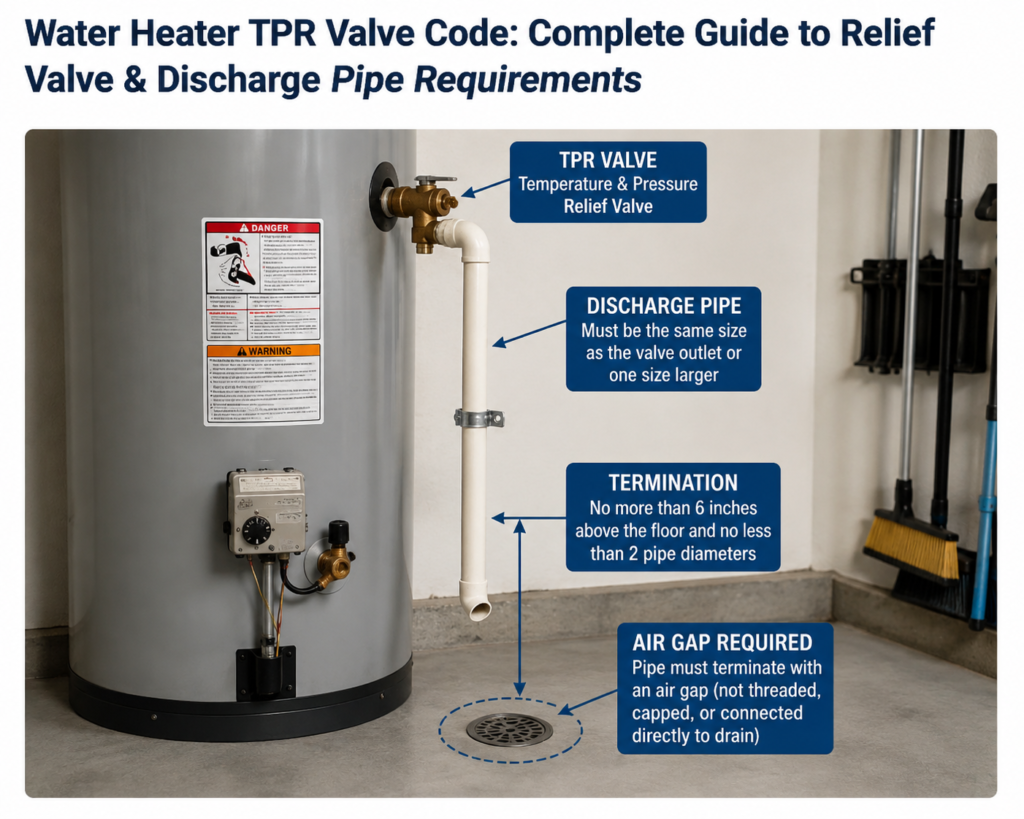
Quick Answer: Water heater TPR valve code covers more than simply having a temperature-and-pressure relief valve on the tank. The valve must be correctly rated and installed, and its discharge pipe must provide an unrestricted, safely terminated path for hot water or steam if the valve opens.
Under the 2024 International Residential Code (IRC), relief-valve discharge piping cannot connect directly to the drainage system. It must discharge through an air gap in the same room as the water heater, remain at least as large as the valve outlet, drain by gravity without being trapped, serve only one relief device, and contain no valve or tee fitting.
The commonly repeated “6-inch rule” is only part of the answer. Under the 2024 IRC model-code baseline, a discharge pipe terminating above the floor or a waste receptor must end no more than 6 inches above it and no less than two discharge-pipe diameters above it. Local adoption and amendments can change the applicable requirement, so 6 inches should not be treated as a universal rule for every U.S. home. For the rest of the installation—not just the relief system—see our water heater code requirements guide.
Water Heater TPR Valve Code at a Glance
| What to Check | 2024 IRC Model-Code Baseline | Why It Matters |
|---|---|---|
| Relief protection | Pressure and temperature relief protection is required | Protects the water heater against dangerous pressure or temperature |
| Valve standard | Relief valve must conform to ANSI Z21.22 and have adequate capacity | The safety device must be suitable for the equipment it protects |
| Pressure setting | At least 25 psi above system pressure, no more than 150 psi, and not above the tank's rated working pressure | Prevents use of an incorrectly rated pressure-relief device |
| Temperature setting | Not greater than 210°F | Provides emergency overtemperature protection |
| Temperature sensing | Sensing element monitors water within the top 6 inches of the tank | Places the temperature sensor where required |
| Isolation valves | No check or shutoff valve between the relief valve and the tank, equipment, or discharge termination | Keeps the emergency relief path available |
| Discharge pipe size | Not smaller than the relief-valve outlet and full size to the air gap | Prevents restriction of relief flow |
| Air gap | Required in the same room as the water heater | Prevents a direct connection to the drainage system |
| Routing | Must not be trapped and must flow by gravity | Prevents standing water or an obstructed relief path |
| Termination | Must be readily observable and arranged to avoid personal injury or structural damage | Makes discharge visible without creating another hazard |
| Floor/receptor clearance | No more than 6 inches and no less than two discharge-pipe diameters above the floor or waste-receptor flood-level rim | Maintains the required separation at the discharge point |
| Pipe end | No threaded connection at the termination | Reduces the opportunity for the relief path to be capped |
| Valves and tees | Not permitted in the discharge piping | Keeps the relief path unrestricted |
| Materials | Must meet the IRC's approved material provisions or an approved relief-valve drain-tube standard | The piping must be suitable for relief-valve discharge conditions |
These are model-code baselines. The enforceable requirement at a particular home depends on the code edition and amendments adopted by the state or local jurisdiction, along with the equipment listing and manufacturer instructions.
What Does a Water Heater TPR Valve Protect Against?
A TPR valve—also called a T&P valve or temperature-and-pressure relief valve—is an emergency safety device. It protects a pressurized water heater against two different hazards: excessive internal pressure and excessive water temperature.
Section P2804.1 of the 2024 IRC permits either separate pressure- and temperature-relief valves or a combination pressure-and-temperature relief valve. Section P2804.2 requires the relief device to have adequate rated capacity for the equipment it serves and to conform to ANSI Z21.22 / CSA 4.4, the standard covering relief valves for hot-water supply systems.
The valve is not a normal operating control. If it discharges, the safe response is not to plug the pipe, cap its end, or isolate the valve. Discharge may point to a valve problem, excessive system pressure, thermal expansion, or an abnormal temperature condition. If water is already coming from the valve or discharge pipe, use our water heater pressure relief valve leaking guide for that separate diagnostic decision.
TPR Valve Requirements Under the 2024 IRC
Before considering the discharge pipe, the relief valve itself has to satisfy requirements involving its rating, placement, capacity, and connection to the water heater.
Pressure Relief Requirements
Under IRC P2804.3, a pressure-relief valve serving a tank must be installed directly into a tank tapping or in a water line close to the tank. Its relief rating must be adequate for the pressure conditions of the equipment it protects.
The valve must be set to open at not less than 25 psi above system pressure and not greater than 150 psi. Its setting also cannot exceed the tank's rated working pressure.
The 150-psi figure is therefore a model-code ceiling, not a universal setting that overrides the equipment rating. If professional evaluation determines that the valve itself is defective or incorrectly matched and replacement is necessary, our water heater pressure relief valve cost guide covers the separate replacement-cost decision.
Temperature Relief Requirements
IRC P2804.4 requires the temperature-relief device to have a rating compatible with the equipment it protects. Its temperature-sensing element must monitor water within the top 6 inches of the tank, and the valve must be set to open at a temperature of not greater than 210°F.
The ANSI Z21.22 / CSA 4.4 relief-valve standard likewise specifies that a T&P valve operates when its temperature-sensing element reaches 210°F or less.
That 210°F figure is an emergency relief threshold, not a recommended household water-heater setting. For the separate homeowner decision involving normal temperature settings, scald risk, comfort, and efficiency, see our safe water heater temperature guide.
This also creates two unrelated “6-inch” measurements that are easy to confuse. One concerns where the temperature-sensing element monitors water inside the tank. The other concerns certain discharge-pipe terminations above a floor or waste receptor. They are separate requirements.
No Valve Can Isolate the Safety Device
IRC P2804.6 prohibits a check valve or shutoff valve between the relief valve and the tank, between the relief valve and the heating equipment, or between the relief valve and the termination of its discharge pipe.
If excessive pressure or temperature develops, the relief path must remain available without anyone first having to operate another valve.
TPR Discharge Pipe Requirements
A correctly rated TPR valve does not make an installation compliant by itself. The pipe connected to its outlet is part of the safety system.
IRC P2804.6.1 contains 14 requirements for relief-valve discharge piping. The parallel 2024 International Plumbing Code Section 504.6 contains the same core 14-item discharge framework. For homeowners, those provisions are easier to understand as four practical questions: Can the pipe carry full relief flow? Will it drain freely? Is the termination safe? Can anything obstruct it?
The Pipe Cannot Restrict Relief Flow
The discharge pipe cannot be smaller than the diameter of the relief-valve outlet and must discharge full size to the required air gap. It must serve a single relief device rather than being tied into piping serving another relief valve or other equipment.
The 2024 IRC also addresses discharge piping installed with insert fittings. In that situation, the piping must be one nominal size larger than the relief-valve outlet, and the outlet end of the tubing must be fastened in place.
This distinction matters because older summaries sometimes describe the upsizing rule as if a particular tubing material automatically triggers it. The current 2024 wording ties the requirement specifically to discharge piping installed with insert fittings.
The Discharge Pipe Must Drain by Gravity
The discharge line must not be trapped and must be installed so that it flows by gravity. It also cannot contain valves or tee fittings.
An obvious rise, loop, or low section that retains water can therefore matter even if the pipe eventually turns downward. The routing itself is part of the relief system, not merely a cosmetic plumbing detail.
The Termination Must Be Safe and Observable
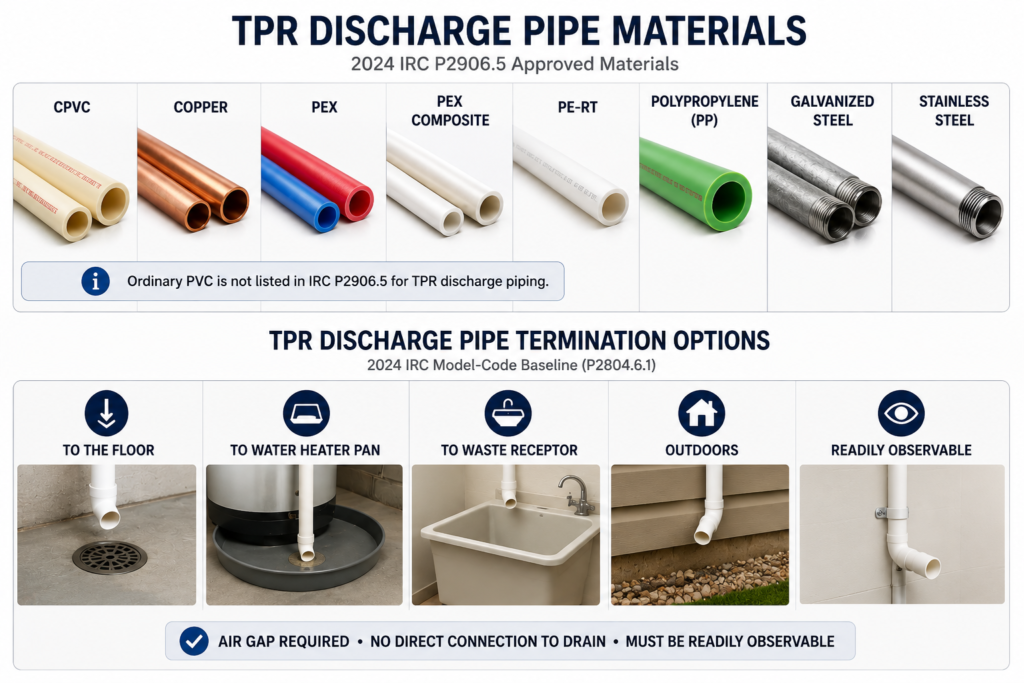
Under the 2024 IRC model-code baseline, the discharge may be directed to the floor, the pan serving the water heater or storage tank, a waste receptor, or outdoors, provided the remaining discharge requirements are satisfied.
The termination must be arranged so that discharge does not cause personal injury or structural damage, and it must be readily observable by building occupants. That visibility gives the homeowner a warning that the valve, water heater, or plumbing system may need attention.
The end of the discharge pipe cannot have a threaded connection. A threaded end creates an obvious opportunity for someone to attach a cap to stop nuisance dripping. A TPR discharge line must never be capped or plugged.
A TPR discharge line should also not be confused with the water heater's leak-management system. The relief line and the pan perform different jobs. Our water heater drain pan code guide covers when a pan is required, how its drain is handled, and the separate code questions surrounding that protection.
The Pipe Cannot Connect Directly to the Drainage System
The IRC prohibits a direct connection between the TPR discharge pipe and the building drainage system. Instead, it must discharge through an air gap located in the same room as the water heater.
A pipe therefore should not be judged solely by whether it looks neat or disappears into a nearby wall. How and where it actually terminates is part of determining whether the installation meets the model-code baseline.
What Does the TPR Valve “6-Inch Rule” Actually Mean?
This is one of the most misunderstood parts of water heater TPR valve code.
Under 2024 IRC P2804.6.1, a discharge pipe terminating above the floor or the flood-level rim of a waste receptor must end:
- not more than 6 inches above it; and
- not less than two times the discharge-pipe diameter above it.
So the common statement that the pipe simply needs to be “within 6 inches of the floor” is incomplete. Six inches is the maximum in this IRC termination scenario; the same provision also establishes a minimum separation based on the discharge-pipe diameter.
The IRC is also a model code. The enforceable requirement at a particular property depends on the code adopted by that jurisdiction and any amendments made to it.
For example, Minnesota Administrative Rule 4714.0608 amends UPC Section 608.5. Its current language requires relief-valve discharge piping to discharge independently by gravity through an air gap to a safe place of disposal or within 18 inches of the floor. It also states that relief-valve drains cannot terminate in a building's crawl space or discharge into a water-heater pan.
That one jurisdictional example is enough to show why a national article should not tell every homeowner that “6 inches from the floor” is universally required. Start with the model-code baseline, then identify the code edition and amendments actually adopted where the property is located.
How to Visually Check a TPR Valve and Discharge Pipe
A homeowner can identify several warning signs without operating the valve or altering the plumbing.
- Confirm that a relief valve is present on the water heater.
- Look for a discharge pipe connected to the valve outlet.
- Look for an obvious reducer that makes the discharge line smaller than the valve outlet.
- Check for a visible shutoff valve, check valve, or tee in the relief path.
- Follow the pipe for an obvious rise, loop, or trapped section.
- Make sure the termination is open rather than capped or plugged.
- Check whether the discharge point is visible rather than disappearing into a concealed location.
- Look for a termination where hot water or steam could injure someone or damage the building.
- Note active dripping, corrosion, mineral deposits, or staining around the valve or discharge line.
These observations can reveal reasons for further investigation, but they cannot verify the valve's internal condition, relief capacity, pressure setting, temperature operation, material approval, or compliance with local amendments.
If the valve is actively dripping or repeatedly discharging, do not assume the valve itself has failed. Use our water heater pressure relief valve leaking guide to separate valve failure from system-pressure and temperature problems.
One possible cause of recurring discharge after heating cycles is thermal expansion in a closed plumbing system. Our water heater expansion tank cost guide explains that separate pressure-control issue and when an expansion tank may become relevant.
If correcting the installation requires changing the valve, pipe size, material, routing, or termination, have the applicable requirements confirmed before altering the safety system.
What Materials Can Be Used for a TPR Discharge Pipe?
There is no single nationwide rule saying that every TPR discharge pipe must be copper. The acceptable material depends on the plumbing code in force, the pipe or drain-tube listing, and any applicable manufacturer instructions.
Under the 2024 International Residential Code (IRC), Section P2804.6.1 allows discharge piping made from materials identified in Section P2906.5 or from materials tested, rated, and approved for this purpose under ASME A112.4.1.
The 2024 IRC P2906.5 water-distribution table includes materials such as:
- CPVC;
- copper and copper-alloy pipe or tubing;
- PEX;
- PEX composite piping;
- PE-RT;
- polypropylene;
- galvanized steel; and
- stainless steel.
Ordinary PVC is different. PVC does not appear in the P2906.5 water-distribution table referenced by the 2024 IRC TPR discharge rule. That is why ordinary white PVC used as a relief-valve discharge pipe deserves closer investigation rather than assuming that all plastic piping is interchangeable.
Can PEX Be Used for a TPR Discharge Line?
PEX appears in the 2024 IRC water-distribution material table, so the model-code answer is not a blanket “PEX is prohibited.” The complete pipe-and-fitting arrangement still has to satisfy the discharge requirements.
One especially important provision concerns insert fittings. Under 2024 IRC P2804.6.1, discharge piping installed with insert fittings must be one nominal size larger than the relief-valve outlet, and the outlet end of the tubing must be fastened in place.
That distinction matters because older summaries sometimes make it sound as though PEX itself automatically triggers the size increase. The current 2024 wording ties the requirement to the use of insert fittings.
For any material, the useful question is not simply “Is this copper or plastic?” It is whether the complete pipe-and-fitting system is approved for the application, correctly sized, properly routed, and accepted under the code governing the property.
Where Can the TPR Discharge Pipe Terminate?
The termination point is one of the areas where model codes and local amendments can produce very different-looking compliant installations.
| Termination Scenario | 2024 IRC Baseline | What to Watch For |
|---|---|---|
| Floor | Permitted when the remaining discharge requirements are satisfied | Minimum and maximum termination clearances still apply |
| Water-heater pan | Listed as a permitted discharge location under P2804.6.1 | Local plumbing codes can prohibit this arrangement |
| Waste receptor | Permitted with the required air gap | The relief pipe cannot connect directly to the drainage system |
| Outdoors | Permitted | The installation still must satisfy gravity-flow, safety, visibility, material, and local-code requirements |
| Hidden termination | Does not satisfy the readily-observable requirement | Occupants must be able to notice discharge |
| Direct drain connection | Not permitted | The IRC requires an air gap rather than a direct drainage connection |
The water-heater pan deserves special attention because two different protection systems are involved. A pan manages leakage from the heater or associated plumbing, while the TPR line provides an emergency pressure-and-temperature relief path. For the separate requirements involving pans, pan drains, sizing, placement, and termination, see our water heater drain pan code guide.
Why Local TPR Valve Codes Can Look Different
The 2024 IRC is useful as a national model-code baseline, but it is not automatically the enforceable plumbing code at every U.S. address. A state or local jurisdiction may use another model code, adopt a different edition, or amend individual provisions.
A clear example comes from Minnesota Administrative Rule 4714.0608. Minnesota amends UPC Section 608.5 so relief-valve discharge piping must discharge independently by gravity through an air gap to a safe place of disposal or within 18 inches of the floor. The same rule prohibits termination in a building's crawl space and prohibits relief-valve discharge into a water-heater pan.
Compare that with the 2024 IRC baseline, which lists the water-heater pan as one possible discharge location and applies the 6-inch maximum/two-pipe-diameter minimum rule to certain floor and waste-receptor terminations.
For a homeowner, the practical hierarchy is:
- Identify the relevant model-code provision.
- Determine which edition the jurisdiction adopted.
- Check state or local amendments.
- Follow the equipment listing and manufacturer instructions.
- Use the Authority Having Jurisdiction (AHJ) when an installation-specific interpretation is needed.
The important point is not to memorize 50 different state rules. It is to avoid treating a requirement copied from another state's inspection checklist as automatically applicable to your property. Our water heater code requirements guide covers the broader code layers that can affect the rest of a water-heater installation.
Common TPR Valve Code Problems
Some defects directly conflict with the IRC model-code requirements. Others are condition warnings that deserve investigation but should not automatically be described as code violations. Keeping those categories separate helps homeowners understand what an inspector is actually flagging.
| What You See | How to Treat It | Why |
|---|---|---|
| No discharge pipe | Code problem | The relief device requires compliant discharge piping |
| Pipe smaller than valve outlet | Code problem | The discharge path cannot be undersized |
| Shutoff or check valve in relief path | Code problem | The safety device cannot be isolated |
| Valve or tee in discharge pipe | Code problem under the IRC baseline | These fittings are expressly prohibited in the discharge line |
| Pipe rises or forms a trap | Code problem | The line must remain untrapped and drain by gravity |
| Threaded pipe end | Code problem | The IRC prohibits a threaded termination |
| Capped or plugged end | Serious safety problem | It can obstruct the emergency relief path |
| Direct connection to drainage | Code problem under the IRC baseline | The IRC requires an air gap instead |
| Hidden termination | Code problem under the IRC baseline | The termination must be readily observable |
| Ordinary PVC pipe | Material-compliance concern | PVC is not among the P2906.5 materials referenced by the 2024 IRC discharge-piping rule |
| Corrosion or mineral deposits | Condition warning | May indicate leakage or deterioration, but is not by itself the same as an installation-code violation |
| Active dripping | Diagnostic warning | The cause may involve system pressure, thermal expansion, valve condition, or abnormal temperature |
If a home inspector flags the TPR system, the useful follow-up question is not simply “Is this wrong?” Ask which requirement is involved, which adopted code applies, and whether the issue is an installation defect or a condition that needs diagnosis.
What If the TPR Valve Is Dripping?
A dripping TPR valve should never be capped, plugged, or isolated. The valve itself may need attention, but discharge can also occur because system pressure is excessive, thermal expansion is raising pressure in a closed system, or the water heater is experiencing an abnormal temperature condition.
That is a different homeowner decision from determining whether the valve and discharge pipe are installed to code. Our water heater pressure relief valve leaking guide covers the diagnostic path in detail.
Thermal Expansion Is Not the TPR Valve's Job
In a closed plumbing system, heated water can increase system pressure because the expanded water cannot move back into the supply. A TPR valve may discharge when pressure becomes high enough, but the relief valve is an emergency safety device—not the system's normal thermal-expansion control.
If the relief valve tends to drip after heating cycles and the home has a pressure-reducing valve, check valve, backflow device, or another component that creates a closed system, the plumbing may need a separate thermal-expansion evaluation. Our water heater expansion tank cost guide covers that separate decision, including when an expansion tank may be relevant.
Do Tankless and Heat Pump Water Heaters Use the Same TPR Rules?
Heat Pump Water Heaters
A conventional residential heat pump water heater still uses a storage tank, so its relief protection should not be treated as fundamentally different simply because a heat pump provides the heat. The applicable code, equipment listing, and manufacturer instructions still determine the required relief device and discharge arrangement.
Tankless Water Heaters
Tankless equipment should be treated separately. Do not assume that every tankless heater requires the exact same combination temperature-and-pressure relief arrangement used on a storage tank.
The required relief protection can depend on the type of appliance, its listing, manufacturer instructions, and the locally adopted code. Depending on the equipment and jurisdiction, the required arrangement can differ from the combination TPR valve commonly found on a storage heater.
The better question is therefore not simply “Does every tankless water heater need a TPR valve?” It is what relief protection the listed appliance and locally adopted code require for that specific installation. For the wider installation and cost considerations, see our tankless water heater installation cost guide.
Should You Test a TPR Valve Yourself?
The test lever exists so the relief mechanism can be checked, but this article should not be treated as a step-by-step testing procedure.
Maintenance instructions vary by relief-valve and water-heater manufacturer. An older, corroded, leaking, or long-neglected valve may also reveal an existing problem when operated and might not reseat properly afterward.
The safest approach is to follow the maintenance instructions supplied with the specific water heater and relief valve. If the valve is heavily corroded, already leaking, of unknown age or condition, or does not have a safe discharge arrangement, have it evaluated before operating the lever.
Regardless of the maintenance schedule, never use the TPR valve as a normal pressure-control device and never disable the safety device because it has started leaking.
When Should You Call a Plumber or the Building Department?
A licensed plumber is the appropriate next step when the system requires physical changes or when the relief valve is behaving abnormally. Examples include:
- a missing, capped, plugged, or obstructed discharge pipe;
- a shutoff valve installed in the relief path;
- repeated or continuous discharge;
- significant corrosion around the relief valve;
- an undersized or questionable discharge-pipe material;
- a pipe that must be resized or rerouted to drain correctly;
- a questionable valve rating or relief capacity; or
- a relief valve that appears damaged or inoperative.
If evaluation shows that the valve itself needs replacement, our water heater pressure relief valve cost guide covers typical replacement-cost considerations without turning this code article into a repair-price page.
The local building or plumbing department becomes especially useful when the question is not how to repair the installation but which code rule applies. The AHJ can clarify the locally adopted edition, amendments, and acceptable termination arrangements for a particular jurisdiction.
Frequently Asked Questions
How far from the floor should a TPR discharge pipe end?
Under the 2024 IRC model-code baseline, certain floor or waste-receptor terminations must be no more than 6 inches above the floor or flood-level rim and no less than two discharge-pipe diameters above it. That is not a universal U.S. dimension because locally adopted codes and amendments can differ.
Can a TPR discharge pipe terminate outside?
Yes under the 2024 IRC baseline, provided the complete installation satisfies the remaining requirements, including gravity drainage, safe discharge, an observable termination, approved material, and locally applicable rules.
Can the TPR valve discharge into the water-heater pan?
The 2024 IRC lists the pan serving the water heater or storage tank as a permitted discharge location when the other requirements are satisfied. That is not universal: Minnesota's plumbing rule, for example, expressly prohibits relief-valve discharge into a water-heater pan.
Can PVC be used for a TPR discharge pipe?
Ordinary PVC does not appear in the 2024 IRC P2906.5 water-distribution table referenced by the TPR discharge-piping rule. CPVC is listed. PVC and CPVC should not be treated as interchangeable materials for this application.
Can PEX be used for a TPR discharge pipe?
PEX appears in the 2024 IRC's referenced water-distribution materials, but the complete installation still has to satisfy the discharge-piping provisions. Where insert fittings are used, the 2024 IRC requires the discharge piping to be one nominal size larger than the relief-valve outlet and requires the outlet end of the tubing to be fastened in place.
Can the TPR pipe connect directly to a floor drain?
Not as a direct drainage connection under the 2024 IRC. The relief pipe must instead discharge through an air gap located in the same room as the water heater.
Can the end of the discharge pipe be threaded or capped?
No. The 2024 IRC prohibits a threaded connection at the termination. A cap or plug is even more serious because it can obstruct the emergency relief path.
How often does a TPR valve have to be replaced?
The model-code provisions discussed here do not establish a universal calendar-based replacement interval. Replacement depends on factors such as valve condition and performance, correct rating, manufacturer guidance, and findings during inspection or service.
Bottom Line
A code-compliant water heater TPR system is more than a brass valve screwed into a tank. The relief device must be correctly rated and connected, and the discharge pipe must remain appropriately sized, unobstructed, gravity-drained, safely terminated, and suitable for the code governing the property.
The biggest mistake is treating one familiar rule—especially “6 inches from the floor”—as a nationwide answer. The 2024 IRC provides a useful model-code baseline, but adopted codes and local amendments can change termination height, permitted locations, materials, and other details.
For a homeowner, the practical goal is to identify obvious safety defects, understand what an inspector or plumber is flagging, and verify the locally applicable requirement before altering the relief system. A TPR valve is an emergency safety device, so capping, isolation, rerouting, replacement, or repeated discharge should be addressed through proper code and plumbing evaluation rather than a workaround.