
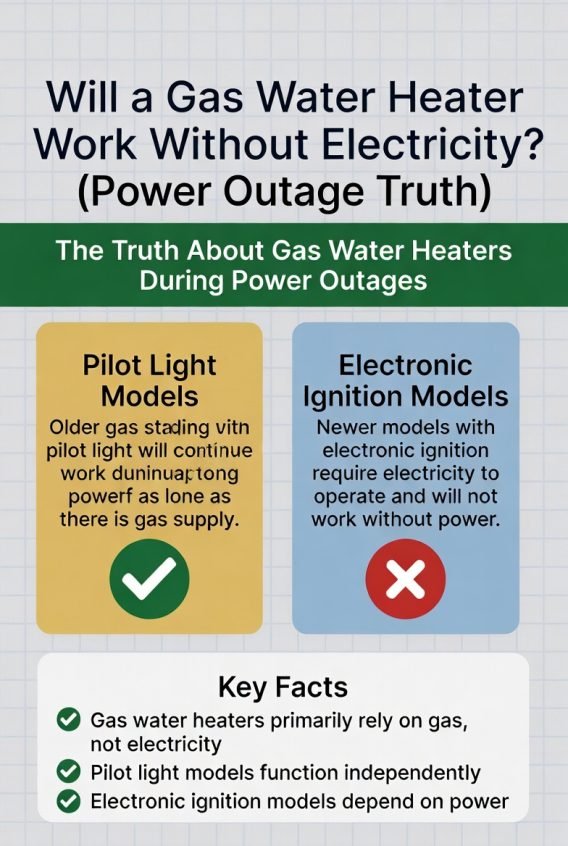
Will a Gas Water Heater Work During a Power Outage?
Some gas water heaters can continue heating water without household electricity. Others stop heating as soon as electrical power is lost.
The answer depends on the heater’s ignition system, gas control, venting design and electrical requirements—not simply on whether it burns natural gas or propane.
A gas storage water heater may continue operating during an outage when it:
- Uses an atmospheric or another non-powered venting system
- Uses a standing pilot or manually lit pilot system
- Uses a thermocouple- or thermopile-powered gas control
- Does not require an external AC electrical connection
- Still has an available gas supply and a properly operating pilot and vent system
A gas water heater will normally stop reheating during an outage when it:
- Uses AC-powered electronic ignition
- Has an electrically powered blower or inducer
- Requires a powered control board or safety-control system
- Is a modern residential gas tankless model that depends on electronic controls
Quick Answer
A gas water heater can continue heating without household electricity only when its ignition, controls and venting are designed to operate without external power.
Many atmospheric-vent storage water heaters with standing-pilot or thermopile-powered controls can continue operating during a blackout. Power-vent, power-direct-vent and most modern gas tankless water heaters require electricity and normally stop heating when power is lost.
A powered storage water heater may still contain usable hot water after it shuts down. The outage can prevent reheating without immediately eliminating the hot water already stored in the tank.
Stored Hot Water Is Different From Active Reheating
When the power fails, three separate questions determine whether hot water remains available:
- Will water continue to flow? The water heater itself does not normally create household water pressure. Municipal water service may continue, but a private well pump, booster pump or building water system may also lose power.
- Is hot water already stored? A storage-tank heater may retain usable hot water after its burner or powered controls stop operating.
- Can the heater reheat incoming cold water? This depends on whether its ignition, controls and venting require external electricity.
A powered gas storage heater may therefore provide a limited amount of previously heated water during an outage while being unable to replace the heat after cold water enters the tank.
How long the stored water remains useful depends on:
- Tank capacity
- Water temperature when the outage begins
- Tank insulation
- Household hot-water use
- Incoming cold-water temperature
- Whether a hot-water recirculation pump has stopped
- How much cold water enters the tank during use
There is no dependable two-hour, twelve-hour or one-day guarantee. A lightly used, well-insulated tank may retain useful heat much longer than a heavily used tank.
Gas Water Heater Power-Outage Comparison
| Water Heater Type | Usually Requires Household Electricity? | Likely Behaviour During an Outage |
|---|---|---|
| Atmospheric-vent tank with standing pilot | Often no | May continue heating if the pilot, gas supply and vent remain operational |
| Atmospheric-vent tank with piezo ignition and thermopile control | Often no | May operate without external electricity |
| Storage tank with AC-powered electronic ignition | Yes | Stops reheating, but stored hot water may remain temporarily |
| Power-vent gas storage tank | Yes | The blower and controls stop, preventing burner operation |
| Power-direct-vent gas storage tank | Yes | Powered combustion and venting controls stop during the outage |
| Non-powered direct-vent storage tank | Not always | May continue operating; check the exact model specifications |
| Modern residential gas tankless heater | Usually yes | Ignition, controls, sensors and the combustion fan normally stop |
| Heat-pump or hybrid storage heater | Yes | Cannot actively heat water, though stored hot water may remain temporarily |
| Conventional electric storage heater | Yes | Heating elements stop, but previously heated tank water may remain usable |
This table describes common designs. The rating plate and manufacturer’s manual provide the final answer for a specific heater.
Atmospheric-Vent Gas Water Heaters
An atmospheric-vent water heater relies on the natural upward movement of hot combustion gases through a draft hood and approved metal vent or chimney. It does not use an electrically powered exhaust blower.
Many conventional atmospheric-vent storage water heaters can operate without household electricity. Depending on the model, they may use:
- A continuously burning standing pilot
- A push-button piezo igniter used to light the pilot
- A thermocouple or thermopile heated by the pilot flame
- A self-powered gas control that uses electricity generated by a thermopile
A piezo igniter produces a spark mechanically when its button is pressed. It does not normally need a wall outlet or household electricity.
Some atmospheric heaters also have a flashing status light, diagnostic indicator or electronic-looking gas control. These features do not automatically mean the heater requires external power. On certain models, a thermopile generates the small electrical current used by the gas control and status system.
Will Every Atmospheric-Vent Heater Work During an Outage?
No. A non-powered design may be capable of operating during an outage, but successful operation still depends on:
- An uninterrupted natural-gas or propane supply
- A stable pilot flame
- A functioning thermocouple, thermopile and gas control
- A clear vent with proper natural draft
- Adequate combustion air
- A normal call for heat from the thermostat
- No existing ignition or safety fault
A power outage does not correct a failed pilot, defective gas control, blocked vent or interrupted gas supply.
Not Every Electronic-Looking System Uses Household Electricity
The terms electronic control and electronic ignition are often used too broadly. Three different systems should be distinguished.
Piezo Push-Button Ignition
A piezo igniter produces its own spark when the button is pressed. It is normally used only to light the pilot according to the procedure printed on the heater.
Once the pilot is established, a compatible standing-pilot system may continue operating without household electricity.
Thermopile-Powered Gas Control
A thermopile converts heat from the pilot flame into a small electrical current. That current can operate a compatible gas control and status indicator without a wall plug or external electrical supply.
A heater can therefore have electronic monitoring or an LED status light and still be capable of operating during a household power outage.
AC-Powered Electronic Ignition
An AC-powered system uses household electricity for one or more components, such as:
- Automatic spark ignition
- A hot-surface igniter
- An electronic gas-valve control
- Flame sensing and safety monitoring
- A digital display
- A blower or inducer motor
- Pressure-switch and airflow controls
When power is lost, this type of heater cannot complete its normal startup sequence unless a suitable and approved backup-power source is supplying it.
Atmospheric Vent vs Direct Vent vs Power Vent
Venting design is an important clue, but similar-sounding vent terms do not all describe the same system.
Atmospheric Vent
An atmospheric-vent heater uses natural draft rather than a fan. It commonly vents vertically through an approved metal vent or chimney.
When paired with a non-powered pilot and gas control, it may continue operating without household electricity.
Direct Vent
A direct-vent heater draws combustion air from outside and sends combustion gases outdoors through a sealed vent system.
Some direct-vent storage heaters operate without an electrically powered blower. Therefore, direct vent does not automatically mean power vent.
Check the model specifications rather than judging electrical dependence from the vent location alone.
Power Vent
A power-vent heater uses an electrically powered blower to move combustion gases through its vent system. The controls normally verify blower operation and airflow before allowing the burner to ignite.
During a power outage, the blower cannot establish the required airflow, so the heater normally stops reheating.
Power Direct Vent
A power-direct-vent heater uses sealed outdoor combustion air together with electrically powered venting. It requires electricity for the blower and control sequence.
Never bypass the blower, pressure switch, airflow control or another safety device to make a powered heater operate during an outage.
Can Vent-Pipe Material Identify the System?
Plastic vent piping is common on many power-vent and condensing heaters, while traditional atmospheric heaters commonly use metal venting. However, pipe material alone is not a reliable final test.
Approved vent materials vary by appliance design, temperature, listing and manufacturer instructions. Use the model number and technical documentation to identify the exact venting system.
Does a Power Cord Mean the Heater Needs Electricity?
A power cord plugged into an outlet is strong evidence that the heater depends on household electricity.
However, the absence of a visible plug does not prove the heater is power-independent. A water heater may be hardwired through a junction box or connected to powered equipment that is not immediately obvious.
To identify the electrical requirements:
- Locate the model and serial-number rating plate
- Look for voltage, amperage, wattage and frequency information
- Check for a power cord or hardwired electrical connection
- Listen for a blower during normal operation
- Identify the venting type
- Review the electrical-requirements section of the manufacturer’s manual
Do not remove electrical covers, disconnect wiring or open a sealed combustion chamber merely to determine whether the heater requires power.
What Happens to a Gas Storage-Tank Heater During a Blackout?
A storage-tank water heater provides one important advantage during an outage: it contains water that was heated before the power failed.
Its behaviour falls into one of two broad categories.
The Heater Does Not Require External Electricity
If the heater uses a non-powered pilot, gas control and venting system, it may continue cycling and reheating the tank while the fuel supply and all safety systems remain operational.
The Heater Requires External Electricity
If the heater uses powered ignition, a blower or an AC control system, the burner normally stops operating. The household may still use the hot water stored in the tank until it cools or is displaced by incoming cold water.
After power returns, allow the heater to follow its normal restart sequence. Use the manufacturer’s instructions if the control displays an error or remains in lockout.
Do not manually light a heater designed for automatic electronic ignition unless its manufacturer specifically provides an approved lighting procedure.
Will a Gas Tankless Water Heater Work Without Electricity?
Most modern residential gas tankless water heaters require household electricity even though natural gas or propane supplies the heating energy.
Electricity commonly operates:
- The water-flow sensor
- The electronic ignition system
- The control board
- The combustion fan
- Flame and temperature sensors
- The digital display and user controls
- Safety monitoring
- Built-in freeze-protection components
Without electrical power, the heater normally cannot detect a hot-water demand, start the fan, complete ignition or regulate the burner.
Water may still flow through the plumbing, but it will not be actively heated by the tankless unit.
Unlike a storage tank, a tankless heater does not hold a large reserve of previously heated water. Loss of operation is therefore usually noticeable immediately after any hot water remaining in the pipes is used.
Could a Particular Tankless Model Work Differently?
Specialised or unusual products may use different systems, but homeowners should not assume a gas tankless heater is power-independent.
Check the exact model’s electrical rating, installation manual and power-outage instructions. Do not bypass sensors, force ignition or modify the wiring to make the appliance operate without its required electrical supply.
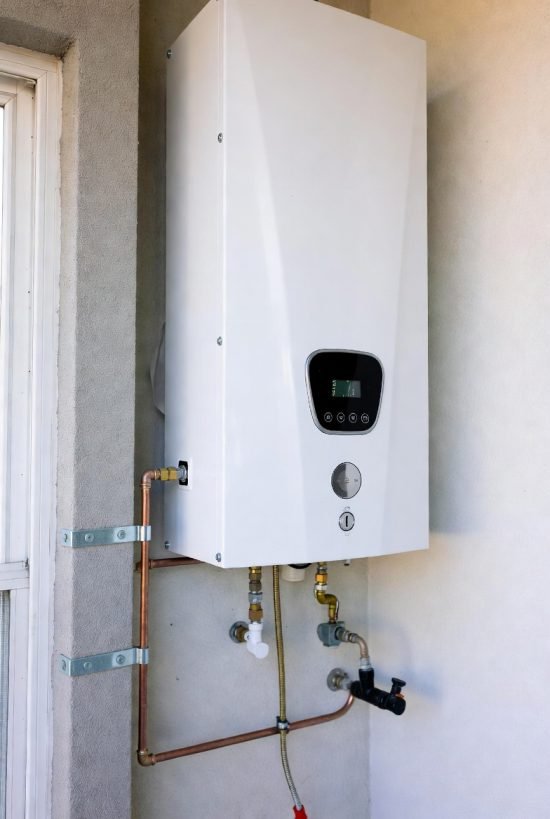
Do Heat-Pump, Hybrid and Electric Water Heaters Work Without Power?
Heat-pump, hybrid and conventional electric water heaters cannot actively heat water during a power outage unless they receive electricity from a suitable backup source.
This includes:
- Heat-pump water heaters
- Hybrid water heaters
- Conventional electric storage water heaters
- Electric tankless water heaters
A heat-pump water heater uses electrically powered components such as a compressor, fan, controls and pumps to move heat into the tank. Most hybrid models also contain electric-resistance elements. Both heating modes require electricity.
The word hybrid does not mean the heater contains a gas-powered or automatic emergency backup. It generally means the unit can switch between heat-pump and electric-resistance operation.
However, a storage model may still contain usable hot water when the outage begins. The loss of power stops active reheating; it does not instantly cool the water already stored in the insulated tank.
What Happens During a Short or Extended Power Outage?
There is no reliable fixed timeline for how long hot water will remain available. Outage performance depends on:
- The type of water heater
- Whether it can continue reheating without household electricity
- Tank capacity
- Starting water temperature
- Tank insulation
- Incoming cold-water temperature
- Household hot-water use
- Whether a private well or building pump also loses power
Short Outage With a Storage Tank
A storage-tank heater may continue supplying water heated before the outage.
- A non-powered gas storage heater may continue heating normally
- A powered gas storage heater may stop reheating but retain stored hot water
- An electric, heat-pump or hybrid tank may retain stored hot water
- A tankless heater normally stops producing new hot water
Using less hot water preserves the tank’s remaining heat. Each hot-water draw introduces colder replacement water and lowers the average tank temperature.
Extended Outage With a Storage Tank
During an extended outage, a powered tank gradually loses useful heat through household use and normal standby heat loss.
A gas storage heater designed to operate without external electricity may continue cycling when:
- The natural-gas or propane supply remains available
- The pilot and gas control are operating normally
- The venting system drafts correctly
- Adequate combustion air is available
- No safety fault interrupts operation
A powered gas, electric, heat-pump or hybrid heater cannot actively recover until electricity returns or an approved backup source supplies the required power.
Extended Outage With a Tankless Heater
A tankless water heater does not store a large reserve of heated water. When its controls, ignition or combustion fan lose power, a modern gas tankless unit normally stops producing hot water.
A small amount of warm water may remain in nearby pipes, but this is not meaningful stored capacity.
Does a Gas Water Heater Use Gas or Electricity?
A gas water heater uses natural gas or propane to create heat. Depending on its design, it may also rely on electricity to manage ignition, combustion and safety.
Electricity may operate:
- Automatic spark or hot-surface ignition
- Electronic control boards
- Gas-valve controls
- Flame sensors
- Combustion or exhaust blowers
- Pressure and airflow switches
- Water-flow sensors
- Digital displays
- Freeze-protection components
- Hot-water recirculation pumps
This is why two heaters that both burn gas can behave differently during the same outage. Their fuel is the same, but their ignition, control and venting systems may not be.
Will a Hot-Water Recirculation System Work During an Outage?
Most hot-water recirculation pumps require electricity. The pump may therefore stop even when a non-powered gas water heater continues heating the tank.
When the recirculation pump is offline:
- Hot water may take longer to reach distant fixtures
- Water in the return loop may cool
- Smart controls and programmed schedules may stop
- The pump or controller may need to restart after power returns
Loss of recirculation does not necessarily stop the water heater itself. It mainly changes how quickly hot water reaches the fixtures.
Will Natural-Gas Service Continue During a Blackout?
Natural-gas service often remains available during an ordinary electrical outage, but continued service is not guaranteed.
Gas availability may be affected by:
- Damage to utility infrastructure
- Severe storms, flooding, earthquakes or fires
- A utility emergency shutdown
- Damage to the property’s service line or meter
- A closed or damaged appliance connection
- An empty propane tank at a property using stored fuel
A water heater capable of operating without electricity still cannot heat water when its fuel supply is unavailable.
After a utility gas shutdown, do not attempt to restore service or relight appliances unless the gas provider or appliance manufacturer has confirmed that it is safe.
Can Backup Power Run a Gas Water Heater?
A gas water heater that requires electricity may be able to operate from a correctly selected backup source. Compatibility depends on the appliance’s voltage, running load, startup demand, wiring arrangement and manufacturer requirements.
Possible backup sources include:
- A manufacturer-approved battery backup
- An appropriately rated uninterruptible power supply
- A portable power station
- A portable generator
- A permanently installed standby generator
- A home battery system supplying approved backup circuits
Do not choose backup equipment from a generic water-heater wattage estimate. Use the rating plate and electrical specifications for the exact model.
Information to Check Before Selecting Backup Power
- Required voltage and frequency
- Rated amperage or wattage
- Motor or blower startup demand
- Whether the heater is plug-connected or hardwired
- Whether the manufacturer permits generator, inverter or UPS operation
- Required grounding and neutral arrangement
- Power-quality requirements for electronic controls
- Required runtime
- Other appliances sharing the backup source
A qualified electrician should evaluate the connection when the heater is hardwired, supplied through household circuits or contains sensitive electronic controls.
Can a UPS or Portable Power Station Run the Heater?
A UPS or portable power station may operate some powered gas water heaters, but suitability must be confirmed for the exact model.
The backup unit must provide:
- The correct voltage and frequency
- Enough continuous output for normal operation
- Enough surge output to start any blower or inducer motor
- Power quality compatible with the heater’s controls
- Sufficient battery capacity for the desired runtime
- A connection method permitted by both manufacturers
Battery capacity and maximum power output are different specifications. A battery may store enough energy for several hours while still lacking the surge output required to start a blower.
Keep battery equipment dry and away from leaking water, excessive heat and combustion exhaust.
Can a Portable Generator Power a Gas Water Heater?
Possibly. A generator must meet the heater’s electrical requirements and be connected safely.
A plug-connected gas water heater may be compatible when:
- The generator supplies the correct voltage and frequency
- Its continuous and surge ratings exceed the heater’s requirements
- The connection follows both manufacturers’ instructions
- The receptacle and any extension cord are correctly rated
- The generator has enough capacity for every connected load
A hardwired water heater should not be connected through an improvised plug, cord or wiring alteration. Supplying household circuits requires approved transfer equipment installed according to applicable electrical rules.
Portable Generator Safety
- Operate a portable generator outdoors only
- Keep it at least 20 feet from the home and other occupied buildings
- Point the exhaust away from doors, windows and ventilation openings
- Never operate it in a home, garage, basement, shed or crawlspace
- Never plug a generator into a household wall outlet
- Never use a male-to-male or double-ended power cord
- Use approved transfer equipment when supplying household wiring
- Keep the generator dry without enclosing it in a space that traps exhaust
- Maintain working carbon-monoxide alarms inside the home
- Allow the generator to cool before refuelling
Generator exhaust contains carbon monoxide, an invisible and potentially fatal gas.
Can You Manually Light an Electronic Gas Water Heater?
Do not manually light a water heater designed for automatic electronic ignition unless the manufacturer provides an explicit approved procedure for that model.
An electronically controlled heater may need to verify:
- Blower operation
- Vent airflow
- Pressure-switch status
- Flame-sensor operation
- Gas-valve timing
- Temperature and limit controls
Introducing a flame manually does not recreate this safety sequence and can create a fire, explosion or carbon-monoxide hazard.
Never bypass the blower, pressure switch, flame sensor, control board or another safety device to make the heater operate during an outage.
Can a Powered Gas Water Heater Be Converted to Work Without Electricity?
Do not modify a listed water heater to eliminate its designed electrical requirements.
Unsafe modifications include:
- Replacing automatic ignition with an improvised standing pilot
- Operating a power-vent heater without its blower
- Bypassing a pressure or airflow switch
- Replacing a powered gas control with an incompatible mechanical control
- Altering internal wiring to defeat a safety circuit
- Installing unapproved fuel-conversion components
The heater was tested and listed as a complete system. Altering its ignition, venting or safety controls can make it unsafe and may violate the manufacturer’s instructions and local requirements.
Use an approved backup-power solution or consider outage performance when the existing heater reaches its normal replacement point.
How to Tell Whether Your Water Heater Will Work Without Power
- Find the model number. Locate the rating plate on the tank or appliance cabinet.
- Check the electrical rating. Look for volts, amps, watts or hertz.
- Look for a power connection. Identify a plug or visible hardwired connection without removing covers.
- Identify the vent design. Determine whether the unit is atmospheric vent, direct vent, power vent or power direct vent.
- Listen during normal operation. A blower starting before ignition indicates powered venting.
- Check the ignition description. The manual may identify standing pilot, piezo, thermopile, intermittent pilot, direct spark or hot-surface ignition.
- Read the outage instructions. Look for sections covering power failure, backup power, restart or lockout.
| Clue | What It Usually Suggests | Important Qualification |
|---|---|---|
| Power cord or hardwired connection | The heater requires electricity | Confirm its voltage and backup requirements in the manual |
| Blower runs before ignition | A powered venting or combustion system | The burner normally cannot operate without the blower |
| Standing pilot with no external wiring | It may operate without household electricity | Confirm the gas-control and venting design |
| Piezo push button | The pilot spark may not require household power | Other components could still require electricity |
| LED status light with no power cord | It may use a self-powered thermopile control | An LED alone does not prove household-power dependence |
| Digital display or touch controls | Usually indicates powered electronics | Check for a concealed or hardwired electrical supply |
| Modern gas tankless design | Usually requires electricity | Verify the exact model specifications |
Common Power-Outage Myths
Myth: Every Gas Water Heater Works Without Electricity
False. Many gas heaters rely on powered ignition, electronic controls, blowers and safety systems.
Myth: Every Storage-Tank Heater Keeps Heating
False. A storage tank may retain hot water, but a powered model cannot actively reheat it without electricity.
Myth: Every Electronic-Looking Gas Control Needs a Wall Outlet
False. Some atmospheric models use a thermopile-powered control and status light without household electricity.
Myth: Direct Vent Always Means Power Vent
False. Some direct-vent systems operate without a powered blower. Direct vent and power direct vent are different designs.
Myth: A Gas Tankless Heater Is Better During a Blackout
Usually false. Most modern gas tankless heaters require electricity and do not contain a tank of stored hot water.
Myth: Any Small Generator Will Run a Gas Water Heater
False. Voltage, running load, startup demand, electrical configuration and manufacturer compatibility must all be checked.
Power-Outage Preparation Checklist
- Record the heater’s make and model number
- Save a copy of the manufacturer’s manual
- Confirm whether household electricity is required
- Identify whether the heater is plugged in or hardwired
- Confirm whether it uses a blower
- Review the correct outage and restart procedure
- Keep combustion-air and vent openings clear
- Maintain working carbon-monoxide alarms
- Have any proposed backup-power connection evaluated before an emergency
- Test approved backup equipment according to its instructions
- Never operate or store a fuelled portable generator indoors
Knowing where utility shutoffs are located is useful for emergencies, but do not remain inside to operate equipment or valves when leaking gas or carbon monoxide is suspected.
Should You Replace a Water Heater for Better Outage Resilience?
Replacing a safe, functional water heater solely because it requires electricity is rarely the first option to consider.
First evaluate:
- How often outages occur
- How long they normally last
- Whether stored tank water provides adequate short-term coverage
- Whether an approved backup-power system is practical
- Whether the household has medical, accessibility or sanitation needs requiring dependable hot water
- The heater’s age and warranty status
- The tank’s condition and repair history
- The total installed replacement cost
Outage resilience is most sensibly considered when the heater is already nearing replacement, has a leaking tank, requires a major repair or no longer serves the household adequately.
A non-powered atmospheric gas heater may offer blackout operation, but it may not be suitable or available in every home or jurisdiction. Venting, combustion air, emissions requirements and installation conditions affect the available choices.
Frequently Asked Questions
Will My Gas Water Heater Still Supply Hot Water When the Power Goes Out?
Possibly. A storage tank may contain usable hot water even when its burner stops. Continued reheating depends on whether the ignition, controls and venting require household electricity.
Will a Gas Water Heater With a Pilot Light Work Without Power?
It may. A standing-pilot or thermopile-powered atmospheric heater often operates without external electricity. Confirm the exact model because a pilot flame alone does not describe every electrical or venting requirement.
Will a Power-Vent Gas Water Heater Work Without Electricity?
No. Its blower and controls require electrical power. The burner normally cannot operate unless the required airflow is established.
Will a Gas Tankless Water Heater Work During a Blackout?
Most modern residential gas tankless heaters will not. Their flow sensor, ignition system, fan and control board generally require electricity.
Will a Heat-Pump Water Heater Work During a Blackout?
It cannot actively heat water without electricity. Its insulated storage tank may still contain usable hot water temporarily.
Can I Use a Battery Backup for My Water Heater?
Possibly. Compatibility depends on the heater’s electrical requirements and the backup unit’s voltage, continuous output, surge capacity, power quality and battery capacity.
Can I Plug My Water Heater Into a Portable Generator?
A plug-connected model may be compatible with a correctly sized generator when both manufacturers permit the arrangement. Never backfeed household wiring or operate the generator indoors.
Will the Water Heater Restart Automatically When Power Returns?
Some models restart automatically. Others may perform a diagnostic sequence, display a fault or require a manufacturer-approved reset. Check the manual and investigate recurring lockout.
Does Natural Gas Always Remain Available During a Blackout?
No. Service often continues during an ordinary electrical outage, but utility shutdowns, severe disasters and damaged local infrastructure can interrupt it.
Bottom Line
A gas water heater works without household electricity only when its ignition, gas control and venting systems are designed to operate without external power.
Atmospheric storage heaters with standing-pilot or thermopile-powered controls may continue heating. Power-vent, power-direct-vent and most modern gas tankless heaters normally stop operating when power is lost.
A powered storage heater may still provide water heated before the outage, but it cannot recover that heat until electricity returns or an approved backup source is connected.
Identify the exact model, check its rating plate and read its manufacturer documentation before an outage. Do not bypass safety controls, manually light an automatic-ignition heater or use improvised generator wiring.
The decisive question is not merely whether the appliance burns gas. It is whether every system required for ignition, combustion, venting and control can operate safely without household electricity.