
Replacing a failed electric water-heater element is usually one of the more affordable water-heater repairs. A professional heating-element replacement commonly costs about $100 to $350, while the element itself usually costs only $10 to $60. Many straightforward professional jobs fall near $200 to $300.
The part is inexpensive. Most of the bill comes from diagnosis, draining the tank, electrical safety checks, labour, access and restarting the heater correctly.
Quick answer: Expect roughly $100 to $350 for professional water-heater element replacement. DIY parts may cost $20 to $80 after including the element and basic tools, but working on a 240-volt appliance carries serious electrical and scalding risks.
Water Heater Element Replacement Cost
| Repair scenario | Typical cost | What affects the price |
|---|---|---|
| DIY single-element replacement | $20–$80 | Element, wrench, tester or small supplies |
| Professional single-element replacement | $100–$350 | Diagnosis, labour, draining, removal and restart |
| Straightforward professional repair | $200–$300 | Common range when access is easy and no other fault is found |
| Both elements replaced | $200–$450 | Additional part, testing and labour |
| Difficult or combined repair | $300–$500+ | Stuck element, thermostat work, wiring repair or heavy sediment |
These are national planning ranges, not guaranteed local prices. Labour rates, service-call fees, heater location and the amount of diagnostic work can move the final quote higher or lower.
Water Heater Element Cost Breakdown
| Cost component | Planning range | What you are paying for |
|---|---|---|
| Heating element | $10–$60 | The replacement component itself |
| Service call or diagnosis | $50–$150 | Travel, electrical testing and fault confirmation |
| Labour | $100–$250 | Shutting down, draining, removal, installation, refill and testing |
| Additional thermostat or wiring work | Quoted separately | Required only when testing reveals another fault |
A low-cost element does not mean the whole job should cost only the price of the part. The technician must verify that the element is actually defective, safely isolate the 240-volt circuit, drain enough water to remove the element, install the correct wattage and voltage component, refill the tank completely and test the system.
Why Element Replacement Is Sometimes Cheap—and Sometimes Expensive
Lower-cost repair
The repair usually stays near the lower end when:
- The failed element is correctly diagnosed
- The heater is easy to access
- The element unscrews without difficulty
- The drain valve works properly
- No thermostat, wiring or breaker problem is found
- The tank is otherwise in sound condition
Higher-cost repair
The price can rise when:
- The element is corroded or seized in the tank
- The tank drains slowly because of sediment
- The drain valve leaks or becomes blocked
- The technician must replace both elements
- A thermostat, wire or electrical connection is also damaged
- The heater is installed in a tight closet, attic or finished space
- The initial diagnosis was incorrect and a second visit is required
Important: Confirm power is off with a suitable electrical tester before touching wiring or removing an element. Never energise an electric water heater before the tank is completely full. Operating an element without full water coverage can cause immediate dry-fire failure.
How Electric Water Heater Elements Fail
Heating elements can fail for several reasons. The failure is not always caused by age alone.
Dry firing
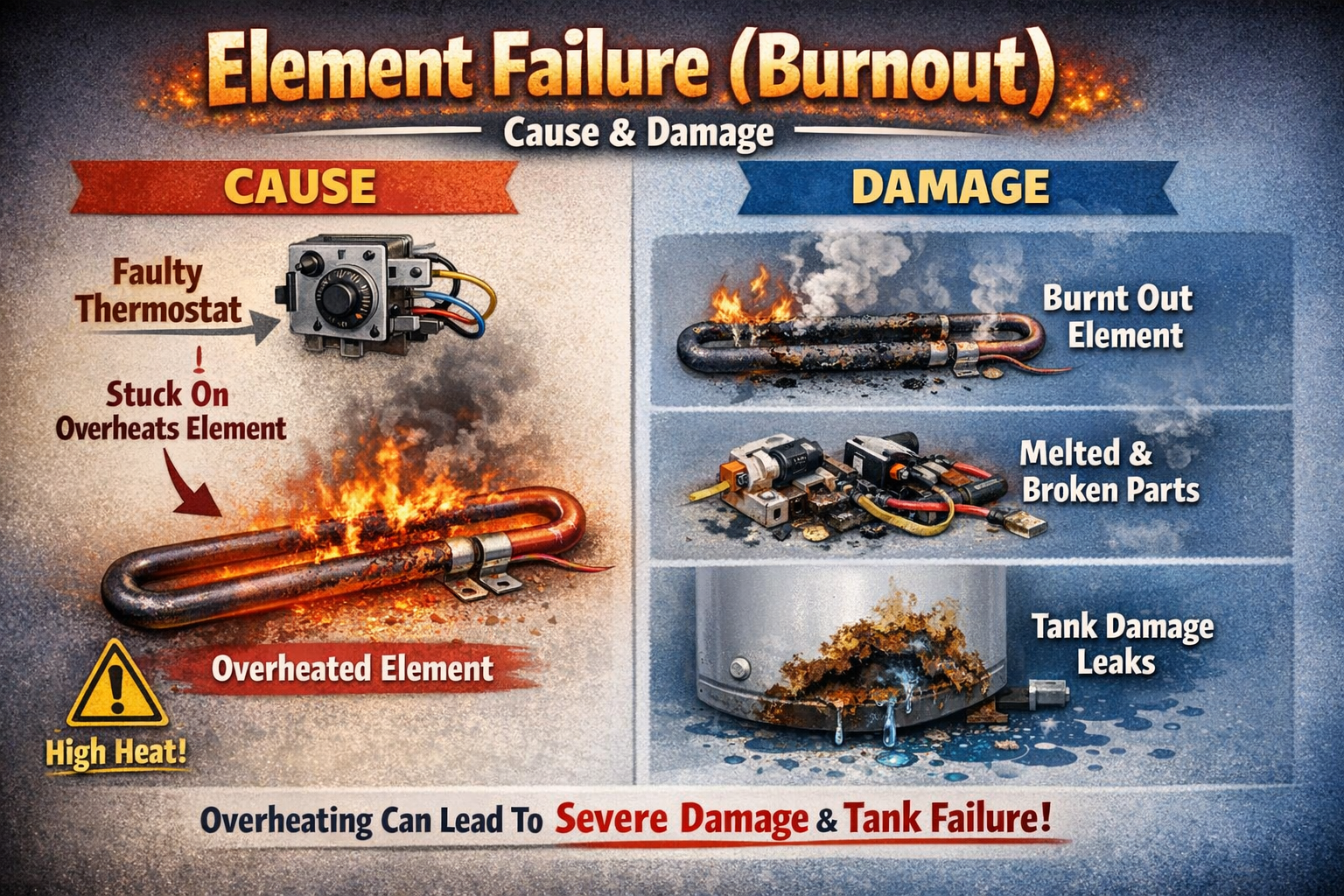
Dry firing happens when electricity reaches the element before it is fully submerged. Without water to absorb the heat, the element can overheat and fail almost immediately. This is why the tank must be completely refilled and air purged from the hot-water lines before power is restored.
Sediment and mineral buildup
Minerals can accumulate inside the tank and around the lower element. Heavy sediment may reduce usable tank capacity, contribute to noise and make draining or element removal more difficult. Mineral conditions vary by water supply and maintenance history.
Normal electrical wear
Repeated heating cycles can eventually weaken the element. Electrical connections, thermostats and wiring should also be inspected because symptoms blamed on the element may come from another component.
Incorrect voltage or wattage
The replacement element must match the heater’s electrical specifications. Installing an incompatible component can cause poor performance, overheating or electrical problems.
Upper vs Lower Water Heater Element
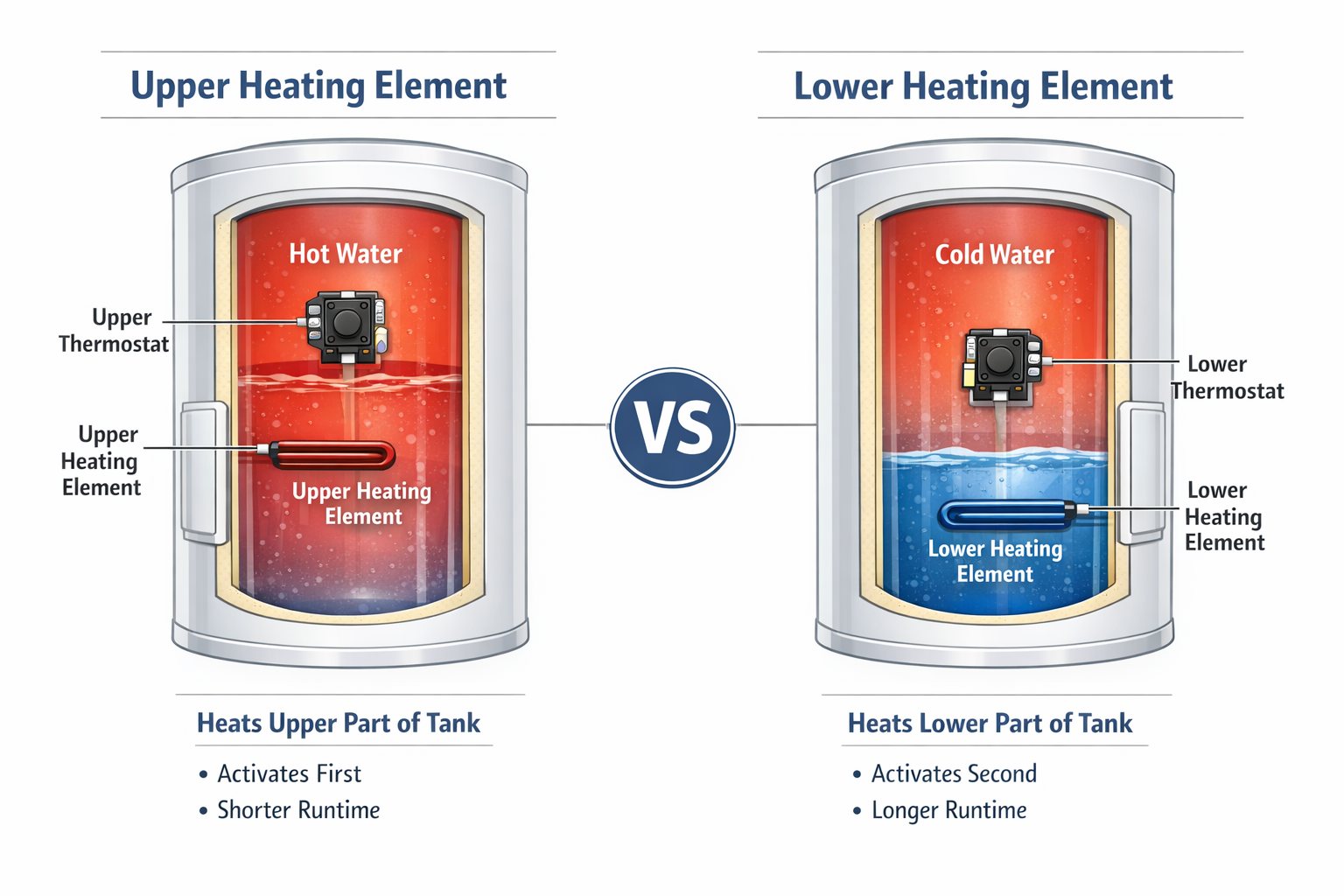
Most standard residential electric tank water heaters use an upper and a lower heating element. In most residential non-simultaneous systems, the two elements operate in sequence rather than heating at the same time.
| Element | Main role | Possible symptoms when it fails |
|---|---|---|
| Upper element | Heats the upper portion of the tank first and helps control the heating sequence | Little or no hot water, depending on the exact fault |
| Lower element | Heats most of the stored water after the upper section reaches temperature | Some hot water remains, but it runs out quickly or recovery is slow |
Symptoms alone cannot confirm which element has failed. A technician should test resistance and continuity and verify that the thermostat is sending power correctly before replacing parts.
Should both elements be replaced?
Replacing both elements may make sense when both test poorly, both are heavily scaled, the heater is already drained or the additional part cost is small compared with a future service call. It should not be presented as automatically necessary when only one element has failed and the other tests correctly.
Are You Overpaying for Water Heater Element Replacement?
A fair quote depends on the confirmed fault and the work included—not simply the price of the heating element. A straightforward professional repair often costs around $200 to $300, while difficult removal, replacing both elements or correcting another electrical problem can push the total higher.
| Quoted price | What it may represent | What to verify |
|---|---|---|
| Under $100 | Possible for DIY parts or a limited service, but unusually low for a complete professional visit | Confirm whether diagnosis, labor, draining, installation and testing are included |
| $100–$250 | Reasonable for a straightforward single-element repair in some markets | Ask whether the service-call fee, element and restart are included |
| $250–$350 | Common when complete diagnosis, draining and professional labor are included | Confirm whether one or both elements are being replaced |
| $350–$500+ | May be justified for a seized element, dual-element replacement or combined electrical work | Request an itemized explanation before approving the repair |
A high quote is not automatically unfair, and a low quote is not automatically a bargain. The important question is whether the contractor has clearly identified the failed component and explained the complete scope of work.
Warning signs in a repair quote
- The technician cannot explain whether the upper or lower element failed
- No resistance, continuity or ground-fault testing was performed
- The thermostat and electrical supply were not checked
- The quote does not separate diagnosis, parts and labor
- Both elements are recommended without test results
- Additional thermostat or wiring work is added without explanation
- The contractor cannot confirm the required voltage and wattage
- The repair price approaches replacement cost without discussing tank condition
Heating Element vs Thermostat Failure
Heating-element and thermostat faults can produce similar symptoms. Replacing an element based only on symptoms can leave the original problem unresolved.
| Symptom | Possible element-related cause | Other possible cause |
|---|---|---|
| No hot water | Failed upper element or an open element circuit | Tripped breaker, high-limit switch, upper thermostat or wiring fault |
| Some hot water, but it runs out quickly | Failed lower element | Lower thermostat fault, high demand or an undersized heater |
| Slow hot-water recovery | Weak, scaled or failed element | Incorrect voltage, thermostat problem or unusually cold inlet water |
| Water is too hot | A grounded element is one possible cause | Incorrect thermostat setting or failed thermostat |
| Breaker repeatedly trips | Shorted or grounded element may be responsible | Damaged wiring, loose connection or breaker fault |
Symptoms provide useful clues, but they do not confirm the failed component. Proper diagnosis may include checking supply voltage, element resistance, electrical continuity and whether either element has an unwanted connection to ground.
What the technician should test
- Whether the heater is receiving the correct supply voltage
- Whether the high-limit reset or ECO has tripped
- Resistance across the upper and lower elements
- Continuity through each element
- Whether either element is grounded to the tank
- Whether the upper and lower thermostats switch correctly
- The condition of wiring, terminals and electrical connections
Electrical safety: Residential electric water heaters commonly use a 240-volt circuit. Power must be switched off at the breaker and confirmed absent with a suitable tester before access panels, thermostats, wiring or heating elements are touched.
When the Heating Element Is Not the Real Problem
Element replacement will not solve the problem when another electrical, plumbing or capacity issue is responsible.
Possible alternative causes include:
- A tripped circuit breaker
- A tripped high-limit reset switch or ECO
- A failed upper or lower thermostat
- Loose, burned or damaged wiring
- Incorrect voltage reaching the heater
- A plumbing crossover allowing cold water into the hot-water system
- A leaking hot-water line
- Household demand exceeding the tank’s recovery capacity
- Incorrect thermostat settings
- A broken dip tube or another internal plumbing problem
Do not approve element replacement until
- The failed element has been identified
- Resistance and continuity have been tested
- The element has been checked for a ground fault
- The thermostat and electrical supply have been checked
- The technician has explained why the test results match the diagnosis
- The correct replacement voltage, wattage and mounting style are confirmed
- The tank has been inspected for leakage and significant corrosion
Types of Replacement Heating Elements
The replacement must match the water heater’s specifications. Elements are not automatically interchangeable simply because they fit the tank opening.
| Element characteristic | Why it matters |
|---|---|
| Voltage | The element must match the water heater’s rated electrical supply |
| Wattage | Incorrect wattage can change recovery performance and electrical load |
| Screw-in or flange mounting | The mounting style must match the tank opening |
| High-density or low-density design | Lower watt density spreads heat across more surface area and may reduce localized heat intensity |
| Material | Copper, stainless steel, nickel alloy and titanium-style elements differ in price and application |
The water heater’s rating plate, wiring diagram and model-specific parts information should determine which element is installed.
Repair or Replace the Water Heater?
An element failure alone usually does not justify replacing the entire water heater. Heating elements and thermostats are serviceable components, so repair is often sensible when the tank remains dry and structurally sound.
| Condition | Likely better option | Reason |
|---|---|---|
| One failed element, sound tank and no leakage | Repair | The failed component is replaceable and the cost is relatively modest |
| Both elements failed but the tank is otherwise sound | Compare repair cost | Dual-element replacement may still be economical |
| Element plus thermostat or wiring fault | Request an itemized repair quote | Combined work may remain worthwhile, but the complete cost should be reviewed |
| Water leaking through the tank body | Replace | A corroded or ruptured storage tank is generally not repairable |
| Older heater with repeated expensive failures | Compare replacement | Repeated repairs may offer poor long-term value |
| Repair quote is a substantial share of replacement cost | Obtain both quotes | A new heater may provide better reliability and warranty coverage |
Tank age matters, but condition matters more. An older heater with a sound, dry tank may justify an affordable element repair, while any heater with leakage through the tank body generally requires replacement.
Real-World Element Replacement Scenarios
Scenario 1: Straightforward single-element replacement
- One failed element is confirmed
- The tank drains normally
- The element removes without difficulty
- No additional electrical fault is found
Planning total: $150 to $300
Scenario 2: Both elements replaced
- Both elements test poorly or are heavily scaled
- The tank is already drained
- No tank leakage or major wiring problem exists
Planning total: $200 to $450
Scenario 3: Seized element and slow drainage
- The element is corroded into the tank opening
- Sediment slows the draining process
- Additional labor is required
Planning total: $300 to $500+
Scenario 4: Incorrect diagnosis
- An element is replaced without complete testing
- The original problem remains
- A thermostat, wiring or supply-voltage fault is later identified
Possible result: two service calls and an unnecessary replacement part
How to Avoid Overpaying
Before approving the repair, ask:
- Which element failed: upper or lower?
- What test confirmed the failure?
- Was the element checked for resistance, continuity and grounding?
- Were both thermostats tested?
- Is the service-call fee included?
- Does the quote cover draining, refilling and restarting the heater?
- Is one element or both elements being replaced?
- Does the replacement match the heater’s voltage and wattage?
- What happens if the element is seized or the drain valve will not work?
- Is there a parts or workmanship warranty?
- What is the complete installed replacement cost for comparison?
A clear written estimate should identify the confirmed fault, replacement component, labor charge and any additional costs that could arise.
How to Reduce Future Element Failures
- Never restore power before the tank is completely full
- Follow the manufacturer’s flushing and maintenance instructions
- Address heavy sediment and mineral buildup
- Use an element with the correct voltage, wattage and mounting style
- Keep temperature settings within the manufacturer’s recommended range
- Repair loose or overheated electrical connections promptly
- Investigate recurring breaker trips rather than repeatedly resetting the circuit
- Have persistent no-hot-water or overheating problems correctly diagnosed
The Most Expensive Mistake
The most expensive mistake is replacing a heating element without confirming why the water heater is not working.
An open element, grounded element, failed thermostat, tripped high-limit switch, breaker problem and damaged wiring can produce overlapping symptoms. Replacing parts based only on symptoms can create a second repair bill without correcting the original fault.
Scope and Limitations
This guide applies primarily to residential electric storage-tank water heaters with replaceable screw-in or flange-style heating elements.
It does not cover:
- Gas water heaters
- Heat-pump compressor or refrigeration-system repairs
- Electric tankless heating chambers
- Commercial three-phase systems
- Water heaters with leakage through the storage tank
Testing and replacement procedures vary by manufacturer and model. Follow the heater’s rating plate, wiring diagram, owner’s manual and official service instructions.
Frequently Asked Questions
How much does it cost to replace a water-heater element?
Professional replacement commonly costs about $100 to $350. Straightforward repairs often fall near $200 to $300, while dual-element or combined electrical repairs may cost more.
How much does a water-heater element cost by itself?
The replacement element commonly costs about $10 to $60, depending on voltage, wattage, material, mounting type and model compatibility.
Can I replace a water-heater element myself?
Some experienced homeowners perform the repair, but it involves a 240-volt electrical circuit, hot water and draining the tank. Power must be confirmed off, the correct part must be installed and the tank must be completely full before electricity is restored.
How do I know whether the upper or lower element failed?
An upper-element failure may cause little or no hot water, while a lower-element failure may allow some hot water that runs out quickly. These symptoms are not conclusive, so the elements and thermostats should be electrically tested.
Should both water-heater elements be replaced together?
Not automatically. Replacing both may make sense when both test poorly, both are heavily scaled or the additional cost is modest while the tank is already drained. A correctly functioning element does not always require replacement.
Can a thermostat look like a failed heating element?
Yes. A failed thermostat, wiring problem, tripped high-limit switch or lack of electrical supply can produce similar symptoms. Testing should confirm the fault before parts are replaced.
What does a grounded water-heater element mean?
A grounded element has an unintended electrical path from the heating coil to the element sheath or tank. It can cause overheating, continuous heating or breaker problems and should be confirmed with electrical testing.
Can sediment damage a water-heater element?
Heavy mineral buildup can surround the lower element, interfere with heat transfer, slow tank drainage and complicate removal. The severity depends on water quality and maintenance history.
Is it worth replacing an element in an older water heater?
It may be worthwhile when the tank is dry, structurally sound and the element is the only confirmed problem. Replacement becomes more attractive when the tank leaks, corrosion is severe or several costly failures are occurring together.
Bottom Line
Expect professional water-heater element replacement to cost approximately $100 to $350, with many straightforward repairs falling near $200 to $300. The element itself is inexpensive; most of the total comes from diagnosis, electrical testing, draining, labor and safely returning the heater to service.
The repair usually offers good value when the failed element is confirmed and the tank remains in sound condition. When the diagnosis is unclear, the storage tank is leaking or several components are failing, compare an itemized repair estimate with complete replacement before approving the work.
Technical and pricing references
For element testing, thermostat diagnosis, replacement procedures and dual-element operation, review Rheem’s electric water-heater technical bulletins and the model-specific manuals available through A. O. Smith’s product literature. For consumer pricing context, see Forbes Home’s plumbing repair cost guide.