
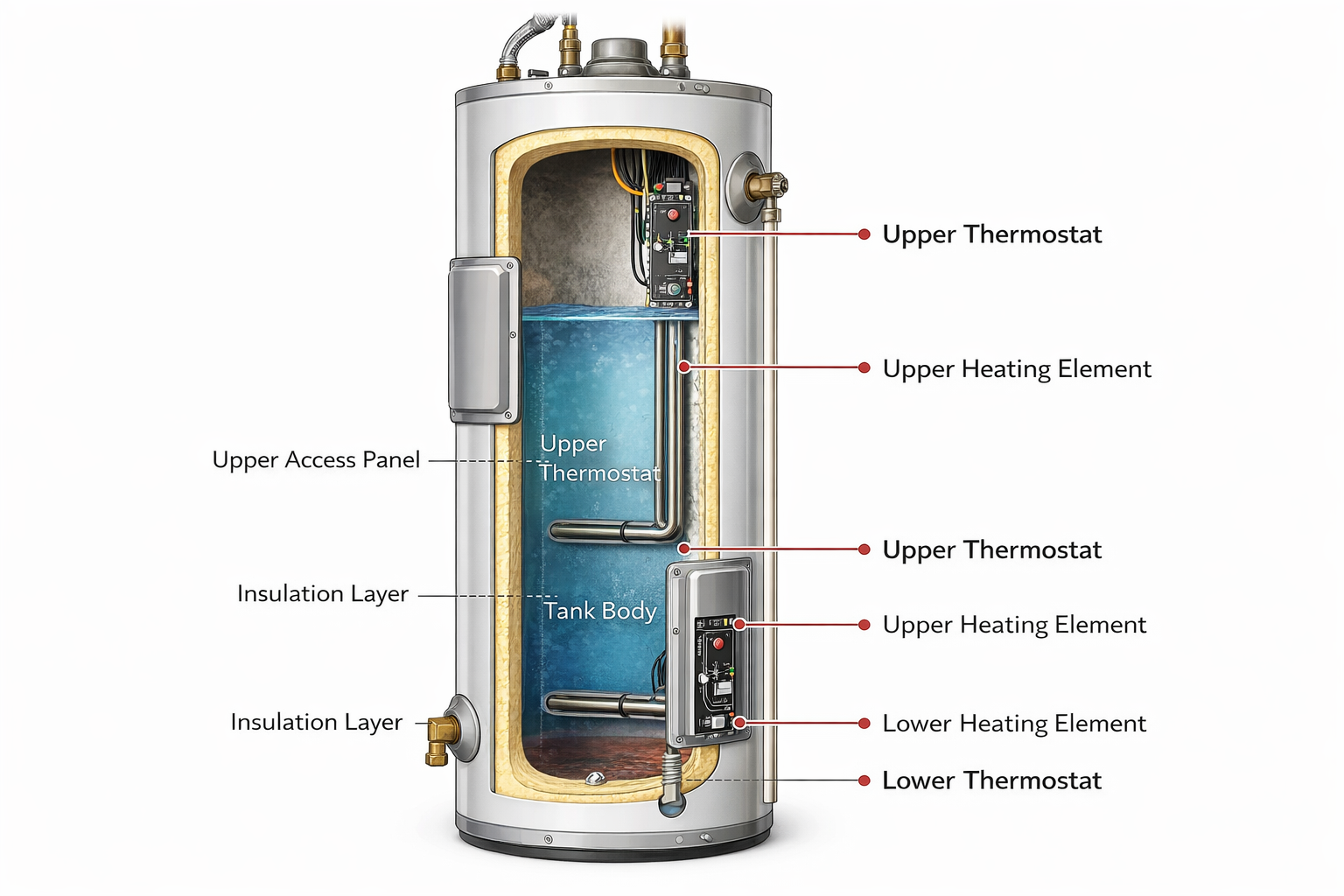
A conventional electric water heater thermostat typically costs $100 to $350 to diagnose and replace professionally, although the control itself may cost only $15 to $60. Before approving the repair, confirm that the heater has power and that the high-limit control and heating elements were checked. Cold, lukewarm or excessively hot water does not by itself prove that the thermostat has failed.
This guide focuses primarily on the mechanical thermostats used in conventional electric tank water heaters. Heat-pump water heaters, tankless systems and models with electronic control boards may use different sensors and control assemblies with different repair costs.
Before Paying for Replacement, Check the Power, Temperature Setting and ECO
A completely cold electric water heater does not automatically have a failed thermostat. The same complaint can result from a tripped circuit breaker, loss of incoming power, an opened high-limit safety control or a failed heating element.
Three preliminary checks may help rule out a simple cause before a thermostat is replaced:
- Confirm that the dedicated double-pole circuit breaker has not tripped.
- Check whether the thermostat settings are unusually high.
- Determine whether the high-limit control, commonly called the ECO or energy cut-off, has opened.
Electrical safety: A conventional residential electric tank water heater commonly operates on a dedicated 240-volt circuit. Turn off the correct breaker and verify that the circuit is de-energized before removing an access cover. Never assume the power is off merely because the heater is not producing hot water.
Do not touch exposed terminals or conductors, bypass a safety control or perform energized voltage testing without appropriate training and equipment. Stop if wiring, terminals, insulation or plastic components show scorching, melting or other heat damage.
How to Check the Red ECO Reset Button Safely
Many conventional electric tank water heaters have a red reset button on or near the upper thermostat. The button is part of the high-limit safety control, which interrupts electrical power when the control detects an abnormal overtemperature condition.
Layouts differ, so follow the instructions for the exact water-heater model. A typical manufacturer-directed check involves:
- Turn off power to the water heater at the dedicated circuit breaker.
- Verify that the heater is de-energized before opening the access area.
- Remove the upper access-panel cover.
- Carefully move the insulation aside without touching the wiring or terminals.
- Press the red reset button firmly.
- Return the insulation to its original position and reinstall the protective access cover before restoring power.
A click generally indicates that the high-limit control had opened and was reset. No click does not prove that the upper thermostat is defective; the control may not have tripped, may already be reset or may require further model-specific diagnosis.
A. O. Smith’s electric water-heater troubleshooting guidance also instructs homeowners to disconnect power before accessing and resetting the ECO.
Resetting the control may restore operation after a one-time event, but it does not explain why the safety device opened. Possible causes include:
- A thermostat that is not seated firmly against the tank
- A thermostat with stuck or damaged contacts
- A grounded heating element
- Loose, overheated or incorrectly connected wiring
- An unusually high thermostat setting
- Another condition causing abnormal tank temperature
If the ECO opens again, do not continue resetting it. Repeated trips require diagnosis.
Why a Defective Reset Control Can Become a Thermostat Repair
The red button is not normally replaced as a separate inexpensive push button. On many conventional electric water heaters, the ECO is incorporated into the upper thermostat or upper control assembly.
If testing confirms that the high-limit control itself is defective, the repair may require replacement of the complete upper thermostat assembly. This is one reason a complaint described as a “broken reset button” can turn into a professional thermostat-replacement bill.
Check the Temperature Setting Before Assuming the Control Failed
A thermostat setting around 120°F is a common residential starting point for balancing hot-water comfort, energy use and scald protection. Household requirements and manufacturer instructions can differ, so the actual setting should be chosen according to the heater manual and the needs of the occupants.
If the upper and lower controls are set substantially higher, reduce them according to the manufacturer’s instructions and verify the delivered-water temperature safely. Mechanical thermostat dial markings are approximate and do not guarantee an exact faucet temperature.
See our guide to choosing a safe water heater temperature for more detail. If the water remains excessively hot after the setting is reduced, see why a water heater may be getting too hot.
Can Sediment Contribute to Abnormal Heating?
Heavy sediment or mineral buildup can reduce heat transfer, increase recovery time and place additional operating stress on the heater. It does not prove that the thermostat has failed, but it should be considered when the heater has slow recovery, noise, overheating symptoms or a long history without maintenance.
Our water heater flush cost guide explains professional flushing prices, DIY limitations and when sediment removal may no longer restore normal performance.
Water Heater Thermostat Replacement Cost
Most homeowners can use $100 to $350 as a preliminary planning range for professional replacement of a conventional electric water heater thermostat. A straightforward repair may fall near the lower end. Extensive diagnosis, replacement of more than one control, damaged wiring or an additional heating-element repair can raise the total.
| Repair or service | Planning range | What the price may include |
|---|---|---|
| Basic electric thermostat part | $15–$60 | One compatible mechanical upper or lower thermostat; OEM, electronic and model-specific controls may cost more |
| Professional thermostat replacement | $100–$350 | Service visit, diagnosis, replacement control, installation and an operational check |
| Diagnostic or service-call fee | $50–$150 | Travel, inspection and electrical testing; some contractors credit this fee toward the completed repair |
| Two thermostats replaced | Usually higher than a single-control repair | Two compatible controls installed during one visit; ask for the incremental cost rather than assuming both are necessary |
| Thermostat plus element or wiring repair | $250–$500+ | Additional parts and labor for a heating element, burned terminal, damaged conductor or related electrical fault |
| DIY part cost | $15–$60 | Part only; testing equipment, correct diagnosis and electrical risk are not included |
These are national planning ranges, not guaranteed local quotes. Published estimates vary, and the final price depends on labor rates, the contractor’s service minimum, the heater design, part availability and the exact scope of the repair.
Current consumer cost guides illustrate that variation. HomeGuide estimates approximately $100 to $350 for thermostat replacement, while Angi places professional replacement at approximately $150 to $200. Neither range should be treated as a universal price ceiling.
The important comparison is not simply the price of the thermostat against the final bill. A professional repair price also covers determining which component failed, working safely around a high-voltage circuit, matching the replacement control and confirming that the heater operates correctly afterward.
What Should Be Checked Before the Thermostat Is Replaced?
A competent diagnosis should rule out the other common causes of a cold or underperforming electric water heater.
Before authorizing thermostat replacement, ask whether the following were checked:
- Is the water heater receiving the correct electrical supply?
- Has the dedicated double-pole circuit breaker tripped?
- Has the ECO or high-limit control opened?
- Were the upper and lower heating elements tested?
- Was either element checked for a ground fault?
- Are any terminals, wires or plastic controls loose, scorched or melted?
- Is each mechanical thermostat sitting firmly against the tank surface?
- Does the upper control transfer power through the intended heating sequence?
These checks matter because thermostat and heating-element failures can produce overlapping symptoms. A lower thermostat or lower element problem may leave the household with only a limited amount of hot water. Loss of power, an opened high-limit control, a failed upper thermostat or a failed upper element can leave the tank completely cold.
Our water heater element replacement cost guide explains the separate costs and symptom patterns associated with heating-element failure. For broader checks when the entire heater is cold, see why a hot water heater stops working.
Why the Installed Price Is Higher Than the Part Price
The thermostat itself is normally only one part of the bill. The installed price reflects the complete service visit and the responsibility involved in identifying and correcting the actual failure.
Diagnostic and Service-Call Charges
A plumber, electrician or qualified water-heater technician may need to inspect the electrical supply, high-limit control, upper and lower thermostats, both heating elements and associated wiring before identifying the failed component.
The service-call fee helps cover travel, inspection time, electrical testing equipment and the contractor’s minimum charge. Some companies list this fee separately. Others include it in a flat-rate repair price or credit it toward the completed work.
Ask how the diagnostic charge is handled before scheduling the visit. A separate service fee is not automatically unnecessary, but it should be disclosed clearly.
Electrical Testing and Part Matching
Thermostats that look similar are not necessarily interchangeable. A replacement control must be compatible with the heater’s model, voltage, current rating, control arrangement and wiring diagram.
Some electric water heaters have two conventional mechanical thermostats. Others have one thermostat, simultaneous-element wiring, temperature sensors or an electronic control assembly. The heater’s data plate, model number and manufacturer documentation should determine which component is installed.
A proper diagnosis also includes inspecting the conductors and terminals. Installing a new thermostat without correcting a loose or overheated connection can leave the underlying fault—and potentially an electrical hazard—unresolved.
Labor and Final Operational Checks
For a conventional mechanical thermostat replacement, the technician generally must:
- Shut off and verify the electrical supply
- Remove the access cover and carefully move the insulation
- Inspect the thermostat, element terminals and wiring
- Confirm which component has failed
- Document or identify the existing wiring arrangement
- Install a compatible replacement control
- Ensure that the thermostat sits firmly against the tank
- Restore the insulation and protective access cover
- Confirm that the heater returns to the intended operating sequence
The physical replacement may be straightforward on some conventional units, but the service visit is not priced solely by the number of minutes required to connect the new control.
Upper vs Lower Water Heater Thermostat
Many conventional residential electric water heaters use two heating elements and two thermostatic controls. They are commonly wired for non-simultaneous operation, meaning that only one element normally operates at a time.
The usual heating sequence works as follows:
- Power reaches the upper control through the high-limit safety device.
- If the upper portion of the tank is below the thermostat setting, the upper element is energized first.
- When the upper portion of the tank reaches the set temperature, the upper element switches off.
- The upper control then makes power available to the lower thermostat.
- The lower thermostat energizes the lower element as needed to heat the lower portion of the tank.
This is why the upper thermostat is sometimes described as the master control. On a typical non-simultaneous system, it not only controls the upper element but also determines when the lower heating circuit can operate.
The operating sequence is documented in the Bradford White residential electric water-heater service manual. The exact terminal arrangement and testing procedure still depend on the manufacturer and model.
| Control | Typical function | Possible complaint if it or its circuit fails |
|---|---|---|
| Upper thermostat | Controls the upper element and, on a common non-simultaneous system, transfers power to the lower heating circuit after the upper zone is satisfied | No hot water, an abnormal heating sequence or failure of the lower circuit to receive power |
| Lower thermostat | Controls the lower element after power becomes available from the upper control | A limited amount of hot water, reduced usable capacity or slow recovery |
| High-limit control or ECO | Interrupts electrical power when an abnormal overtemperature condition is detected | A completely cold heater after the safety control opens; repeated trips require diagnosis |
| Heating element | Converts electrical energy into heat in the upper or lower portion of the tank | No hot water, reduced capacity, slow recovery, overheating or repeated safety trips, depending on the element and failure mode |
These symptom patterns help narrow the possibilities, but they do not confirm a failed thermostat. A failed element, grounded element, loose connection, loss of incoming power or another electrical problem can create a similar complaint.
Not every electric water heater follows this exact arrangement. Compact, lowboy, point-of-use and specialized models may use one element, one thermostat, simultaneous-element wiring or electronic controls. Diagnosis should follow the wiring diagram and service instructions for the exact model.
How to Tell Whether a Quote Is Reasonable
Evaluate a thermostat-replacement quote by its scope rather than comparing it with one rigid national price ceiling. A higher quote may be reasonable when it includes extensive diagnosis, two controls, a special-order part or repairs to damaged terminals and wiring. A lower quote may also be legitimate when the fault is clear, the technician is already onsite or the diagnostic fee is credited toward the repair.
Before approving the work, ask:
- Which component failed: the upper thermostat, lower thermostat, high-limit assembly or heating element?
- What testing confirmed the diagnosis?
- Is the quote for one thermostat or more than one control?
- Does the total include the diagnostic or service-call fee?
- Is any wiring or terminal repair included?
- Is the replacement an OEM part or a compatible universal control?
- Does the manufacturer’s parts warranty cover the component?
- What labor and parts warranty will apply to the completed repair?
Be cautious when thermostat replacement is recommended solely from the reported symptoms, especially if the electrical supply, ECO and heating elements were not checked. Also request an explanation before approving bundled work that is not connected to a documented fault.
At the same time, a higher price is not automatically evidence of overcharging. Emergency service, difficult access, damaged wiring, electronic controls, model-specific parts, local labor rates and replacement of multiple components can all increase the final total.
Electric and Gas Water Heater Controls Are Different Repairs
The inexpensive upper and lower thermostats discussed in this guide are primarily associated with conventional electric resistance water heaters.
On many gas tank water heaters, temperature regulation is incorporated into a combination gas control valve or electronic gas-control assembly. That component may also interact with the pilot system, burner, temperature sensor and other safety controls.
Replacing a gas control valve is therefore not the same job as replacing a mechanical electric thermostat, and it should not be priced using the electric repair ranges above.
If a gas water heater will not remain lit or has ignition-related symptoms, see our guides to a water heater pilot that will not stay lit and water heater ignition failure.
The next step is determining whether the symptoms point more strongly toward the thermostat, heating element, high-limit control, electrical supply or another part of the system.

Is It the Thermostat or Another Water Heater Problem?
A thermostat failure cannot be confirmed from the household symptom alone. A failed heating element, opened high-limit control, tripped circuit breaker, damaged conductor or loss of incoming power may produce a similar complaint.
The operating sequence also matters. On a common dual-element electric water heater, a problem in the upper heating circuit can prevent the lower circuit from receiving power. A lower-circuit failure may still allow the upper portion of the tank to heat, leaving the household with a limited amount of hot water rather than a completely cold tank.
| Household symptom | Possible causes | Safe first steps |
|---|---|---|
| No hot water at all | Loss of electrical power, tripped breaker, opened ECO, failed upper thermostat, failed upper element or damaged wiring | Check whether the dedicated breaker has tripped. Internal diagnosis requires proper de-energization and electrical testing. |
| Only a small amount of hot water | Failed lower thermostat, failed lower element, lower circuit not receiving power, heavy demand, damaged dip tube or undersized tank | Compare the complaint with recent hot-water use and note whether the tank eventually recovers. |
| Slow recovery | One element not operating, thermostat problem, mineral scale, incorrect element wattage, low supply voltage or unusually high demand | Determine whether recovery recently became slower or has always been inadequate for the household. |
| Water is excessively hot | Temperature setting too high, thermostat not seated against the tank, stuck thermostat contacts, grounded element or wiring fault | Avoid using dangerously hot water and arrange diagnosis if the temperature remains excessive or continues rising. |
| Reset button trips repeatedly | Thermostat fault, grounded element, loose or overheated wiring, thermostat not contacting the tank or another overheating condition | Do not continue resetting the high-limit control. Repeated trips require diagnosis. |
| Circuit breaker trips repeatedly | Shorted element, ground fault, damaged wiring, loose connection or another electrical fault | Leave the breaker off and have the heater and circuit inspected. |
| Water temperature fluctuates | Thermostat contact problem, loose wiring, element fault, mismatched thermostat settings, mineral buildup, heavy usage or plumbing crossover | Record when the fluctuation occurs and whether it follows heavy household demand. |
These patterns can help narrow the possibilities, but they are not proof of a failed thermostat. Thermostat replacement should be supported by electrical testing and the wiring diagram for the exact model.
Why a Grounded Heating Element Can Look Like a Thermostat Problem
A heating element contains an electrical resistance coil insulated from its metal sheath and the water-heater tank. If that insulation fails and current finds a path from the element to the metal sheath or tank, the element has developed a ground fault.
In many cases, the resulting fault causes the circuit breaker to open. In some failure conditions, however, the element may continue heating abnormally. This can produce excessively hot water until the high-limit safety control opens.
A temperature and pressure relief valve may also discharge when the tank experiences excessive temperature or pressure. The valve should never be capped, plugged or disabled. Replacing it without checking the conditions that caused it to open may leave the underlying problem unresolved.
Our water heater pressure relief valve cost guide explains why temperature, pressure and thermal-expansion conditions should be evaluated before treating the valve as the only failed component.
How Testing Separates Thermostat and Heating-Element Failures
A proper diagnosis should identify the failed component rather than relying only on the reported symptom. The exact procedure depends on the heater’s model and wiring arrangement.
Testing may involve:
- Confirming the heater model, voltage, element wattage and control arrangement
- Inspecting the junction box, conductors and terminals for looseness or heat damage
- Checking whether the ECO or high-limit control has opened
- Confirming that each thermostat sits firmly against the tank
- Testing whether the upper control completes the intended heating sequence
- Checking whether power becomes available to the lower thermostat when required
- Testing each heating element for the expected electrical resistance
- Checking each element for an unintended electrical path to ground
- Comparing the installed wiring with the manufacturer’s wiring diagram
- Confirming normal water temperature and operation after the repair
The Bradford White residential electric water-heater service manual documents the upper-to-lower control sequence and model-specific electrical testing procedures. The exact terminals and expected readings vary by control design.
Understanding Heating-Element Resistance
Heating-element resistance depends on the element’s rated voltage and wattage. It should not be judged against one universal number.
The expected resistance can be estimated using this formula:
Resistance in ohms = voltage squared ÷ wattage
For example:
- A 4,500-watt element rated for 240 volts has an expected resistance of approximately 12.8 ohms.
- A 5,500-watt element rated for 240 volts has an expected resistance of approximately 10.5 ohms.
- A 3,500-watt element rated for 240 volts has an expected resistance of approximately 16.5 ohms.
The measured resistance should be compared with the element’s nameplate rating and the manufacturer’s service specification. A different wattage, voltage or element design will produce a different normal reading.
Resistance testing alone does not rule out every element failure. A separate ground-fault test checks whether an unintended electrical path exists between an element terminal and the metal tank or element flange.
Electrical testing boundary: Never perform resistance or ground-fault testing on an energized water heater. Turn off the correct breaker and verify that voltage is absent before touching conductors or terminals. Component testing may also require wires to be disconnected according to the manufacturer’s procedure.
Live-voltage diagnosis exposes energized 240-volt terminals and should be left to a qualified person with appropriate training, test equipment and protective procedures.
For many homeowners, the value of understanding these tests is not performing them personally. It is knowing that thermostat replacement should be supported by test results rather than guesswork.
Should You Replace One Thermostat or Both?
A conventional dual-element electric water heater commonly has an upper and a lower thermostat, but failure of one does not prove that the other is about to fail.
Replacing only the confirmed failed control is generally reasonable when:
- The other thermostat operates and tests normally
- There is no visible heat damage at the other access area
- The heater is otherwise in good condition
- The controls are available separately
- The manufacturer does not specify a paired replacement kit
Replacing both controls during the same visit may be reasonable when:
- Both controls produce abnormal or inconsistent test results
- Both show heat-related or physical damage
- A compatible manufacturer kit includes both controls
- The incremental part and labor cost is modest
- The homeowner prefers to reduce the possibility of paying for another service visit
Do not approve two replacement thermostats merely because they are the same age. Ask which control failed, whether the other was tested and how much replacing the second control adds to the total.
Can You Replace an Electric Water Heater Thermostat Yourself?
Replacing a mechanical thermostat can be physically straightforward on some conventional electric tanks, but the work involves high-voltage wiring, accurate diagnosis and correct part matching.
An experienced DIYer considering the repair should be able to:
- Identify and shut off the correct double-pole circuit breaker
- Verify absence of voltage with suitable test equipment
- Follow the exact manufacturer wiring diagram
- Match the replacement control by model and electrical rating
- Document the original conductor positions before disconnecting them
- Recognize loose, scorched, brittle or melted wiring
- Ensure that the replacement thermostat sits firmly against the tank
- Restore the insulation and protective access cover correctly
Stop and call a qualified professional when:
- The circuit breaker will not remain on
- The high-limit control trips repeatedly
- Wiring, terminals or controls are burned, melted or brittle
- The heater uses an electronic control board or unfamiliar sensor assembly
- The wiring does not match the manufacturer’s diagram
- More than one electrical component appears to have failed
- The storage tank is leaking or heavily corroded
- Safe de-energization cannot be confirmed
Never bypass the thermostat or high-limit control. Do not energize the water heater with exposed conductors or with its insulation and protective access covers improperly installed.
Check the Parts Warranty Before Paying
Before buying a thermostat or approving professional replacement, locate the heater’s model and serial number and check the manufacturer’s warranty terms.
A thermostat, heating element or related control may qualify for parts coverage depending on:
- The heater model and installation date
- The original warranty period
- Whether product registration was required
- Whether the claimant must be the original owner
- The documented cause of failure
- Whether installation and maintenance requirements were satisfied
- Whether an authorized replacement part or service provider is required
Parts coverage does not necessarily include diagnosis, travel or installation labor. Ask the manufacturer and contractor which costs remain the homeowner’s responsibility before authorizing the repair.
When Is Thermostat Repair Worth It?
Thermostat replacement is usually a sensible repair when the failure is confirmed, the tank is not leaking, the wiring and heating elements remain serviceable and the total repair price is modest compared with replacing the water heater.
Repair is generally more attractive when:
- The thermostat is the only confirmed failure
- The water heater is otherwise reliable
- The tank has no active leak
- Compatible replacement parts are readily available
- The heater still meets the household’s hot-water needs
- The repair includes reasonable parts and labor coverage
Consider complete water-heater replacement more seriously when:
- The storage tank is leaking
- There is severe corrosion or extensive water damage
- Multiple thermostats, elements or conductors require repair
- The unit has required repeated recent service
- Replacement parts are discontinued or unusually expensive
- The heater is inefficient or too small for the household
- The repair total represents a substantial portion of the full replacement cost
Age alone should not decide the outcome. Tank condition, leak status, repair history, remaining warranty, efficiency, capacity and the complete replacement quote should be considered together.
Can Maintenance Prevent Thermostat Failure?
Routine maintenance cannot prevent every thermostat failure, but it can help uncover conditions that contribute to poor performance, overheating or electrical stress.
Useful preventive steps include:
- Keeping the thermostat setting within the manufacturer’s recommended range
- Setting the upper and lower thermostats consistently when both are adjustable
- Addressing excessively hot water or repeated ECO trips promptly
- Having loose, scorched or melted electrical connections repaired
- Managing sediment according to the heater manufacturer’s instructions and local water conditions
- Inspecting the tank and plumbing connections for leakage and corrosion
- Following the maintenance instructions for the exact model
See our water heater maintenance schedule for a broader inspection and service plan.
Frequently Asked Questions
How much does it cost to replace a water heater thermostat?
Professional replacement of a conventional electric water heater thermostat commonly falls within a planning range of about $100 to $350. The total depends on the service-call fee, local labor rates, whether one or more controls are replaced, part compatibility and whether an element or wiring problem is found.
How do I know whether the thermostat or heating element is bad?
Symptoms alone cannot confirm the difference. Diagnosis may require checking the electrical supply, high-limit control, thermostat operation, element resistance and whether either element has developed a ground fault. A limited amount of hot water may point toward the lower heating circuit, while a completely cold tank may involve the power supply, ECO, upper thermostat, upper element or associated wiring.
Why does my water heater reset button keep tripping?
Repeated high-limit trips may be associated with a thermostat fault, grounded heating element, loose or overheated wiring, incorrect wiring or a thermostat that is not firmly contacting the tank. Do not continue resetting the control. Repeated trips require diagnosis.
Do both water heater thermostats need to be replaced together?
No. Failure of one thermostat does not automatically mean the other is defective. Replacing both may be reasonable when both test abnormally, both show damage or a compatible manufacturer kit includes both controls. Otherwise, replacing only the confirmed failed component may be appropriate.
Can I replace a water heater thermostat myself?
Some experienced DIYers can replace a conventional mechanical thermostat, but the work involves 240-volt wiring and accurate part matching. Do not attempt it unless you can safely shut off and verify power, follow the manufacturer’s wiring diagram and recognize damaged electrical components.
Is a gas water heater thermostat the same component?
No. On many gas tank water heaters, temperature control is incorporated into a combination gas control valve or electronic control assembly. Diagnosing and replacing that assembly is different from changing the mechanical thermostat used on a conventional electric tank.
How long does a water heater thermostat last?
There is no dependable universal service-life figure for the thermostat alone. Its lifespan depends on the control design, electrical connections, installation quality, operating temperature, usage and whether overheating or element faults place additional stress on the system.
Bottom Line
The thermostat part is usually inexpensive. The real value of a professional repair lies in identifying the correct failed component, working safely around the electrical system and confirming that the heater returns to normal operation.
Before approving replacement, ask what was tested, what the total includes and whether the control remains under warranty. That process is more reliable than judging the repair by the thermostat’s retail price alone.