
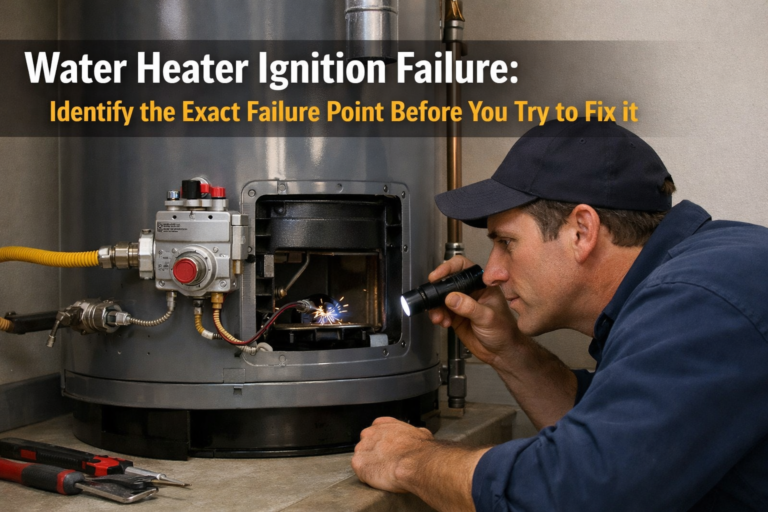
How to Identify the Ignition Failure Stage
A water heater ignition failure does not identify one specific broken part. It means the heater could not complete its normal ignition sequence or could not confirm that a safe, stable flame had been established.
Depending on the heater design, the cause may involve the igniter, pilot assembly, gas supply, flame-proving device, gas control valve, wiring, venting, combustion air or another safety control.
The safest approach is not to continue attempting ignition or start replacing components. First identify:
- The type of ignition system the water heater uses
- What happens during the lighting or startup attempt
- Whether a status light or error code is displayed
- Whether the failure occurs before ignition, after a flame appears or during normal burner operation
Stop Immediately if You Smell Gas or See Unsafe Combustion
If you smell gas or hear what may be escaping gas, leave the building immediately.
- Do not operate lights, switches, thermostats or appliances
- Do not use a phone while inside the building
- Do not attempt to relight the water heater
- Do not remain inside to investigate or operate gas valves
- Contact the gas utility or emergency services from outside and follow their instructions
Stop using the water heater and arrange professional inspection if you notice:
- A bang, boom or delayed ignition
- Flame appearing outside the intended burner area
- Soot, scorch marks or melted components
- Repeated ignition failures or lockouts
- A damaged, loose or disconnected vent
- A carbon-monoxide alarm
- Headache, dizziness, nausea, weakness or confusion that may indicate carbon-monoxide exposure
If a carbon-monoxide alarm activates or occupants experience possible exposure symptoms, move everyone into fresh air and contact emergency services.
Quick Diagnosis: What Does the Ignition Symptom Suggest?
| What You Observe | Possible Failure Stage | Recommended Next Step |
|---|---|---|
| No status light or electrical activity on a powered model | Power supply, wiring, control or open safety-circuit problem | Record the symptoms and check the model-specific manual |
| Igniter clicks or sparks but no pilot flame appears | Gas supply, pilot assembly, electrode position or gas-control problem | Stop repeated attempts and follow the model-specific instructions |
| Pilot lights but will not remain lit | Pilot flame, thermocouple, thermopile, flame sensor, airflow or gas-control problem | Note how long the flame remains and whether a code appears |
| Pilot remains lit but the main burner does not start | Thermostat, thermopile output, gas control or burner-control problem | Professional testing is generally required |
| Main burner lights and then shuts down | Flame-proving, grounding, venting, combustion-air or safety-control problem | Record the status code and do not repeatedly reset the heater |
| Blower runs but ignition does not begin | Pressure-switch, vent, condensate, airflow or electronic-control problem | Use the troubleshooting chart for the exact power-vent model |
| The unit retries and enters lockout | The control could not establish or verify safe operation | Record the error code before performing any manual-authorised reset |
| Ignition produces a bang, boom or flame rollout | Delayed ignition or unsafe combustion | Stop using the heater and obtain professional service |
These symptoms can narrow the failure stage, but they do not prove that a particular component has failed. Different faults can produce similar behaviour.
First Identify the Water Heater’s Ignition System
Gas water heaters do not all ignite in the same way. Check the model number, rating plate, control type and owner’s manual before interpreting what you observe.
Standing-Pilot Water Heater
A standing-pilot heater keeps a small pilot flame burning continuously. When the thermostat calls for heat, the gas control supplies gas to the main burner, which is ignited by the existing pilot flame.
There may be no new spark each time the main burner starts. A pilot that will not remain lit may involve the pilot flame, thermocouple, thermopile, gas control or surrounding combustion conditions.
Manual Spark-to-Pilot Water Heater
Many residential gas tank heaters use a push-button piezo igniter to light the pilot. The flame may be viewed through a small window or confirmed by a status light, depending on the model.
The control-knob position, waiting period, button sequence and required ignition time vary between models. Follow the lighting instructions printed on the heater or provided in its manual. Do not substitute a generic retry limit or an online lighting sequence for the manufacturer’s procedure.
If the prescribed procedure does not work, stop and review the troubleshooting guidance for that exact model rather than continuing to press the igniter indefinitely.
Electronic-Ignition or Power-Vent Water Heater
An electronic model may use a blower, pressure switch, ignition control, spark electrode and electronic flame sensor. A typical sequence may include:
- The thermostat calls for heat
- The control verifies required safety circuits
- The blower starts on a power-vent model
- The pressure switch confirms airflow
- The igniter or spark electrode activates
- The gas valve opens
- The pilot or main burner ignites
- The control confirms the flame
- The burner continues until the thermostat is satisfied
The exact sequence varies by model. If a required signal is missing, the control may stop the sequence, retry according to its programming or enter a safety lockout.
Read the Status Light or Error Code Before Resetting
Many modern gas water heaters use a flashing status light or digital error code. This is often the most useful starting point for diagnosis.
Before switching the control off or performing a reset:
- Count the number of flashes
- Note whether the pattern pauses and repeats
- Write down any letters or numbers shown on the display
- Record whether the blower, igniter, pilot or main burner operated
- Find the error-code chart for the exact model number
An “ignition failure” or “flame failure” code normally describes the condition detected by the control. It does not automatically mean that the igniter or flame sensor must be replaced.
Failure to prove flame may result from several causes, including:
- A weak or unstable flame
- Gas-supply or pressure problems
- A dirty or mispositioned flame sensor
- Poor grounding
- Damaged wiring
- Improper venting or combustion air
- A blocked condensate or vent system on an applicable model
- A faulty gas or ignition control
Perform a reset only when the manufacturer’s instructions specifically permit it. If the heater returns to the same lockout, stop resetting it and arrange proper diagnosis.
Safe Ignition-Failure Decision Flow
Step 1: Check for Immediate Danger
Do not continue troubleshooting if there is a gas odour, suspected escaping gas, delayed ignition, flame rollout, soot, scorching or a carbon-monoxide warning.
Leave the building when a gas leak is suspected. Delayed ignition, abnormal flames and combustion-gas concerns require professional inspection.
Step 2: Identify Whether the Heater Requires Electrical Power
A power-vent or electronically controlled heater normally requires household electricity. No display, blower, control light or other activity on this type may involve:
- Loss of electrical power
- A tripped breaker
- A disconnected plug
- Loose or damaged wiring
- An open limit or safety circuit
- A failed transformer or control
A conventional standing-pilot or manual-piezo water heater may not require household electricity for normal burner operation. Do not treat a lack of electrical activity as a fault until the heater type is confirmed.
Step 3: Determine Whether the Igniter Operates
If the model should produce a spark but no spark or igniter action can be confirmed, possible causes include:
- A failed piezo or electronic igniter
- A cracked electrode insulator
- A damaged, loose or disconnected ignition wire
- Incorrect electrode position or spark gap
- Poor electrical grounding
- A control that has not authorised ignition
- An open pressure switch, limit switch or other safety interlock
The spark may be difficult or impossible to see through some viewing windows. Listen and observe only as instructed by the manufacturer. Do not open a sealed combustion chamber merely to look for a spark.
Do not assume the igniter is defective unless the model’s sequence shows that it should be operating at that stage.
Step 4: Spark or Clicking Occurs, but No Flame Appears
Spark or clicking without a pilot or burner flame may involve gas delivery, the pilot assembly, electrode position, a safety interlock or the gas control.
Possible causes include:
- Interrupted gas service
- Low or unstable inlet gas pressure
- Air remaining in newly serviced gas piping
- An obstructed pilot or burner opening
- A spark that is not reaching the correct ignition point
- A gas control valve that is not opening correctly
- A control withholding gas because another safety condition was not proven
- Incorrect fuel type or an improper fuel conversion
Do not loosen gas connections, attempt to purge gas piping through repeated ignition attempts, adjust gas pressure or insert tools into the pilot or burner assembly. These tasks require appropriate equipment, training and procedures.
Step 5: The Pilot Lights but Will Not Stay Lit
A pilot that goes out after the control is released may involve:
- A weak, unstable or incorrectly positioned pilot flame
- A thermocouple that is not heated correctly
- Low thermopile output
- A damaged flame-proving device or wire
- A tripped thermal switch
- Poor combustion air
- Downdrafting or venting problems
- A failing gas control valve
A thermocouple, thermopile and electronic flame sensor are different devices. Do not order a replacement until the water heater’s actual system has been identified.
Step 6: The Pilot Stays Lit, but the Main Burner Does Not Start
If the pilot remains stable but the main burner does not operate when hot water is needed, possible causes include:
- The water temperature is already above the control setting
- The thermostat or gas control is not calling for burner operation
- Thermopile output is insufficient to operate the gas valve
- The main gas valve is not opening
- The burner or main gas path is obstructed
- A wiring or control fault is interrupting the call for heat
This stage generally requires electrical output, gas-pressure or control testing by a qualified technician.
Step 7: The Main Flame Appears and Then Shuts Down
A main flame that starts and then stops may mean the control did not receive a reliable flame-proving signal or that another safety condition interrupted operation.
Possible causes include:
- A dirty, damaged or mispositioned flame sensor
- A weak or unstable burner flame
- Poor grounding or incorrect electrical polarity
- Loose or damaged sensor wiring
- Low or unstable gas pressure
- Restricted combustion air
- Improper venting or backdrafting
- A pressure-switch or condensate problem on a power-vent model
- A failing gas control or ignition module
A brief flame followed by shutdown does not prove that the flame sensor itself is defective.
Step 8: The Heater Retries and Enters Lockout
Repeated programmed attempts followed by lockout mean the control could not complete or verify safe operation.
Depending on the model, the underlying cause may involve:
- Failure to establish a flame
- Failure to prove a flame
- An open pressure or limit switch
- A blocked intake or exhaust vent
- A condensate drainage problem
- Overtemperature protection
- Unstable combustion
- Control, wiring or grounding faults
Record the code before resetting. Do not repeatedly cycle the power or clear the lockout to force the heater to continue operating.
What a Homeowner Can Safely Check
When there is no gas odour, delayed ignition, flame rollout, vent damage or carbon-monoxide warning, a homeowner can generally perform limited external observations:
- Find the rating plate and record the exact model number
- Locate the correct owner’s manual
- Record status-light flashes or digital error codes
- Check whether a powered model is plugged in
- Check whether the circuit breaker serving a powered model has tripped
- Look for an obvious external obstruction at an accessible air intake or vent termination without dismantling it
- Observe the pilot or burner only through the manufacturer-provided viewing area
- Follow the lighting instructions printed on the heater or in its manual
If the prescribed lighting process fails, stop and consult the model-specific troubleshooting instructions or a qualified professional. Do not improvise additional ignition attempts.
What Requires a Qualified Professional
Do not attempt to:
- Adjust or measure gas pressure without proper training and equipment
- Loosen, disconnect or alter gas piping
- Purge gas piping through the water heater
- Remove or dismantle a sealed combustion assembly
- Bypass a pressure switch, limit switch, thermal switch or flame-proving device
- Alter an electrode position or spark gap without the correct service procedure
- Clean pilot or burner openings with wire, drills or improvised tools
- Test a live gas valve or ignition control without appropriate equipment
- Operate the heater with a damaged vent or signs of backdrafting
- Continue resetting a heater that repeatedly enters lockout
Professional diagnosis is also appropriate when the problem is intermittent. An intermittent ignition failure can disappear during a basic inspection while still involving unstable gas pressure, poor grounding, damaged wiring, venting or a failing control.
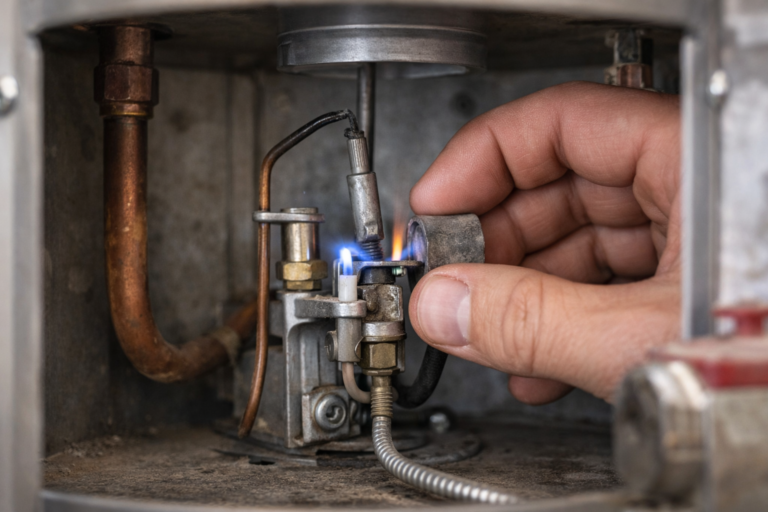
Water Heater Ignition Failure Causes by Failure Stage
The same visible ignition symptom can have several possible causes. Before replacing a component, the technician should identify the water heater model, ignition design, error code and point at which the startup sequence stops.
The following sections explain the main failure stages and the systems that may need to be tested.
1. No Igniter Click or Spark
If the water heater should generate a spark but no igniter activity can be confirmed, possible causes include:
- A failed piezo igniter or electronic ignition component
- A cracked spark-electrode insulator
- A loose, damaged or disconnected ignition wire
- Incorrect electrode position or spark gap
- Poor electrical grounding
- Loss of household power on a powered model
- An open pressure switch, thermal switch or limit circuit
- A gas control or ignition module that has not authorised the spark
No spark does not automatically prove that the igniter has failed. On an electronic or power-vent model, the control may intentionally prevent ignition because an earlier safety condition was not satisfied.
The spark can also be difficult to see through some viewing windows. Do not open or dismantle a sealed combustion chamber simply to inspect the electrode.
2. Spark or Clicking but No Flame
When the igniter operates but the pilot or main burner does not light, the problem may involve gas delivery, spark position, the pilot assembly, a safety interlock or the gas control.
Possible causes include:
- Interrupted gas service
- Low or unstable inlet gas pressure
- Air remaining in gas piping after authorised service
- An obstructed pilot or burner opening
- A damaged or incorrectly positioned spark electrode
- A gas control valve that is not opening
- An open safety circuit preventing gas release
- Incorrect fuel type or an improper fuel conversion
Spark without flame does not prove that the gas valve is defective. The spark may be occurring in the wrong position, gas may not be reaching the pilot correctly, or the control may be withholding gas because another condition has not been proven.
Do not attempt to purge gas piping by repeatedly trying to light the water heater. Gas-pressure testing, gas-line purging and internal burner work require a qualified professional.
3. Pilot Lights but Will Not Stay Lit
A pilot that appears but goes out when the control is released may involve the flame-proving device, pilot quality, combustion conditions or gas control.
Possible causes include:
- A weak, unstable or incorrectly positioned pilot flame
- The pilot flame not heating the thermocouple or thermopile correctly
- A failing thermocouple
- Insufficient thermopile output
- A dirty, damaged or mispositioned electronic flame sensor
- A loose or damaged sensor connection
- A tripped thermal switch
- Restricted combustion air
- Downdrafting or improper venting
- A defective gas control valve
A thermocouple, thermopile and electronic flame sensor are different components. They operate differently and should not be treated as interchangeable replacement parts.
4. Pilot Stays Lit but the Main Burner Does Not Start
If the pilot remains stable but the main burner does not operate when hot water is needed, possible causes include:
- The tank water is already above the control setting
- The thermostat or gas control is not calling for heat
- Thermopile output is too low to operate the main gas valve
- The main gas valve is not opening
- The burner or main gas passage is obstructed
- A wiring or control fault is interrupting the call for heat
This condition generally requires electrical-output, gas-pressure or gas-control testing. A stable pilot alone does not confirm that the complete gas control is operating correctly.
5. Burner Lights and Then Shuts Down
A main burner that starts but shuts down shortly afterward may indicate that the control did not receive a reliable flame-proving signal or that another safety condition interrupted operation.
Possible causes include:
- A contaminated, damaged or mispositioned flame sensor
- Poor grounding or incorrect electrical polarity
- Loose or damaged sensor wiring
- A weak or unstable burner flame
- Low or fluctuating gas pressure
- Restricted combustion air
- Improper venting or backdrafting
- An overheating condition
- A pressure-switch or condensate fault on a power-vent model
- A failing gas control or ignition module
A brief flame followed by shutdown does not prove that the flame sensor should be replaced. The quality of the flame, grounding, wiring, gas pressure and venting can all affect the flame-proving signal.
6. Blower Runs but Ignition Does Not Begin
This symptom mainly applies to power-vent and other electronically controlled water heaters.
Possible causes include:
- A blocked intake or exhaust vent
- A pressure switch that does not close
- A damaged, loose or obstructed pressure-switch hose
- Condensate backing up into the system
- A blocked condensate drain or trap
- A blower or inducer problem
- Loose or damaged wiring
- A faulty ignition control
The control may wait for the pressure switch to confirm airflow before permitting ignition. Therefore, a functioning blower does not automatically prove that the complete venting system is working correctly.
Never bypass a pressure switch to make the heater operate. The switch is part of the appliance’s safety sequence.
7. Repeated Ignition Attempts Followed by Lockout
Lockout is a control response, not a complete diagnosis. It means the water heater could not establish or verify safe operation within its programmed sequence.
Depending on the model, the underlying cause may involve:
- Failure to establish a pilot or main flame
- Failure to prove an established flame
- An open pressure, limit or thermal switch
- Restricted intake or exhaust venting
- Insufficient combustion air
- Unstable gas pressure
- A grounding or wiring problem
- An overtemperature condition
- A condensate problem
- A faulty gas valve or ignition control
Record the flash pattern or displayed error code before performing any reset allowed by the manufacturer.
If the same fault returns, continuing to reset or cycle power is not a repair. The condition causing the lockout must be identified.
8. Intermittent or Unpredictable Ignition
A water heater that operates during some cycles and fails during others may have an intermittent connection or operating condition rather than one completely failed component.
Possible causes include:
- A loose wire or electrical connector
- A cracked electrode that fails under certain conditions
- An unstable flame-proving signal
- Changing gas pressure
- Intermittent venting or draft problems
- A sticking pressure switch
- Condensate affecting a power-vent system
- A gas control or ignition module beginning to fail
Intermittent faults can be difficult to confirm because the water heater may operate normally during an inspection. Recording the error code, timing and exact startup behaviour can help prevent unnecessary part replacement.
What Is Normal and What Is Dangerous?
Normal operating sounds vary by model. A heater may produce a soft click, an igniter sound, a blower sound or a brief programmed pause during startup.
The manufacturer’s manual should describe the expected operating sequence. The following conditions should not be accepted as normal:
- A gas odour
- A bang, boom or forceful delayed ignition
- Flame appearing outside the intended burner area
- Soot, scorching or melted components
- A damaged or disconnected vent
- Repeated ignition failure
- Repeated safety lockout
- A burner flame that repeatedly starts and collapses
- A carbon-monoxide alarm
- Headache, dizziness, nausea, weakness or confusion near the appliance
If you smell or hear suspected leaking gas, leave the building immediately and contact the gas utility or emergency services from outside. Do not operate lights, phones or other electrical equipment before leaving.
If a carbon-monoxide alarm activates or occupants experience possible exposure symptoms, move everyone into fresh air and contact emergency services.
What Determines Water Heater Ignition Repair Cost?
The cost of an ignition repair depends on the actual failure—not merely the words “ignition failure” shown on the control.
Important cost factors include:
- The water heater make, model and ignition design
- Whether the unit uses a standing pilot, thermocouple, thermopile, electronic flame sensor or power-vent control
- The amount of diagnostic testing required
- The price and availability of the exact replacement component
- Whether the burner assembly must be removed
- Whether the combustion chamber is sealed
- Local labour and minimum service-call charges
- Access to the water heater
- Whether gas-pressure, venting or combustion testing is required
- Whether additional wiring, grounding, condensate or safety-control faults are found
- Whether the part remains under the manufacturer’s warranty
A thermocouple, igniter, complete pilot assembly, gas control valve and electronic ignition module are different repairs. They should not be combined into one generic price range.
Ignition Repairs That Are Usually Less Extensive
Repairs may be relatively limited when diagnosis confirms:
- A loose external electrical connection
- A replaceable igniter or electrode
- A serviceable thermocouple
- A replaceable flame sensor
- A damaged ignition lead
- A minor external intake or vent obstruction
Even a relatively simple component can carry a minimum service charge, diagnostic fee and labour cost.
Ignition Repairs That May Be More Expensive
Costs can increase when the problem involves:
- A complete gas control valve
- An electronic ignition module
- A blower or inducer assembly
- A pressure-switch or condensate system requiring extensive diagnosis
- Gas-pressure or supply problems
- Substantial venting corrections
- Multiple damaged components
- Discontinued or model-specific parts
- Restricted attic, closet or crawlspace access
What an Ignition-Repair Quote Should Include
| Quote Item | What the Contractor Should Explain |
|---|---|
| Diagnostic charge | What testing is included and whether the fee applies toward the repair |
| Confirmed failure | The exact component or operating condition responsible for the fault |
| Diagnostic evidence | The error code, test result or sequence observation supporting the diagnosis |
| Replacement part | Part number, compatibility, price and warranty |
| Labour | Estimated time and work required to access and replace the component |
| Safety testing | Whether gas pressure, combustion, venting or flame quality will be checked |
| Additional corrections | Any wiring, grounding, venting, gas or code problems found |
| Repair warranty | Coverage for the part and the contractor’s labour |
A strong diagnosis should explain what the control detected, what was tested and why the proposed repair addresses the complete failure.
Repair or Replace a Water Heater With Ignition Failure?
Ignition failure does not automatically mean the complete water heater must be replaced. The decision depends on the storage tank’s condition, the failed component, repair history, warranty and the complete cost of restoring safe operation.
Repair Is Usually More Reasonable When:
- The storage tank is not leaking
- There is no significant tank corrosion
- The failure is limited to a serviceable igniter, sensor, thermocouple, wire or pilot component
- The venting and combustion system are otherwise sound
- The replacement component is readily available
- The repair is covered fully or partly by warranty
- The heater has not experienced repeated unrelated failures
- The complete repair cost remains reasonable compared with installed replacement
Replacement Deserves Strong Consideration When:
- The storage tank is leaking
- The tank or combustion area has serious corrosion
- The heater has repeated ignition or control failures
- A major gas-control or electronic repair represents a substantial portion of installed replacement cost
- The required part is discontinued or difficult to obtain
- The unit also needs expensive gas, electrical, venting or code corrections
- The heater is approaching the end of its expected service life
- The existing capacity or efficiency no longer suits the household
Age alone should not make the decision. An older heater with a sound tank and a minor ignition component failure may still be economical to repair. A newer heater with a leaking storage tank generally requires replacement.
Compare the Complete Repair and Replacement Prices
Do not compare a repair quote only with the retail price of an uninstalled water heater.
A complete replacement estimate may include:
- The new water heater
- Removal and disposal of the existing unit
- Installation labour
- Permit and inspection charges
- Gas, venting or electrical modifications
- Drain-pan and drainage work
- Expansion-control or other locally required accessories
- Access-related labour
- Parts and labour warranty coverage
The better decision is based on total project cost, expected remaining service life and the condition of the complete system—not one repair part in isolation.
How to Avoid Paying for the Wrong Repair
Before authorising a component replacement, ask:
- What exact error code or status-light pattern was recorded?
- Which ignition system does this water heater use?
- At what point does the ignition sequence stop?
- Was the gas supply or inlet pressure tested where necessary?
- Was the flame-proving signal checked?
- Were wiring and grounding inspected?
- Were venting and combustion air evaluated?
- Was the pressure-switch and condensate system checked on a power-vent model?
- What test confirmed that the proposed component is defective?
- Is the component covered by the manufacturer’s warranty?
- What happens if the new component does not resolve the fault?
“The heater would not ignite” is a symptom. It is not proof that the igniter, flame sensor, thermocouple or gas valve must be replaced.
Common Ignition-Failure Misdiagnoses
Replacing the Igniter Because There Is No Flame
No flame does not necessarily mean there is no spark. The spark may be present but incorrectly positioned, gas may not be reaching the ignition point, or another safety condition may be preventing gas release.
Replacing the Flame Sensor Because the Flame Goes Out
A weak flame, poor grounding, damaged wiring, unstable gas pressure, restricted combustion air or improper venting can all produce a flame-proving failure.
Replacing the Gas Control Without Testing the Safety Circuit
A gas control may appear unresponsive when the actual cause is insufficient thermopile output, an open thermal switch, a pressure-switch fault, poor wiring or another condition preventing ignition authorisation.
Assuming Air in the Gas Line Will Clear Through Repeated Attempts
Gas-piping purging must follow proper procedures. Repeated homeowner ignition attempts are not a safe substitute for authorised gas-line service.
Resetting the Heater Before Recording the Code
Turning the heater off or resetting the control may erase or interrupt the most useful diagnostic clue. Record the flash pattern or displayed code first.
Ignoring Venting Because the Burner Initially Lights
A venting or combustion-air fault may allow initial ignition before causing unstable flame, shutdown, soot or safety lockout.
Can Maintenance Prevent Ignition Failure?
Not every ignition problem is preventable, but appropriate maintenance can reduce faults associated with dust, blocked airflow, loose venting, corrosion and neglected condensate systems.
Useful maintenance practices include:
- Keeping storage and combustible materials away from the heater
- Keeping accessible external air-intake openings clear
- Having the vent system inspected for looseness, corrosion or blockage
- Watching for soot, scorching, corrosion or abnormal operating sounds
- Keeping condensate drains clear on applicable power-vent or condensing models
- Following the maintenance schedule for the exact model
- Having recurring ignition failures professionally diagnosed
- Maintaining working carbon-monoxide alarms
Do not dismantle an FVIR or sealed combustion chamber as routine homeowner maintenance. Internal burner and pilot work should follow the model-specific service procedure.
Frequently Asked Questions
What Does Ignition Failure Mean on a Water Heater?
It means the heater did not establish or verify the flame required for safe operation. The cause may involve the igniter, gas supply, flame-proving system, gas control, venting, combustion air, wiring or another safety circuit.
Why Does My Water Heater Click but Not Light?
Clicking may indicate that the igniter is operating, but it does not prove that the spark is correctly positioned or that gas is reaching the ignition point. Pilot, electrode, gas-supply, safety-control and gas-valve problems are possible.
Why Does the Pilot Go Out When I Release the Control?
Possible causes include a weak pilot flame, poor thermocouple heating, low thermopile output, an open thermal safety device, venting problems, insufficient combustion air or a failing gas control.
Why Does the Burner Light and Then Shut Off?
The control may be losing the flame-proving signal or responding to another unsafe condition. The flame sensor, grounding, gas pressure, wiring, venting, combustion air and electronic controls may require testing.
Can I Reset an Ignition-Failure Code?
Follow only the reset procedure provided for the exact model. Record the code first. If the same lockout returns, stop resetting the heater and arrange diagnosis.
Can a Dirty Burner Cause Ignition Failure?
Contamination or obstruction can affect ignition and flame quality. However, homeowners should not insert tools into gas passages or dismantle sealed burner assemblies. Cleaning must follow the manufacturer’s service procedure.
How Much Does Water Heater Ignition Repair Cost?
The cost depends on the exact failed component, model, diagnostic time, labour, access and whether additional gas, electrical or venting problems exist. Obtain an itemised diagnosis rather than relying on a single generic ignition-repair price.
Should I Repair or Replace an Older Gas Water Heater?
Consider tank condition, repair history, replacement-part availability, warranty and complete repair cost. A leaking storage tank requires replacement, while a minor serviceable ignition component may still be economical to repair.
Does This Guide Apply to Tankless Water Heaters?
No. Tankless units use different airflow systems, ignition sequences, sensors and model-specific error codes. Use the manufacturer’s documentation for the exact tankless model.
Scope and Limitations
This guide primarily covers residential gas storage water heaters, including standing-pilot, manual spark-to-pilot, electronic-ignition and power-vent models.
It does not provide a complete diagnostic procedure for:
- Electric resistance water heaters
- Heat-pump water heaters
- Tankless gas water heaters
- Commercial water-heating systems
- Boilers or combination heating systems
- Propane conversion or gas-pressure adjustment
Exact ignition sequences, error codes, electrical test values and repair procedures vary by model. Use the rating plate to locate the correct manufacturer documentation.
Bottom Line
A water heater ignition failure is a problem somewhere in the startup or flame-verification sequence. It is not automatic proof that one particular component has failed.
Start by identifying the ignition-system type, recording the error code and determining where the sequence stops. Do not repeatedly reset the heater, attempt to purge gas through repeated ignition attempts or replace parts based only on a generic symptom.
Leave immediately when gas leakage or carbon-monoxide exposure is suspected. Delayed ignition, flame rollout, soot, vent damage and repeated lockout require professional attention.
The correct repair is the one supported by the model-specific sequence, diagnostic code and proper testing—not the first component associated with the words “ignition failure.”