
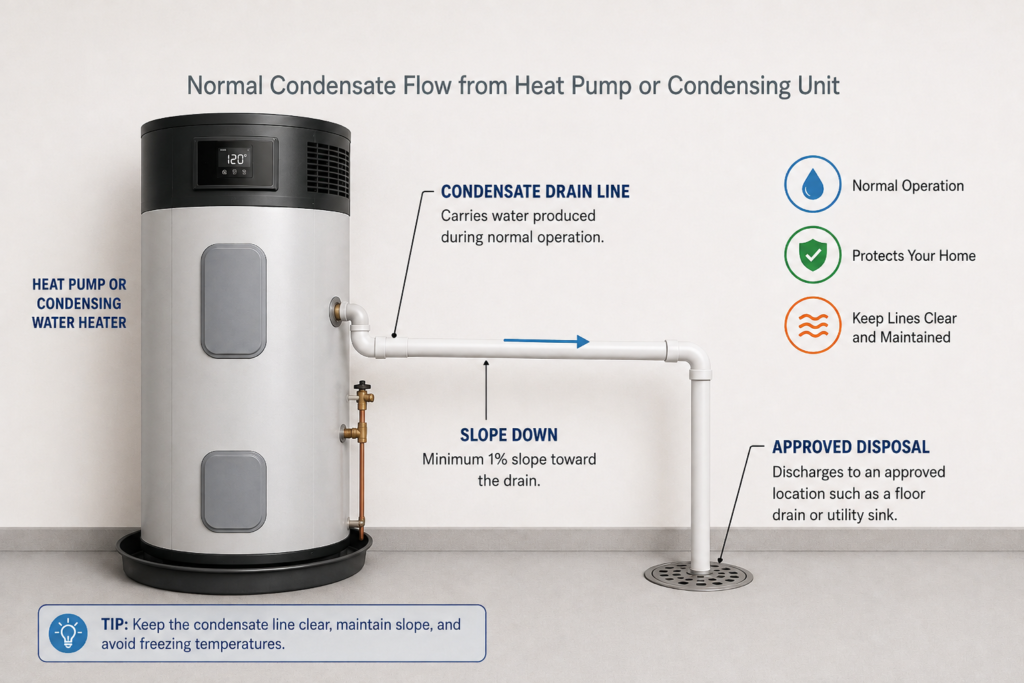
Quick Answer: Not every water heater needs a condensate drain. Heat-pump water heaters produce condensate as moisture in the surrounding air collects on the evaporator coil, while condensing gas water heaters produce condensate when water vapor in the combustion exhaust cools into liquid. Both need an appropriate drainage path, but the requirements are not identical.
The requirements below use the 2024 International Plumbing Code (IPC) as the primary model-code reference. The 2024 IPC is a model code, not automatically the code enforced at every U.S. home. Residential installations can instead fall under the International Residential Code (IRC), UPC-derived plumbing codes, state codes, local amendments, and the appliance manufacturer's installation instructions. Specific section numbers, approved materials, and installation details can therefore differ by jurisdiction and adopted edition.
A condensate drain is also different from a water-heater safety-pan drain and a TPR discharge pipe. Each performs a separate function and should be evaluated under the requirements that apply to that system. For the broader compliance framework, see our water heater code requirements guide.
Water Heater Condensate Drain Requirements at a Glance
| Question | 2024 Model-Code / Installation Baseline | Important Caveat |
|---|---|---|
| Does a heat-pump water heater produce condensate? | Yes. Moisture condenses at the evaporator during heat-pump operation and needs a drainage path. | Follow the water heater's installation instructions and locally adopted code. |
| Does a condensing gas water heater produce condensate? | Yes. Liquid combustion byproducts must be collected and discharged to an approved fixture or disposal area. | Combustion condensate can be acidic and requires approved corrosion-resistant piping. |
| Does every tankless water heater need a condensate drain? | No. The combustion-condensate requirements apply to condensing equipment. | Identify the specific appliance type and follow its installation instructions. |
| What slope does a gravity condensate drain need? | The applicable 2024 IPC provisions use a minimum 1% horizontal slope toward discharge. | That equals 1/8 inch of fall per 12 inches of horizontal run. |
| What size is an evaporator or cooling-coil condensate drain? | IPC Section 314.2.2 establishes a minimum 3/4-inch pipe size. | Do not automatically apply this rule to fuel-burning condensate piping. |
| What size is a fuel-burning condensate pipe? | It cannot be smaller than the condensate-drain connection on the appliance. | The manufacturer can impose additional requirements. |
| Can PVC be used? | PVC is among the materials listed by the 2024 IPC for evaporator/cooling-coil condensate drainage. | Fuel-burning condensate piping must also be approved and corrosion resistant for that application. |
| Can condensate connect directly to DWV piping? | Evaporator/cooling-coil condensate drains cannot connect directly to plumbing drain, waste, or vent piping under the 2024 IPC. | An approved condensate-disposal arrangement is required. |
| Does the condensate drain need a trap? | Under IPC Section 314.2.4, trapping is required where the equipment or appliance manufacturer requires it. | There is no single external-trap rule for every water heater. |
| Can a condensate pump be used? | Yes, where gravity drainage is impractical and the appliance and installation permit it. | Additional failure protection can apply in certain locations. |
| Does combustion condensate always need a neutralizer? | No blanket 2024 IPC requirement applies to every condensing water heater. | Manufacturer instructions and applicable local disposal requirements can require additional treatment. |
This table is a model-code reference, not a substitute for the code adopted by the local authority having jurisdiction. Earlier editions and UPC-derived codes can differ in section numbering, material lists, discharge arrangements, and other details.
Which Water Heaters Produce Condensate?
The first question is not what pipe to install. It is why the water heater is producing condensate. The answer determines which drainage requirements matter.
Heat-Pump Water Heaters
A heat-pump water heater contains an evaporator coil that absorbs heat from the surrounding air. As air passes across the cold evaporator surface, moisture in the air can condense into water. That water needs to be collected and drained while the heat-pump portion of the heater operates.
ENERGY STAR's Heat Pump Water Heater guidance describes this as benign condensate and says it must be drained away from the heater. A gravity drain can be used where practical, while a condensate pump is an option where gravity drainage is not practical.
This is important when a homeowner sees water associated with a new heat-pump water heater: condensate from the designated drain can be part of normal heat-pump operation and is not, by itself, evidence that the storage tank is leaking. Water appearing outside the intended condensate pathway, however, deserves investigation.
Condensing Gas and Condensing Tankless Water Heaters
A condensing gas water heater produces condensate through a different process. These appliances extract additional heat from the combustion exhaust. As the exhaust gases cool, water vapor condenses into liquid that must be collected and disposed of.
Under 2024 IPC Section 314.1, liquid combustion byproducts from condensing appliances must be collected and discharged to an approved plumbing fixture or disposal area according to the manufacturer's instructions. The condensate piping must be made from an approved corrosion-resistant material.
Combustion condensate can be acidic. As a manufacturer-specific example, Navien describes condensate from its condensing tankless water heaters as approximately pH 3–5 and identifies corrosion-resistant materials such as PVC and CPVC for its applicable condensate drains.
That pH range is a product-family example, not a universal value for every condensing water heater. The appliance instructions and applicable disposal requirements remain the controlling references for a specific installation.
What About Non-Condensing Water Heaters?
The IPC provision for liquid combustion byproducts specifically addresses condensing fuel-burning appliances. A conventional electric resistance storage heater also does not contain the evaporator used by a heat-pump model.
This distinction matters especially with tankless equipment because tankless and condensing are not interchangeable terms. ENERGY STAR explains that condensing gas tankless water heaters use a secondary heat exchanger that removes additional heat from combustion gases until condensation forms, which is why those units require a condensate drain.
For any individual non-condensing appliance, the manufacturer's instructions still control the installation and should be checked rather than assuming requirements from the appliance category alone.
If you are evaluating the broader work involved in installing the appliance rather than the condensate drain itself, see our tankless water heater installation cost guide.
Heat-Pump Condensate and Combustion Condensate Are Not the Same
The word condensate can make these systems sound more alike than they are.
Heat-pump condensate comes from moisture in the surrounding air. ENERGY STAR describes HPWH condensate as benign, clean water. The major concerns are giving that water a reliable drainage path, preventing blockage or overflow, and avoiding routing that can freeze.
Combustion condensate comes from the exhaust of a condensing fuel-burning appliance. Because combustion products are involved, the condensate can be acidic. That adds corrosion, material-compatibility, and possible neutralization considerations that do not normally apply to HPWH condensate.
This difference is why sizing, material, disposal, and treatment advice should never be transferred automatically from one type of condensate system to the other.
Which Plumbing Code Applies to a Residential Condensate Drain?
The 2024 IPC provides a clear national model-code framework, but it is not the only code family used for U.S. homes.
IPC and IRC Jurisdictions
For one- and two-family residential construction governed by the International Residential Code, the 2024 IRC Chapter 14 contains parallel condensate provisions for cooling coils and evaporators.
For example, IRC Section M1411.9 requires condensate from cooling coils and evaporators to reach an approved disposal location with at least a 1% horizontal slope. Section M1411.9.2 addresses condensate drain materials and uses a minimum 3/4-inch nominal diameter for the condensate waste and drain line covered by that provision. Section M1411.9.3 requires the line to be maintainable so blockages can be cleared without cutting the drain apart.
The IRC also separately addresses condensate pumps and certain overflow-protection situations. The details and section numbering can change between editions, which is another reason to identify the code actually adopted where the water heater is installed.
UPC and California Plumbing Code Jurisdictions
Some jurisdictions use the Uniform Plumbing Code (UPC) family rather than the IPC. The UPC has its own condensate-waste and indirect-drainage framework, so IPC section numbers and wording should not be assumed to apply unchanged in a UPC jurisdiction.
California is an important example. The current 2025 California Plumbing Code, effective January 1, 2026, is based on the 2024 Uniform Plumbing Code with California amendments.
The practical rule is simple: use the model-code discussion on this page to understand the installation, but use the locally adopted code, local amendments, appliance listing, manufacturer instructions, and authority having jurisdiction to determine compliance at a particular home.
What Does the 2024 IPC Require for Condensate Drainage?
Section 314 of the 2024 International Plumbing Code separates condensate requirements into two categories that are particularly useful for water-heater installations.
Fuel-Burning Condensing Appliances
Under IPC Section 314.1, liquid combustion byproducts from a condensing appliance must be collected and discharged to an approved plumbing fixture or disposal area according to the manufacturer's instructions.
The condensate piping must:
- be made from an approved corrosion-resistant material;
- be no smaller than the drain connection on the appliance; and
- maintain at least a 1% horizontal slope toward discharge where the piping drains by gravity.
This is why the statement “all water-heater condensate drains must be 3/4 inch” is inaccurate. The fuel-burning provision uses the appliance's condensate-drain connection as the minimum-size baseline.
Evaporators and Cooling Coils
IPC Section 314.2 applies to equipment and appliances containing evaporators or cooling coils. This is the relevant IPC model-code framework for condensate produced at a heat-pump water heater's evaporator.
Section 314.2.1 requires condensate to be conveyed from the drain-pan outlet to an approved place of disposal. Gravity piping must maintain at least a 1% horizontal slope in the direction of discharge.
That equals:
1/8 inch of vertical fall for every 12 inches of horizontal run.
A gravity route should therefore provide continuous fall toward disposal rather than unnecessary rises or low spots where condensate can collect.
What Size Should the Condensate Drain Be?
For condensate drainage governed by the IPC evaporator and cooling-coil provisions, 2024 IPC Section 314.2.2 establishes a minimum condensate waste and drain-line size of 3/4-inch pipe size. The line cannot decrease in size between the drain-pan connection and the place of condensate disposal.
The corresponding 2024 IRC residential provision uses 3/4-inch nominal diameter wording for the condensate drainage covered by IRC Section M1411.9.2. This small wording difference is another reason not to substitute terminology from one code edition or code family for another.
Fuel-burning condensate follows a different IPC sizing rule. Under Section 314.1, the condensate pipe cannot be smaller than the drain connection on the condensing appliance. The manufacturer's instructions can require more.
Where Can Heat-Pump Water Heater Condensate Drain?
Under IPC Section 314.2.1.1, condensate drains covered by the evaporator/cooling-coil provisions must not connect directly to plumbing drain, waste, or vent piping.
The 2024 IPC identifies the following plumbing fixtures as permitted condensate discharge categories:
- floor sink;
- floor drain;
- trench drain;
- mop sink;
- hub drain;
- standpipe;
- utility sink; and
- laundry sink.
For the exact IPC model-code wording, see 2024 IPC Section 314.2.1.1.
The same IPC provision recognizes discharge to grade outdoors, while the broader rule prohibits condensate disposal that creates a nuisance. ENERGY STAR also advises routing HPWH condensate so the drain line will not freeze. Outdoor discharge can therefore be workable, but the route, climate, approved disposal location, appliance instructions, and local requirements all matter.
Why the Drain Should Not Connect Directly to DWV Piping
An approved indirect discharge arrangement keeps the appliance condensate pathway separated from the building's drainage system rather than creating an unrestricted direct connection between them. The exact receptor and connection arrangement depend on the applicable code family and installation.
This is also why “there is a floor drain nearby” does not automatically answer every installation question. The condensate still has to discharge using the arrangement permitted by the locally adopted code.
What Materials Can Be Used for a Condensate Drain?
Under 2024 IPC Section 314.2.2, condensate systems serving evaporators and cooling coils can use:
- ABS;
- cast iron;
- copper and copper alloy;
- CPVC;
- cross-linked polyethylene (PEX);
- galvanized steel;
- PE-RT;
- polyethylene;
- polypropylene;
- PVC; and
- PVDF.
The components must still have pressure and temperature ratings suitable for the installation.
This material list is edition-specific. Do not assume that every earlier IPC/IRC edition or UPC-derived code contains exactly the same list. Verify the code edition actually adopted by the jurisdiction before treating a particular material as locally approved.
Why PVC Can Be Acceptable Here but Not Automatically for a TPR Discharge Pipe
PVC is expressly listed by the 2024 IPC for evaporator/cooling-coil condensate drainage. That does not make it interchangeable with piping used for a water heater's temperature-and-pressure relief valve.
A condensate drain normally carries low-pressure water produced during appliance operation. A water heater TPR valve discharge pipe performs an emergency safety function and can carry very hot discharge. Its sizing, material, routing, and termination requirements are evaluated under a different code framework.
Combustion Condensate Adds a Corrosion Requirement
For a condensing fuel-burning water heater, IPC Section 314.1 requires condensate piping to use an approved corrosion-resistant material and to follow the appliance manufacturer's instructions.
That matters because combustion condensate can be acidic. A material permitted for ordinary evaporator condensate should not automatically be assumed suitable for raw combustion condensate or its downstream disposal system without checking the appliance instructions and applicable local requirements.
Does Condensing Water Heater Condensate Need a Neutralizer?
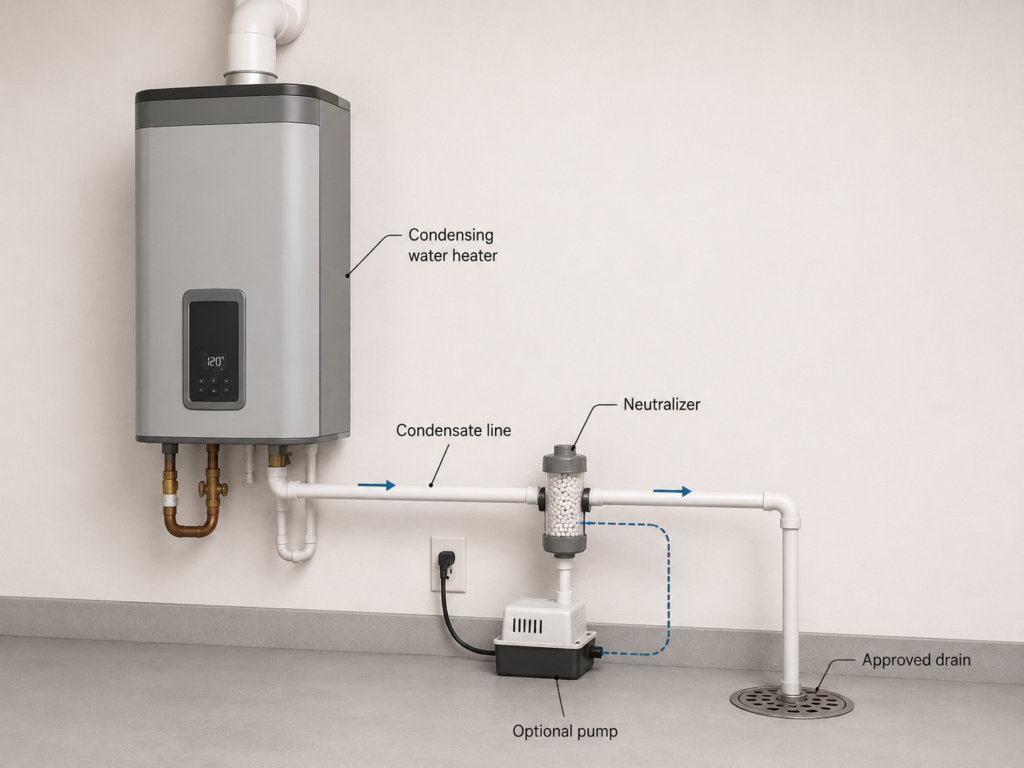
Not every condensing water heater automatically requires a condensate neutralizer. Combustion condensate can be acidic, but whether it must be neutralized before disposal depends on the appliance instructions and the requirements that apply at the installation location.
A condensate neutralizer passes acidic condensate through neutralizing media before the liquid reaches downstream drainage components. This can reduce corrosion risk and help satisfy disposal requirements where neutralization is required.
As a manufacturer-specific example, Navien states that condensate from its condensing tankless water heaters is approximately pH 3–5 and identifies neutralization as an option that can be required by local codes or regulations.
That does not create a blanket U.S. rule requiring a neutralizer on every condensing water heater. The appliance instructions and applicable local disposal requirements control the specific installation.
Neutralization is primarily a combustion-condensate issue. ENERGY STAR describes heat-pump-water-heater condensate as benign water rather than the acidic condensate created by condensing gas equipment.
Neutralizer media is also not necessarily permanent. Some manufacturer neutralizer products are designed for inspection, cleaning, and media replacement, so a required neutralizer should be maintained according to its manufacturer's instructions.
When Is a Condensate Pump Needed?
A gravity drain is the simplest arrangement when an approved disposal point can be reached with continuous fall. When the water heater is below the available drain or a practical gravity route is unavailable, a condensate pump can move the water to an approved discharge location.
ENERGY STAR's heat-pump water heater guidance specifically identifies a condensate pump as an option where gravity drainage is not practical.
A pump adds a mechanical failure point, so the installation also has to account for what happens if that pump stops moving water.
Some Pump Installations Need Failure Protection
Under 2024 IRC Section M1411.10, a condensate pump located in an uninhabitable space such as an attic or crawl space must be connected to the appliance or equipment it serves so that pump failure prevents the served equipment from continuing to operate. The pump must also be installed according to the pump manufacturer's instructions.
That is a location-specific model-code requirement—not a rule that every condensate pump in every installation must shut down the water heater.
If a pump overflows, stops discharging, repeatedly cycles abnormally, or causes the appliance to shut down, the cause should be corrected rather than bypassing the pump or its safety controls.
Does a Water Heater Condensate Drain Need a Trap?
Not universally. There is no model-code rule requiring the same external trap arrangement on every water-heater condensate line.
2024 IPC Section 314.2.4 states that condensate drains are trapped where required by the equipment or appliance manufacturer.
The appliance instructions are therefore the key reference. Some equipment incorporates condensate-management components into the appliance, while other designs specify a particular external trap or drain arrangement. Adding a trap simply because another appliance uses one can be as inappropriate as omitting a trap that the manufacturer requires.
What Happens If the Condensate Drain Becomes Blocked?
A blocked condensate line can cause water to back up, overflow, leak into the surrounding area, or activate equipment protection.
The 2024 IPC addresses serviceability directly. Section 314.2.5 requires condensate drain lines to be configured so blockages can be cleared and maintenance performed without cutting the drain line.
The corresponding 2024 IRC residential provision, Section M1411.9.3, carries the same basic maintainability requirement. A condensate system therefore needs to do more than drain correctly when new; it should also provide a practical way to clear future obstructions.
Overflow Protection Can Be Required Where Water Damage Is Possible
Some installations need additional protection because a stopped condensate drain could damage building components.
Under 2024 IRC Section M1411.11, a Category IV condensing appliance requires an auxiliary drain pan where stoppage of its condensate drainage system could damage a building component. The section provides an exception for a fuel-fired appliance that automatically shuts down if condensate drainage stops.
The IRC also contains separate auxiliary-drain and overflow-protection provisions for equipment with cooling coils or evaporators. The required safeguard therefore depends on the appliance, its location, and the locally adopted code rather than on a universal rule that every condensate-producing water heater needs a second pan.
Condensate Drain vs. TPR Discharge Pipe
A condensate drain and a TPR discharge pipe can both be visible near a water heater, but they perform completely different jobs.
| Feature | Condensate Drain | TPR Discharge Pipe |
|---|---|---|
| Purpose | Removes water produced during normal appliance operation | Carries emergency discharge from the temperature-and-pressure relief valve |
| Normal flow | Can occur while a condensate-producing appliance operates | Routine discharge is not normal operation |
| Typical service | Low-pressure condensate drainage | Potentially very hot emergency discharge |
| Requirements | Depend on condensate type, appliance instructions, and applicable condensate provisions | Governed by separate relief-valve and discharge-piping requirements |
This is why a material that works for a condensate drain is not automatically acceptable for TPR discharge. For the separate relief-valve requirements, see our water heater TPR valve code guide.
Condensate Drain vs. Water Heater Pan Drain
The condensate drain and the water-heater safety-pan drain also serve different purposes.
The condensate drain carries water intentionally produced during normal operation of a condensate-producing appliance.
The safety pan provides protection when leakage or other unwanted water reaches the area beneath the heater.
If a normally dry safety pan begins holding water, identify the source rather than assuming the pan has become part of the normal condensate system.
For pan placement and drainage requirements, see our water heater drain pan code guide.
Common Water Heater Condensate Drain Problems
| Condition | Why It Matters | How to Classify It |
|---|---|---|
| No controlled drainage path | Condensate has nowhere appropriate to go. | Code, manufacturer, or installation concern |
| Gravity line runs uphill, sags, or lacks required slope | Water can remain in the line instead of flowing toward disposal. | Installation/code concern where a gravity-drain provision applies |
| Drain does not meet the applicable sizing rule | The required capacity or appliance-connection baseline may not be met. | Code/installation concern |
| Direct evaporator-condensate connection to DWV piping | The 2024 IPC prohibits direct connection to plumbing drain, waste, or vent piping. | Code concern under that model-code framework |
| Drain cannot be serviced without cutting it | Prevents the intended clearing of blockages and routine maintenance. | Code concern under current IPC/IRC provisions |
| Clogged, kinked, or crushed line | Can cause backup, overflow, leakage, or equipment shutdown. | Maintenance or installation issue |
| Normal HPWH condensate discharged into the safety pan | Uses a protective pan as the routine condensate disposal path. | Installation concern |
| Exterior termination freezes | Can block the condensate discharge path. | Climate/installation concern |
| Condensate pump fails or overflows | Water can accumulate where gravity drainage is unavailable. | Mechanical/safety concern |
| Combustion condensate routed through unsuitable material | Acidic condensate can contribute to corrosion. | Material/manufacturer-compliance concern |
| No neutralizer installed | Only becomes a defect where the applicable appliance or disposal requirements call for neutralization. | Not automatically a national code violation |
| Condensate line mistaken for the TPR or pan drain | The systems serve different functions and follow different requirements. | Inspection/design misunderstanding |
The classification matters. A clogged condensate line, for example, is usually a maintenance or condition problem rather than proof that the original installation violated code. Likewise, the absence of a neutralizer is not automatically a defect unless the requirements applying to that installation call for one.
How to Visually Check a Water Heater Condensate Drain
A homeowner can perform a useful look-only check without disconnecting piping, opening combustion components, or altering electrical safety controls.
- Identify the appliance type. Determine whether the heater is a heat-pump model, condensing fuel-burning model, or equipment that does not normally produce appliance condensate.
- Find the condensate connection. A condensate-producing appliance should have an intentional drainage path from its designated outlet.
- Follow a gravity drain visually. Look for obvious uphill sections, deep sags, crushed tubing, or kinks.
- Look for water where it should not be. Standing water around the heater, pump, neutralizer, or safety pan deserves investigation.
- Identify the disposal point. The drain should end at an intentional disposal location rather than an unexplained improvised connection.
- Check for freeze exposure. Exterior routing should not appear vulnerable to an easily blocked frozen outlet.
- Observe a condensate pump if present. Leakage, overflow, abnormal cycling, or repeated appliance shutdown can indicate a problem.
- Check whether the drain is maintainable. There should be a practical way to clear an obstruction without cutting the drain piping apart.
- Keep the systems distinct. The condensate drain, TPR discharge pipe, and water-heater safety-pan drain serve separate functions.
This visual check can identify questions worth investigating, but it does not replace the appliance installation instructions or an evaluation by a qualified plumber, HVAC technician, or local code official.
When Should You Call a Plumber, HVAC Technician, or Building Department?
Professional evaluation is appropriate when:
- condensate leaks onto the floor or into finished areas;
- the drain repeatedly clogs, backs up, or overflows;
- a condensate pump repeatedly fails or shuts the appliance down;
- you cannot identify where the condensate is intended to discharge;
- combustion condensate appears to be corroding piping or surrounding materials;
- the drain appears directly connected to DWV piping in a way that conflicts with the applicable code;
- an exterior discharge repeatedly freezes;
- you are unsure whether a neutralizer, trap, pump, or overflow safeguard is required; or
- the appliance instructions and the installed drainage arrangement appear inconsistent.
A plumber or HVAC technician can evaluate the appliance and drainage system. Questions about the code edition or amendments actually enforced at the property should be directed to the local authority having jurisdiction.
Frequently Asked Questions
Does every water heater need a condensate drain?
No. Heat-pump water heaters and condensing fuel-burning water heaters are common condensate-producing types. A conventional water heater should not automatically be assigned condensate requirements that belong to a different appliance design.
Does every tankless water heater need a condensate drain?
No. Condensing tankless water heaters produce combustion condensate. Tankless and condensing are not interchangeable terms, so identify the actual model before deciding what drainage requirements apply.
Does a water heater condensate drain need a trap?
Not universally. Under the 2024 IPC evaporator/cooling-coil framework, condensate drains are trapped where the equipment or appliance manufacturer requires it. Follow the instructions for the actual water heater.
Does a condensing tankless water heater need a neutralizer?
Not automatically in every U.S. installation. Combustion condensate can be acidic, but whether neutralization is required depends on the appliance instructions and the requirements governing disposal at that location.
Can a condensate pump be used for a water heater?
Yes, where the appliance and installation permit it. A pump can provide drainage when gravity disposal is impractical. Under the 2024 IRC model-code baseline, a pump in an uninhabitable space such as an attic or crawl space also requires failure protection that prevents the served equipment from continuing to operate if the pump fails.
Bottom Line
A correct condensate system starts with identifying what type of water heater is producing the water. Heat-pump water heaters create benign condensate from moisture in the surrounding air. Condensing fuel-burning water heaters create combustion condensate that can be acidic.
Then verify the drainage arrangement that applies to that appliance: gravity drainage or a pump, compatible materials, an approved disposal point, service access, and any manufacturer- or code-required trap, neutralizer, or overflow protection.
Keep the condensate drain, TPR discharge pipe, and water-heater safety-pan drain separate in both purpose and compliance. If the route is unclear, repeatedly backs up, leaks, freezes, corrodes nearby materials, or conflicts with the appliance instructions, have the installation evaluated rather than improvising around the problem.