
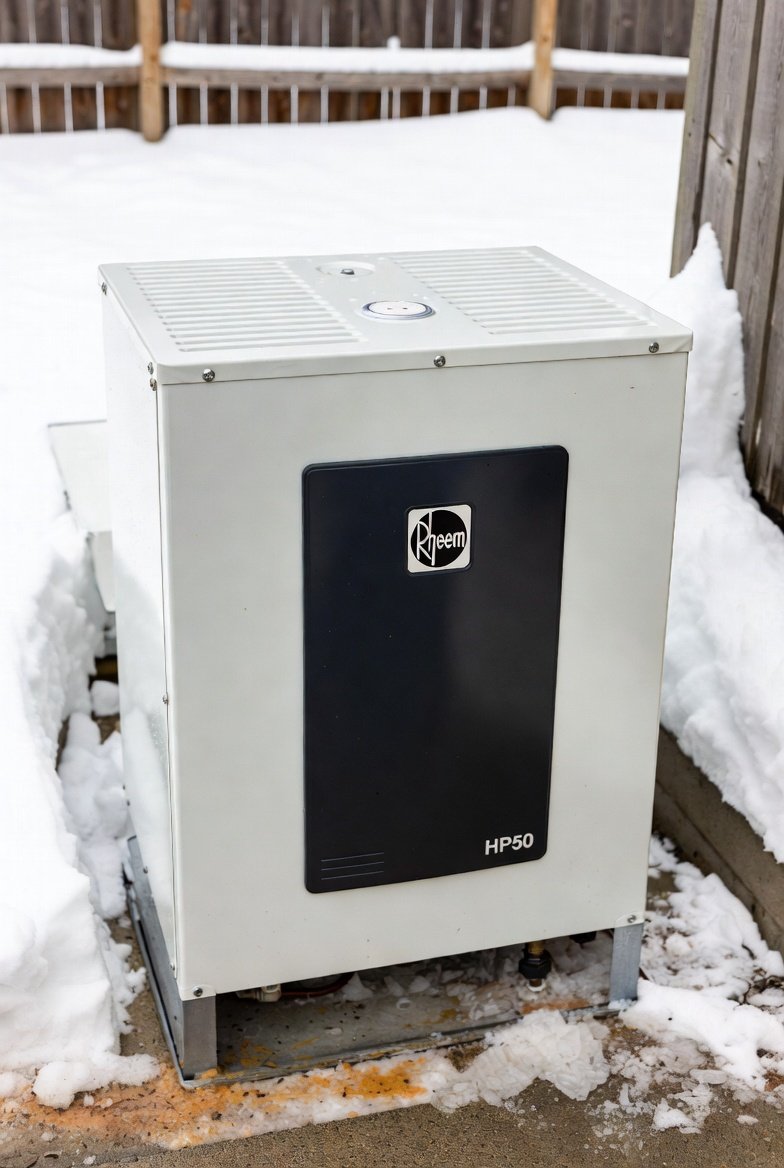
Best Heat Pump Water Heater for Cold Climates: What Actually Works in Winter
In warm states, heat pump water heaters are easy decisions.
In cold states, they’re conditional.
The question isn’t just “Does it work?”
It’s:
- Will it stay in heat pump mode?
- Will resistance run all winter?
- Will savings collapse?
- Which setup actually survives January?
This is a cold-climate buyer confidence guide — not a brand roundup.
We’ll cover:
- Real winter operating thresholds
- Basement vs garage installs
- Ducting mistakes that kill efficiency
- Tank sizing in northern states
- Which features define “best” in cold regions
- When it’s not the right move
Cold Climate Performance: The Real Thresholds
Most ENERGY STAR guidance places ideal operating environments roughly between 40°F and 90°F, with around 1,000 cubic feet of air volume recommended for proper operation.
Here’s what that means in practice:
- 60–70°F ambient: Excellent efficiency (COP 3+)
- 50°F ambient: Good performance
- Low 40s°F: Efficiency drops
- Below ~40°F: Resistance elements assist more frequently
Heat pump water heaters do not stop working below 40°F.
They simply rely more on electric elements.
That distinction matters.
Basement vs Garage vs Unconditioned Space (Cold State Reality)
Basement (Best Case in Cold Regions)
In northern homes, basements often remain:
- 50–65°F even in winter
- Thermally buffered from outdoor extremes
This keeps the heat pump in efficient mode most of the year.
Basement installs are typically the strongest cold-climate scenario.
Installed cost breakdown:
water heater cost
Attached Garage (Conditional)
Garages in winter may drop:
- Into the 30s°F overnight
- Below 40°F during cold snaps
This increases hybrid mode usage.
If installed here:
- Consider insulating the garage
- Evaluate ducting options
- Size tank appropriately
- Expect more resistance activation during peak cold weeks
Operating cost modeling:
water heater cost to run
Detached or Unconditioned Outbuilding (High Risk)
If ambient temperature frequently sits below 40°F:
- Resistance dominates
- Savings shrink substantially
- ROI may weaken
In these cases, compare fuel alternatives carefully:
gas vs electric water heater
Ducting in Cold Climates — What Works and What Doesn’t
Cold-climate ducting is often misunderstood.
Best practices:
- Do NOT duct both intake and exhaust directly outdoors in freezing climates
- Avoid pulling sub-40°F intake air
- If ducting, pull intake from conditioned or semi-conditioned space
- Exhaust to outside can sometimes help in summer, but winter intake matters more
Incorrect ducting is one of the fastest ways to destroy winter efficiency.
Installation nuance:
water heater installation cost
Permit and clearance considerations:
water heater replacement code
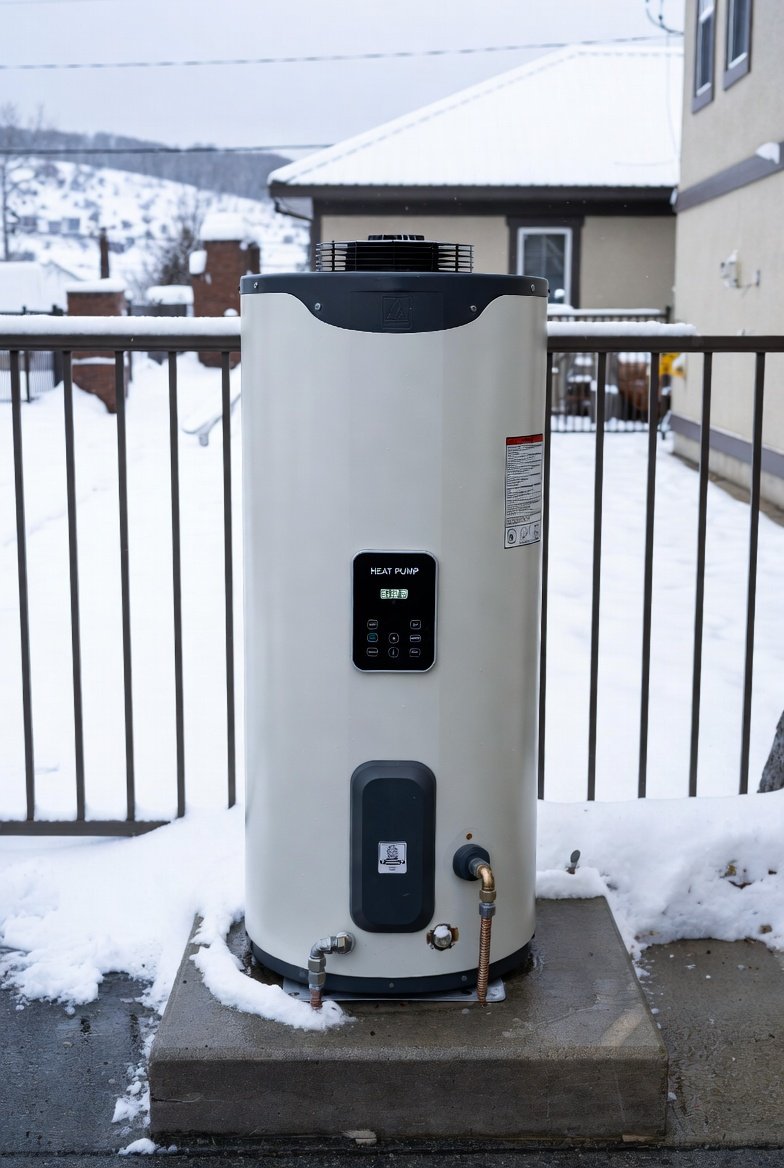
Air Volume & Space Requirements (Cold States Need This Right)
Default rule:
~1,000 cubic feet of air volume
Some models allow smaller spaces with duct kits, but that is model-specific.
Tight mechanical closets in northern homes are common.
If space is limited:
- Ducting may be required
- Noise becomes more noticeable
- Air recirculation reduces COP
Typical operating noise:
45–60 dB
Tank Sizing in Cold Climates
Cold climates increase:
- Hybrid mode usage
- Recovery time stress
Heat pump-only recovery is slower than resistance.
Larger households in northern states should strongly consider:
- 65–80 gallon units
- Hybrid mode in winter
Undersizing increases resistance runtime — which reduces savings.
Replacement timing overview:
water heater replacement cost
What Makes a Heat Pump Water Heater “Best” for Cold Climates
It’s not brand loyalty.
It’s feature criteria.
Best for Unconditioned Garage
- Lowest minimum HP mode threshold
- Strong hybrid logic
- Good compressor durability
Best for Basement Install
- Quiet operation
- Ducting flexibility
- Smart scheduling modes
Best for Large Families in Northern States
- 65–80 gallon tank
- High first-hour rating
- Hybrid mode reliability
Best for Tight Spaces
- Duct kit compatibility
- Verified minimum space requirement
- Smart controls
Some models are built to meet “Northern Climate” performance tiers — those typically maintain better performance in lower ambient conditions.
Cold Climate Buyer Checklist
Before purchasing:
- What is the winter overnight low in install space?
- Will intake air fall below ~40°F?
- Is there ~1,000 cubic feet of air volume?
- Is ducting planned correctly?
- Is tank size matched to household demand?
- Is hybrid mode acceptable in winter?
- Is there proper condensate drainage?
- Is noise acceptable in this location?
- Are electrical requirements met?
- Does the ROI still work at your electric rate?
Cold Climate Red Flags (When It’s Not Ideal)
- Detached uninsulated structure
- Consistent sub-freezing intake air
- Very low electric rates + cheap natural gas
- Small household with minimal hot water demand
- Forcing HP-only mode year-round in freezing environment
Annual savings modeling:
water heater annual savings
Cold State ROI Reality
In basement installs in northern states:
Savings often remain strong.
In unconditioned winter environments:
Savings shrink — but may still beat resistance tanks.
In low electric-rate + cheap gas regions:
Fuel comparison becomes critical.
Installed cost context:
heat pump water heater cost
Contractor Verdict
Heat pump water heaters absolutely work in cold climates.
But “best” means:
- Correct installation environment
- Proper tank sizing
- Hybrid mode usage in winter
- Correct ducting
- Realistic ROI expectations
Basement installs = strong candidate.
Garage installs = plan carefully.
Detached cold structure = evaluate alternatives.
Decision Matrix
Best Overall (Cold Climate): Basement install + 65+ gallon tank + hybrid mode
Best Garage Strategy: Insulated garage + proper ducting + larger tank
Caution Zone: Frequent sub-40°F intake air
Not Ideal: Unconditioned detached structure + cheap gas alternative
FAQs
Do heat pump water heaters work below freezing?
Yes, but resistance elements assist more often as ambient temperature drops.
Is a basement the best place in cold states?
Typically yes, due to stable temperatures.
Will savings disappear in winter?
Savings may shrink if resistance runs frequently, but proper placement preserves most efficiency.
Should I oversize the tank in cold climates?
Often yes, especially for larger households.
Is a garage installation risky in northern states?
It can be, unless insulated and properly ducted.