
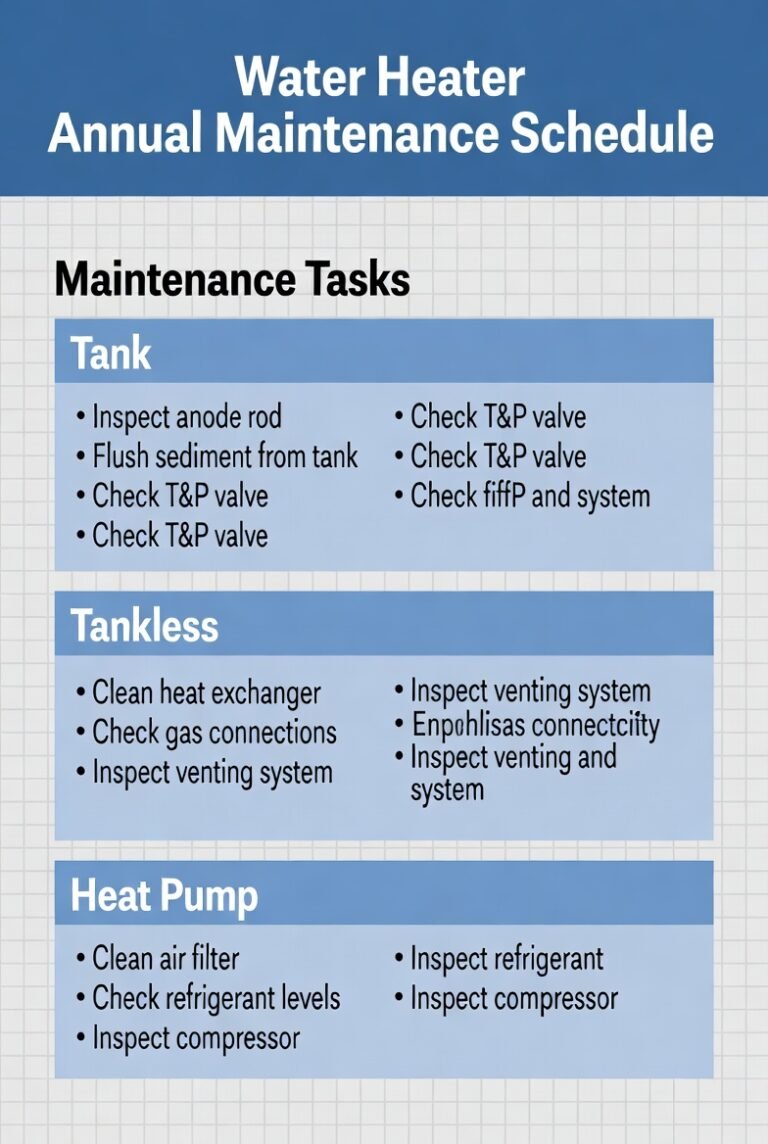
A useful water heater maintenance schedule must account for the type of heater, the exact model instructions, water quality, household demand and the condition of the existing system. There is no single checklist that applies unchanged to every electric, gas, tankless and heat-pump water heater.
For many homes, a practical baseline includes regular visual observation, periodic safety and condition checks, and an annual maintenance review. Hard water, heavy hot-water use, recurring sediment, unusual noises or manufacturer-specific instructions may justify shorter intervals.
Quick answer
Look over the water heater every one to three months and use an annual review as a practical maintenance-planning baseline. Storage tanks may require periodic flushing and anode evaluation, tankless systems may require descaling and inlet-filter cleaning, and heat-pump models require air-filter and condensate maintenance. The exact tasks and intervals should come from the use-and-care manual for the installed model.
Quick Water Heater Maintenance Schedule
| Interval | Main tasks | Typical responsibility |
|---|---|---|
| Every 1–3 months | Look for leakage, corrosion, unusual noise, blocked access, warning lights, fault codes and condensate problems | Homeowner observation |
| Every 6–12 months | Review safety components, visible gas-vent conditions, combustion-air openings and heat-pump filter condition as applicable | Follow the exact model manual; some tasks require professional service |
| Annual planning review | Determine whether flushing, descaling, anode evaluation, burner service, electrical diagnosis or condensate maintenance is due | Experienced homeowner or qualified professional, depending on the task and manual |
| More often when conditions justify it | Address hard water, recurring scale, heavy use, dusty conditions, freezing exposure or active warning signs | Frequency based on the model manual, water conditions and service history |
This schedule is a planning framework rather than a substitute for the instructions supplied with the heater.
Check the exact model manual first
Maintenance intervals and procedures vary among manufacturers and models. Locate the model number and review the official use-and-care manual before draining the tank, operating the T&P valve, removing an anode rod, opening an electrical compartment, servicing a burner or descaling a tankless unit. Where the manual differs from this schedule, follow the manual and applicable local requirements.
Monthly or Quarterly Homeowner Inspection
Most homeowners do not need a full professional service visit every month. A brief visual inspection every one to three months can, however, reveal leakage, corrosion or operating changes before the next scheduled service.
This is a practical observation interval, not a universal manufacturer requirement.
Look for visible water and corrosion
Inspect the area around the heater without opening service panels or disturbing gas, electrical or plumbing connections.
Look for:
- water beneath or around the tank
- moisture near the drain valve
- leakage at the hot- and cold-water connections
- water near the T&P discharge pipe
- corrosion, staining or mineral deposits around fittings
- moisture inside the drain pan
- a blocked, damaged or disconnected pan drain
- water around tankless or heat-pump condensate components
Water around a heater does not always mean the tank itself has failed. The source may be a connection, relief valve, drain valve, condensate line or nearby plumbing fixture. Our leaking water heater guide explains the main leak locations and when tank replacement becomes more likely.
Listen for new or worsening sounds
Popping, rumbling, crackling, sizzling or high-pitched sounds can indicate sediment, mineral scale, restricted flow, condensation or another operating condition. The meaning depends on the heater type and when the sound occurs.
Do not assume every noise means that the unit needs flushing. Review our guide to a water heater making noise before choosing a maintenance or repair response.
Check access and the surrounding area
Keep the heater accessible for inspection, emergency shutoff, service and eventual replacement. Do not allow stored belongings to:
- block the cold-water shutoff valve
- cover an electrical disconnect or service panel
- obstruct combustion-air openings
- touch a gas vent, draft hood or hot surface
- block the air filter or intake of a heat-pump model
- restrict access to tankless isolation valves
- interfere with a condensate line, trap or pump
Combustible materials, gasoline, solvents and household chemicals should not be stored against or immediately beside fuel-burning equipment.
Review displays and warning indicators
For heaters with electronic controls, note:
- active error or fault codes
- unexpected changes in operating mode
- repeated shutdowns or resets
- unusual temperature changes
- filter or service reminders
Record any displayed code before resetting the appliance. Repeated faults should be evaluated using the manufacturer’s diagnostic instructions rather than repeatedly cleared without identifying the cause.
Every 6–12 Months: Safety and Condition Checks
Several water-heater components deserve periodic review, but the correct interval and responsible person depend on the exact model instructions and installation.
| Component or condition | What should be reviewed | Homeowner boundary |
|---|---|---|
| T&P relief system | Valve condition, discharge piping and signs of recurring discharge | Do not operate the valve unless the exact manual permits it and the discharge path is safe |
| Thermal-expansion system | Visible leakage, support condition and recurring pressure symptoms | Pressure diagnosis and expansion-tank adjustment are generally professional tasks |
| Gas venting | Loose joints, corrosion, displacement, soot, scorching and visible blockage | Visual observation only; do not disconnect or modify vent components |
| Combustion-air openings | Openings remain unobstructed and the room has not been altered around the appliance | Design or correction should be handled by a qualified professional |
| Heat-pump air filter | Dust accumulation, filter alerts and restricted airflow | Clean only accessible filters according to the model instructions |
| Condensate system | Standing water, blockage, leakage or condensate-pump problems | Follow the manual; inaccessible or overflowing systems need professional service |
T&P Relief Valve Maintenance and Safety
The temperature-and-pressure relief valve is a safety device intended to release water when unsafe temperature or pressure conditions occur. It must not be capped, plugged, isolated by a shutoff valve or treated as an ordinary drain.
Manufacturer instructions differ. Some models call for a valve operation check at a stated interval, while other manuals use different inspection or service language. Follow the exact procedure and interval supplied with the installed heater.
Scalding and leakage warning
Water released through the T&P valve can be extremely hot. An older valve may also continue leaking or fail to reseat after operation. Do not test it when the discharge route is unsafe, the piping is damaged, the valve already leaks or the model instructions are unavailable. Arrange professional evaluation instead.
The discharge-pipe termination should not be described using one universal national measurement. Model plumbing and residential codes regulate pipe size, material, routing, valves and termination, but the locally adopted edition and amendments determine the requirement at a particular property.
See our water heater code requirements guide for a qualified overview, or review the ICC model water-heater provisions.
Recurring relief-valve discharge is not normal scheduled maintenance. It may indicate excessive system pressure, thermal expansion, overheating, a defective valve or another condition requiring diagnosis.
Thermal Expansion and Water Pressure Checks
When heated water cannot expand back into the incoming supply because of a check valve, backflow preventer or pressure-reducing valve, pressure can rise in the plumbing system. An approved means of thermal-expansion control may be required.
During routine observation, look for:
- water around the expansion-tank connection
- an expansion tank that is visibly unsupported
- recurring T&P discharge
- unusual pressure changes or pipe movement
- repeated leakage at fixtures or water-heater connectors
Do not assume that replacing a leaking relief valve will correct the underlying problem. System pressure, thermal expansion and heater temperature may also need evaluation.
Annual Storage-Tank Water Heater Maintenance Review
An annual review is a useful planning baseline for many storage water heaters, but the precise tasks and intervals should come from the model manual.
The review may determine whether the following work is due:
- checking for leakage and corrosion
- draining or flushing sediment according to the manufacturer’s procedure
- evaluating the sacrificial or powered anode system at its specified interval
- reviewing the T&P valve and discharge piping
- checking the thermal-expansion arrangement
- confirming the temperature setting
- reviewing the drain pan and pan drain
- checking gas venting and combustion conditions where applicable
- evaluating electrical controls when symptoms or service instructions justify it
- recording the date, observations and completed work
A professional service visit may combine several of these tasks, but the included work varies by contractor and heater type. Review our water heater service cost guide before comparing quotes.
How Often Should You Flush a Tank Water Heater?
Periodic draining or flushing can help remove loose sediment from a storage tank, but manufacturers do not all prescribe the same interval or procedure.
Rheem recommends annual flushing as a general guideline for most households and approximately every six months in hard-water conditions. The manual for the installed heater may specify a different schedule. Review Rheem’s flushing guidance.
| Condition | Schedule approach |
|---|---|
| Normal water conditions with no recurring sediment symptoms | Use the model-manual interval; annual flushing is a common manufacturer guideline |
| Hard water or recurring mineral buildup | Review the tank sooner; some manufacturer guidance recommends roughly six-month flushing |
| Heavy household hot-water demand | Inspect more frequently and adjust service based on actual sediment accumulation |
| Older tank that has never been flushed | Obtain professional advice before disturbing a deteriorated drain valve or heavily sedimented tank |
| Tank leaking from its body or base | Do not treat flushing as a repair; evaluate the heater for replacement |
For pricing and the factors that affect service difficulty, see our water heater flush cost guide.
For more information on sediment symptoms and what flushing may or may not correct, see our guide to sediment in a water heater.
Water Hardness and Maintenance Frequency
Hard water contains elevated concentrations of minerals such as calcium and magnesium. These minerals can contribute to sediment in storage tanks and scale inside tankless heat exchangers.
Water hardness is commonly expressed in grains per gallon, but a hardness reading alone should not be used to create a rigid national maintenance interval. Maintenance frequency also depends on:
- the manufacturer’s instructions
- household water consumption
- water-heater temperature
- tank or heat-exchanger design
- well-water sediment
- water-treatment equipment
- previous flushing or descaling findings
- how quickly noise, scale or flow problems return
Where hard water causes recurring buildup, consider shortening the manufacturer’s baseline interval after consulting the manufacturer or a qualified service professional. Avoid assigning an unsupported nine-month interval solely because the water falls into a middle hardness category.
Anode Rod Inspection Schedule
The sacrificial anode rod helps protect a steel tank by corroding in place of exposed tank metal. Its depletion rate varies considerably among homes.
Anode life can be affected by:
- water chemistry
- water hardness
- softened water
- household hot-water demand
- water temperature
- anode material
- tank design
- electrical conductivity
- previous replacement history
Do not automatically wait until year three before the first inspection. Some manufacturer schedules call for an earlier review, followed by periodic inspection based on the rod’s actual condition.
Likewise, “replace at 50% depletion” is not a universal rule. Manufacturer criteria may refer to exposed core wire, reduced rod diameter, coating, breakage or another model-specific condition.
Anode removal may require substantial overhead clearance and force. On an older tank, attempting removal can damage the fitting or nearby piping. Our water heater anode rod replacement cost guide explains the labor, access and replacement factors involved.
Annual Electric Water Heater Review
Routine electric water-heater maintenance should focus on water-side condition, safety components and visible warning signs. Testing energized electrical components is not a normal homeowner maintenance task.
An annual review may determine whether the heater needs:
- tank flushing according to the model manual
- anode-system evaluation
- T&P relief and discharge review
- thermal-expansion and water-pressure evaluation
- inspection for leakage near element gaskets or access panels
- diagnosis of repeated breaker trips
- temperature-setting review
- updated maintenance documentation
Heating elements, thermostats, high-limit controls, wiring and electrical connections should generally be tested only when performance symptoms or the manufacturer’s service instructions justify it.
Repeated breaker trips, burning odors, scorched wiring, melted insulation or moisture entering an electrical compartment require prompt professional evaluation.
Annual Gas Water Heater Review
A gas water heater requires maintenance of the water-storage system plus evaluation of combustion and exhaust conditions.
A professional review may include:
- tank flushing where appropriate
- anode-system evaluation
- burner and ignition condition
- gas-control operation
- flame condition
- combustion-air availability
- draft hood and vent-connector condition
- signs of soot, scorching or exhaust spillage
- gas-connector and shutoff condition
- T&P relief and thermal-expansion review
Do not change gas-control settings, alter combustion-air openings or disassemble venting as part of homeowner maintenance.
Immediate safety warning: A gas odor, carbon-monoxide alarm, soot, scorching, melted components or visible exhaust spillage should not wait for the next maintenance interval. Leave the area when appropriate and follow the instructions of the gas utility, fire service or emergency authority.
Maintenance Costs and Service Records
This schedule intentionally avoids assigning one universal time or price to each task. Service cost varies according to heater type, location, access, contractor scope, regional labor rates, unit condition and whether parts or code corrections are required.
Before hiring a contractor, ask whether the quoted service includes:
- tank flushing or tankless descaling
- T&P relief-system review
- anode inspection or replacement
- gas burner and venting review
- electrical diagnosis
- heat-pump filter and condensate service
- replacement parts
- travel or diagnostic charges
- a written condition report
Keep a maintenance record containing the date, model number, observed symptoms, completed tasks, replaced parts and contractor invoice. Documentation can assist future diagnosis and may help support a warranty claim, but missing one annual flush does not automatically void every manufacturer warranty.
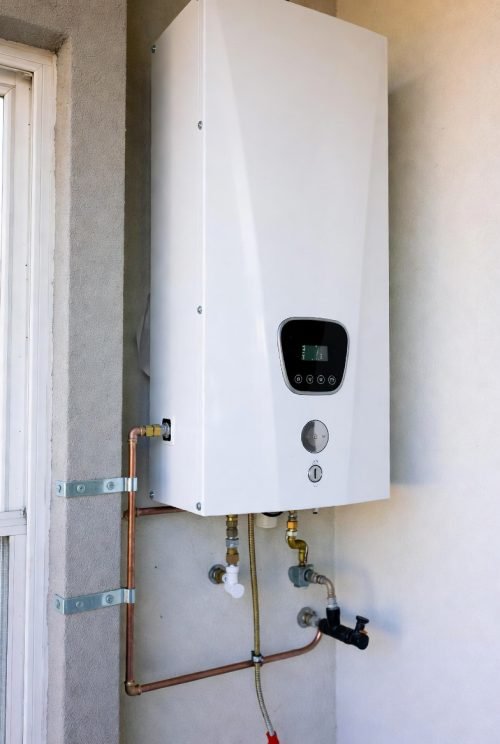
Tankless Water Heater Maintenance Schedule
Tankless water heaters do not store a large volume of hot water, but mineral scale, inlet debris, combustion conditions and condensate problems can still affect their performance. Maintenance requirements vary between gas-fired, electric, condensing and noncondensing models.
Use the exact manufacturer manual to determine the approved flushing solution, service-valve arrangement, filter-cleaning procedure and maintenance interval for the installed unit.
| Interval | Tankless maintenance task | Typical responsibility |
|---|---|---|
| Every 1–3 months | Look for leakage, active fault codes, unusual sounds, blocked air openings and condensate overflow | Homeowner observation |
| At the manual-specified interval | Clean the inlet-water filter or screen when the manufacturer provides a safe procedure | Experienced homeowner or professional, depending on access and instructions |
| Commonly reviewed annually | Determine whether heat-exchanger flushing or descaling is due | Follow the exact manual; use professional service when the isolation or flushing procedure is unclear |
| More often in hard-water conditions | Review recurring scale, reduced flow, temperature instability or premature service alerts | Frequency based on water quality, model guidance and previous service findings |
| During professional service | Evaluate burner condition, venting, condensate components, freeze protection and stored diagnostic history where applicable | Qualified service professional |
Rheem describes annual flushing or descaling as a common tankless-maintenance guideline and recommends more frequent service where hard water or heavy mineral content causes faster scale buildup. The manual for the installed unit still controls. Review Rheem’s tank and tankless maintenance guidance.
Tankless descaling and mineral buildup
Scale can form inside a tankless heat exchanger as minerals precipitate from heated water. The rate of buildup depends on water hardness, temperature, flow rate, household demand and equipment design.
Possible signs of scale or restricted flow include:
- reduced hot-water flow
- unstable outlet temperature
- longer heating response
- unusual operating noise
- scale-related fault codes
- maintenance alerts appearing sooner than expected
Do not assign one universal twelve- or twenty-four-month interval to every tankless heater. Some units may be reviewed for annual descaling, while hard-water conditions, heavy use or recurring buildup can justify shorter intervals.
Our tankless water heater maintenance cost guide explains the main factors affecting descaling and professional service pricing.
Gas tankless maintenance
Professional gas tankless service may include evaluation of:
- burner and ignition condition
- gas-control operation
- combustion-air supply
- air-intake and exhaust terminations
- listed vent components and joints
- condensate trap and drain on condensing models
- condensate neutralizer where installed
- freeze-protection components
- recirculation controls where applicable
- stored error-code or diagnostic history
Do not adjust gas pressure, combustion settings, internal configuration switches or vent components as routine homeowner maintenance.
Electric tankless maintenance
Electric tankless heaters do not have burners or combustion vents, but whole-house models can draw substantial electrical current.
Arrange professional evaluation when you notice:
- repeated breaker trips
- burning odors
- discolored or overheated wiring
- unstable hot-water temperature
- repeated control-board faults
- water entering an electrical compartment
Opening energized compartments, testing high-current circuits or changing breaker and conductor sizes is not routine homeowner maintenance.
Heat-Pump Water Heater Maintenance Schedule
A heat-pump water heater combines a storage tank with refrigeration components, an air filter, a fan, an evaporator coil and a condensate system. It therefore needs normal tank-water-heater maintenance plus airflow and condensate care.
| Interval | Heat-pump maintenance task | Typical responsibility |
|---|---|---|
| Every 1–3 months | Look for filter alerts, blocked airflow, unusual fan noise, condensate leakage and fault codes | Homeowner observation |
| Every 6–12 months | Clean the accessible air filter according to the model instructions | Homeowner task when the manual provides a safe procedure |
| More often in dusty locations | Inspect and clean the filter before airflow becomes restricted | Follow filter alerts and manufacturer guidance |
| Annually | Clean or service the condensate line as directed and review tank, airflow and fault-history conditions | Homeowner only where the manual provides a safe procedure; otherwise professional service |
ENERGY STAR recommends cleaning heat-pump water-heater air filters every six to twelve months, more frequently in high-dust locations, and cleaning condensate lines annually. Review ENERGY STAR heat-pump water heater maintenance guidance.
Air-filter maintenance
A dirty air filter can restrict airflow across the evaporator coil and interfere with normal heat-pump operation. Some models display a filter reminder, while others specify a fixed cleaning interval in the manual.
Clean only filters designed for homeowner access. Do not remove internal panels or reach into the fan or refrigeration section unless the manufacturer provides an authorized procedure.
Condensate drainage
Heat-pump water heaters produce condensate that must drain away from the unit. Depending on the installation, the system may include a condensate line, drain pan, trap or pump.
Look for:
- standing water near the heater
- a blocked, loose or disconnected condensate line
- overflow from the condensate pan
- a condensate pump that runs continuously or fails to operate
- water stains or moisture beneath the unit
Do not automatically assume that water near a heat-pump heater is harmless condensate. Persistent water may also come from a plumbing connection, safety valve or leaking storage tank and should be diagnosed.
Evaporator coil and airflow
Keep the air intake, discharge path and manufacturer-required clearances unobstructed. Do not store boxes, clothing or household chemicals against the air openings.
A homeowner may visually observe accessible surfaces for heavy dust or obstruction. Internal coil cleaning, damaged fins, refrigerant faults and fan repairs should be handled according to the manufacturer’s service instructions.
Common Water Heater Maintenance Mistakes
Most maintenance mistakes result from using a generic schedule, ignoring active warning signs or attempting work without reviewing the instructions for the exact model.
Waiting for complete failure before checking the heater
Maintenance cannot prevent every breakdown, but regular observation can reveal leakage, corrosion, blocked airflow, warning codes or venting concerns before complete loss of hot water.
Assuming every tank should be flushed the same way
Flush procedures and intervals vary. An older tank with a deteriorated drain valve or years of undisturbed sediment may need professional assessment before it is flushed.
Waiting until year three to inspect every anode rod
Anode depletion depends on water chemistry, demand, temperature, rod material and tank design. Some manufacturers call for an initial inspection earlier than year three. Follow the model manual rather than one universal age rule.
Treating recurring T&P discharge as normal
Repeated relief-valve discharge may indicate excessive pressure, thermal expansion, overheating or a defective valve. It should be diagnosed rather than accepted as normal operation.
Ignoring combustion or venting warning signs
Soot, scorching, displaced vent components, unusual exhaust conditions or a carbon-monoxide alarm require immediate attention. They should not wait for an annual maintenance visit.
Skipping heat-pump airflow and condensate care
A clogged filter or obstructed condensate route can interfere with operation and contribute to water damage. Heat-pump maintenance must address both tank components and heat-pump-specific systems.
Changing internal settings without manufacturer instructions
DIP switches, combustion settings, service menus and control-board parameters are not general annual maintenance tasks. Changing them incorrectly can cause operational or safety problems.
Does Sediment Affect Water Heater Performance?
Sediment and mineral scale can interfere with heat transfer, contribute to noise and affect performance. The actual impact varies by heater design, fuel type, sediment composition and amount of buildup.
There is no reliable universal percentage for efficiency loss or fixed number of service years lost because maintenance was skipped.
Possible effects of substantial sediment or scale include:
- popping or rumbling sounds
- reduced usable hot-water capacity
- longer recovery time
- temperature instability
- restricted tankless flow
- greater stress on heating surfaces
- difficulty draining a storage tank
- recurring maintenance alerts or fault conditions
Maintenance may help manage sediment and mineral scale, but it cannot restore a storage tank that is already leaking through its body or reverse advanced corrosion.
Homeowner Maintenance vs Professional Service
| Task | Typical responsibility | Important boundary |
|---|---|---|
| Look for leaks, corrosion and warning lights | Homeowner | Do not open energized or gas-control compartments |
| Keep access and visible air openings clear | Homeowner | Do not modify combustion-air openings |
| Clean an accessible heat-pump filter | Homeowner, when covered by the manual | Do not remove internal refrigeration panels |
| Operate the T&P valve | Follow the exact manual or use professional service | Scalding, leakage and failure-to-reseat risks apply |
| Flush a storage tank | Experienced homeowner or professional | Follow the manufacturer’s shutdown, draining and restart procedure |
| Remove or inspect an anode rod | Advanced homeowner or professional | Clearance, torque, tank movement and fitting damage are concerns |
| Descale a tankless heat exchanger | Experienced homeowner or professional, according to the manual | The approved solution, service valves and isolation procedure are model-specific |
| Evaluate gas combustion and vent performance | Qualified professional | Do not adjust gas or combustion settings as homeowner maintenance |
| Test elements, thermostats or internal wiring | Qualified service or electrical professional | High-voltage hazards apply |
Warning Signs That Should Not Wait for Scheduled Maintenance
Do not wait for the next quarterly or annual review when the heater shows an active safety, leakage or electrical problem.
Arrange prompt evaluation for:
- water leaking from the tank body or base
- continuous or recurring T&P discharge
- gas odor
- a carbon-monoxide alarm
- soot, scorching or melted components
- damaged or disconnected gas venting
- repeated breaker trips
- burning odors or overheated wiring
- water entering an electrical compartment
- persistent tankless or heat-pump fault codes
- condensate overflow
- rapidly declining hot-water output
- rust-colored water associated with the hot-water system
Emergency boundary: A gas odor, carbon-monoxide alarm, electrical arcing, smoke or active fire requires emergency action rather than ordinary maintenance. Leave the area when appropriate and follow instructions from the gas utility, fire service or emergency authority.
Printable Water Heater Maintenance Checklist
Print or save this checklist with the appliance manual. Complete only the tasks that apply to the installed heater and follow the exact manufacturer instructions before performing maintenance.
Every 1–3 months
- ☐ Check beneath and around the heater for water
- ☐ Look for corrosion or mineral deposits at connections
- ☐ Check the drain pan for moisture
- ☐ Confirm access to shutoff valves and service panels remains clear
- ☐ Listen for new popping, rumbling, sizzling or high-pitched sounds
- ☐ Record active warning lights or error codes
- ☐ Visually check gas venting for displacement, corrosion, soot or scorching
- ☐ Check heat-pump air openings for obstruction
- ☐ Look for condensate leakage or overflow
Every 6–12 months
- ☐ Review the exact model maintenance schedule
- ☐ Inspect the visible T&P valve and discharge-pipe condition
- ☐ Check for recurring relief-valve discharge
- ☐ Look for expansion-tank leakage or inadequate support
- ☐ Confirm visible combustion-air openings remain unobstructed
- ☐ Clean the accessible heat-pump air filter according to the manual
- ☐ Review the condensate line, pan and pump for signs of blockage
- ☐ Confirm tankless intake and exhaust terminations appear unobstructed
Annual maintenance-planning review
- ☐ Determine whether storage-tank flushing is due
- ☐ Determine whether tankless descaling is due
- ☐ Clean or service the heat-pump condensate line as directed
- ☐ Check whether anode inspection is due under the model manual
- ☐ Arrange gas burner and venting service where appropriate
- ☐ Arrange electrical diagnosis when symptoms justify it
- ☐ Review T&P relief and thermal-expansion conditions
- ☐ Record the service date and completed work
- ☐ Keep contractor invoices and replacement-part details
Adjust the schedule when conditions change
- ☐ Review flushing or descaling sooner when hard water causes recurring buildup
- ☐ Clean heat-pump filters more frequently in dusty locations
- ☐ Inspect freeze-protection conditions before cold weather
- ☐ Arrange immediate evaluation when leakage or safety warnings appear
- ☐ Reassess replacement planning as repair frequency and corrosion increase
Maintenance by Heater Age and Service History
Age matters, but it should not replace model-specific maintenance or condition-based decisions. A well-maintained older unit may remain serviceable, while a newer heater may need early attention because of aggressive water chemistry, high pressure, installation defects or component failure.
| Condition or life stage | Maintenance approach |
|---|---|
| Newer heater with documented service | Follow the manual, establish a maintenance log and learn how quickly sediment or scale develops in the home |
| Mid-life heater with stable operation | Continue model-specific maintenance and watch for changes in leakage, noise, recovery and repair frequency |
| Older heater with limited service history | Use greater caution before disturbing an old drain valve, anode fitting or deteriorated connection |
| Heater with recurring repairs or corrosion | Compare continued maintenance and repair costs with planned replacement |
| Tank leaking through its body | Routine maintenance will not repair the tank; replacement is normally required |
Do not use year ten or year twelve as an automatic replacement deadline. Consider age together with leakage, corrosion, repair history, hot-water reliability, parts availability and the consequences of an unexpected failure.
Cold-Weather and Seasonal Maintenance
Seasonal maintenance is mainly relevant when equipment, piping or condensate components are installed in garages, attics, outdoor locations or other areas exposed to low temperatures.
Before freezing weather, consider:
- checking that exposed water piping is protected as required
- confirming outdoor tankless intake and exhaust openings are unobstructed
- reviewing the model’s freeze-protection requirements
- checking that condensate lines cannot freeze or back up
- confirming that a heat-pump model remains within its approved operating-temperature range
- following shutdown and draining instructions for equipment left unused in freezing conditions
Do not assume that flushing every fall is universally required. Flush timing should be based on the manual, water quality and actual sediment history.
Maintenance Records and Warranty Documentation
Keep maintenance information with the water-heater manual or household records.
A useful service log includes:
- manufacturer and model number
- serial number
- installation date
- maintenance date
- tasks completed
- observed leakage, noise or fault codes
- parts replaced
- contractor name and invoice
- water-hardness or treatment information where known
- next recommended service date
Many warranties require installation, operation and maintenance consistent with the written instructions, but missing one documented annual flush does not automatically void every warranty. Review the exact warranty language and retain records that may support a future claim.
When Maintenance Becomes Replacement Planning
Maintenance is intended to support safe operation and manage normal wear. It cannot repair a leaking tank body, reverse advanced corrosion or guarantee that an aging heater will not fail.
Begin comparing replacement options when the heater shows one or more of the following:
- leakage from the tank body or base
- advanced corrosion around tank components
- repeated repairs within a short period
- frequent element, thermostat, ignition or control failures
- declining hot-water capacity despite maintenance
- obsolete or difficult-to-source parts
- significant venting, electrical or plumbing corrections
- an increasing risk of water damage if the tank fails
For equipment and installation cost factors, see our water heater replacement cost guide.
Frequently Asked Questions
How often should I flush my water heater?
Follow the interval in the exact model manual. Annual flushing is a common general recommendation for storage tanks, while hard-water conditions or recurring sediment may justify approximately six-month intervals under some manufacturer guidance.
How often should a tankless water heater be descaled?
Many tankless systems are reviewed for descaling annually, but the correct interval depends on the model, water hardness, usage and previous scale buildup. Hard-water conditions may require more frequent service.
Does skipping an annual flush void the warranty?
Not automatically in every case. Warranty coverage depends on the written terms, maintenance requirements and cause of failure. Damage related to sediment, scale, pressure or failure to follow the manual may be treated differently from a manufacturing defect.
Can I inspect an anode rod myself?
An experienced homeowner may be able to inspect an anode rod when the manual permits it, but removal can require substantial clearance and torque. An older tank, seized fitting or restricted location can make professional service the safer choice.
Do heat-pump water heaters require more maintenance?
They require additional airflow and condensate care compared with standard electric tanks. ENERGY STAR recommends cleaning accessible filters every six to twelve months, more frequently in dusty locations, and cleaning condensate lines annually.
Does sediment reduce water-heater efficiency?
Sediment and scale can interfere with heat transfer, contribute to noise and affect performance. The actual efficiency effect varies, so one universal percentage should not be applied to every water heater.
How often should the T&P valve be tested?
Use the interval and method in the exact manufacturer manual. Because discharged water can be extremely hot and an older valve may fail to reseat, professional service is appropriate when the discharge route is unsafe or the valve already leaks or shows deterioration.
Should I replace a water heater after ten years?
Age alone does not create an automatic replacement deadline. Evaluate the unit’s condition, leak risk, repair history, reliability, parts availability and installation location. A leaking tank body normally requires replacement regardless of age.
Bottom Line
The best water heater maintenance schedule is based on the exact model, heater type, water quality and actual service history—not one universal annual checklist.
A practical plan includes:
- visual observation every one to three months
- periodic review of safety and operating conditions
- manufacturer-directed flushing or descaling
- anode evaluation at the model-specified interval
- gas combustion and venting service by a qualified professional
- heat-pump filter and condensate maintenance
- shorter intervals when hard water, heavy use or recurring buildup justifies them
- prompt evaluation of leakage, gas, venting or electrical warning signs
- documented service and replacement planning as the unit’s condition changes
Routine maintenance can support reliable operation and help identify developing problems, but it cannot guarantee a fixed lifespan or prevent every failure. Use structured observation, model-specific instructions and professional service whenever the task exceeds safe homeowner maintenance.