
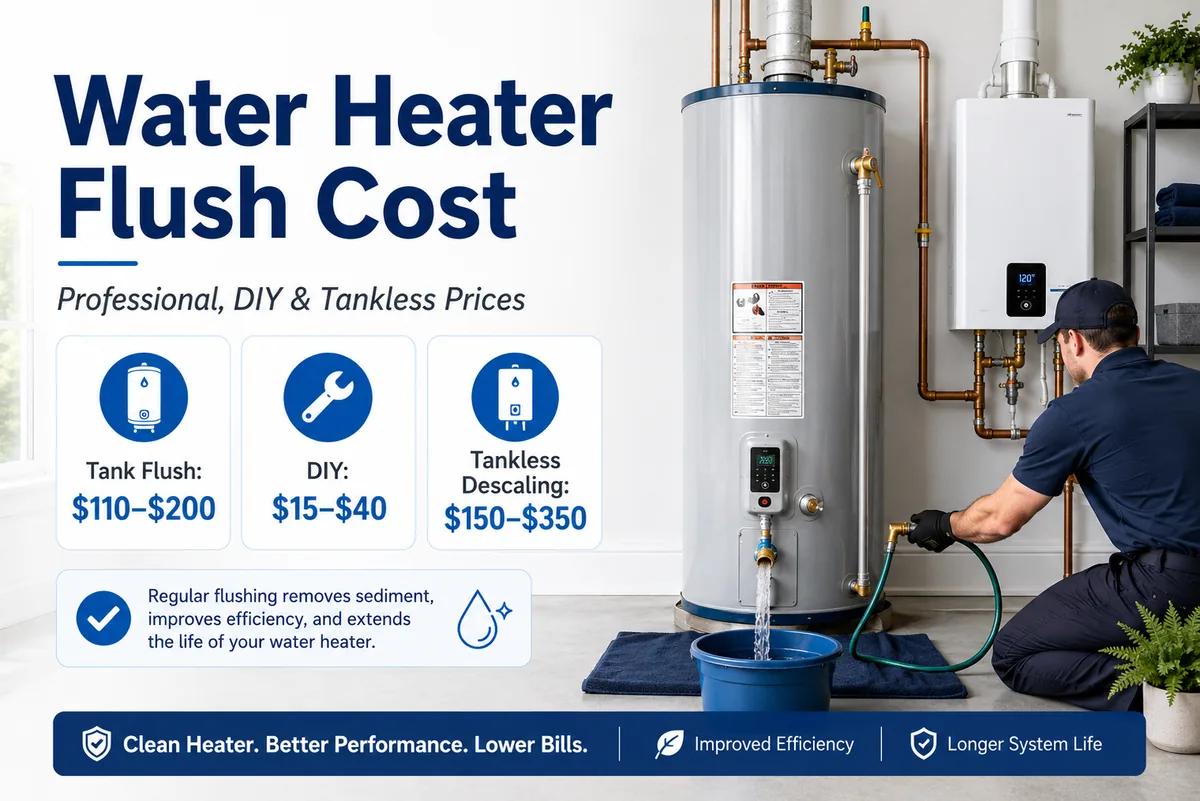
A professional water heater flush typically costs $110 to $200, with around $160 being a common price for a standard tank-style water heater. A DIY tank flush may cost $15 to $40 when you already have basic tools, while professional tankless water heater flushing or descaling commonly costs $150 to $350.
The final price depends on the type and condition of the water heater, local plumber rates, service-call minimums, accessibility, sediment buildup and whether the drain valve or another component needs attention.
Quick answer: A quote between $110 and $200 is generally within the normal range for a straightforward professional tank flush. A price above that may still be reasonable when the heater drains slowly, access is difficult or additional maintenance and repairs are included.
How Much Does It Cost to Flush a Water Heater?
| Service | Typical cost | What the price usually covers |
|---|---|---|
| Professional tank flush | $110–$200 | Draining, flushing loose sediment, refilling and restarting the heater |
| DIY tank flush | $15–$40 | Basic hose and supplies when other tools are already available |
| Professional tankless flush or descale | $150–$350 | Circulating descaling solution through the heat exchanger and basic cleaning |
| DIY tankless flushing kit | $100–$300 | Pump, hoses, bucket and descaling solution; many kits can be reused |
These are national planning ranges rather than guaranteed local prices. A plumber may charge a flat maintenance price, an hourly rate or a minimum service-call fee. This is why two homeowners with similar water heaters may receive different quotes.
What Is Included in a Professional Water Heater Flush?
A standard professional tank flush normally involves:
- Shutting off the heater, fuel or electrical supply safely
- Closing the cold-water inlet
- Connecting a hose to the tank’s drain valve
- Draining water and loose sediment from the tank
- Using the cold-water supply to help move remaining sediment
- Closing the drain valve and refilling the tank
- Restoring operation after confirming that the tank is full
- Checking for obvious leakage around the drain valve and connections
A basic flush is not necessarily a complete water heater inspection. Testing the temperature-and-pressure relief valve, inspecting the anode rod, checking burners or heating elements and diagnosing performance problems may be separate services.
Ask what the quoted price includes
Before booking the service, ask whether the price includes:
- The plumber’s trip or service-call charge
- Labor from arrival through restart
- A basic visual inspection
- Drain-valve troubleshooting
- Tankless descaling chemicals, when applicable
- Cleanup after the work
- Any surcharge for same-day, weekend or emergency scheduling
A low advertised price may cover only a straightforward drain and refill. The final invoice can rise when the heater has poor access, compacted sediment or a valve that will not open or reseal properly.
What Affects Water Heater Flush Cost?
Tank capacity can affect draining and refilling time, but it is not always the largest pricing factor. Many plumbers charge primarily for labor, travel and the difficulty of completing the service.
The main factors affecting the cost are:
- Local labor rates: Plumbing prices vary considerably between cities and regions.
- Service-call minimums: Some companies charge a minimum amount even when the flush is completed quickly.
- Sediment condition: Loose sediment is easier to remove than compacted mineral buildup.
- Drain-valve condition: A clogged, leaking, seized or damaged valve can turn routine maintenance into a repair.
- Accessibility: Water heaters in tight closets, attics, platforms or finished spaces may take longer to service.
- System type: Tankless units require a pump, hoses and descaling solution rather than a simple tank drain.
- Additional maintenance: Anode-rod work, safety-valve replacement and diagnostic testing are normally priced separately.
A well-maintained 50-gallon tank may cost less to flush than a neglected 30-gallon unit with a blocked drain valve. Tank size matters, but condition and labor requirements usually provide better context for comparing quotes.
DIY Water Heater Flush Cost
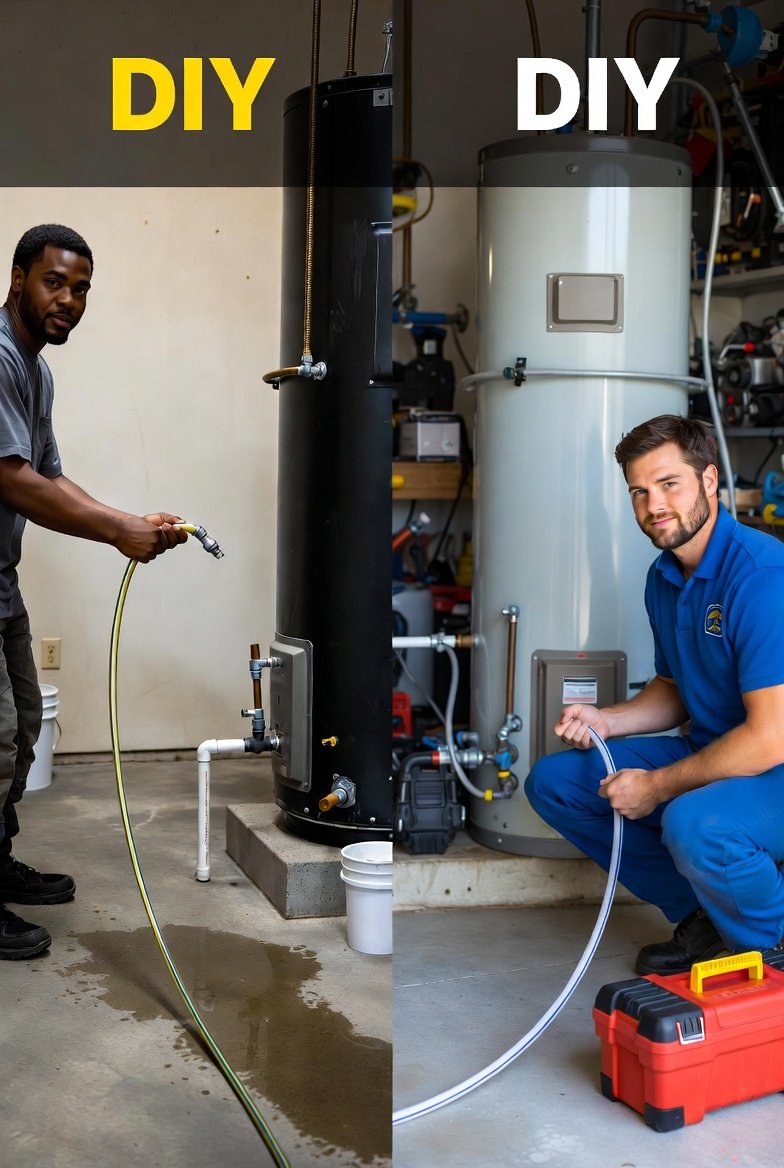
A DIY flush may cost as little as $15 to $40 when you already own a bucket, basic hand tools and suitable safety equipment. Starting from scratch can cost more.
| DIY item | Typical cost |
|---|---|
| Garden hose | $15–$25 |
| Bucket or drain pan | $5–$15 |
| Hose cap or small fittings | $5–$15 |
| Replacement drain valve, if required | $10–$30 for the part |
| Likely DIY cost with basic tools already owned | $15–$40 |
| Likely cost when buying several supplies | $25–$70 |
A straightforward tank flush commonly takes around 45 to 90 minutes, although slow drainage, sediment or cooling time can extend the job.
DIY flushing may be reasonable when
- The heater has been maintained regularly
- The drain valve appears undamaged and operates normally
- There is no active leak, severe corrosion or moisture around the tank
- The unit is installed in an accessible location
- You understand the manufacturer’s shutdown and restart instructions
Call a professional instead when
- The tank is leaking or visibly corroded
- The drain valve is damaged, blocked, seized or will not close
- The heater has gone many years without maintenance
- Rust flakes, heavy discoloration or large amounts of debris appear
- The unit is located in an attic or another area where leakage could cause serious damage
- You are uncertain about shutting off or restoring gas, electricity or water safely
Safety warning: Water inside the tank may be hot enough to cause serious burns. Shut down the heater according to its manufacturer instructions and allow the water to cool before draining. Never restore electricity to an electric water heater until the tank has completely refilled.
If sediment prevents water from flowing through the drain valve, do not force the valve or insert objects without understanding the risk. A damaged valve can leak after the service and may require the tank to be drained before it can be replaced.
Tankless Water Heater Flush and Descaling Cost
A professional tankless water heater flush generally costs $150 to $350. The service is often called either flushing or descaling because a pump circulates a cleaning solution through the heat exchanger to remove mineral scale.
| Tankless service | Typical cost |
|---|---|
| Professional flush or descale | $150–$350 |
| DIY flushing kit | $100–$300 |
| Replacement descaling solution for a reusable kit | Usually less than purchasing a complete kit again |
A tankless maintenance visit may include:
- Isolating the unit using its service valves
- Connecting a circulation pump and hoses
- Running approved descaling solution through the heat exchanger
- Rinsing the system with clean water
- Cleaning the inlet-water filter
- Checking for leaks, scale or error conditions
Not every tankless model uses the same maintenance procedure. Follow the manual for the exact unit, particularly regarding approved solutions, service-valve operation and circulation time.
How Hard Water Changes Flush Frequency
Annual flushing is a common maintenance starting point for many tank and tankless water heaters. However, the correct schedule depends on manufacturer guidance, water hardness, household usage and how quickly sediment or scale develops.
Homes with hard or mineral-heavy water may require more frequent flushing or descaling, but a universal schedule such as “every six months above a specific hardness level” does not apply to every heater.
| Water and usage conditions | Practical planning guidance |
|---|---|
| Soft to moderately hard water | Check the owner’s manual; annual maintenance is a common starting point |
| Hard water or high household usage | Inspect sooner and consider more frequent maintenance when scale develops quickly |
| Very hard water or repeated scale problems | Ask a plumber whether water treatment or a revised maintenance schedule is appropriate |
You can check water hardness through your local water utility, a home test kit or a water-treatment professional. Rumbling noises, reduced hot-water performance, visible sediment and recurring scale can also justify an earlier inspection, although these symptoms may have other causes.
Common Water Heater Flush Add-On Costs
The flush itself may be only one part of the invoice. Additional work should be listed separately so you can understand why the final price exceeds the advertised maintenance rate.
| Possible add-on | Planning range or pricing approach | Why it may be needed |
|---|---|---|
| Service-call or trip fee | May be included or charged separately | Covers travel and the plumber’s minimum visit charge |
| Drain-valve repair or replacement | Quote required | The existing valve may be clogged, damaged or leaking after operation |
| Temperature-and-pressure relief valve replacement | About $50–$300 | The safety valve may leak, fail testing or require replacement |
| Anode-rod replacement | About $150–$350 | A depleted rod leaves the steel tank more exposed to corrosion |
| Same-day or after-hours service | Company-specific premium | Urgent appointments commonly cost more than scheduled maintenance |
If a routine flush reveals leakage, significant corrosion or several failing components, request separate prices for maintenance, repair and full replacement before approving additional work.
How these cost ranges were estimated
The national pricing ranges in this guide are planning estimates compiled from current consumer cost data and professional maintenance guidance. Published national guides place a standard professional tank flush near $110 to $200, while professional tankless flushing or descaling commonly falls near $150 to $350. Actual quotes depend on location, system condition and the scope of service.
For an additional consumer pricing reference, see Bob Vila’s water heater repair cost guide.For maintenance procedures and frequency guidance, review Rheem’s flushing guidance and A. O. Smith’s drain-and-flush instruction.
Is Flushing a Water Heater Worth the Cost?
Flushing a water heater can be worthwhile, but it does not produce the same financial return in every home. Its main value is removing loose sediment or mineral scale, supporting normal heat transfer, preserving hot-water performance and creating an opportunity to identify valve or corrosion problems before they become more serious.
It is not honest to promise that a $110 to $200 professional flush will automatically pay for itself through lower energy bills. The actual value depends on the heater type, water quality, maintenance history, service price and condition of the unit.
| Situation | Likely maintenance value | Why |
|---|---|---|
| Tank has been flushed regularly and is working normally | Usually worthwhile | Routine maintenance is easier when sediment has not been allowed to compact for years |
| Hard water or visible mineral buildup | Potentially high value | Sediment and scale may develop faster and affect flow or heat transfer |
| Tankless heater in a mineral-heavy water area | Often important | Scale can accumulate inside the heat exchanger and restrict performance |
| Older tank with unknown maintenance history but no active leak | Inspection first | The drain valve, tank base and visible connections should be checked before disturbing years of buildup |
| Tank is leaking or severely corroded | Usually poor value | Flushing cannot repair a leaking steel tank or reverse structural corrosion |
What flushing may help protect
- Normal heat transfer between the burner or heating elements and the stored water
- Hot-water capacity when sediment is occupying space near the bottom of the tank
- Quieter operation when loose sediment contributes to rumbling or popping sounds
- Tankless flow and heat-exchanger performance where mineral scale is developing
- The ability to identify a weak drain valve, leaking connection or maintenance issue during a planned visit
What flushing cannot guarantee
- A specific reduction in the household’s energy bill
- A fixed number of additional years of service life
- Removal of every layer of hardened scale
- Repair of a leaking tank, failed heating element or defective control
- Restoration of a badly neglected heater to like-new condition
Removing sediment may improve operating conditions, but savings vary too much to justify a universal claim such as an 8% or 10% reduction in energy use. Water-heater fuel type, household demand, temperature setting and the severity of buildup all affect the outcome.
When Flushing a Water Heater May Not Be Worth It
Do not judge the decision by age alone. A regularly maintained older heater may be a better flushing candidate than a younger tank showing active leakage or serious corrosion.
Ask for an inspection before proceeding when:
- Water is leaking from the tank body or collecting around the base
- The drain valve is cracked, badly corroded, blocked or already leaking
- Rust flakes or severe discoloration are coming from the heater
- The tank makes loud noises and has never received maintenance
- Several parts are failing at the same time
- The heater repeatedly loses hot-water capacity despite previous repairs
- Access is difficult enough that a leak could damage ceilings, floors or finished rooms
- The cost of flushing and additional repairs approaches a meaningful share of replacement cost
Important distinction: Flushing does not create corrosion inside a healthy tank. However, operating an old drain valve or removing compacted debris can reveal an existing weakness that was not previously visible. A plumber may recommend inspection rather than an aggressive flush when the tank’s condition is uncertain.
Water Heater Flush, Repair or Replacement?
A flush is maintenance, not a cure for every hot-water problem. Use the condition of the tank and the type of failure to decide whether maintenance, repair or replacement is the more sensible next step.
| Condition | Best starting point | Reason |
|---|---|---|
| Heater works normally but routine maintenance is due | Flush or descale | Preventive maintenance is easier before performance problems become severe |
| Rumbling, popping or visible sediment without leakage | Inspect and consider flushing | Sediment may be contributing, but other causes should not be ignored |
| Working tank with a leaking drain or safety valve | Repair plus maintenance assessment | A replaceable valve problem does not automatically mean the entire heater has failed |
| No hot water because of a failed element, thermostat or ignition component | Diagnostic repair | Flushing alone will not restore a failed electrical or combustion component |
| Water leaking through the tank body | Replacement | A corroded or ruptured storage tank is generally not repairable |
| Multiple expensive repairs on an older unit | Compare repair and replacement quotes | Repeated spending may provide poor long-term value |
A simple quote-comparison rule
Ask the contractor to separate the estimate into:
- Basic flushing or descaling
- Service-call or diagnostic fee
- Parts and component repairs
- Emergency or access surcharges
- Complete installed replacement cost
This makes it easier to see whether you are approving routine maintenance, a repair or a combination of both. It also prevents a low advertised flush price from being confused with the final cost of restoring a neglected system.
How Flushing Fits Into a Long-Term Maintenance Plan
There is no universal age at which flushing suddenly becomes worthwhile or worthless. A better plan follows the manufacturer’s instructions and adjusts for water hardness, usage and the heater’s condition.
| Maintenance situation | Recommended approach |
|---|---|
| Newer or regularly maintained heater | Follow the owner’s manual and maintain a consistent flushing schedule |
| Hard water or rapid mineral buildup | Inspect sooner and discuss whether more frequent flushing, descaling or water treatment is appropriate |
| Older heater with documented maintenance | Continue condition-based maintenance while watching for leakage, corrosion and repeated component failures |
| Older heater with unknown history | Have the tank and drain valve inspected before attempting an aggressive DIY flush |
| Leaking tank or repeated expensive failures | Shift from maintenance planning to replacement planning |
Keep invoices or maintenance records when professional service is completed. They can help document the heater’s history, support future troubleshooting and clarify what work has already been performed.
Frequently Asked Questions
How much does it cost to flush a water heater?
A professional tank-style water heater flush typically costs $110 to $200. A DIY flush may cost $15 to $40 when basic tools are already available. Professional tankless flushing or descaling commonly costs $150 to $350.
How much should a water heater flush cost?
A quote between $110 and $200 is generally within the normal planning range for a straightforward professional tank flush. Higher prices may be reasonable when the plumber includes inspection work, difficult access, heavy sediment removal or drain-valve repairs.
Can I flush a water heater myself?
Some homeowners can flush a tank-style heater when the system is accessible, in sound condition and has a working drain valve. Follow the manufacturer’s shutdown and restart instructions carefully. Hire a professional when the unit is leaking, severely corroded, difficult to access or has an uncertain maintenance history.
Can flushing damage an old water heater?
A normal flush does not damage a sound tank. However, opening a degraded drain valve or disturbing years of compacted debris may reveal existing corrosion, leakage or valve weakness. An inspection is sensible before flushing an older neglected heater.
Does flushing improve water-heater efficiency?
Removing sediment or mineral scale can support heat transfer and normal system performance. The amount of energy saved varies, so homeowners should not expect a guaranteed percentage reduction in their utility bill.
How often should a water heater be flushed?
Annual flushing is a common starting point, but the correct frequency depends on the manufacturer’s instructions, water hardness, usage and the rate of sediment or scale buildup. Hard-water conditions may justify more frequent inspection or maintenance.
Does a water-heater warranty require annual flushing?
Warranty and maintenance terms vary by manufacturer and model. Review the owner’s manual and warranty rather than assuming every product has the same requirement. Damage associated with scale, improper maintenance or incorrect servicing may be treated differently from a covered manufacturing defect.
Is tankless descaling more expensive than flushing a tank water heater?
Usually. Professional tankless flushing or descaling commonly costs $150 to $350, compared with approximately $110 to $200 for a standard tank flush. Tankless service requires a circulation pump, hoses and an approved cleaning solution.
How long does a water heater flush take?
A straightforward tank flush commonly takes around 45 to 90 minutes. Cooling time, slow drainage, heavy sediment, difficult access or valve problems can extend the appointment.
Bottom Line
Expect to pay approximately $110 to $200 for a professional tank-style water heater flush, $15 to $40 for a basic DIY flush and $150 to $350 for professional tankless flushing or descaling.
Flushing is most valuable as consistent preventive maintenance on a heater that is otherwise in serviceable condition. When a tank is leaking, badly corroded or experiencing repeated expensive failures, compare the cost of maintenance and repairs with a complete replacement quote before spending more money.