
Water Heater Too Hot? Start With These Safety Checks
A water heater that produces excessively hot or scalding water may simply be set too high. However, sudden temperature spikes, unpredictable temperature changes, or water that remains too hot after the setting is lowered can indicate a thermostat, heating-control, gas-control, sensor, wiring, or mixing-valve problem.
The pattern can help narrow down the likely cause:
- Hot water is consistently too hot at every fixture: The temperature setting may be too high, or the thermostat, temperature sensor, gas control, or central mixing valve may be inaccurate.
- The water suddenly became scalding hot: A thermostat, gas-control, sensor, wiring, or electric heating-element fault may be present.
- The water is too hot even on the lowest setting: The control may be miscalibrated, incorrectly installed, damaged, or unable to stop the heating cycle correctly.
- Only one faucet or shower is too hot: The problem is more likely a shower cartridge, anti-scald stop, local mixing valve, or fixture-side plumbing issue than the water heater itself.
- The temperature rises and falls unpredictably: A thermostat, sensor, control board, plumbing crossover, mixing valve, recirculation system, or tankless control problem may be involved.
Do not assume that the thermostat dial shows the exact temperature reaching your faucets. Measure the delivered water temperature carefully and compare it with the heater setting before deciding whether the problem is a simple adjustment or a failed component.
What to Do Immediately
Take these precautions when the water feels dangerously hot:
- Stop using the hot water: Avoid direct skin contact until the temperature has been measured and the cause is understood.
- Keep children, older adults, and other vulnerable users away from affected fixtures: Serious scald injuries can occur quickly at elevated temperatures.
- Turn off an electric water heater at the circuit breaker when overheating is severe or unpredictable: Do not remove access panels or test live wiring yourself.
- Do not operate a gas water heater when you smell gas: Leave the building immediately. Do not operate electrical switches or attempt to relight the heater. Contact the gas utility or emergency services from a safe location.
- Do not keep adjusting or resetting the heater when temperatures continue to rise: Recurring or uncontrollable overheating requires professional diagnosis.
- Do not cap or block the temperature-and-pressure relief valve: Hot-water discharge from this valve may indicate excessive temperature, excessive pressure, thermal expansion, or a faulty valve.
If the water remains scalding after a reasonable temperature adjustment, fluctuates without warning, or the heater shows electrical damage, repeated safety trips, gas-related symptoms, leaking, or relief-valve discharge, stop using the system and contact a qualified professional.
How Hot Is Too Hot for a Water Heater?
The U.S. Consumer Product Safety Commission recommends lowering residential water-heater temperature to approximately 120°F to reduce tap-water scald risk.
Higher temperatures can cause serious burns much faster, especially for children, older adults, people with limited mobility, and people with reduced skin sensitivity.
| Water Temperature | Approximate Exposure Time Associated With Severe Burns |
|---|---|
| 120°F | About 5 minutes |
| 130°F | About 30 seconds |
| 140°F | About 6 seconds |
| 150°F | About 2 seconds |
These figures are approximate. Injury time can vary according to age, skin condition, circulation, health, and length of exposure. Even water below 140°F can cause a serious injury when contact continues long enough.
For more guidance, see our complete guide to safe water-heater temperature.
How to Measure the Tap Temperature Correctly
Do not rely only on the thermostat dial. Heater controls are not always exact, and the temperature inside a storage tank may differ from the temperature delivered at a faucet.
- Choose a frequently used faucet located reasonably close to the water heater.
- Use a reliable kitchen or cooking thermometer.
- Run the hot water until its temperature stabilizes.
- Collect the water in a heat-resistant container instead of placing your hand directly under the stream.
- Measure and record the temperature.
- Repeat the test at a second faucet or shower.
- Compare both readings with the heater’s temperature setting.
If the measured temperature is much higher than the control setting, or the temperature changes sharply between tests, the problem may involve a thermostat, temperature sensor, mixing valve, gas control, grounded electric element, wiring fault, or tankless-system control.
Is the Whole House Too Hot or Only One Fixture?
This is one of the fastest ways to determine whether the water heater is actually responsible.
| What You Observe | More Likely Cause |
|---|---|
| Every faucet and shower is too hot | Water-heater setting, thermostat, temperature sensor, gas control, central mixing valve, or heating-control fault |
| Only one shower is too hot | Shower cartridge, anti-scald stop, local mixing valve, or fixture adjustment |
| Only one faucet is affected | Fixture cartridge, local plumbing crossover, or nearby valve problem |
| Temperature varies throughout the home | Mixing-valve fault, plumbing crossover, recirculation problem, sensor fault, or unstable heater control |
| Water becomes hottest after several short hot-water draws | Possible temperature stacking in a storage water heater |
If only one fixture is affected, lowering the water-heater setting may reduce hot-water performance throughout the home without correcting the actual fixture problem.
Most Likely Cause Based on the Symptom
| Symptom | Possible Cause |
|---|---|
| Water is always too hot | Temperature setting too high, inaccurate thermostat, failed temperature sensor, or mixing-valve problem |
| Water suddenly became scalding hot | Thermostat, temperature sensor, gas-control, grounded-element, or wiring fault |
| Water is too hot on the lowest setting | Miscalibrated control, failed thermostat, poor thermostat contact, grounded element, failed gas control, or sensor fault |
| Temperature spikes randomly | Unstable thermostat, sensor, control board, mixing valve, crossover, or recirculation problem |
| Electric water heater overheats | Failed thermostat, grounded heating element, damaged wiring, or high-limit control problem |
| Gas water heater overheats | Incorrect setting, gas-control thermostat fault, temperature stacking, or temperature-sensing problem |
| Only one fixture is too hot | Shower cartridge, anti-scald stop, local mixing valve, or plumbing crossover |
This table narrows the investigation, but it does not prove that a specific component has failed. Temperature testing and model-specific diagnosis may still be required.
Why Is the Water Heater Too Hot?
1. The Temperature Setting Is Too High
This is the simplest possibility and should be checked first.
A setting above approximately 120°F may produce water that feels excessively hot and increases scald risk. Gas-control dials may use labels such as Low, Hot, A, B, and C rather than exact temperatures, so the delivered tap temperature should always be measured after an adjustment.
If lowering the setting brings the measured temperature into a safe, predictable range and the temperature remains stable, the heater may not require repair.
2. Thermostat or Temperature-Control Failure
A thermostat or temperature control should stop the heating cycle when the water reaches its intended set point. If the control is inaccurate, poorly positioned, damaged, or stuck, the heater may continue heating beyond the selected temperature.
Possible signs include:
- the measured tap temperature does not match the control setting
- the water becomes progressively hotter
- temperature changes occur without any adjustment
- the heater remains too hot after the setting is reduced
- the electric high-limit safety switch repeatedly trips
For typical repair pricing, see our guide to water heater thermostat replacement cost.
3. Grounded Heating Element or Electrical-Control Fault
In an electric water heater, a damaged heating element can sometimes become electrically grounded. Part of the element may then continue heating even when normal thermostat control should have stopped the heating cycle.
Other possible electrical causes include:
- a failed upper or lower thermostat
- incorrect or damaged wiring
- loose or overheated terminal connections
- a thermostat that is not seated correctly against the tank
- a faulty high-limit switch or related control
Do not test live heating elements, thermostats, terminals, or wiring unless you are qualified to work with high-voltage electrical equipment.
4. Gas-Control Valve or Temperature-Sensor Fault
A gas storage water heater uses a gas-control assembly to monitor tank temperature and regulate burner operation.
If the temperature-sensing or control mechanism becomes inaccurate or fails, the burner may run too long or maintain water above the intended setting.
Possible warning signs include:
- water remains too hot after the control is lowered
- temperature changes occur without adjustment
- the burner cycles abnormally
- the heater displays a status-light or error-code warning
Internal gas controls should be diagnosed and replaced by a qualified gas-appliance professional.
5. Mixing Valve, Shower Cartridge, or Plumbing Problem
The water heater may be operating correctly even when the delivered water feels too hot.
Possible delivery-side causes include:
- a failed thermostatic mixing valve
- an incorrectly adjusted tempering valve
- a worn or damaged shower cartridge
- an incorrectly set anti-scald stop
- a hot-and-cold plumbing crossover
- a recirculation-system configuration problem
A single-fixture problem should normally be diagnosed at the affected fixture or nearby plumbing before changing the water-heater temperature for the entire home.
Why Is the Water Heater Too Hot Even on the Lowest Setting?
Water that remains too hot on the lowest setting is unlikely to be explained by the setting alone.
Possible causes include:
- a miscalibrated or failed thermostat
- a thermostat that is not making proper contact with the storage tank
- a grounded electric heating element
- incorrect or damaged electrical wiring
- a failed gas-control thermostat or temperature sensor
- a faulty tankless outlet-temperature sensor
- a control-board or recirculation-system fault
- a failed thermostatic mixing valve
- temperature stacking after repeated short hot-water draws
Do not continue lowering, resetting, or repeatedly cycling the heater when the measured temperature remains excessive. Turn off an electric heater at the breaker when it can be done safely and arrange professional diagnosis. For gas units, follow the manufacturer’s shutdown instructions and contact a qualified technician.
Electric, Gas, and Tankless Water Heaters Overheat Differently
Electric Water Heaters
Electric storage water heaters may overheat because of thermostat, wiring, high-limit control, or grounded heating-element problems.
Components commonly involved in diagnosis include:
- the upper thermostat
- the lower thermostat
- the upper and lower heating elements
- the high-limit switch, also called the ECO
- electrical wiring and terminal connections
Repeated high-limit trips, water that remains too hot after adjustment, or overheating accompanied by electrical odors, damaged wiring, smoke, sparking, or breaker problems requires immediate shutdown and professional testing.
Gas Water Heaters
Gas storage heaters may produce excessively hot water because of an incorrect control setting, gas-control thermostat failure, temperature-sensing problem, abnormal burner cycling, or temperature stacking.
Temperature stacking can occur when several small amounts of hot water are used in quick succession. Each short draw introduces cooler water near the bottom of the tank and may trigger another heating cycle while very hot water remains near the top. The outlet temperature can therefore rise above the selected control setting.
Gas-system diagnosis may involve:
- the gas-control valve
- the internal temperature sensor
- burner operation
- status-light or error-code patterns
- temperature stacking
- manufacturer-specific temperature settings
Do not dismantle or adjust internal gas controls. A qualified technician should inspect a gas heater that remains too hot after a safe setting reduction.
Tankless Water Heaters
A tankless water heater may produce excessively hot or unstable water because of:
- an incorrect digital temperature setting
- a faulty outlet-temperature sensor
- a flow-sensor or flow-rate problem
- a control-board fault
- a recirculation-system or plumbing crossover problem
- incorrect installation or commissioning settings
- a model-specific fault or error code
Record any displayed error code and consult the manufacturer’s manual before resetting the unit or replacing components. For routine service information, see our guide to tankless water heater maintenance cost.
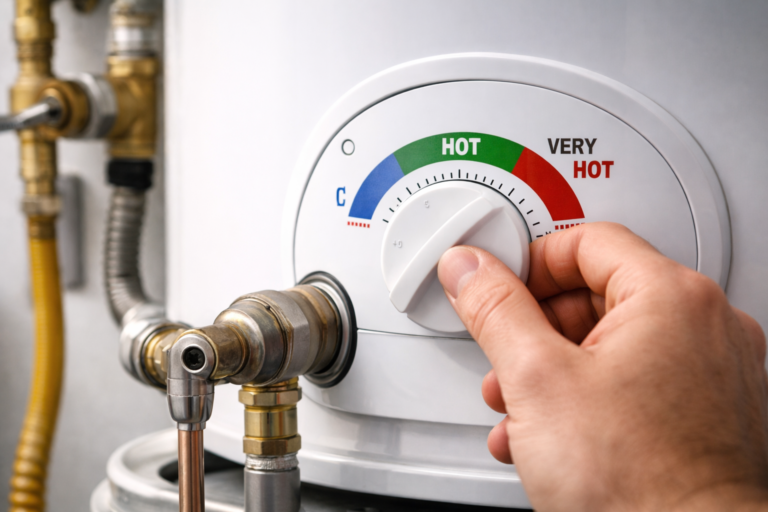
How to Lower Water-Heater Temperature Safely
If the water is consistently hotter than intended but is not fluctuating unpredictably, leaking, discharging from the relief valve, or showing electrical or gas-related warning signs, begin by confirming the delivered temperature and reviewing the heater setting.
The adjustment method depends on the heater type and model. Always follow the instructions printed on the unit or included in the manufacturer’s manual.
Step 1: Measure the Delivered Water Temperature
- Use a reliable kitchen or cooking thermometer.
- Run the hot water until the temperature stabilizes.
- Collect the water in a heat-resistant container instead of testing it with your hand.
- Measure the temperature at two fixtures.
- Record the readings before making an adjustment.
If only one faucet or shower is excessively hot, investigate the fixture, shower cartridge, anti-scald stop, pressure-balancing valve, or local mixing valve before changing the heater setting for the entire home.
Step 2: Review the Current Temperature Setting
A setting near 120°F is commonly recommended for residential use to reduce scald risk and unnecessary energy consumption.
Some plumbing systems store water at a higher temperature and use a properly installed thermostatic mixing valve to lower the delivered temperature. These systems must be correctly designed, adjusted, and maintained.
Do not assume that labels such as Low, Hot, A, B, or C represent exact temperatures. Always measure the delivered temperature after changing the setting.
Step 3: Adjust the Heater According to Its Type
Gas Storage Water Heater
- Locate the external temperature-control dial.
- Reduce the setting by one small increment.
- Do not dismantle or modify the internal gas-control assembly.
- Follow the manufacturer’s instructions when the dial does not display exact temperatures.
If the water remains excessively hot after a reasonable setting reduction, the gas-control thermostat or temperature-sensing mechanism may require professional diagnosis.
Electric Storage Water Heater
Electric water heaters commonly have upper and lower thermostats behind access panels. These panels can expose high-voltage components.
Homeowners who are not trained and equipped to verify that electrical power is disconnected should not remove the access panels. Have a licensed electrician, plumber, or qualified water-heater technician inspect or adjust the thermostats.
When professional adjustment is performed, the upper and lower thermostat settings should normally remain consistent unless the manufacturer specifies otherwise.
Tankless Water Heater
- Use the built-in digital control or approved remote controller.
- Lower the set point gradually.
- Check for an error code or service warning.
- Do not repeatedly reset a unit that continues to overheat or fluctuate.
Persistent overheating may involve an outlet-temperature sensor, flow sensor, control board, plumbing crossover, recirculation configuration, or model-specific control fault.
Heat-Pump Water Heater
- Check the digital temperature setting.
- Confirm that the unit is operating in the intended mode.
- Look for error messages or temperature-sensor warnings.
- Review any mixing-valve or recirculation settings connected to the system.
Step 4: Allow the Heater to Stabilize and Retest
A storage water heater needs time to complete a heating cycle and stabilize after an adjustment. The required time depends on tank size, fuel type, incoming-water temperature, recent hot-water use, and the size of the temperature change.
After the heater has stabilized:
- measure the delivered temperature again
- test more than one fixture
- confirm that the temperature is stable rather than rising or falling unpredictably
- compare the new readings with the heater setting
If the water remains excessively hot after the setting has been lowered and the heater has had enough time to stabilize, the problem is likely more than a simple adjustment.
When to Stop Troubleshooting
Stop using the heater and arrange professional diagnosis when any of the following conditions are present:
- the water remains scalding on the lowest practical setting
- the temperature rises or falls unpredictably
- the electric high-limit switch repeatedly trips
- the circuit breaker repeatedly trips
- you see melted wiring, scorch marks, smoke, or sparking
- you smell gas
- the gas burner cycles abnormally
- the heater displays a recurring error code
- the temperature-and-pressure relief valve repeatedly discharges hot water
- the tank is leaking, bulging, or severely corroded
- you hear boiling, violent rumbling, or unusual pressure-related sounds
Do not continue resetting the heater, repeatedly changing the controls, or replacing components based only on symptoms. A failed thermostat, grounded element, gas-control fault, wiring problem, temperature sensor, pressure issue, or mixing-valve failure should be confirmed before parts are replaced.
Temperature-and-Pressure Relief Valve Warning
A storage water heater normally includes a temperature-and-pressure relief valve, commonly called a T&P valve. It is designed to discharge water when temperature or pressure reaches an unsafe level.
Hot water coming from the relief-valve discharge pipe may be caused by:
- excessive water temperature
- excessive plumbing-system pressure
- thermal expansion in a closed plumbing system
- a failed or waterlogged expansion tank
- a faulty or contaminated relief valve
- an overheating thermostat or control problem
Never cap, plug, clamp, restrict, or block the T&P relief valve or its discharge pipe. Doing so removes an essential safety device and can create a dangerous pressure condition.
A small amount of water released during a properly performed valve test is different from repeated dripping, continuous flow, or sudden discharge during normal operation. Recurring discharge should be inspected by a licensed plumber.
Typical Cost to Repair a Water Heater That Is Too Hot
The final repair cost depends on the heater type, failed component, labor rates, diagnostic time, accessibility, warranty coverage, and whether additional plumbing, gas, pressure-control, or electrical work is required.
| Repair or Service | Typical Installed Cost | When It May Be Needed |
|---|---|---|
| Diagnostic or service visit | $75–$200 | The cause is unclear or the temperature remains excessive after adjustment |
| Basic temperature adjustment | $0–$150 | The setting is too high and no component has failed |
| Electric thermostat replacement | $150–$350 | The thermostat is inaccurate, stuck, damaged, or not controlling the element correctly |
| Electric heating-element replacement | $150–$400 | The element is damaged, shorted, or electrically grounded |
| Electrical wiring or terminal repair | $150–$500+ | Loose, overheated, incorrectly wired, or damaged connections are found |
| Gas-control valve replacement | $300–$700 | The gas-control thermostat or temperature-sensing assembly has failed |
| Thermostatic mixing-valve repair or replacement | $200–$600 | Delivered temperature is excessive or unstable despite normal tank operation |
| Shower cartridge or anti-scald adjustment | $100–$350 | Only one shower or fixture is affected |
| T&P valve or expansion-system repair | $150–$600+ | The relief valve is leaking or discharging because of pressure, expansion, valve, or temperature problems |
| Tankless sensor or control repair | $200–$800+ | An outlet sensor, flow sensor, control board, or recirculation control is faulty |
These are broad planning ranges rather than contractor quotes. Emergency service, difficult access, permits, proprietary controls, premium components, and extensive electrical or plumbing work can increase the final price.
For a wider breakdown, see our guide to water heater repair cost.
Should You Repair or Replace the Water Heater?
Repair May Make Sense When:
- the tank itself is not leaking
- the overheating is caused by one replaceable component
- the heater is relatively young
- the unit has otherwise been reliable
- the repair is covered by warranty
- the repair cost is low compared with replacement
- the system still meets the household’s hot-water demand
Replacement May Be Better When:
- the tank is leaking or structurally damaged
- corrosion is extensive
- multiple electrical, gas, control, or plumbing problems are present
- the heater has required repeated repairs
- replacement parts are unavailable or unusually expensive
- the heater is near or beyond its expected service life
- the repair cost represents a large portion of replacement cost
- the existing heater no longer meets the household’s capacity or efficiency needs
Overheating alone does not automatically mean that the entire water heater must be replaced. Thermostats, heating elements, gas controls, sensors, mixing valves, wiring connections, and fixture cartridges may be repairable when the tank remains structurally sound.
Compare the diagnosis with the full water heater replacement cost before approving an expensive repair. You can also compare the heater’s age with the expected water heater lifespan.
Real-World Overheating Scenarios
Scenario 1: Every Fixture Suddenly Becomes Scalding Hot
This pattern points away from a single-faucet problem. Possible causes include a failed thermostat, temperature sensor, gas-control assembly, grounded electric element, wiring fault, or central mixing-valve failure.
Stop using the hot water, prevent vulnerable users from accessing the fixtures, and shut down the heater when it can be done safely. Arrange professional diagnosis instead of repeatedly changing the control setting.
Scenario 2: Water Remains Too Hot After the Setting Is Lowered
The thermostat or control may be miscalibrated, damaged, poorly seated against the tank, or unable to stop the heating cycle. Electric models may also have a grounded heating element, while gas models may have a failed gas-control thermostat or temperature sensor.
Allow enough time for the storage tank to stabilize before retesting. If the temperature remains excessive, stop treating the problem as a simple setting issue.
Scenario 3: Only One Shower Is Too Hot
If every other fixture delivers water at a normal temperature, the water heater is less likely to be the cause.
Common fixture-side causes include:
- a worn or damaged shower cartridge
- an incorrectly adjusted anti-scald stop
- a failed pressure-balancing valve
- a faulty local mixing valve
A plumber can inspect the affected fixture without unnecessarily lowering the temperature for the entire home.
Scenario 4: Water From a Gas Heater Becomes Hotter After Several Short Uses
Repeated small draws can trigger multiple burner cycles while already-hot water remains near the top of the tank. This temperature-stacking effect can produce delivered water hotter than the selected control setting.
A qualified technician can evaluate the control setting, gas-control operation, usage pattern, and whether a thermostatic mixing valve would improve delivered-temperature stability.
Scenario 5: The T&P Valve Releases Very Hot Water
This may involve excessive temperature, excessive pressure, thermal expansion, a failed expansion tank, or a faulty relief valve.
Do not block the valve or discharge pipe. Turn off the heater when it can be done safely and contact a licensed plumber.
Common Mistakes to Avoid
- Assuming hotter water is always better: Higher settings increase scald risk, standby heat loss, and energy consumption.
- Trusting the control dial without measuring: The delivered tap temperature may not match the labeled setting.
- Lowering the heater because only one shower is affected: A cartridge, anti-scald stop, or local mixing valve may be the actual cause.
- Resetting a high-limit switch repeatedly: Repeated trips indicate an unresolved electrical or overheating condition.
- Replacing a thermostat without testing the element and wiring: More than one fault can cause excessive temperature.
- Ignoring T&P valve discharge: Relief-valve activity may indicate a temperature, pressure, expansion, or valve problem.
- Opening electrical panels without proper training: Electric water heaters commonly operate on high voltage.
- Attempting internal gas-control repair: Gas-control and combustion work should be completed by a qualified professional.
- Delaying repair when the temperature fluctuates: Unpredictable scalding water creates a continuing injury risk.
How to Prevent Future Temperature Problems
- keep the heater near a safe and practical temperature setting
- measure the delivered tap temperature after changing the control
- inspect mixing valves, shower cartridges, and anti-scald controls when fixtures behave differently
- address recurring high-limit trips, breaker trips, or error codes promptly
- have damaged wiring, overheated terminals, and gas controls repaired professionally
- follow the manufacturer’s maintenance and flushing recommendations
- include the T&P valve and discharge piping in routine professional inspections
- have thermal-expansion controls checked when relief-valve discharge occurs
- record unusual changes in temperature, burner behavior, or recovery cycles
Use our water heater maintenance schedule to organize routine inspections and service.
Frequently Asked Questions
Why Is My Water Heater Suddenly Too Hot?
A sudden temperature increase may be caused by a failed or miscalibrated thermostat, grounded electric heating element, damaged wiring, gas-control fault, temperature sensor, control-board problem, central mixing-valve failure, or temperature stacking.
Why Is My Water Heater Too Hot on the Lowest Setting?
If the measured tap temperature remains excessive on the lowest practical setting, the thermostat or temperature control may be inaccurate or failed. Other possibilities include poor thermostat contact, a grounded electric element, incorrect wiring, a failed gas-control thermostat, a faulty sensor, or a mixing-valve problem.
Can a Heating Element Make the Water Too Hot?
Yes. An electric heating element that becomes electrically grounded may continue producing heat outside normal thermostat control. However, thermostats, wiring, terminal connections, and high-limit controls should also be tested because they can create similar symptoms.
Can a Gas Water Heater Produce Water Hotter Than Its Setting?
Yes. Possible causes include an inaccurate gas-control thermostat, a temperature-sensing fault, abnormal burner operation, or temperature stacking after repeated short hot-water draws.
Should I Turn Off the Water Heater When the Water Is Too Hot?
Turn off an electric heater at the breaker when overheating is severe, unpredictable, or accompanied by electrical warning signs and the panel can be reached safely. For gas units, follow the manufacturer’s shutdown instructions. If you smell gas, leave immediately and contact the gas utility from a safe location.
Why Is Only One Shower Too Hot?
A single overheated shower is more likely caused by a worn cartridge, incorrectly adjusted anti-scald stop, failed pressure-balancing valve, or local mixing-valve problem than by the water heater.
Is 140°F Too Hot for Household Water?
Water at 140°F presents a serious scald risk and can cause severe burns within seconds. Some systems store water at higher temperatures while using a properly installed thermostatic mixing valve to reduce the delivered temperature, but this arrangement requires correct installation and ongoing maintenance.
Does Overheating Mean the Water Heater Must Be Replaced?
No. A heater may be repairable when the problem is limited to a thermostat, heating element, gas control, sensor, mixing valve, wiring connection, or fixture cartridge. Replacement becomes more likely when the tank leaks, corrosion is severe, several systems are failing, or repair cost is high relative to the heater’s age and condition.
How Much Does It Cost to Fix a Water Heater That Is Too Hot?
A simple temperature adjustment may cost little or nothing. Professional repairs commonly range from approximately $150 to $700 or more, depending on the cause. Tankless controls, extensive wiring work, mixing-valve replacement, pressure problems, and proprietary gas-control components can cost more.
Final Answer
If your water heater is too hot, first determine whether the problem affects the entire home or only one fixture. Measure the delivered temperature with a thermometer instead of relying only on the control dial.
A consistently high but stable temperature may be corrected by lowering the setting according to the manufacturer’s instructions. Water that remains scalding on the lowest setting, fluctuates unpredictably, trips safety controls, or causes the T&P valve to discharge points to a thermostat, grounded element, wiring, gas-control, sensor, mixing-valve, pressure, or plumbing problem.
Stop using the system when overheating creates an immediate scald risk or is accompanied by gas odor, electrical damage, repeated breaker trips, relief-valve discharge, leaking, or abnormal burner behavior. Professional diagnosis can determine whether a targeted repair or complete water-heater replacement provides the safer and more economical solution.