
Hot Water Heater Not Working? Start With These Checks
A water heater can stop producing hot water because of a lost power or gas supply, a failed heating component, an ignition problem, a faulty thermostat, or a safety shutdown.
The exact symptom helps narrow down the cause:
- Completely cold water usually points to a power, fuel, ignition, upper-element, or control problem.
- Lukewarm water may indicate a failed heating element, thermostat problem, sediment buildup, weak burner performance, or excessive hot-water demand.
- Hot water that runs out quickly can result from a failed lower element, reduced tank capacity, sediment buildup, an undersized heater, or unusually high usage.
- A heater that repeatedly shuts off may have an electrical fault, overheating condition, ignition problem, airflow restriction, or model-specific control error.
- A newly installed water heater that does not work may have an installation, wiring, gas-supply, valve, setup, or damaged-component issue.
Start with the safety checks below, identify whether you have an electric or gas water heater, and then follow the troubleshooting path that matches the actual symptom.
Safety Checks Before Troubleshooting
Stop troubleshooting and contact the appropriate professional when any of the following conditions are present:
- You smell gas: Leave the building immediately. Do not operate electrical switches, light a flame, use a phone inside the building, or attempt to relight the heater. Contact your gas utility or emergency services from a safe location.
- The breaker or reset button keeps tripping: Do not continue resetting it. Repeated trips can indicate damaged wiring, a shorted heating element, a faulty thermostat, or overheating.
- The water is dangerously hot: Stop using the hot water and turn the heater off when it is safe to do so. A thermostat or temperature-control problem may be present. See our guide to a water heater that is too hot.
- Water is leaking from the tank: Shut off the cold-water supply and disconnect the heater’s power or gas supply only when it is safe to do so. A leaking storage tank usually requires replacement.
- You see smoke, active sparking, scorch marks, or melted wiring: Turn off power at the breaker if it can be done safely and contact a licensed electrician or plumber.
Do not remove electrical access panels, open sealed combustion components, test live wiring, or work on gas controls unless you are qualified to do so.
Quick Diagnosis by Symptom
| What the Water Heater Is Doing | Likely Problem Area |
|---|---|
| No lights, sound, ignition activity, or hot water | Power supply, circuit breaker, disconnect switch, gas supply, or control power |
| Completely cold water from an electric heater | Upper heating element, upper thermostat, high-limit switch, wiring, or power supply |
| Completely cold water from a gas heater | Gas supply, pilot light, electronic ignition, thermocouple, flame sensor, burner, or gas control |
| Water becomes warm but never fully hot | Heating element, thermostat setting, burner performance, sediment buildup, or excessive demand |
| Hot water runs out unusually quickly | Lower element, thermostat, sediment, tank capacity, dip tube, or high household demand |
| Heater works after a reset but stops again | Electrical fault, overheating, thermostat problem, damaged element, or control failure |
| Gas burner lights and then shuts off | Flame sensor, thermocouple, gas control, combustion air, or venting problem |
| Heater displays a fault or error code | Model-specific sensor, ignition, airflow, control-board, or component fault |
This table helps narrow the investigation, but it does not confirm that a specific part has failed. Several different faults can produce the same symptom.
Five Checks to Perform First
1. Confirm the Problem Affects the Entire Home
Test the hot water at more than one faucet or shower.
If only one fixture is affected, the water heater may be working correctly. The problem could instead be a clogged faucet aerator, failed shower cartridge, closed supply valve, mixing-valve problem, or plumbing restriction near that fixture.
2. Identify Your Water Heater Type
Determine whether you have:
- an electric tank water heater
- a conventional gas tank water heater
- a power-vent gas water heater
- a tankless water heater
- a heat-pump water heater
The correct troubleshooting steps depend on the system. An electric tank heater uses heating elements and thermostats, while a gas heater depends on fuel supply, ignition, combustion, and venting.
3. Check the Power or Fuel Supply
For an electric water heater:
- Check the electrical panel for a tripped circuit breaker.
- Confirm that any nearby disconnect switch is turned on.
- Consider whether the home recently experienced a power outage or electrical work.
- Reset a tripped breaker only once. Stop if it trips again.
For a gas water heater:
- Check whether other gas appliances in the home are operating.
- Confirm that the heater’s gas control is in the correct operating position.
- Look for a pilot light, ignition activity, status light, or error code, depending on the model.
- Never attempt to ignite or relight the heater when you smell gas.
4. Check the Temperature Setting
A typical household water-heater setting is approximately 120°F.
A temperature setting that is too low can make the heater appear faulty. A setting that is too high increases the risk of scalding and may contribute to overheating or safety shutdowns.
Do not keep increasing the temperature to compensate for a heater that is no longer performing normally.
5. Observe the Exact Heating Pattern
Run a hot-water tap and carefully note what happens:
- The water remains completely cold: Focus on the energy supply, ignition system, upper heating element, upper thermostat, high-limit switch, or controls.
- The water becomes lukewarm: Check for heating-element, thermostat, burner, sediment, capacity, or demand problems.
- The water starts hot and quickly turns cold: Investigate the lower heating element, thermostat, tank capacity, sediment buildup, dip tube, or unusually high usage.
- The heater starts and then shuts down: Look for error codes, repeated breaker trips, overheating, flame loss, ignition failure, or airflow problems.
Electric and Gas Water Heaters Fail Differently
Electric Water Heaters
A standard electric tank water heater commonly contains:
- an upper heating element
- a lower heating element
- upper and lower thermostats
- a high-limit safety switch, also called an ECO
- electrical wiring and terminal connections
A failure in the upper heating circuit can leave the home with no hot water. A failed lower element more commonly causes reduced hot-water capacity or water that runs out quickly, although thermostat, wiring, sediment, capacity, and usage problems can create similar symptoms.
Gas Water Heaters
A conventional gas water heater may rely on:
- a gas shutoff valve
- a pilot light or electronic ignition system
- a thermocouple or flame sensor
- a burner assembly
- a gas control valve
- adequate combustion air
- proper venting
A gas heater may fail to ignite, light and then shut off, or stop operating because its safety controls detect an ignition, flame, airflow, venting, or combustion problem.
Do not use an electric-water-heater diagnosis for a gas unit, and do not assume that one symptom proves a particular component has failed. The next step is to follow the troubleshooting section for your heater type and exact symptom.
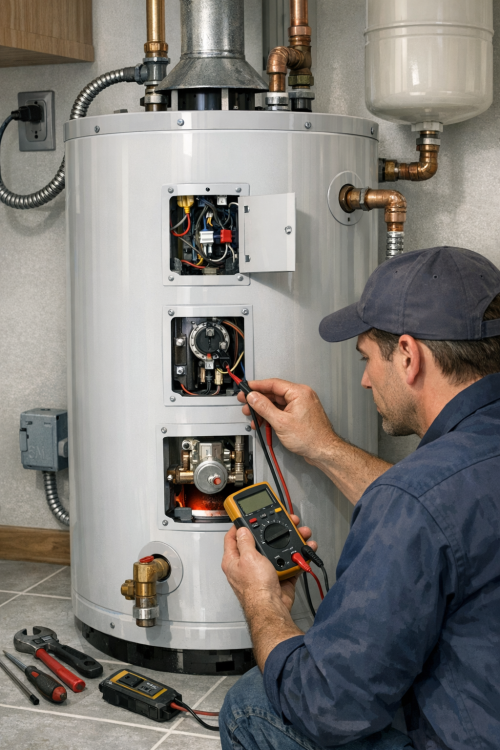
Electric Water Heater Not Working
If an electric water heater produces no hot water, the problem is usually related to the electrical supply, high-limit safety switch, thermostat, heating element, or internal wiring.
1. Check the Circuit Breaker
Look for the double-pole breaker labeled for the water heater.
- If it has tripped, switch it fully off and then back on once.
- If it trips again, stop resetting it.
- Repeated trips may indicate a shorted heating element, damaged wiring, a loose connection, or another electrical fault.
A breaker that remains on does not prove that power is reaching every component inside the heater. Testing internal voltage requires proper equipment and should be handled by a qualified professional.
2. Check the High-Limit Reset Button
Many electric tank water heaters have a red high-limit reset button located behind the upper access panel.
The high-limit switch may trip because of:
- a faulty thermostat
- a heating element that remains energized
- loose or damaged wiring
- overheating inside the tank
- an electrical supply or connection problem
Resetting the button once may restore operation temporarily. If it trips again, do not continue pressing it. The underlying cause needs to be diagnosed.
3. Consider an Upper Heating Element or Thermostat Failure
The upper heating circuit normally heats the upper portion of the tank first and then transfers control to the lower circuit.
If the upper element, upper thermostat, wiring, or related control fails, the heater may produce no hot water at all.
Possible signs include:
- completely cold water
- no noticeable recovery after several hours
- a high-limit switch that repeatedly trips
- visible damage around electrical terminals
Heating elements and thermostats should be tested rather than replaced based only on symptoms. See our guide to water heater element replacement cost for typical repair pricing.
4. Consider a Lower Heating Element Failure
A failed lower heating element more commonly causes reduced hot-water capacity than completely cold water.
Possible signs include:
- the first few minutes of water are hot
- hot water runs out much faster than normal
- recovery takes longer than expected
- the tank produces only a limited amount of fully heated water
These symptoms can also result from a faulty thermostat, sediment buildup, a damaged dip tube, unusually high usage, or a tank that is too small for the household.
Gas Water Heater Not Working
A gas water heater depends on an uninterrupted gas supply, proper ignition, flame detection, burner operation, combustion air, and safe venting.
1. Confirm the Gas Supply
- Check whether other gas appliances in the home are operating.
- Confirm that the water heater’s gas shutoff valve has not been closed.
- Verify that the gas control is set to the correct operating position.
- Do not operate the heater or attempt ignition when you smell gas.
If the entire home has lost gas service, contact the utility provider. Do not dismantle the gas valve or burner assembly.
2. Check the Pilot Light or Ignition System
Older gas water heaters may use a standing pilot light. Newer models may use electronic ignition, a status light, or a powered control system.
A heater may fail to ignite because of:
- an interrupted gas supply
- a failed igniter
- a dirty pilot assembly
- a faulty thermocouple or flame sensor
- a gas-control fault
- insufficient combustion air
- a model-specific safety lockout
Follow the manufacturer’s lighting instructions printed on the heater or provided in the owner’s manual. Do not repeatedly attempt ignition when the burner does not light normally.
For a more detailed explanation, see our guide to water heater ignition failure.
3. Check the Status Light or Error Code
Many modern gas water heaters use a flashing status light or digital error code to identify the area of failure.
The code may point to an issue involving:
- ignition failure
- flame loss
- temperature sensors
- gas controls
- airflow or venting
- overheating
Record the exact code and compare it with the manufacturer’s manual before replacing any component.
4. Burner Lights and Then Shuts Off
If the burner ignites but shuts down shortly afterward, possible causes include:
- a weak or unstable flame signal
- a dirty thermocouple or flame sensor
- restricted combustion air
- a venting or draft problem
- a faulty gas control
- an overheating or safety condition
Combustion and venting problems can create carbon-monoxide risks. These systems should be inspected by a qualified gas-appliance professional.
Water Heater Is On but Not Heating Enough
A heater that produces lukewarm water is operating at least partially, but it may not be reaching or maintaining the expected temperature.
Common causes include:
- temperature controls set too low
- a failed electric heating element
- a faulty thermostat or temperature sensor
- weak burner performance
- sediment buildup reducing heat transfer
- a damaged dip tube
- a plumbing crossover or faulty mixing valve
- household demand exceeding the heater’s capacity
Test the water at more than one fixture. If only one shower or faucet is affected, the issue may be located at that fixture rather than inside the water heater.
Hot Water Runs Out Quickly
Hot water that starts normally and then becomes cold usually points to a capacity, recovery, or partial-heating problem.
Possible causes include:
- a failed lower heating element
- a faulty lower thermostat
- sediment reducing usable tank capacity
- a damaged cold-water dip tube
- a tank that is undersized for the household
- simultaneous use of showers, laundry, and dishwashing
- a burner or heating element that is recovering too slowly
Compare current performance with the heater’s normal behavior. A sudden reduction in capacity suggests a component, control, or sediment problem. A heater that has always run out quickly may simply be too small for the household’s peak demand.
Breaker or Reset Button Keeps Tripping
A breaker or high-limit reset button that repeatedly trips is a warning sign, not a normal operating condition.
Possible causes include:
- a shorted heating element
- damaged or loose wiring
- a faulty thermostat
- an element that remains energized
- overheating
- an incorrect breaker, circuit, or electrical connection
Do not repeatedly reset the breaker or high-limit switch. Turn the heater off and arrange for electrical testing by a qualified plumber, electrician, or water-heater technician.
Why the Water Heater Keeps Turning Off
A heater that repeatedly starts and stops may be responding to a component fault, unstable control signal, safety condition, or loss of power or fuel.
The likely causes depend on the heater type.
Possible Electric Water Heater Causes
- loose electrical connections
- a faulty thermostat
- a damaged heating element
- high-limit switch activation
- breaker or supply-voltage problems
Possible Gas Water Heater Causes
- pilot or flame-sensing failure
- interrupted gas supply
- gas-control malfunction
- restricted combustion air
- venting or draft problems
- model-specific safety lockout
Do not assume that sediment is responsible for every shutdown. The exact cause may require electrical testing, burner inspection, error-code diagnosis, or manufacturer-specific troubleshooting.
New Water Heater Not Working
A newly installed water heater that produces no hot water may have an installation or startup problem rather than a worn-out component.
Common causes include:
- the circuit breaker or disconnect was not switched on
- the gas shutoff valve remains closed
- air remains in the gas line
- the gas control or thermostat was not set correctly
- electrical wiring is incomplete or incorrect
- the tank was energized before it was completely full, damaging an electric element
- water valves are closed or incorrectly positioned
- the unit is displaying an installation-related error code
- a power-vent or tankless model lacks electrical power
Do not modify a new installation yourself when the work is covered by an installer or manufacturer warranty. Contact the installer first and document any error codes, leaks, unusual sounds, ignition problems, or electrical trips.
How to Tell Whether the Water Heater Is Broken
A single temporary interruption does not always mean the entire heater has failed. However, the following signs suggest that professional diagnosis or replacement may be necessary:
- the tank itself is leaking
- the breaker or reset button repeatedly trips
- the burner or ignition system repeatedly fails
- the heater shows recurring error codes
- water remains cold after the energy supply has been confirmed
- multiple components are failing
- the tank shows significant corrosion
- rusty or discolored hot water comes from multiple fixtures
- the heater makes persistent rumbling or popping sounds
- repair costs are high relative to replacement cost
- the unit is near or beyond its expected service life
A leaking storage tank generally cannot be repaired permanently. Component failures such as a thermostat, heating element, igniter, flame sensor, or thermocouple may be repairable when the tank itself remains structurally sound.
Who Should You Call?
| Problem | Appropriate Professional |
|---|---|
| Leaking tank, plumbing connection, valve problem, or insufficient hot water | Licensed plumber |
| Repeated breaker trips, damaged wiring, or electrical supply problem | Licensed electrician or qualified water-heater technician |
| Gas burner, ignition, combustion, or venting problem | Licensed plumber, HVAC technician, or qualified gas-appliance technician |
| Suspected gas leak | Gas utility or emergency services from a safe location |
| New unit, warranty issue, or manufacturer error code | Installer or manufacturer-authorized service provider |
| Only one faucet or shower is affected | Plumber or fixture-repair professional |
Typical Water Heater Repair Costs
Repair costs vary by heater type, location, labor rates, accessibility, and the exact failed component.
| Problem or Repair | Typical Installed Cost | Typical Difficulty |
|---|---|---|
| Basic external inspection or service call | $75–$200 | Low |
| Heating-element replacement | $150–$350 | Moderate |
| Thermostat replacement | $150–$300 | Moderate |
| Thermocouple or flame-sensor repair | $150–$350 | Moderate |
| Igniter or pilot assembly repair | $175–$450 | Moderate |
| Burner cleaning or repair | $150–$400 | Moderate |
| Tank flushing or sediment service | $100–$250 | Low to moderate |
| Gas-control valve replacement | $300–$700 | High |
| Electrical wiring or connection repair | $150–$500+ | Moderate to high |
These are broad planning ranges, not contractor quotes. Complex diagnostics, difficult access, emergency service, permits, and premium components can increase the final cost.
For a broader cost breakdown, see our guide to water heater repair cost.
Should You Repair or Replace the Water Heater?
Repair May Make Sense When:
- the tank itself is not leaking
- the heater is relatively young
- the problem is limited to one replaceable component
- the unit has otherwise been reliable
- the repair is covered by warranty
- the repair cost is low compared with replacement
Replacement May Be Better When:
- the storage tank is leaking
- corrosion is extensive
- multiple components are failing
- repairs have become frequent
- the unit is near the end of its expected lifespan
- the tank no longer meets the household’s hot-water demand
- the repair cost represents a large portion of replacement cost
Age alone should not determine the decision, but it matters when combined with tank condition, reliability, energy use, warranty coverage, and repair expense.
Compare the likely repair with the complete water heater replacement cost before approving a major repair. You can also review the typical water heater lifespan when evaluating an older unit.
Preventing Future Water Heater Problems
Routine maintenance cannot prevent every component failure, but it can reduce sediment-related problems, reveal leaks early, and help the heater operate more consistently.
- inspect the tank and nearby plumbing for leaks
- follow the manufacturer’s flushing recommendations
- keep the temperature near a safe and practical setting
- keep combustion-air openings and the area around gas heaters clear
- have venting problems inspected promptly
- check the anode rod according to tank condition and water quality
- address recurring breaker trips, error codes, or ignition failures promptly
Use our water heater maintenance schedule to plan routine checks and service.
Frequently Asked Questions
Why Is My Water Heater Not Working?
The most common causes include a tripped breaker, interrupted gas supply, failed heating element, faulty thermostat, ignition failure, damaged flame sensor, high-limit shutdown, wiring fault, or model-specific control error.
Why Is My Water Heater On but the Water Is Cold?
An electric unit may have a failed upper element, thermostat, high-limit switch, or internal wiring problem. A gas unit may have a gas-supply, pilot, ignition, burner, flame-sensing, or gas-control problem.
Why Is My Hot Water Only Lukewarm?
Lukewarm water can result from a low temperature setting, failed heating element, thermostat fault, weak burner performance, sediment buildup, plumbing crossover, faulty mixing valve, or excessive household demand.
Why Does My Hot Water Run Out So Fast?
Possible causes include a failed lower heating element, thermostat problem, sediment reducing usable tank capacity, damaged dip tube, undersized tank, slow recovery, or unusually heavy hot-water use.
Can I Reset My Water Heater?
An electric heater’s breaker or high-limit button may be reset once when no other hazard is present. Do not keep resetting it if it trips again. Repeated trips indicate a fault that requires diagnosis.
How Long Should I Wait for Hot Water After a Reset?
A tank water heater may need approximately 30 minutes to several hours to recover, depending on its fuel type, tank size, temperature rise, and whether all heating components are operating correctly.
Why Is My New Water Heater Not Producing Hot Water?
A new heater may have an unopened valve, incorrect control setting, incomplete electrical connection, gas-supply problem, air in the gas line, installation error, damaged dry-fired element, or model-specific startup fault. Contact the installer when the unit is newly installed or under warranty.
Does No Hot Water Mean I Need a New Water Heater?
No. Many no-hot-water problems are caused by replaceable components or interrupted power or fuel. Replacement is more likely when the tank leaks, corrosion is severe, failures are recurring, or repair cost is high relative to the heater’s remaining value.
Final Answer
When a hot water heater is not working, begin by identifying the exact symptom and the type of heater you own. Completely cold water, lukewarm water, short hot-water duration, repeated shutdowns, and breaker trips point to different groups of possible causes.
Check the external power or fuel supply, temperature setting, status lights, error codes, and whether the problem affects the entire home. Stop immediately when there is a gas smell, tank leak, electrical damage, repeated breaker trip, or combustion concern.
Simple supply or setting problems may be corrected quickly. Heating-element, thermostat, ignition, burner, wiring, gas-control, venting, and leaking-tank problems usually require professional diagnosis before deciding whether repair or replacement offers better value.