
Quick answer: If you’re wondering how long it takes to install a water heater, a straightforward professional tank replacement usually takes about 2 to 4 hours when the new unit is similar to the old one, the location is easy to access, and the existing plumbing, venting, gas, or electrical connections can be reused without major corrections.
Jobs take longer when the project changes the system rather than simply replacing the appliance. A tank-to-tankless conversion, fuel-type change, relocation, new venting, electrical upgrades, gas-line work, or difficult access can turn a few-hour replacement into a half-day, full-day, or multi-visit project.
Planning note: Installation time at the house is not always the same as total project time. Product availability, permits, inspection scheduling, additional trades, and hot-water recovery can extend the overall timeline even when the physical replacement itself takes only a few hours.
How Long Does It Take to Install a Water Heater?
For most homeowners, the biggest timeline question is not simply whether the heater is gas, electric, tank, or tankless. It is how much of the existing installation can be reused.
| Installation Scenario | Useful Planning Range | Why the Time Changes |
|---|---|---|
| Straightforward tank replacement | About 2–4 hours | Same general type and location, with usable existing connections and good access. |
| Tank replacement with significant corrections | Several hours to a full day | Vent, valve, piping, drain-pan, electrical, platform, or access work adds labor. |
| Existing tankless replaced with a similar tankless unit | Several hours; site-dependent | Existing mounting, gas, venting, electrical, condensate, and water connections may be reusable. |
| Tank-to-tankless conversion | Often most of a day | May require new venting, gas capacity, electrical work, condensate routing, or relocated connections. |
| Major relocation or fuel-type conversion | Full day or multiple visits possible | New infrastructure, permits, other trades, or construction changes can extend the project beyond one appointment. |
Replacement vs. Conversion: The Biggest Timeline Difference
A like-for-like replacement is usually the fastest scenario because much of the existing installation may already be suitable for the new unit.
For example, replacing one conventional electric storage heater with another similar electric tank may allow the installer to reuse the location, water connections, electrical circuit, and much of the existing setup after verifying that everything remains appropriate for the new appliance.
A conversion changes that equation. Switching from a storage tank to tankless, changing fuel type, relocating the heater, or moving to a different technology can introduce new work such as:
- larger or relocated gas piping;
- new venting or combustion-air arrangements;
- electrical circuit or disconnect upgrades;
- condensate drainage for applicable equipment;
- new mounting or structural support;
- changed hot- and cold-water connections;
- removal of obsolete venting or fuel components; and
- permit, inspection, or multi-trade coordination.
This is why two homeowners replacing “a water heater” can receive completely different installation timelines even when the new appliances have similar capacities.
Gas vs. Electric vs. Tankless vs. Heat-Pump Installation Time
| Water Heater Type | Typical Timeline Considerations |
|---|---|
| Electric storage tank | A simple like-for-like replacement can be relatively quick because there is no combustion vent or gas connection. Electrical compatibility, plumbing condition, and access still matter. |
| Gas storage tank | Gas piping, combustion venting, draft configuration, shutoff components, and other fuel-related checks can add work compared with a simple electric replacement. |
| Tankless | Replacing an existing tankless unit can be much simpler than converting from a storage tank. New tankless conversions may require major gas, electrical, venting, condensate, and mounting changes. |
| Heat-pump water heater | A compatible replacement can often be completed in one visit, while conversions may require electrical upgrades, condensate routing, airflow planning, or removal of old gas and vent components. |
For detailed tank installation costs and the work commonly included in a replacement, see our tank water heater installation cost guide. For tankless projects, see our tankless water heater installation cost guide.
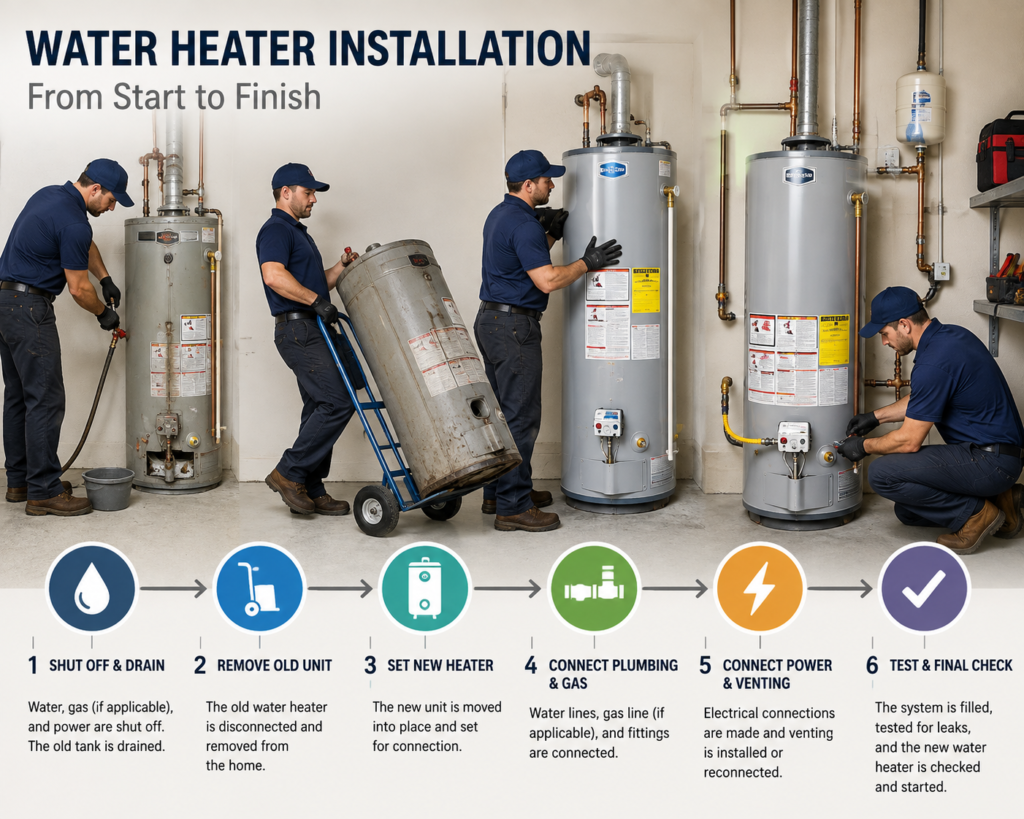
What Happens During a Typical Water Heater Replacement?
A straightforward replacement is usually a sequence of several jobs rather than one continuous installation step.
| Installation Phase | What Happens | What Can Slow It Down |
|---|---|---|
| Shut down and drain the old heater | Utilities are isolated and the storage tank is emptied so it can be disconnected and removed. | Heavy sediment, a damaged drain valve, tank size, or difficult drainage conditions. |
| Disconnect and remove the old unit | Water, gas or electrical, and applicable vent connections are separated and the heater is removed. | Corrosion, seized fittings, narrow doors, stairs, attic access, or limited removal space. |
| Prepare the installation area | The installer evaluates and prepares the location for the replacement heater. | Damaged valves, unsuitable venting, missing drain protection, platform issues, piping corrections, or other required changes. |
| Set and connect the new heater | The new unit is positioned and connected to water and the applicable fuel or electrical system. | Connection locations that differ from the previous heater, new fittings, vent modifications, or utility upgrades. |
| Fill, test, and commission | The system is filled and checked for proper operation, leaks, controls, and applicable gas, venting, or electrical conditions. | Leaks, control problems, venting issues, air in piping, or corrections discovered during startup. |
Even a routine replacement involves more than swapping tanks: the new heater must be connected, tested, commissioned, and left operating properly.
Installation Time vs. Total Project Time
A quoted 2-to-4-hour installation window usually refers to the active work performed at the home. The homeowner's total timeline can be longer.
Additional calendar time can come from:
- waiting for the correct heater to be available;
- permit processing where required;
- scheduling an electrician, gas contractor, or another trade;
- inspection scheduling;
- unexpected corrections discovered after the old heater is removed; or
- waiting for a storage-tank heater to fill and heat after installation.
This distinction matters when planning around a failed heater. A contractor may complete the physical replacement in a few hours even though the entire process from breakdown to final inspection spans longer.
For broader permit and installation requirements, see our water heater code requirements guide.
What Makes Water Heater Installation Take Longer?
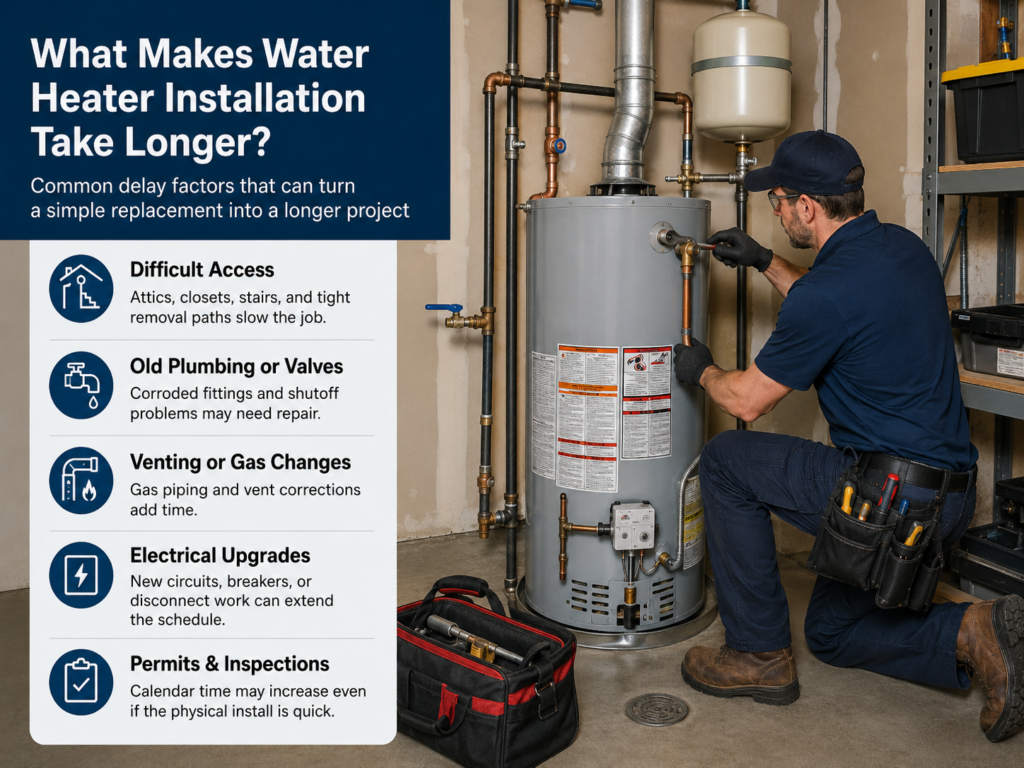
Installation time usually increases when the installer has to correct or rebuild part of the surrounding plumbing, venting, gas, electrical, drainage, or access conditions.
| Delay Factor | Why It Adds Time |
|---|---|
| Difficult access | Narrow doors, stairs, attic openings, tight closets, or long removal paths can make moving the old and new heater slower and more complex. |
| Heavy sediment or drainage problems | An old tank may drain slowly, especially if sediment has accumulated or the drain valve is damaged or obstructed. |
| Corroded valves and fittings | Old shutoff valves, connectors, unions, or piping may need repair or replacement before the new heater can be connected reliably. |
| Venting corrections | A gas heater may need vent-connector, chimney, combustion-air, or termination work before the replacement can be commissioned. |
| Electrical upgrades | A new circuit, breaker, conductor, disconnect, or other electrical work can extend the job and may require a separate electrician. |
| Gas-line changes | Relocation, appliance conversion, or a higher-input heater can require gas-piping evaluation or modification. |
| Drainage, pan, or platform work | Leak protection, condensate handling, platforms, or other location-specific requirements may need to be corrected or added. |
| Relocation or technology change | Moving the heater or converting to tankless, heat pump, or another fuel type can require several systems to be redesigned at once. |
Does an Attic or Closet Installation Take Longer?
It can, but there is no reliable nationwide rule such as “add one hour for a closet” or “add two hours for an attic.”
The actual delay depends on how difficult it is to remove the old heater and move the replacement into position.
Factors that can make an attic or tight-space installation slower include:
- small access openings;
- narrow passageways;
- stairs or ladders;
- limited working room around the appliance;
- the weight and dimensions of the old and new heaters;
- platform or drainage corrections;
- venting or combustion-air changes; and
- a removal path restricted by later remodeling.
For attic-specific access, platform, drainage, and service requirements, see our water heater in attic code guide.
How Permits and Inspections Affect the Timeline
Permits and inspections can affect the calendar timeline even when they do not add several hours to the physical replacement itself.
The process varies by jurisdiction. Depending on where the home is located and how extensive the work is, the project may involve:
- a permit before installation;
- inspection after the work is completed;
- separate electrical, plumbing, mechanical, or gas approvals;
- additional review for relocation or construction changes; or
- another visit if a correction is required before final approval.
This is why a water heater can be physically installed in one afternoon while the complete permitted project takes longer to close out.
Can a Water Heater Be Installed the Same Day?
Yes, many straightforward replacements can be completed in one visit.
Same-day completion is most realistic when:
- the correct replacement heater is available;
- the installer has an open appointment;
- the existing location and utilities are compatible;
- no major vent, gas, electrical, or plumbing corrections are discovered;
- permitting requirements do not delay the appointment; and
- the heater is reasonably easy to access and remove.
A failed heater late in the day, an uncommon model, a major conversion, or a problem discovered after the old unit is removed can push the project into another visit.
When Will Hot Water Be Back After Installation?
The end of the installation and the return of usable hot water are not always the same moment.
With a storage-tank water heater, the new tank first has to be filled and then heat the incoming cold water. How long that takes depends on factors such as:
- tank capacity;
- burner or heating-element input;
- incoming water temperature;
- thermostat setting;
- fuel type; and
- the recovery performance of the specific model.
Because those variables differ, there is no single recovery time that applies to every tank water heater.
A tankless unit does not need to heat a stored tank after startup, although hot water still needs time to travel through the home's piping from the heater to the fixture.
How to Prepare Before the Installer Arrives
Homeowner preparation cannot eliminate technical work, but it can prevent avoidable access delays.
Before the appointment, it is useful to:
- clear boxes, laundry, shelving, tools, or stored items away from the heater;
- provide a clear path from the exterior door to the installation area;
- keep pets and other obstructions away from the work area;
- make the electrical panel, gas shutoff, and relevant utility areas accessible;
- have the existing heater's model information available if possible; and
- tell the installer in advance about stairs, attic access, narrow doors, or other difficult conditions.
Clearing access helps prevent avoidable delays, but it cannot eliminate technical work discovered during the replacement.
When Is a Longer Installation Normal—and When Should You Ask Questions?
Normal Reasons for a Longer Job
A longer-than-expected installation is not automatically a problem. Legitimate delays can happen when the installer discovers:
- a corroded shutoff valve or fitting that needs replacement;
- unsafe or incompatible venting;
- electrical work needed for the new appliance;
- a gas-piping issue;
- drain-pan, platform, or drainage corrections;
- difficult removal access;
- an installation problem that becomes visible only after the old heater is removed; or
- another trade being required before the heater can be commissioned.
When to Ask for Clarification
Ask for details when the timeline changes substantially and the additional work is not clearly explained.
It is reasonable to ask questions when:
- new work appears without an explanation;
- the expected completion time changes repeatedly;
- additional parts or trades are suddenly required;
- a code or installation problem is identified without a clear explanation of the correction;
- the project is unexpectedly being left incomplete overnight; or
- the additional work materially changes the original estimate.
A useful question is:
“What condition was discovered, what work is being added, and how does it affect the price or completion schedule?”
Water Heater Installation Time FAQs
How Long Does a Normal Water Heater Replacement Take?
A straightforward professional tank water heater replacement commonly takes about 2 to 4 hours. Home Depot's water heater installation guidance places a similar tank-to-tank replacement in roughly the same few-hour range. Difficult access, damaged components, venting corrections, electrical work, or other installation changes can extend the job.
Does Gas or Electric Water Heater Installation Take Longer?
A simple electric tank replacement may involve fewer systems because there is no combustion vent or gas connection. A gas replacement can require additional gas and venting work, but actual installation time depends more on the existing conditions than on fuel type alone.
How Long Does It Take to Install a Tankless Water Heater?
Replacing an existing tankless heater with a similar unit can take several hours, depending on the installation. Converting from a storage tank to tankless commonly takes much longer because gas, venting, electrical, condensate, mounting, or plumbing changes may be required. This Old House's water heater replacement guide also illustrates why the work around the appliance—not just setting the new unit in place—affects the overall project timeline.
Can a Water Heater Be Replaced in One Day?
Yes. Many straightforward replacements can be completed during one appointment. Major conversions, difficult access, permit delays, unavailable equipment, or additional trade work can extend the project beyond one day or require another visit.
Does an Attic Water Heater Take Longer to Replace?
It can. The timeline depends on the access opening, passageway, unit size and weight, removal route, working space, and whether platform, drainage, venting, or other location-specific corrections are needed.
Does a Plumber Have to Wait for the New Tank to Heat Before Leaving?
The heater needs to be filled, started, tested, and commissioned appropriately, but the full stored volume does not necessarily need to reach its final temperature before every installation appointment can end. Startup and verification requirements depend on the appliance and installation.
Bottom Line
If you're estimating how long it takes to install a water heater, about 2 to 4 hours is a useful baseline for a straightforward professional tank replacement. More complex projects can take much longer when access, venting, plumbing, gas, electrical, drainage, or system type must change.
When comparing estimates, ask whether the quoted timeline assumes a like-for-like replacement or includes modifications to the existing installation. That distinction usually explains the schedule better than tank size alone.