
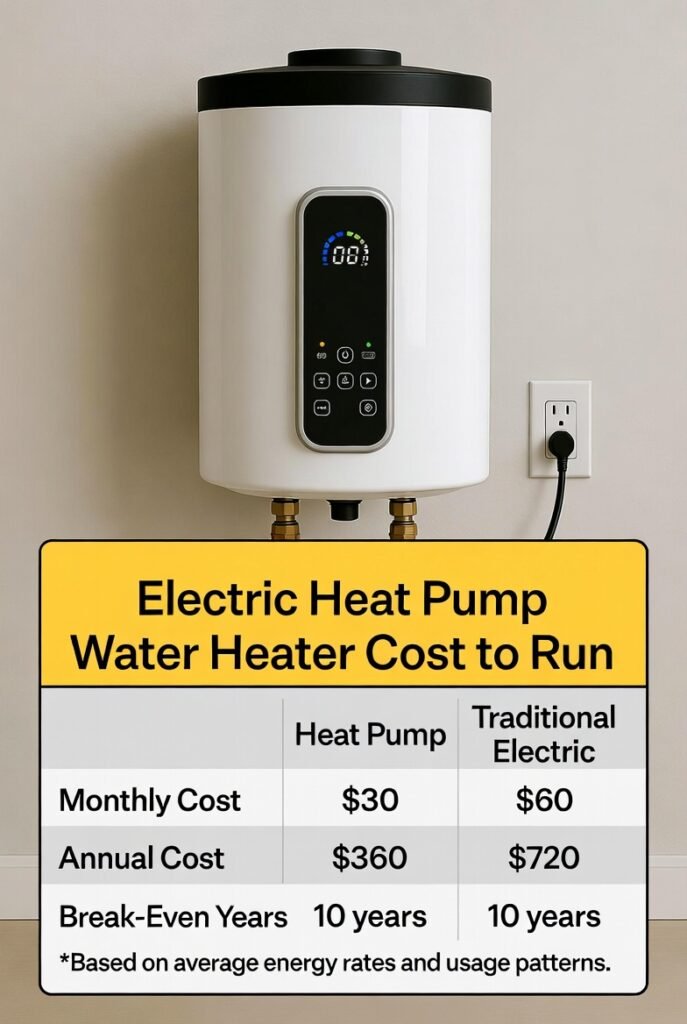
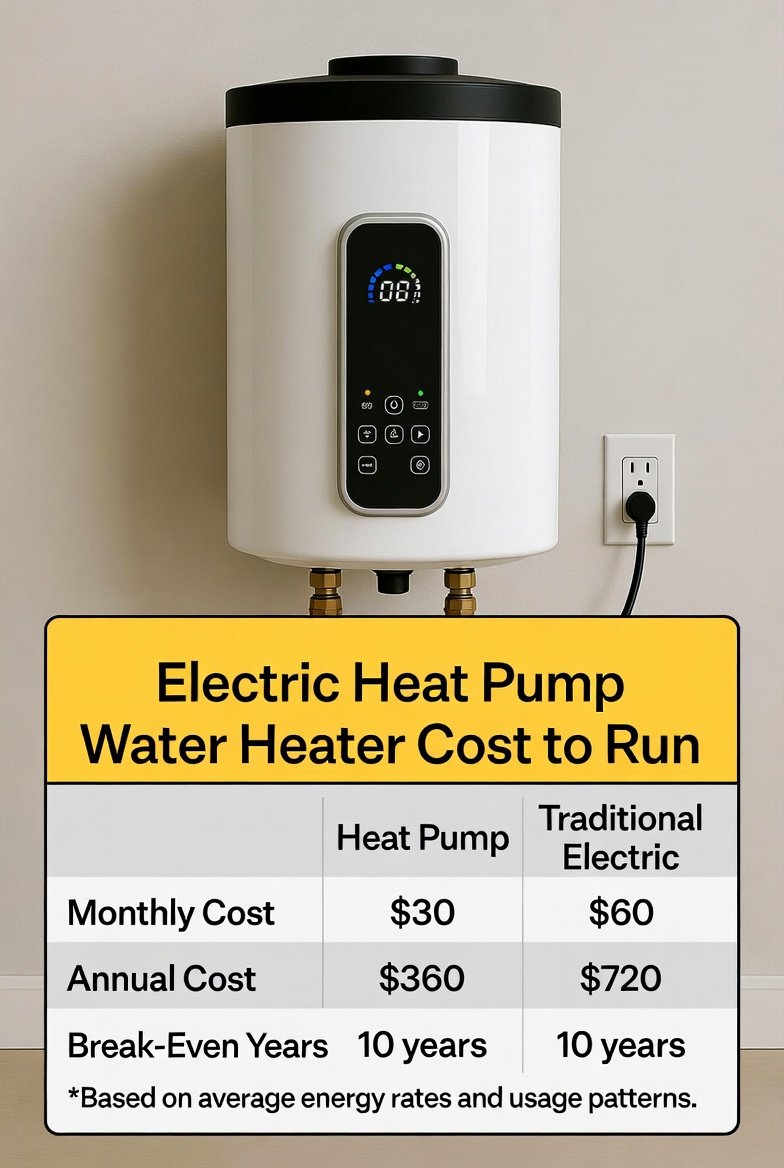
Electric Heat Pump Water Heater Cost to Run: A Transparent Energy Breakdown
If you’re researching the operating cost of an electric heat pump water heater, you’re trying to answer one thing:
What will this add to my utility bill?
Not install cost.
Not rebates.
Not brand comparisons.
Just real operating cost.
This page breaks down the math, rate sensitivity, climate impact, and long-term energy exposure in clear terms.
The Short Answer (Monthly Framing)
For most U.S. households:
- At $0.14 per kWh, expect roughly $15–$25 per month
- At $0.25 per kWh, expect roughly $30–$45 per month
Those numbers assume moderate household demand and a reasonably temperate install location.
Now let’s show where those numbers come from.
How Operating Cost Is Calculated (Transparent Math)
Operating cost =
Annual kWh consumption × electric rate
To estimate kWh usage, we calculate energy required to heat water.
Example: Moderate Household (3–4 People)
Assume:
- 64 gallons/day
- 70°F temperature rise
- 8.34 lbs per gallon
Daily BTU requirement:
64 × 8.34 × 70 ≈ 37,300 BTUs
Convert to kWh:
37,300 ÷ 3,412 ≈ 10.9 kWh of heat energy per day
Now apply heat pump efficiency.
If COP = 3.0:
10.9 ÷ 3.0 ≈ 3.6 kWh/day electricity
Annual use:
3.6 × 365 ≈ 1,314 kWh/year
That aligns with real-world operating ranges of:
1,200 – 1,800 kWh per year
depending on demand and climate.
Electric Rate Sensitivity (This Is the Pivot Variable)
Scenario A — $0.14/kWh
1,300 kWh × $0.14 ≈ $182/year
Monthly ≈ $15
1,800 kWh ≈ $252/year
Monthly ≈ $21
Clearly inexpensive in moderate-rate states.
Scenario B — $0.25/kWh
1,300 kWh × $0.25 ≈ $325/year
Monthly ≈ $27
1,800 kWh ≈ $450/year
Monthly ≈ $37
At higher rates, savings compress.
If you’re modeling full ownership cost (including equipment and tax credits), see:
👉 heat pump
Regional Electric Rate Reality
Electric rates vary significantly:
- Texas: ~$0.14
- Washington: ~$0.11–$0.13
- California: ~$0.28–$0.35
At $0.30/kWh:
1,500 kWh ≈ $450/year
Monthly ≈ $37–$45
Electric rate determines long-term exposure more than equipment type.
If you’re comparing against gas in high-rate states:
👉 gas vs heater cost
How It Compares to Standard Electric Water Heaters
Standard electric resistance tanks often use:
3,500 – 4,500 kWh per year
At $0.14:
≈ $490–$630 annually
At $0.25:
≈ $875–$1,125 annually
Heat pump models typically use roughly half the electricity.
This is why they’re considered one of the lowest-cost electric water heating options available.
Climate Impact on Operating Cost
Heat pumps extract heat from surrounding air.
In mild climates:
- COP remains stable
- Energy use stays near baseline modeling
In cold basements (below ~50°F):
- COP declines
- Resistance elements activate more
- Annual kWh may increase 10–25%
If installed in an unconditioned northern space, model toward the upper end of usage range.
Installation environment also influences efficiency.
Mechanical placement details here:
👉 heat pump installation
Hybrid Mode & Heavy Usage Impact
All integrated heat pump water heaters include electric resistance backup.
During:
- Back-to-back showers
- Laundry + dishwasher overlap
- Large family usage
Hybrid mode activates.
If resistance elements run 15–25% of operating time:
Annual electricity use may increase roughly 10–20% above baseline estimates.
Smaller households often remain in heat pump mode most of the year.
Monthly Cost by Household Size
1–2 People
- 1,000–1,300 kWh/year
- $12–$30 per month
3–4 People
- 1,200–1,800 kWh/year
- $15–$45 per month
5+ People
- 1,800–2,400+ kWh/year
- $20–$60 per month
Usage multiplies electric rate.
10-Year Energy Projection
Moderate rate ($0.14):
≈ $200/year
10-year ≈ $2,000
High rate ($0.25):
≈ $375/year
10-year ≈ $3,750
Electric rate increases over time will proportionally increase totals.
Water heater lifespan considerations matter in long-term modeling:
👉 water heater life span
If you’re evaluating whether replacement timing affects operating cost strategy:
👉 water heater replacement cost
Break-Even Electric Rate Insight
Where does it stop feeling cheap?
Generally:
- Below ~$0.18/kWh → strong operating advantage
- ~$0.18–$0.24 → still favorable
- Above ~$0.25 → advantage narrows
At very high electric rates, gas may become comparable depending on local pricing.
When It’s Still a Low Operating Cost Option
- Moderate electric rates
- Mild climate
- Moderate household usage
- Limited hybrid activation
When Operating Cost Climbs Noticeably
- Electric rates above $0.25
- Cold ambient install location
- Heavy household draw
- Frequent resistance backup use
Contractor Verdict
Best operating cost profile: Moderate-rate regions with average household usage.
Still competitive: High-rate regions with mild climate and controlled demand.
Requires closer comparison: High-rate states with heavy hybrid activation or cold installation conditions.
Operating cost is primarily a function of electric rate and usage pattern — not marketing efficiency claims.
FAQs
Is a heat pump water heater expensive to run?
In moderate-rate regions, it is typically one of the lowest-cost electric water heating options available.
Does cold weather increase cost?
Yes. Lower ambient temperatures reduce efficiency and increase annual electricity use.
How much does hybrid mode affect cost?
Frequent resistance activation can increase total annual energy consumption by roughly 10–20%.
Is it cheaper than a standard electric tank?
Yes. Heat pump models often use about half the electricity of resistance-only tanks.