

Many electric tankless water heater problems begin before the appliance is mounted. Tripped breakers, disappointing shower flow, unexpected panel upgrades and failed inspections can result when no one verifies the home’s electrical capacity, winter hot-water demand and required circuit configuration before the unit is purchased.
A whole-home electric tankless heater is not a standard electric water heater replacement. Depending on its output, it may require two, three or four dedicated 240-volt circuits and can become one of the largest instantaneous electrical loads in the house.
The right electric tankless water heater installer must therefore understand two different systems:
- the electrical service, panel, breakers and conductor requirements;
- the plumbing flow, temperature rise and simultaneous hot-water demand.
This guide explains who should install an electric tankless water heater, what qualified contractors should calculate before quoting, how to recognize an unsuitable whole-home project and where point-of-use electric tankless equipment can genuinely make sense.
Who Should Install an Electric Tankless Water Heater?
A whole-home electric tankless installation normally requires both qualified electrical and plumbing expertise.
The work may be coordinated by one water-heater company, but the contractor should identify who is legally and technically responsible for each part of the project.
| Professional | What They Should Evaluate or Complete |
|---|---|
| Licensed electrician | Service-load calculation, panel capacity, breaker configuration, dedicated circuits, conductor routing, grounding, disconnect requirements and electrical permits |
| Licensed plumber | Hot-water demand, temperature-rise sizing, water pressure, pipe connections, shutoff and service valves, pressure-relief provisions and plumbing permits |
| Coordinating contractor | Scheduling both trades, selecting the final equipment, obtaining permits, arranging inspections, commissioning the heater and providing a clear warranty structure |
Licensing rules vary by jurisdiction, so the safest national standard is to hire a contractor or coordinated team legally qualified for both the plumbing and high-load electrical work required by the selected unit.
Some manufacturers explicitly require professional electrical and plumbing installation. The Stiebel Eltron Tempra installation instructions, for example, state that the unit must be installed by a licensed electrician and plumber.
Point-of-Use and Whole-Home Installations Are Different Projects
“Electric tankless” describes a broad product category. A small heater serving one sink and a 36-kilowatt whole-home system do not have comparable installation requirements.
| System Type | Typical Application | Installation Implications |
|---|---|---|
| Point-of-use | One sink, remote bathroom, workshop, office, wet bar or seasonal fixture | Usually one smaller dedicated circuit and limited plumbing changes |
| Limited-demand tankless | One shower, small apartment, cabin or selected fixtures | Requires model-specific circuit capacity and careful flow sizing |
| Whole-home electric tankless | Multiple fixtures and normal household hot-water service | May require several dedicated 240-volt circuits and substantial electrical-service capacity |
| High-demand whole-home system | Large household, cold climate or multiple simultaneous showers | May exceed practical residential electrical capacity or require more than one unit |
Point-of-use equipment can be an excellent solution when extending a hot-water pipe to a distant fixture would be disruptive or expensive. Whole-home electric tankless requires a much more demanding feasibility review.
Why Whole-Home Electric Tankless Heaters Use So Much Power
A conventional electric storage heater gradually heats a reservoir of water and relies on that stored supply during periods of high demand. A tankless heater has no large stored reserve. It must add the required heat while the water is moving through the appliance.
That requires substantial instantaneous electrical output.
Current manufacturer specifications illustrate the scale:
| Example Unit Size | Approximate Maximum Draw | Example Circuit Arrangement | Example Manufacturer Service Recommendation |
|---|---|---|---|
| 18 kW | Approximately 75 amps | Two dedicated double-pole circuits | Often 150-amp household service |
| 24 kW | Approximately 100 amps | Three dedicated double-pole circuits | Often 200-amp household service |
| 27 kW | Approximately 112.5 amps | Three 40-amp double-pole breakers | Often 200-amp household service |
| 36 kW | Approximately 150 amps | Four 40-amp double-pole breakers | May recommend 300-amp household service |
These are manufacturer examples, not universal circuit requirements. The exact breaker count, conductor specification, voltage and household-service recommendation must come from the selected unit’s nameplate, listing and installation manual.
The EcoSmart electrical requirements guide shows how circuit and household-service recommendations can change as unit output increases.
The central cost lesson: The heater itself may be relatively affordable, but supplying it with adequate electrical capacity can become the expensive part of the project.
Panel Space Is Not the Same as Electrical Capacity
Homeowners and inexperienced installers often focus only on whether the panel has enough empty spaces for the required breakers.
Breaker space matters, but it answers only one question.
| Electrical Question | What It Actually Establishes |
|---|---|
| Are enough breaker spaces available? | Whether the required breakers can physically fit in the panel |
| Is the panel suitable for the proposed arrangement? | Whether the equipment can accept the specified breakers and circuit configuration |
| Does the dwelling load calculation support the heater? | Whether the home’s electrical service can carry the added demand alongside existing loads |
| Can the service equipment support an upgrade? | Whether the meter, service conductors or utility connection require modification |
| Can the circuits be routed economically? | Whether multiple conductor runs can reach the heater without extensive construction work |
Empty breaker spaces are not unused amperage. A panel may have room for additional breakers while the electrical service is already close to its calculated capacity.
A Subpanel Does Not Create More Service Capacity
A subpanel can provide additional breaker spaces, simplify circuit routing or create a convenient distribution point near the heater.
It does not increase the total electrical capacity supplied to the home.
For example, adding a subpanel to a heavily loaded 200-amp service does not turn that service into a 300-amp service. The new panel still draws from the same available supply.
A qualified electrician must distinguish between:
- a shortage of physical breaker spaces;
- an inadequate or unsuitable main panel;
- insufficient calculated service capacity;
- the need for a utility-supported service upgrade.
An installer who proposes a subpanel as the complete solution without discussing the dwelling load has not yet proved that the heater can be supported.
Is a 200-Amp Service Enough for Electric Tankless?
Sometimes—but the main-breaker label does not answer the question by itself.
A 200-amp service may support certain whole-home electric tankless models when the home has enough calculated capacity remaining. The same service may be unsuitable when the house already contains several major electrical loads.
The electrician should account for equipment such as:
- electric space heating;
- central air conditioning or heat pumps;
- electric ranges and ovens;
- electric clothes dryers;
- EV chargers;
- spa or pool equipment;
- well pumps;
- workshop machinery;
- other large fixed appliances.
A 27 kW heater can draw more than 110 amps at full output, while a 36 kW model can approach 150 amps. That does not mean those appliances draw maximum current constantly, but the electrical system must be designed for their listed requirements.
The correct question is:
Does the home’s calculated electrical load leave enough capacity for this exact heater and the other appliances expected to operate?
A contractor who says “200 amps is always enough” or “200 amps is never enough” is replacing a calculation with a generalization.
Future Electrical Loads Should Be Part of the Decision
A whole-home electric tankless heater can consume a large portion of the service capacity that might otherwise support future electrification.
Before approving the project, consider whether the home may later add:
- an EV charger;
- heat-pump space heating;
- electric cooking;
- a heat-pump or electric dryer;
- a hot tub;
- a workshop;
- an accessory dwelling unit;
- additional air-conditioning equipment.
The installer should explain how much calculated capacity remains after the proposed heater is added. A water-heating decision that works today may make a later EV charger or HVAC conversion more expensive.
Hot-Water Demand Determines the Required Electrical Load
The installer cannot evaluate the electrical system correctly until the required hot-water performance is known.
The correct decision sequence is:
Simultaneous hot-water flow → required temperature rise → necessary heater output → required circuits → electrical-service feasibility
The plumbing and performance evaluation should determine:
- the fixtures likely to operate at the same time;
- their combined hot-water flow rate;
- the coldest expected inlet-water temperature;
- the desired outlet-water temperature;
- the resulting temperature rise;
- the exact model output at those conditions.
Bathroom count may provide a rough shopping shortcut, but it does not establish whether a unit can maintain the desired temperature during winter.
Why Electric Tankless Performance Falls in Cold Weather
An electric tankless heater has a fixed maximum heating output. When incoming water becomes colder, the appliance must add more heat to every gallon to reach the same outlet temperature.
As the required temperature rise increases, the maximum flow the unit can heat decreases.
Consider two homes using a 120°F outlet setting:
- 70°F inlet water requires a 50°F temperature rise;
- 40°F inlet water requires an 80°F temperature rise.
The same heater will deliver less hot-water flow in the second home because each gallon requires substantially more energy.
A model advertised at a high maximum GPM under favorable inlet-water conditions may support only one substantial hot-water draw under a much larger winter temperature rise.
Ask every installer:
At our coldest expected inlet-water temperature, how many gallons per minute will this exact model deliver at the proposed outlet temperature?
If the answer is only “it serves three bathrooms,” the sizing analysis is incomplete.
Continuous Hot Water Does Not Mean Unlimited Flow
A properly sized electric tankless system can continue producing hot water without depleting a storage tank. That is continuous duration—not unlimited simultaneous capacity.
If demand exceeds the heater’s available output, the system may:
- deliver water below the selected temperature;
- reduce water flow to preserve temperature;
- struggle when an additional fixture opens;
- provide acceptable performance in summer but disappoint in winter.
Some units use flow-control technology to maintain the selected temperature by restricting flow when demand exceeds heating capacity. That can preserve temperature, but the reduced flow may feel like a water-pressure problem.
Minimum Activation Flow Matters Too
Electric tankless sizing is not only about maximum demand. The heater must also detect sufficient water flow to activate and remain heating.
Depending on the model, very small draws can create:
- delayed activation;
- water that does not become fully hot at a low-flow faucet;
- cycling during handwashing;
- poor performance with restrictive aerators;
- temperature fluctuations when flow changes.
A small point-of-use application should therefore be matched to the fixture’s actual flow—not merely the heater’s maximum output.
What Qualified Installers Do Before Giving a Final Quote
A reputable contractor begins with verification rather than a product recommendation.
Before issuing a final whole-home estimate, the installer or coordinated trade team should:
- identify whether the project is point-of-use, limited-demand or whole-home;
- measure or estimate the coldest expected inlet-water temperature;
- calculate expected simultaneous hot-water flow;
- select a model that can meet that demand at the required temperature rise;
- read the unit’s nameplate and installation instructions;
- verify voltage, amperage, breaker and conductor requirements;
- inspect the electrical panel and service equipment;
- determine whether the required breaker spaces are available;
- complete or arrange the necessary dwelling load calculation;
- inspect the route from the panel to the heater;
- identify any panel, subpanel, service or utility work;
- inspect water piping, pressure, mounting space and service access;
- review water hardness and future maintenance requirements;
- confirm permit and inspection responsibility.
A price given before these steps are completed should be treated as a preliminary estimate, not a reliable final quote.
The Panel-to-Heater Distance Can Change the Installation Cost
A whole-home unit may require several separate conductor runs between the electrical panel and the heater.
The project is usually simpler when:
- the panel is nearby;
- the route is open and accessible;
- conduit can be surface-mounted where acceptable;
- finished walls do not need extensive cutting;
- the panel already has the required spaces and capacity.
Costs can rise when circuits must be routed:
- across a finished basement;
- through multiple floors;
- behind cabinetry;
- through masonry;
- across an attic or crawlspace;
- between detached structures.
The estimate should state the approximate conductor route and identify whether drywall, painting, cabinetry or exterior repairs are excluded.
The Heater May Be Inexpensive, but the Electrical Work May Not Be
Electric tankless equipment can cost less than many comparable gas tankless units because it does not need a burner, gas valve, combustion fan or exhaust system.
However, a whole-home installation may add costs for:
- multiple dedicated breakers;
- several conductor runs;
- conduit and fittings;
- panel modifications;
- a subpanel;
- a main-panel replacement;
- service conductors and meter equipment;
- utility coordination;
- electrical permits and inspections;
- wall and ceiling access.
This is why homeowners should not buy a large electric tankless unit before the electrical assessment is complete. A discounted appliance can become an expensive project if the home requires substantial supporting work.
Our tankless water heater installation labor-cost guide explains how plumbing, electrical and access conditions affect contractor charges.
Will the Energy Savings Recover the Upgrade Cost?
Electric tankless heaters eliminate most storage-related standby losses, but the savings do not automatically justify a costly panel or service upgrade.
The financial comparison should use the additional installed cost of electric tankless—not merely the unit price.
A simple way to evaluate the proposal is:
Simple payback = additional installed cost ÷ estimated annual operating savings
| Illustrative Added Project Cost | Illustrative Annual Savings | Illustrative Simple Payback |
|---|---|---|
| $600 | $100 per year | 6 years |
| $1,500 | $75 per year | 20 years |
| $2,800 | $50 per year | 56 years |
These examples demonstrate how the calculation works. They are not national savings estimates, expected installation costs or guaranteed outcomes.
The actual result depends on:
- local electricity rates;
- household hot-water use;
- the efficiency and condition of the existing heater;
- the additional installation cost;
- maintenance and repairs;
- service life;
- changes in household occupancy or demand.
If a whole-home electric tankless system needs several thousand dollars of electrical work, energy savings alone may not recover the premium within a practical ownership period.
Where Electric Tankless Water Heating Makes the Most Sense
Electric tankless is not inherently a poor choice. It is highly application-dependent.
Stronger use cases include:
- a remote sink that would be expensive to connect to the main hot-water system;
- a workshop, garage, office or pool house;
- a low-demand seasonal property;
- a small apartment with limited simultaneous use;
- a warm-climate home with modest whole-house demand;
- new construction designed around the electrical load;
- a location where compact wall mounting is especially valuable;
- a fixture that experiences long waits and distribution losses from the central heater.
Point-of-use electric tankless can be particularly attractive when installing one suitable electrical circuit costs less than opening walls or trenching to extend a long hot-water line.
When a Good Installer Should Recommend Another System
The most trustworthy electric tankless installer is willing to reject a project when the numbers do not work.
A contractor should recommend reconsidering or delaying the installation when:
- the required winter flow exceeds practical electric tankless output;
- the dwelling load calculation does not support the selected unit;
- a service upgrade would make the project financially unreasonable;
- the conductor route would require extensive destructive work;
- future EV, HVAC or cooking upgrades need the available capacity more urgently;
- the homeowner expects several simultaneous showers in a cold climate;
- utility service changes are unavailable or excessively expensive;
- frequent outages make instantaneous electric water heating impractical;
- a standard electric storage heater would meet the need more economically;
- a heat pump water heater would provide better efficiency with much lower instantaneous electrical demand;
- multiple point-of-use units would solve the actual problem more effectively.
A recommendation against whole-home electric tankless is not necessarily evidence of limited expertise. It may show that the contractor is evaluating the home rather than simply selling an appliance.
Electric Tankless Feasibility Checklist
| Question | Why It Matters |
|---|---|
| Is this a point-of-use or whole-home project? | These applications have fundamentally different electrical and plumbing requirements |
| What is the required winter GPM? | Cold inlet water can sharply reduce available flow |
| What kW model is required? | Heater output determines circuit and service requirements |
| How many dedicated circuits are required? | Large units may need two, three or four double-pole breakers |
| Are sufficient breaker spaces available? | Multiple circuits can consume six or eight panel spaces |
| Does the load calculation support the unit? | Open spaces do not prove that electrical capacity is available |
| Is a service upgrade required? | Panel, meter, conductor and utility work can dominate the project cost |
| How far is the panel from the heater? | Several long conductor runs can materially increase labor and material costs |
| What future electrical loads are planned? | EV charging, heat pumps and electric cooking may compete for service capacity |
| Will the unit activate at low fixture flow? | Minimum-flow limitations can affect sinks and restrictive fixtures |
| Has water quality been considered? | Hard water can increase scale formation and maintenance requirements |
| Who handles permits and inspection corrections? | Responsibility should be clear before work begins |
If the contractor can answer these questions with model-specific numbers and a clear written scope, the project has moved beyond sales language and into a defensible installation plan.
How to Verify an Electric Tankless Water Heater Installer
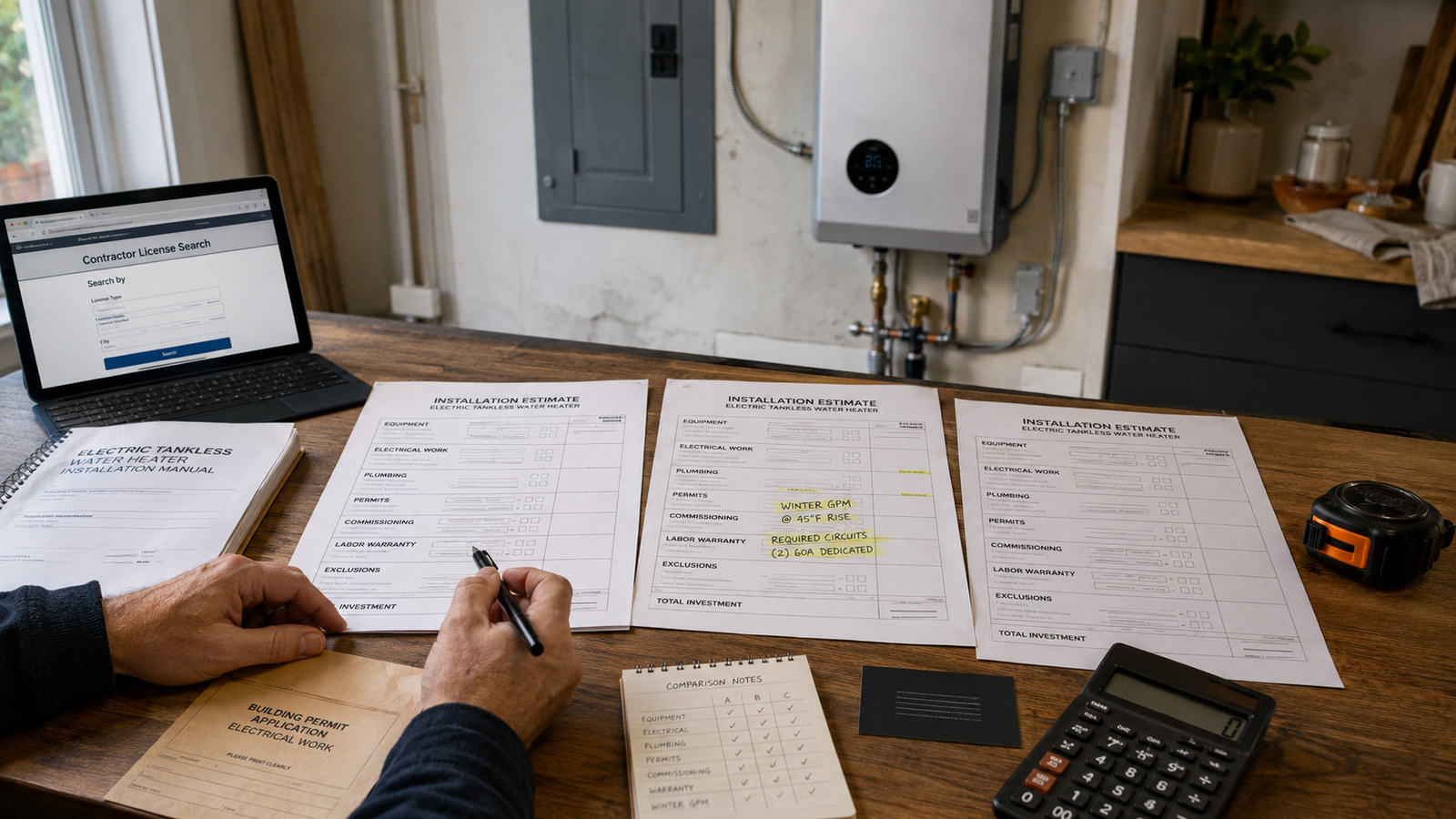
Once the home passes the initial feasibility review, the next step is confirming that the contractor can complete both sides of the project correctly.
General water-heater experience is not enough. A contractor may be excellent at replacing storage tanks while having little experience with multi-circuit electric tankless systems, winter flow-rate sizing or residential electrical-service limitations.
Before accepting an estimate, verify:
- the contractor’s active state or local licence;
- the licence classification covering the proposed work;
- general liability insurance;
- workers’ compensation coverage where required;
- the identity of any electrical or plumbing subcontractors;
- recent experience with the same type of electric tankless project;
- who obtains permits and schedules inspections;
- who is responsible for correcting contractor-caused inspection failures;
- the length and scope of the labor warranty.
A licence number printed on an estimate does not prove that the licence is active or appropriate for the work. Verify it through the relevant state or local licensing authority.
Manufacturer Directories Are a Starting Point, Not Complete Vetting
Some water-heater manufacturers provide contractor directories or lists of installers familiar with their products. These resources can help identify potential companies, but appearing in a directory does not replace independent verification.
You should still check:
- licence status;
- insurance coverage;
- recent customer reviews;
- experience with whole-home electric tankless systems;
- whether the company performs the electrical work itself or subcontracts it;
- whether the installer has worked with the exact model being proposed.
The closest contractor—or the first company listed in a directory—is not automatically the best-qualified option for a high-load whole-home installation.
What the Installer Should Inspect Before Finalizing the Price
A final whole-home quote should follow an on-site inspection. Photographs, phone descriptions and online questionnaires may support a preliminary estimate, but they rarely reveal every condition that affects cost and feasibility.
| Inspection Area | What the Contractor Should Check |
|---|---|
| Electrical service | Main service rating, service-equipment condition, existing major loads and calculated available capacity |
| Electrical panel | Panel model, condition, breaker compatibility and available spaces |
| Circuit route | Distance to the heater, number of conductor runs, conduit path and finished surfaces that may require access |
| Hot-water demand | Expected simultaneous fixtures, winter inlet-water temperature and required outlet temperature |
| Water system | Pipe size, water pressure, shutoff locations, service access and existing leaks or defects |
| Installation location | Mounting surface, working clearances, accessibility and protection from freezing or physical damage |
| Water quality | Hardness, sediment risk, inlet-screen access and future descaling requirements |
| Permit requirements | Electrical, plumbing or water-heater permits required by the local jurisdiction |
If the contractor gives a firm whole-home price without inspecting the panel, circuit route and installation location, ask which assumptions and exclusions are built into that number.
What an Electric Tankless Installation Quote Should Include
A useful quote separates the appliance from the electrical, plumbing and administrative work. One unexplained total makes it difficult to compare contractors or understand what could later become a change order.
| Quote Category | Details That Should Appear |
|---|---|
| Equipment | Exact manufacturer, model, kW rating, voltage, warranty and included accessories |
| Performance assumptions | Winter inlet-water temperature, target outlet temperature, required GPM and simultaneous fixtures |
| Electrical evaluation | Existing service rating, panel condition, dwelling-load conclusion and required upgrades |
| Breakers and circuits | Quantity, amperage, breaker type and number of dedicated circuits |
| Conductors and conduit | Number of runs, approximate length, routing method and included access work |
| Panel or service work | Breaker rearrangement, subpanel, panel replacement, meter work or utility coordination |
| Plumbing | Mounting, water connections, shutoff valves, service access and manufacturer-required pressure-relief provisions |
| Existing heater | Disconnection, removal, disposal and any required site repairs |
| Permits and inspections | Required permits, fees, inspection scheduling and correction responsibility |
| Commissioning | Leak testing, temperature setup and performance testing under expected demand |
| Warranty | Manufacturer registration, labor coverage and exclusions |
| Excluded work | Drywall, painting, cabinetry, concealed damage, utility charges or other work not included |
Our tankless water heater installation labor-cost guide explains how access, electrical work and project complexity can affect contractor charges.
Do Not Compare Quotes by the Final Total Alone
The lowest estimate may reflect an efficient contractor, but it may also exclude work included by other bidders.
Before comparing totals, normalize the estimates by confirming that each contractor priced the same:
- heater model and output;
- breaker and circuit configuration;
- conductor route and approximate length;
- panel or service modifications;
- plumbing valves and fittings;
- removal of the old heater;
- permit fees;
- inspection corrections;
- startup and performance testing;
- labor warranty;
- wall or ceiling repairs.
A quote that appears $1,000 cheaper may not remain cheaper once permits, conductors, disposal and access repairs are added later.
Electric Tankless Installer Red Flags
One weak answer does not always disqualify a contractor, but several of the following signals justify caution.
They Quote a Whole-Home System Without Inspecting the Panel
The contractor cannot confirm breaker space, panel condition, circuit routing or electrical-service capacity without evaluating the existing system.
They Rely Only on the Main-Breaker Rating
“You have 200 amps, so it will work” is not a substitute for evaluating the home’s other electrical loads and the requirements of the selected heater.
They Recommend a Subpanel Without Discussing Service Capacity
A subpanel can add breaker spaces or simplify circuit routing. It does not increase the amount of electrical capacity supplied to the home.
They Size the Heater Only by Bathroom Count
Bathroom count does not establish winter inlet-water temperature, simultaneous hot-water flow or required temperature rise.
They Present Advertised Maximum GPM as Guaranteed Performance
A maximum flow figure measured under favorable conditions may not represent cold-weather output at the homeowner’s chosen temperature setting.
They Cannot Explain the Breaker Arrangement
The installer should be able to identify how many dedicated circuits the selected model requires and which qualified professional will install them.
They Avoid Permit Questions
A contractor should be able to explain which permits apply locally, who obtains them and who resolves contractor-caused inspection corrections.
They Want the Homeowner to Buy the Unit Before the Assessment
Purchasing first can lock the homeowner into equipment that the electrical service cannot support or that cannot meet winter hot-water demand.
They Promise Unlimited Whole-Home Hot Water
Tankless means the heater does not deplete a stored supply. It does not mean unlimited simultaneous flow.
They Pressure You to Decide Immediately
A major electrical and plumbing project should withstand comparison with at least one other properly scoped estimate.
Permits and Inspections Are a Positive Signal
Permit requirements differ by jurisdiction and project scope. Whole-home electric tankless installations commonly require an electrical permit, and plumbing or water-heater permits may also apply.
Before signing the contract, ask:
- Which permits are required?
- Who obtains each permit?
- Are permit fees included?
- Who schedules the inspections?
- Who pays for corrections caused by the contractor’s work?
- Does a panel or service upgrade require utility coordination?
Installers who welcome inspection demonstrate that their work is intended to meet the locally adopted requirements. Our guide to water heater code requirements explains why electrical, plumbing and location rules can affect the final installation.
Questions to Ask Every Electric Tankless Installer
Use the same questions for each contractor so you can compare the answers directly.
- Who will perform the electrical work, and what licence covers it?
- Who will perform the plumbing work?
- Have you installed this model or a comparable whole-home electric unit?
- What winter inlet-water temperature did you use for sizing?
- What GPM will this exact model provide at that temperature rise?
- Which simultaneous fixtures did you include in the demand calculation?
- How many dedicated circuits and breaker spaces are required?
- Does the existing service support the heater after the dwelling load is considered?
- Is the panel suitable, or is a subpanel, panel replacement or service upgrade required?
- How far will the circuits run from the panel to the heater?
- Are conductor routing and access repairs included?
- Which permits and inspections apply?
- Who corrects contractor-caused inspection failures?
- How will you test the unit before final payment?
- What labor warranty do you provide?
- What maintenance does the manufacturer require for our water conditions?
- What alternative would you recommend if the electrical upgrade becomes too expensive?
Qualified contractors should be able to answer these questions in understandable language. A homeowner should not be expected to approve a major service upgrade based on “it should be fine.”
Water Quality and Future Maintenance Should Be Discussed Before Installation
Electric tankless units contain internal water passages and heating surfaces that can lose performance when sediment or mineral scale accumulates.
The contractor should discuss:
- local water hardness;
- inlet filtration;
- access to the inlet screen;
- shutoff and service-valve arrangement;
- the manufacturer’s inspection or descaling recommendations;
- how neglected maintenance may affect warranty coverage;
- who will service the unit after installation.
There is no single universal flushing interval for every electric tankless heater. Maintenance frequency depends on the manufacturer, water conditions, usage and previous service findings. Our tankless water heater maintenance cost guide explains the expenses that may follow installation.
What Should Happen Before Final Payment?
The job is not complete merely because hot water appears at one sink.
Before making the final payment, request:
- permit approval where required;
- the heater’s model and serial number;
- product-registration information;
- copies of manuals and warranties;
- clearly labelled electrical breakers;
- confirmation of the final temperature setting;
- confirmation that the plumbing connections are leak-free;
- an operational test under realistic demand;
- an explanation of the system’s flow limitations;
- maintenance instructions;
- the written contractor labor warranty;
- receipts and a final itemized invoice.
How the Installer Should Test Performance
Turning on one low-flow faucet proves only that the heater activates. It does not prove that the unit can meet the household demand used to justify the purchase.
A meaningful commissioning test should reflect the design assumptions. Depending on the project, that may include:
- measuring the incoming-water temperature;
- confirming the outlet-temperature setting;
- opening the expected simultaneous fixtures;
- checking that the outlet temperature remains reasonably stable;
- observing whether flow is reduced when demand rises;
- checking for leaks, error codes or nuisance breaker trips;
- confirming that low-flow fixtures activate the heater reliably.
The test should also establish what happens when household demand exceeds the heater’s available output. The homeowner should know whether the system allows the outlet temperature to fall, restricts flow or displays an error.
Why the Cheapest Installer Can Cost More Later
A low initial price can become expensive when essential work is omitted.
| Shortcut | Possible Result |
|---|---|
| No dwelling-load evaluation | Failed inspection, nuisance tripping or an unexpected service upgrade |
| Sizing from advertised maximum GPM | Weak winter flow or inadequate simultaneous performance |
| Incomplete circuit planning | Change orders, panel rework or an installation that does not match the manufacturer’s requirements |
| No permit allowance | Extra fees, project delays or unapproved work |
| No service access | Higher maintenance labor and more difficult repairs |
| No realistic commissioning test | Performance problems discovered after final payment |
| Unclear subcontractor responsibility | Disputes over inspection failures, warranties or property damage |
The best value is not automatically the lowest bid. It is the lowest complete and technically defensible price for the performance the homeowner actually needs.
When a Qualified Installer May Tell You to Wait
Delaying the project can be the responsible recommendation when:
- the electrical assessment has not been completed;
- the proposed unit has already been purchased but may be unsuitable;
- a panel or service upgrade was not included in the budget;
- utility approval or utility-side work is required;
- future EV or HVAC plans need to be evaluated first;
- the homeowner’s winter-flow expectations exceed the selected model’s output;
- water-quality problems should be addressed before installation;
- another water-heating system may offer better total value.
A contractor who slows the sale to complete the necessary evaluation may be protecting the homeowner from a much more expensive mistake.
Alternatives When Whole-Home Electric Tankless Does Not Work
Failing the feasibility review does not mean the homeowner has no good options.
| Alternative | When It May Make More Sense |
|---|---|
| Point-of-use electric tankless | One remote fixture needs hot water without a long plumbing extension |
| Standard electric storage heater | Low installation cost and stored peak capacity matter more than compactness |
| Heat pump water heater | Energy efficiency is the priority and the installation space can support the equipment |
| Gas tankless heater | Gas service is available and greater whole-home output is needed |
| Multiple localized heaters | Demand is spread across distant, limited-use fixtures |
| Keep the existing system temporarily | The service upgrade, utility work or replacement plan needs further evaluation |
For a broader ownership comparison, see our tank versus tankless water heater cost guide. When comparing fuel types and operating-cost trade-offs, see our gas versus electric water heater cost guide.
Electric Tankless Installer Hire-or-Walk-Away Checklist
| Hire This Installer When They: | Walk Away or Investigate Further When They: |
|---|---|
| Inspect the panel and proposed circuit route | Quote a complex whole-home job without an inspection |
| Coordinate qualified electrical and plumbing work | Cannot identify who performs each trade’s work |
| Use winter temperature rise and simultaneous GPM | Size the unit only by bathroom count |
| Explain panel space and service capacity separately | Claim a subpanel automatically solves the load problem |
| Provide model-specific breaker requirements | Say the existing panel “should be fine” without evaluation |
| Itemize the appliance, circuits, plumbing and permits | Provide one unexplained total with broad exclusions |
| Welcome permits and inspections | Discourage permits without a jurisdiction-specific reason |
| Describe the final performance test | Consider one hot faucet a complete commissioning test |
| Discuss maintenance and service access | Claim the unit requires no future maintenance or inspection |
| Recommend another system when appropriate | Push whole-home electric tankless into every home |
Frequently Asked Questions
Should a Plumber or Electrician Install an Electric Tankless Water Heater?
A whole-home installation generally requires both electrical and plumbing expertise. One company may coordinate the project, but the estimate should identify the qualified professional responsible for each scope.
Can an Electrician Install the Entire Water Heater?
That depends on local licensing rules and the electrician’s qualifications. Electrical expertise alone does not establish that the contractor is authorized or experienced enough to size and modify the plumbing system.
Can a Plumber Install the Electrical Circuits?
Only when the plumber holds the required electrical licence or the work is completed by a properly licensed electrical professional. Large whole-home units may require several dedicated high-amperage circuits.
Can an Installer Quote the Job From Photographs?
Photographs may support a preliminary estimate, especially for a simple point-of-use installation. A reliable final whole-home quote normally requires inspection of the panel, service equipment, circuit route, plumbing and installation location.
How Many Estimates Should I Get?
For a straightforward point-of-use installation, two complete estimates may be sufficient. For a whole-home project involving panel or service work, obtain at least two or three itemized proposals based on the same performance assumptions.
Does an Authorized Installer Guarantee Good Work?
No directory listing or manufacturer affiliation replaces licence, insurance, reference and scope verification. Confirm who performs the work and who accepts responsibility for permits, inspection corrections and the labor warranty.
Should the Installer Provide a Load Calculation?
The electrical professional should complete the required dwelling-load evaluation to determine whether the proposed heater can be supported. Ask for the conclusion in writing and clarification of any assumptions or planned service upgrades.
Are Permits Always Required?
No single national answer applies. Whole-home electric tankless projects commonly require electrical permits, while plumbing or water-heater permits may also apply. Confirm the local requirements before work begins.
What Happens if the Heater Does Not Meet the Promised Flow?
The contract should identify the performance assumptions used for sizing and explain who is responsible if the installed system does not meet those documented conditions. Verbal claims such as “endless whole-house hot water” are difficult to verify or enforce.
Can I Buy the Heater Before Hiring the Installer?
It is safer to complete the electrical and performance assessment first. Otherwise, you may purchase a unit the service cannot support or one that cannot meet the required winter flow.
Is the Closest Installer Usually the Best Choice?
Not necessarily. Relevant electric tankless experience, qualified trade coordination, clear calculations and a complete written scope matter more than driving distance alone.
What Is the Most Important Question to Ask?
Ask the contractor to demonstrate that the exact heater can meet the expected winter hot-water demand and that the home’s calculated electrical capacity can support all required circuits.
Bottom Line
Hiring the right electric tankless water heater installer is not mainly about finding the fastest appointment or lowest headline price. It is about finding a contractor who can demonstrate that the selected heater, household demand and electrical service are compatible.
The strongest installers inspect before quoting, coordinate qualified electrical and plumbing professionals, document expected winter performance, itemize infrastructure costs, welcome permits and test the completed system under realistic demand.
Most importantly, they are willing to recommend a point-of-use unit, storage heater, heat pump water heater or another solution when whole-home electric tankless does not make technical or financial sense. That judgment—not the brand printed on the appliance—is what protects the homeowner from electrical overloads, weak performance and expensive rework.