
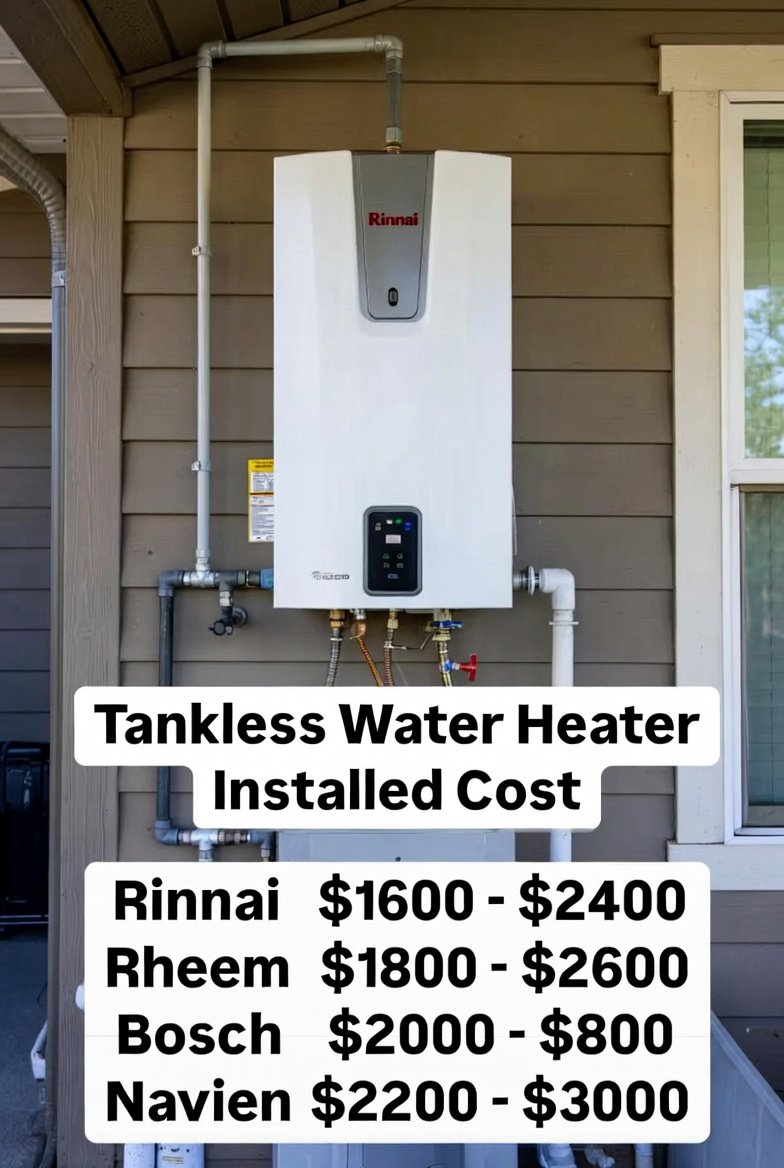
Tankless Gas Water Heater Installation Cost (What You’ll Actually Pay)
When homeowners search for tankless gas water heater installation cost, they’re usually trying to answer one uncomfortable question:
“Why did one installer quote $3,800 and another quoted $9,200?”
The answer isn’t greed.
Its scope.
You are not simply replacing a heater.
You may be upgrading your home’s gas delivery, combustion ventilation, and exhaust system.
Those are fundamentally different projects — and they price differently.
Let’s break it down like a contractor would.
Real Installed Cost Ranges (Gas Tankless Only)
Here’s where most U.S. homeowners land:
Installation Scenario | Typical Installed Cost |
Simple tankless replacement (same location) | $2,400 – $4,500 |
Tank → tankless conversion (minor upgrades) | $3,500 – $6,500 |
Major upgrades or relocation required | $6,000 – $12,000+ |
If you haven’t compared this to traditional systems yet, review the broader water heater replacement cost analysis first — tank systems can change the financial equation entirely.
Installed Cost = 3 Buckets (This Is Where Clarity Begins)
Most articles blend everything into one vague “average.”
Real pricing always follows this formula:
Unit Cost + Base Installation + Upgrade Add-Ons
Understanding this structure lets you control your quote instead of reacting to it.
1️⃣ Unit Cost (The Heater Itself)
Gas tankless units typically range:
- $800 – $2,500+
Cost depends on:
- BTU capacity
- Brand tier
- Condensing vs non-condensing
- Warranty length
Higher BTU units support larger households — but may require larger gas supply lines.
2️⃣ Base Installation (Standard Labor Scope)
Base install generally includes:
- Removing old heater
- Mounting new unit
- Water line connections
- Gas connection (if properly sized)
- Vent tie-in (if compatible)
- Startup + testing
Typical labor time:
- 3–6 hours for straightforward swaps
- 1 full day for moderate conversions
- 1–2 days for upgrade-heavy installs
For a labor-only breakdown, see the detailed labor cost to install tankless water heater guide — this is where most cost confusion originates.
3️⃣ Upgrade Add-Ons (Where Costs Escalate)
This is the real differentiator.
Upgrade | Why It Happens | Impact |
Gas line upsizing | Tankless requires high BTU demand | $$$ |
New venting system | Different exhaust class required | $$$ |
Condensate drain | Required for condensing units | $$ |
Electrical outlet | Gas units still need power | $ |
Permit & inspection | Code compliance | $ |
Relocation | Plumbing & vent rerouting | $$$$ |
If multiple items appear in your quote, you are not in a “standard install” scenario.
Gas Line Sizing: The Hidden Multiplier
Most tank heaters run at significantly lower BTU demand.
Gas tankless units often require 150,000–199,000 BTU.
If your existing gas piping cannot support that:
- Pipe diameter may need to increase
- Sections may need replacement
- Meter load may require review
This is why some conversions jump from $4,500 to $8,000 quickly.
If you’re unsure how fuel infrastructure changes total cost, compare it with gas vs electric water heater cost before committing.
Condensing vs Non-Condensing (Important Tradeoff)
Non-Condensing
- Lower unit cost
- Requires stainless steel venting
- Higher exhaust temperature
Condensing
- Higher unit cost
- Often allows PVC venting
- Requires condensate drainage
Sometimes the more expensive condensing model reduces vent material costs.
Most pages skip this nuance.
Installers do not.
Cost by Household Size (More Accurate Estimation)
Home Size | Typical Installed Range (No Major Upgrades) |
1–2 Bath | $3,000 – $4,500 |
3–4 Bath | $4,000 – $6,500 |
Large Home (High BTU Demand) | $5,500 – $8,000 |
Add gas or vent upgrades, and those numbers climb.
If your home already supports higher demand systems, your costs stay lower.
Conversion Feasibility Diagnostic (Are You a Good Candidate?)
Answer these honestly:
- Is your gas line at least ¾ inch diameter?
- Is the heater staying in the same location?
- Is vent run short and direct?
- Is there an electrical outlet nearby?
- Is your water hardness manageable?
- Is your current meter load sufficient?
- Is relocation unnecessary?
If most answers are “yes,” you’re likely in the lower pricing tier.
If several are “no,” prepare for infrastructure upgrades.
Inspection Failure Scenarios (What Contractors Don’t Mention)
Common reasons installs fail inspection:
- Improper vent termination clearance
- Incorrect vent slope
- Undersized gas line
- Missing condensate neutralizer
- Inadequate combustion air
When corrections are required after inspection, labor costs increase.
This is why reviewing water heater installation code requirements before installation can prevent surprises.
Relocation vs Same-Spot Installation
Relocation multiplies cost because it involves:
- New plumbing routing
- Extended venting
- Gas pipe reruns
- Possible drywall access
If you’re relocating to attic or closet spaces, cost escalation is common.
Micro Case Example (Real-World Scenario)
A 3-bath suburban home replacing a 50-gallon tank:
- Base tankless install: $4,900
- Vent modification: +$850
- Gas line upsizing: +$1,200
Final total: ~$6,950 installed
Same home with compatible gas line and vent:
- $4,200–$5,200 total.
Scope defines price.
Long-Term Ownership Cost Comparison (10-Year View)
Tank Heater | Gas Tankless | |
Install Cost | Lower | Higher |
Energy Efficiency | Moderate | Higher |
Maintenance | Moderate | Annual flush recommended |
Lifespan | 8–12 years | 15–20 years |
If your current heater is near end-of-life, review water heater lifespan years to time your upgrade strategically.
Common Homeowner Mistakes
Buying the unit before evaluating gas capacity
Assuming tankless always saves money
Ignoring water hardness
Not asking for itemized quotes
If your quote feels inflated, compare it with broader tank water heater vs tankless cost before deciding.
Power Outage Reality
Gas tankless systems require electricity for:
- Ignition
- Fan operation
- Control board
During outages, they typically will not operate without backup power.
The Point of No Return
If your installation requires:
- Gas line replacement
- Major vent rerouting
- Relocation
- Multiple infrastructure upgrades
You are upgrading your home’s fuel system — not just replacing a heater.
That’s why cost jumps.
Final Decision Matrix
Best overall value:
Simple in-place tankless replacement.
Best premium upgrade:
Tank → tankless conversion with minimal infrastructure change.
Best budget option:
High-efficiency tank heater when upgrades are extensive.