
Gas vs Electric Water Heater Cost — What You’ll Actually Pay Over Time
Gas is usually cheaper to run.
Electric is usually cheaper to install.
That’s the surface-level answer.
But the real cost difference depends on something far more specific:
- Your utility rates
- Your electrical panel capacity
- Whether a gas line already exists
- Your household size
- How long you plan to stay in the home
Most homeowners choose based on the upfront price.
Smart homeowners choose based on 10-year ownership cost.
Let’s break this down clearly, without generic advice.
Upfront Installation Cost
For standard tank-style systems:
Type | Typical Installed Cost |
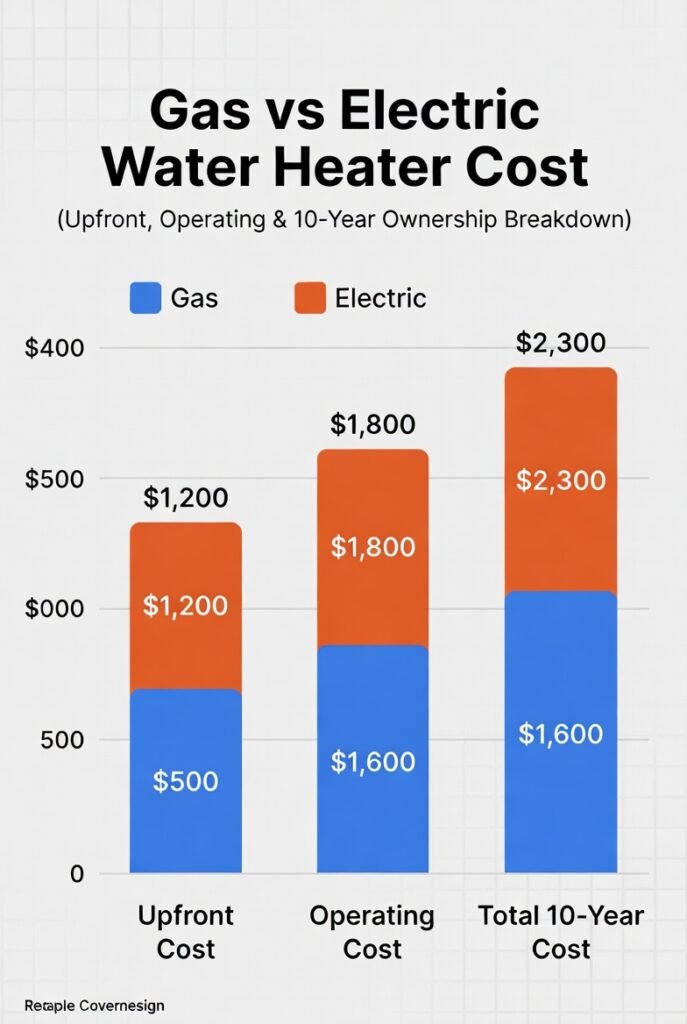
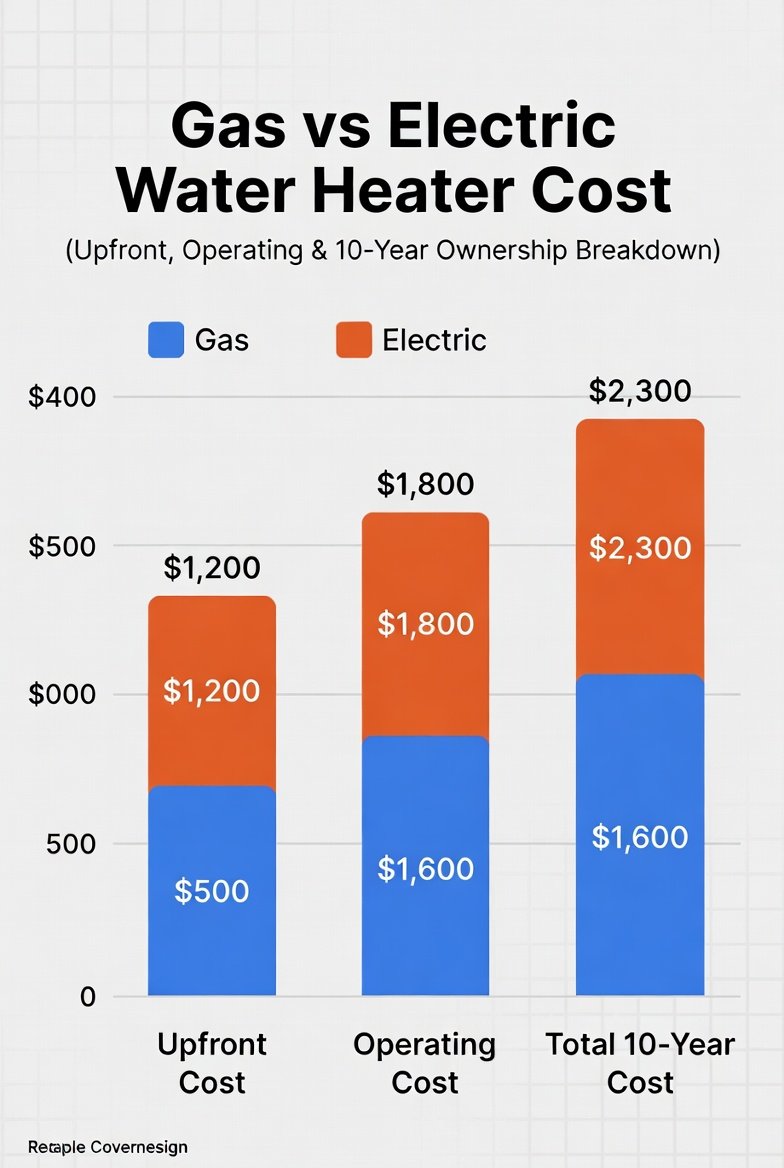
Electric Tank | $1,200 – $2,800 |
Gas Tank | $1,800 – $3,500 |
Gas usually costs more because it may require:
- Venting
- Combustion clearance
- Gas line hook-up
- Permit & inspection
Electric systems typically require:
- Dedicated breaker
- Sufficient panel capacity
- Proper voltage wiring
If you’re reviewing total replacement pricing beyond just fuel type, see the broader water heater replacement cost breakdown for full context.
Infrastructure determines price more than fuel type.
Operating Cost (Monthly Utility Impact)
This is where gas often pulls ahead.
Why Gas Can Be Cheaper to Operate
- Lower cost per BTU in many regions
- Faster recovery rate
- Higher output for larger households
Why Electric May Cost More Monthly
- Higher electricity rates per energy unit
- Slower heating recovery
- Higher demand draw during peak use
But here’s where most articles stop.
They fail to explain efficiency ratings.
Understanding UEF (Efficiency Rating Matters)
UEF (Uniform Energy Factor) measures how efficiently a water heater converts energy into hot water.
- Electric tank heaters often have UEF ratings around 0.90–0.95
- Gas tank heaters usually range 0.55–0.70
Electric appears more efficient on paper.
However, fuel cost per unit changes the equation.
Efficiency does not automatically equal lower bills.
Regional Fuel Cost Example (This Changes Everything)
Let’s compare two simplified scenarios:
Texas Example
- Natural gas: relatively low cost
- Electricity: moderate cost
Gas likely wins long-term.
California Example
- Higher electricity rates
- Moderate gas pricing
The difference shrinks — and sometimes electric becomes competitive.
Your ZIP code matters more than national averages.
10-Year Ownership Cost Model
Let’s model a 3-bath household:
Gas | Electric | |
Install | $2,800 | $2,000 |
Annual Energy | $350 | $550 |
10-Year Energy | $3,500 | $5,500 |
Maintenance | $700 | $600 |
10-Year Total | ~$7,000 | ~$8,100 |
Gas costs more upfront.
Electric costs more monthly.
Gas often breaks even in 3–5 years depending on usage.
Break-Even Formula (Simple Version)
If gas costs $800 more upfront
But saves $200 annually
Break-even = 4 years.
If you plan to stay longer than that, gas may make sense.
If you’re selling within 2–3 years, electric may be smarter.
Infrastructure & Code Requirements
Before choosing, confirm compliance.
Gas heaters require:
- Proper venting
- Combustion air clearance
- Code-approved flue system
Electric heaters require:
- Dedicated breaker
- Adequate amperage
- Panel capacity
Review local water heater installation code requirements before finalizing.
Upgrades can change the cost equation dramatically.
Outage & Reliability Behavior
This is often misunderstood.
Electric Tank
- Stops during power outage
- Simple design
- Fewer combustion components
Gas Tank
- Often continues operating during outages (model dependent)
- Requires vent safety
- May use electronic ignition
If outage resilience matters in your region, gas often has the edge.
Lifespan & Maintenance Comparison
Gas | Electric | |
Lifespan | 8–12 years | 10–15 years |
Maintenance | Burner cleaning | Element replacement |
Corrosion Risk | Similar (water quality dependent) |
Electric systems sometimes last slightly longer due to fewer combustion components.
If you’re timing replacement strategically, see water heater lifespan years for deeper planning.
Resale & Inspection Considerations
In some markets, buyers expect gas systems.
In others, electric is standard.
Gas units require inspection of:
- Venting
- Flue clearance
- Combustion safety
Electric units are often simpler during inspection.
This doesn’t usually determine value — but in certain housing markets, gas is perceived as premium.
Household Modeling (Which Fits Your Home?)
Small Apartment / 1–2 People
Electric often wins:
- Lower install cost
- Lower demand
3–4 Bath Suburban Home
Gas often preferred:
- Faster recovery
- Lower long-term operating cost
Large Household / High Usage
Gas generally performs better under demand pressure.
If you’re comparing tank systems against tankless options too, review tank water heater vs tankless cost before finalizing.
Environmental Angle
Electric produces no on-site combustion emissions.
Gas emits combustion gases but can be efficient in high-demand homes.
Local energy grid composition matters for sustainability decisions.
Limitations (Balanced Perspective)
- Fuel prices fluctuate.
- Panel upgrades can erase electric savings.
- Gas venting upgrades can erase gas savings.
- Water hardness affects both systems equally.
- Regional building codes influence cost.
There is no universal “better.”
There is only “better for your house.”
Final Decision Matrix
Best long-term value (medium–large homes): Gas
Best upfront budget choice: Electric
Best for outage resilience: Gas
Best for simple installation: Electric
Best for heavy usage recovery speed: Gas