
Federal Rebate for Heat Pump Water Heater: What It Really Means in 2025
When homeowners search “federal rebate for heat pump water heater,” they’re usually trying to answer a simple question:
“How much money will the federal government give me?”
The short answer:
There is no instant federal rebate.
There is a federal tax credit under Section 25C that equals 30% of qualifying project cost, up to $2,000 per year for heat pumps and heat pump water heaters.
That distinction matters — because it changes:
- When you receive the benefit
- How it affects your taxes
- Whether you qualify
- What documentation you must keep
- And how it stacks with state or utility rebates
This guide explains it clearly, without hype or confusion.
What the Federal Incentive Actually Is (Section 25C)
The federal program is called the Energy Efficient Home Improvement Credit (25C).
For qualifying heat pump water heaters:
- 30% of project cost
- Maximum $2,000 per year
- Applies to equipment and installation labor
This credit is claimed on your federal tax return using IRS Form 5695.
It is:
- Not a point-of-sale discount
- Not a manufacturer rebate
- Not paid at checkout
- Not issued by your utility
It reduces your federal income tax liability.
Is It Available in 2025 — And Beyond?
Under current IRS guidance, the 25C credit applies to qualifying improvements placed in service after January 1, 2023 and before January 1, 2033.
That means the federal tax credit structure currently runs through 2032, not just 2025.
However, tax law can change. If you are planning around this incentive, confirm eligibility at the time of installation.
How Much Is the Federal Credit?
The math is straightforward:
Example 1
Installed cost: $4,000
30% = $1,200 tax credit
Example 2
Installed cost: $7,000
30% = $2,100 → capped at $2,000
The $2,000 limit is an annual cap for heat pumps, heat pump water heaters, and certain biomass systems combined.
If you already claimed $2,000 for a qualifying HVAC heat pump earlier in the same tax year, you may not have remaining eligibility.
For full cost breakdown before incentives:
water heater cost
Important 2025 Filing Update: QMID Requirement
Beginning with systems placed in service in 2025, IRS instructions require a Qualified Manufacturer Identification Number (QMID) for certain high-efficiency property.
This is a 4-character code provided by the manufacturer.
You may need it when completing Form 5695.
Ask your contractor or manufacturer for:
- Manufacturer certification statement
- QMID code (if applicable)
- ENERGY STAR documentation
This is a new compliance detail many homeowners miss.
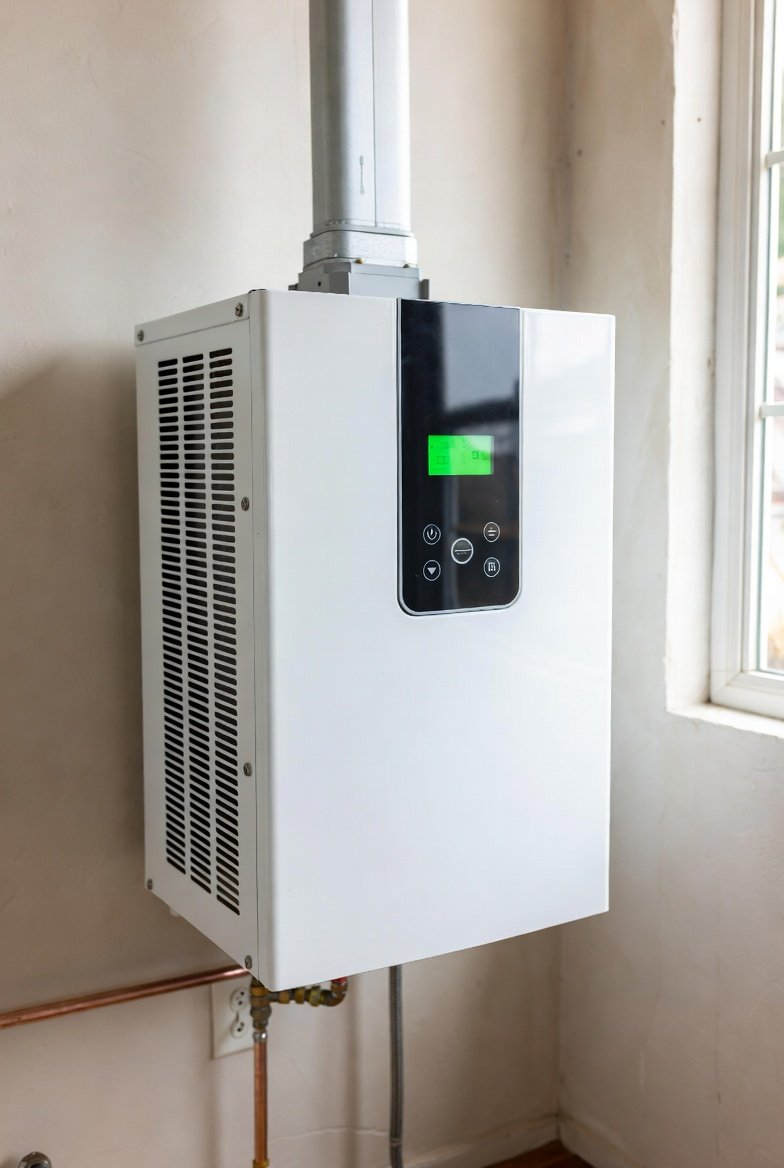
Who Qualifies for the Federal Credit
You generally qualify if:
- The home is your primary residence
- The home is located in the United States
- The equipment meets qualifying efficiency standards (often ENERGY STAR)
- You have federal income tax liability
- The system is installed and placed in service during the qualifying year
The credit reduces your tax owed. It does not increase your refund beyond your tax liability.
Who Does NOT Qualify (Common Edge Cases)
Rental Property Owners
The 25C credit is generally limited to owner-occupied primary residences.
Low Federal Tax Liability
The credit is nonrefundable.
It reduces taxes owed but does not create a payment beyond your tax liability.
No Carryforward
Unlike some energy credits (such as 25D solar credits), the 25C credit does not typically carry forward unused amounts to future years.
Shared Annual Cap
The $2,000 annual limit applies across certain qualifying equipment categories.
If you use it for another qualifying heat pump in the same year, your remaining balance may be zero.
How the Credit Actually Affects Your Taxes (Cash-Flow Reality)
This is where confusion happens.
Example:
If you owe $3,000 in federal taxes and qualify for a $1,200 credit:
You now owe $1,800.
If you owe only $800 and qualify for $1,200:
You may only benefit up to your tax liability.
This is why calling it a “rebate” causes planning mistakes. The money does not reduce your invoice upfront.
What Costs Count?
Eligible costs typically include:
- Heat pump water heater unit
- Installation labor
- Necessary components directly related to installation
Always keep:
- Detailed contractor invoice
- Proof of payment
- Model number and efficiency certification
- Installation (placed-in-service) date
For installation cost detail:
water heater installation cost
How It Interacts With State or Utility Rebates
The federal credit can often be combined with:
- State rebates
- Utility incentives
- Electrification programs
Typical stacking flow:
- Utility rebate reduces invoice
- State rebate reduces invoice
- Federal tax credit applies to eligible cost
For location-specific incentives:
heat pump water heater rebate
Should You Upgrade Just for the Federal Credit?
Not always.
If your current heater is stable and near mid-life, replacing it solely for the tax credit may not be economically optimal.
Consider:
The federal credit improves ROI.
It should not override fundamentals.
Common Filing Mistakes
- Claiming before installation is complete
- Forgetting QMID requirement (2025+)
- Claiming on rental property
- Exceeding annual $2,000 cap
- Using non-qualifying equipment
- Missing documentation
When in doubt, consult a qualified tax professional.
Policy Stability and Future Changes
Federal incentives are governed by tax law.
Current guidance allows the 25C credit through 2032.
However, policy can change with future legislation.
If timing matters for your project, confirm eligibility before scheduling installation.
Contractor-Level Summary
In 2025:
There is no federal instant rebate.
There is a 30% tax credit, capped at $2,000 per year, for qualifying heat pump water heaters installed in an eligible primary residence.
It:
- Reduces federal tax liability
- Requires proper documentation
- May require QMID reporting (2025+)
- Can stack with state and utility rebates
- Does not reduce your invoice at purchase
Decision Matrix
Best fit: Homeowners with tax liability installing in a primary residence
Strong ROI case: When combined with state/utility rebates
Proceed cautiously: Low tax liability or shared annual cap already used
Not eligible: Rental property installations
FAQs
Is there a federal rebate for heat pump water heaters in 2025?
There is a federal tax credit under Section 25C equal to 30% of qualifying cost up to $2,000 per year, not an instant rebate.
Does installation labor count?
Yes, qualifying installation labor is generally included.
Can I combine the federal credit with state rebates?
In many cases, yes. Confirm stacking rules for your state and utility.
Does the credit carry forward if unused?
The 25C credit is generally nonrefundable and does not typically carry forward unused amounts.
What is a QMID and do I need it?
Starting in 2025, IRS filing instructions may require a Qualified Manufacturer Identification Number for certain qualifying property placed in service during the tax year.