
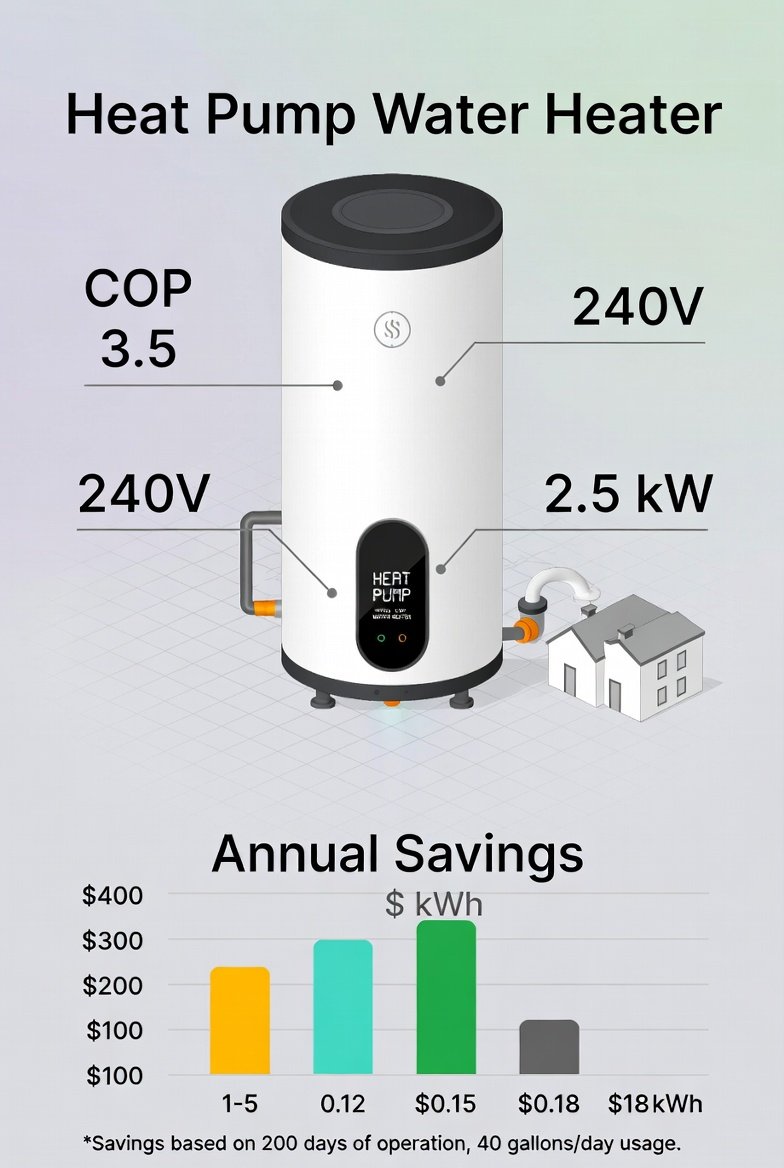
Heat Pump Water Heater Annual Savings: What You Actually Save (With Real Math)
You’ve probably seen this claim:
“Save up to $550 per year.”
That number isn’t invented. ENERGY STAR notes that an ENERGY STAR certified heat pump water heater can save a typical family of four around $550 per year compared to a standard electric resistance water heater.
But that’s an average.
Your actual annual savings depend on:
- Your electric rate
- Your current water heater type
- Household hot water usage
- Installation environment
- How often the unit runs in resistance mode
This page breaks savings down with transparent modeling — not marketing headlines.
Quick Annual Savings Snapshot (Modeled Range)
Replacing a standard electric resistance tank:
Electric Rate | Standard Electric Annual Cost | Heat Pump Annual Cost | Estimated Annual Savings |
$0.14/kWh | ~$560 | ~$210–$260 | ~$300–$350 |
$0.18/kWh | ~$720 | ~$270–$330 | ~$390–$450 |
$0.25/kWh | ~$1,000 | ~$375–$450 | ~$550–$625 |
These ranges assume:
- 4-person household
- 64 gallons/day usage
- Mostly heat pump mode operation
For full installed cost context, see the installed cost breakdown:
water heater cost
Model Assumptions (So You Know Where the Numbers Come From)
To avoid vague claims, here’s what we’re modeling:
- Standard electric tank: ~4,000 kWh/year
- Heat pump water heater: ~1,400–1,700 kWh/year
- COP (Coefficient of Performance): 2.5–3.5
- Electric rate scenarios: $0.14 and $0.25 per kWh
- Resistance mode use: <15% baseline
If resistance elements run more frequently (cold install environment or heavy usage), savings decline. We’ll cover that below.
Standard Electric vs Heat Pump (Core ROI Case)
Example at $0.14/kWh
Standard electric:
4,000 kWh × $0.14 = $560/year
Heat pump:
1,500 kWh × $0.14 = $210/year
Savings ≈ $350 per year
Example at $0.25/kWh
Standard electric:
4,000 kWh × $0.25 = $1,000/year
Heat pump:
1,500 kWh × $0.25 = $375/year
Savings ≈ $625 per year
For detailed operating cost modeling:
water heater cost to run
Household Size Matters
Savings scale with usage.
2-Person Household
- Lower kWh usage
- Typical savings: ~$150–$300/year
4-Person Household
- Mid-range usage
- ~$300–$600/year
6-Person Household
- Higher demand
- $500–$800/year possible (higher electric rates)
More hot water usage = more energy displaced by higher COP efficiency.
Electric Rate Sensitivity (The Biggest Driver)
Savings increase significantly as electric rates rise.
At:
- $0.12/kWh → moderate savings
- $0.18/kWh → strong savings
- $0.25/kWh → substantial savings
This is why ROI differs dramatically by region.
Gas vs Heat Pump: Annual Savings Reality Check
Savings vs gas depend on:
- Gas price per therm
- Efficiency of existing gas unit
- Venting losses
- Climate
In regions with low gas prices and moderate electric rates, annual savings may be smaller.
In higher electric rate states where gas costs are rising, heat pumps often close the gap quickly.
Full fuel comparison breakdown:
gas vs electric water heater cost
The point: savings are contextual — not universal.
Hybrid Mode & Climate Adjustment (Where Savings Shrink)
Heat pump water heaters include:
- Heat pump mode
- Hybrid mode
- Electric resistance backup
Savings assume the unit runs mostly in heat pump mode.
Savings decline when:
- Installed in cold garage or unconditioned space
- Ambient temperature is low
- High-demand mode runs frequently
- Tank is undersized for household
- Setpoint temperature is very high
If resistance runs 20–30% of the time, annual savings may drop 10–25%.
Installation environment matters.
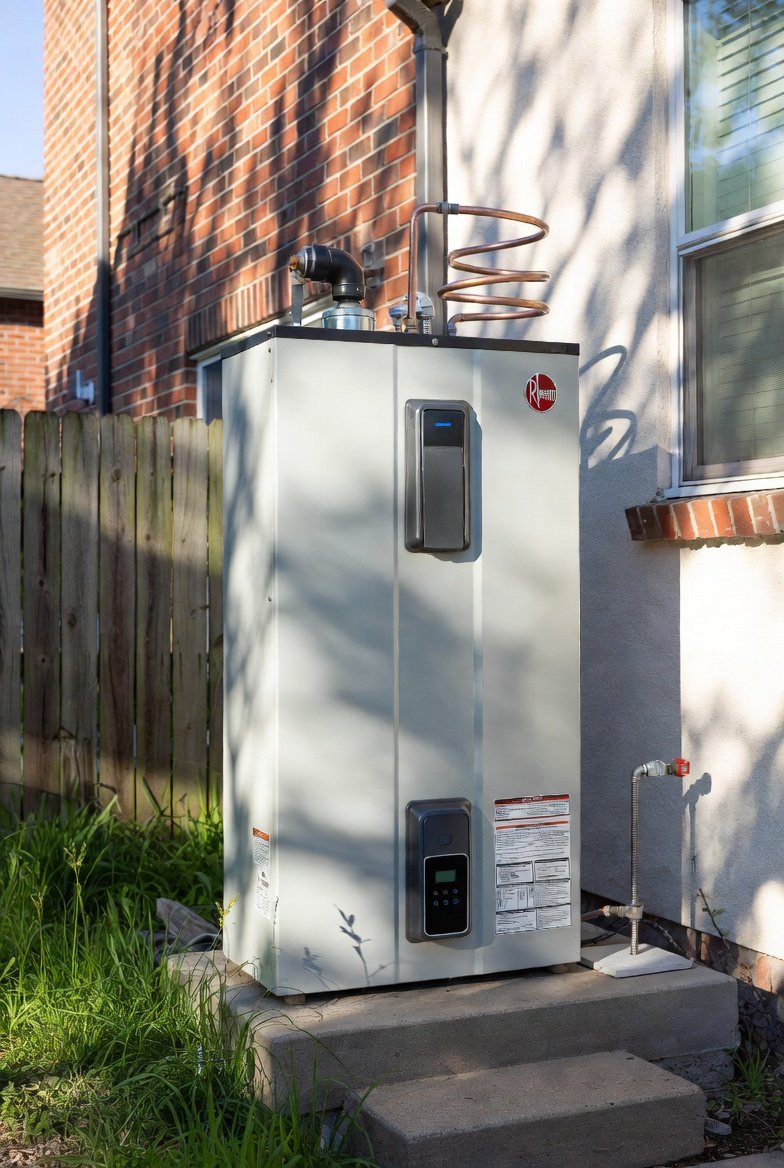
Air volume typically required:
700–1,000 cubic feet
Noise level:
45–60 dB
Installation cost complexity overview:
Permit and code nuance (often overlooked):
installation code requirement
10-Year Savings Projection
Assume $350 annual savings:
10 years → $3,500 saved
At $600 annual savings:
10 years → $6,000 saved
If combined with federal incentive:
rebate for heat pump
Your effective payback accelerates.
Simple Payback Example
Standard electric installed:
~$1,800
Heat pump installed:
~$4,000
Difference:
~$2,200
Federal credit example:
-$1,200
Adjusted gap:
~$1,000
If saving $400/year:
Payback ≈ 2.5 years
Without incentives:
Payback ≈ 5–6 years
Replacement cost timing matters:
When Annual Savings Are Strong
- High electric rates
- 4+ person household
- Mostly heat pump mode operation
- Proper installation environment
- Federal incentive applied
When Savings Are Modest or Questionable
- Very low electric rates
- Small household
- Cold climate install without adequate space
- Frequent resistance backup use
- New, efficient gas heater replacement in low electric-rate region
Savings are conditional — not automatic.
Contractor-Level Verdict
Typical annual savings:
$250–$600 per year replacing standard electric
Higher in high-rate regions
Savings vs gas vary significantly by region.
The best ROI cases:
- Electric resistance replacement
- Moderate-to-high electric rates
- Federal credit + rebates
- Proper installation environment
Savings shrink when:
- Environment forces resistance mode
- Household demand is minimal
- Electric rates are unusually low
Decision Matrix
Best ROI: High electric rates + 4+ person household
Strong ROI: Electric resistance replacement + incentives
Moderate ROI: Low electric rates + small household
Questionable ROI: Efficient gas replacement in low electric-rate region
FAQs
How much can a heat pump water heater save annually?
Most households save between $250 and $600 per year compared to standard electric resistance tanks.
Do electric rates matter?
Yes. Higher kWh rates increase annual savings significantly.
Does hybrid mode reduce savings?
If resistance elements run frequently, savings may drop 10–25%.
How long is payback?
Typically 2–6 years depending on installation cost, incentives, and electric rates.
Are savings guaranteed?
No. They depend on usage, electric rate, installation environment, and operating mode.