
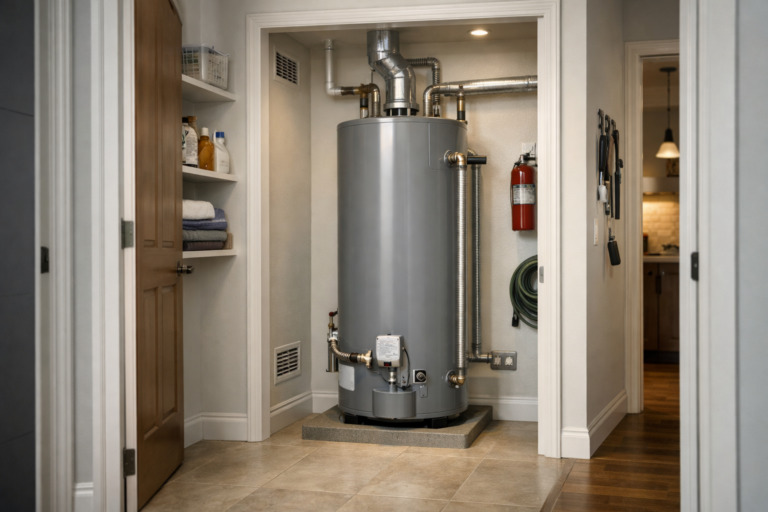
A water heater can be installed in a closet only when the enclosure complies with the locally adopted code, the appliance listing and the manufacturer’s installation instructions. The required clearance, access, combustion air, venting and closet-door design depend on whether the heater is electric, atmospheric gas, direct vent, power vent, tankless or heat pump.
There is no single national closet size, universal louvered-door rule or one clearance measurement that applies to every water heater. A closet that is suitable for an electric resistance tank may be unsuitable for an atmospheric gas heater or a heat pump water heater.
Immediate safety warning
If you smell gas, do not operate switches or create a flame. Leave the building and contact the gas utility or emergency services from a safe location. If a carbon-monoxide alarm sounds, move everyone into fresh air and follow the alarm manufacturer’s emergency instructions. Soot, scorch marks, a disconnected vent or exhaust entering the home also requires prompt professional attention.
Is It Legal to Put a Water Heater in a Closet?
Yes. Many water heaters can legally and safely be installed in a closet, but compliance depends on the appliance type, closet location and installation design.
A compliant water-heater closet may need to address:
- clearance from combustible construction
- access for observation, inspection, service and replacement
- a door and removal path large enough for the appliance
- combustion air for fuel-burning equipment
- approved venting for combustion products
- access to electrical, gas and plumbing connections
- temperature-and-pressure relief-valve discharge piping
- drainage and leak protection where required
- manufacturer-specified installation clearances
- state and local code amendments
The final interpretation belongs to the local authority having jurisdiction, commonly shortened to AHJ. Depending on the location, this may be the municipal building department, plumbing inspector, mechanical inspector or another code-enforcement authority.
A heater that complied when originally installed may not satisfy every requirement applied to a new installation today. Replacing the unit can also trigger current requirements for venting, drainage, electrical connections, seismic restraint or other safety upgrades.
Why the Manufacturer’s Installation Manual Controls
Water heaters are listed appliances. They are tested for installation under specified conditions, including clearances, vent materials, combustion-air arrangements and service access.
The installation manual for the exact model may identify:
- minimum side, rear, front and top clearances
- clearance to combustible materials
- required access to controls and service panels
- combustion-air methods and opening sizes
- approved vent materials and routing
- closet or confined-space installation options
- electrical and gas-supply requirements
- condensate drainage requirements
- temperature-and-pressure relief piping
A generic measurement copied from another installation cannot safely replace the instructions for the actual heater. Two models using the same fuel can still have different venting, air-volume and clearance requirements.
The International Residential Code water-heater provisions also require water heaters to be installed in accordance with their listing and manufacturer instructions, subject to the code adopted locally.
Identify the Water Heater Type First
The heater type determines which closet rules matter most. Check the rating plate and installation manual before evaluating the enclosure.
| Water heater type | Main closet concern | What must be verified |
|---|---|---|
| Electric resistance tank | Service access, electrical equipment, relief piping and drainage | Access panels, disconnect, branch circuit, drain pan and manufacturer clearances |
| Atmospheric gas tank | Combustion air, natural draft and venting | Air volume or openings, draft hood, vent connector and appliance-location restrictions |
| Power-vent gas tank | Approved vent routing and electrical supply | Approved pipe material, maximum equivalent length, air requirements and termination |
| Direct-vent or sealed-combustion gas heater | Sealed combustion-air intake and exhaust system | Intake and exhaust routing, sealed joints, terminal clearances and listing requirements |
| Indoor gas tankless | Venting, combustion air and maintenance access | Approved vent system, intake arrangement, clearances, condensate and service valves |
| Heat pump water heater | Air volume, airflow, condensate and filter access | Room volume, louver or duct requirements, ambient temperature and condensate drainage |
What Clearance Is Required Around a Closet Water Heater?
The word clearance can refer to several separate requirements. Treating them as one measurement is a common source of installation mistakes.
Clearance to combustible materials
Combustible clearance is the required separation between the appliance or venting components and materials capable of burning, including wood framing, shelving, stored cardboard and some finishes.
The required separation can depend on:
- the heater’s listing
- the manufacturer’s installation instructions
- the type of vent connector or vent system
- the locally adopted mechanical or fuel-gas code
Do not assume that a heater approved for a small side clearance allows its draft hood, vent connector, controls or piping to touch nearby construction. Different components can have different clearance requirements.
Service and working space
Service space allows a technician to observe the heater, open panels, inspect controls, test components and complete repairs safely.
ICC-based plumbing and mechanical provisions commonly require a level working space of at least 30 inches by 30 inches in front of the control or service side of an appliance. However, the adopted code, installation location and manufacturer instructions must still be checked before treating that figure as the final requirement for a particular closet. :contentReference[oaicite:0]{index=0}
Service access must also allow:
- control and burner access
- removal of electric heating elements
- filter removal on a heat-pump unit
- operation of shutoff valves
- inspection of the temperature-and-pressure relief system
- routine flushing and maintenance
Door opening and appliance-removal path
The closet opening and route through the building must be large enough to install and later remove the water heater without removing unrelated permanent construction, appliances, pipes or ducts.
Some codes prescribe minimum access-opening dimensions for particular locations such as attics, crawl spaces, pits or excavations. Those provisions should not automatically be applied to every ordinary closet installation.
For a standard closet, verify:
- the tank’s diameter and height
- the clear opening after accounting for hinges and trim
- shelving, framing and nearby appliances
- pipes or ducts that block removal
- the space needed to tilt or maneuver the tank
- whether permanent construction would need alteration
Inadequate removal access can substantially increase replacement labor. Our water heater replacement cost guide explains how difficult access and required upgrades can affect the installed price.
Does a Water Heater Closet Need Ventilation?
The answer depends on what type of heater is installed and what the word ventilation is being used to describe.
Three different air or exhaust functions are often confused:
- Combustion air: Oxygen supplied to a fuel-burning appliance.
- Appliance venting: The approved system that carries combustion products outdoors.
- Heat-pump airflow: Room or ducted air moved across the heat pump’s evaporator.
These systems are not interchangeable.
- Atmospheric gas heaters need adequate combustion air and a properly drafting vent.
- Direct-vent appliances normally use dedicated outdoor-air intake and exhaust pathways.
- Power-vent appliances use fan-assisted exhaust but still follow model-specific air and venting requirements.
- Electric resistance heaters do not need combustion air but still require service and electrical access.
- Heat pump water heaters require sufficient airflow even though they do not burn fuel.
A louvered door may be part of a compliant design, but louvers alone do not prove that the enclosure provides enough air.
Combustion Air for a Gas Water Heater Closet
A gas water heater requires oxygen for combustion. An atmospheric model also relies on adequate draft to move combustion products through the vent system.
Insufficient combustion air can contribute to:
- incomplete combustion
- unstable or abnormal flame behavior
- soot formation
- poor draft
- vent spillage or backdrafting
- nuisance shutdowns
- increased carbon-monoxide risk
The calculation must consider the aggregate input rating of all fuel-burning appliances that obtain combustion air from the same space, not only the water heater.
The 50-cubic-feet-per-1,000-Btu method
Under a commonly used standard indoor-air method, an unconfined space has at least approximately 50 cubic feet of volume for every 1,000 Btu per hour of aggregate appliance input. :contentReference[oaicite:1]{index=1}
For example, a 40,000-Btu water heater considered by itself would require approximately:
40 × 50 = 2,000 cubic feet of qualifying indoor volume
If a second fuel-burning appliance draws air from the same space, its input rating must normally be added to the calculation.
This calculation is only one approved approach. Whether adjoining rooms can be counted depends on how they communicate with the enclosure, the adopted code and the building’s air-infiltration characteristics.
A closet that does not meet the indoor-volume method may still be compliant when approved combustion-air openings, ducts or a mechanical air-supply system are properly designed.
Indoor combustion-air openings
Some code methods allow a confined enclosure to communicate with larger indoor spaces through permanent openings.
The required opening arrangement may depend on:
- the combined appliance input rating
- the adopted code method
- whether the openings communicate directly or through ducts
- the net free area of each grille or louver
- the position of the openings
- the building’s air-tightness
Rules of thumb such as “one square inch per 1,000 Btu” appear in certain combustion-air methods, often with minimum dimensions or minimum free-area requirements. They should not be applied without confirming the exact code section and installation arrangement.
Outdoor combustion air
Combustion air may be supplied from outdoors through approved openings or ducts. Vertical ducts, horizontal ducts, single-opening systems and mechanical-air systems can have different sizing requirements.
Outdoor-air openings and ducts must remain unobstructed and should not terminate where they can be blocked by:
- snow or ice
- insulation
- pests or debris
- stored household items
- later building alterations
A homeowner should not resize, cover or relocate a combustion-air opening without confirming the appliance instructions and locally adopted code.
Do Louvered Water Heater Closet Doors Meet Code?
A louvered door can form part of an approved combustion-air or heat-pump-airflow design, but it is not automatically compliant.
The important measurement is the net free area: the actual open area available for airflow after accounting for louver blades, screens and grille construction.
A door can look heavily vented while providing considerably less free area than its overall dimensions suggest.
What must be verified
- the required free area for the installed appliance or appliances
- the manufacturer’s louver, grille or door requirements
- whether one opening or separate high and low openings are required
- whether the air source is indoors or outdoors
- the louver manufacturer’s published free-area rating
- whether screens or filters reduce airflow
- whether clothing, furniture or stored items block either side
Can a solid closet door be used?
A solid door may be acceptable when the heater receives combustion air or operating airflow through another approved method, such as dedicated outdoor-air ducts, a sealed direct-vent system or manufacturer-approved heat-pump ducting.
A solid door may be unacceptable where openings through the door or enclosure are required to supply combustion air or heat-pump airflow.
Therefore, neither “solid doors always fail” nor “louvered doors always pass” is technically correct.
Atmospheric, Direct-Vent and Power-Vent Closet Requirements
Atmospheric gas water heaters
An atmospheric gas heater draws combustion air from the surrounding space and relies on natural draft through a draft hood and vent system.
The closet inspection should evaluate:
- available combustion-air volume
- the size and position of permanent air openings
- draft-hood clearance and alignment
- vent-connector material and diameter
- upward slope toward the vent or chimney
- support and joint condition
- chimney or common-vent compatibility
- signs of soot, corrosion or vent spillage
Category I natural-draft vent connectors are commonly required to rise toward the chimney or vent, often at least one-quarter inch per foot under ICC-based fuel-gas provisions. Direct-vent, power-vent and condensing appliances follow their manufacturer-specific venting instructions instead.
Direct-vent and sealed-combustion heaters
A direct-vent heater draws combustion air from outdoors and discharges exhaust outdoors through a listed vent system.
This reduces dependence on closet air for combustion, but it does not remove the need to verify:
- approved intake and exhaust materials
- minimum and maximum equivalent vent length
- vent and intake terminal clearances
- sealed and supported joints
- condensate management on condensing models
- service and replacement access
- clearance from nearby construction
Power-vent gas water heaters
A power-vent model uses a fan to move combustion products through approved vent piping. It also requires electrical power and may permit routing that differs from a natural-draft heater.
Power venting does not mean that any pipe material, closet size or air arrangement is acceptable. Vent material, maximum length, elbow allowances, combustion-air source and terminal location must match the model instructions.
Indoor gas tankless water heaters
An indoor gas tankless heater must discharge combustion products outdoors through an approved vent system. Many models also use a dedicated combustion-air intake.
Wall mounting can save floor space, but the enclosure must still provide:
- manufacturer-required service clearances
- access to shutoff valves and controls
- approved intake and exhaust routing
- condensate drainage for condensing models
- space for flushing and maintenance connections
Rheem’s tankless venting guidance explains that indoor gas tankless units require approved outdoor venting and model-specific vent materials.
Can a Water Heater Closet Be Used for Storage?
A mechanical closet should not be treated as unrestricted household storage.
Stored items create a potential violation or safety problem when they:
- block combustion-air openings
- reduce required service space
- obstruct the access or removal path
- touch the heater or hot venting components
- cover electrical disconnects or control panels
- restrict access to shutoff valves
- block the temperature-and-pressure relief valve or discharge pipe
- include flammable liquids, fuels or combustible aerosols
ICC-based residential provisions prohibit certain fuel-fired water heaters from rooms used as storage closets and place additional restrictions on bedroom and bathroom locations. Direct-vent appliances and sealed enclosures can fall under specific exceptions. :contentReference[oaicite:2]{index=2}
The presence of a few objects does not by itself establish whether an installation violates the locally adopted code. The practical test is whether storage changes the room’s use or interferes with clearance, combustion air, venting, controls, safety devices or service access.
Water Heater Closet Preliminary Compliance Checklist
| Inspection point | What to verify | Potential problem |
|---|---|---|
| Heater identification | Fuel type, vent type, model and input rating | Rules for the wrong appliance type are applied |
| Manufacturer instructions | Required clearances, air supply, venting and access | Generic advice conflicts with the appliance listing |
| Combustible clearance | Tank, controls, draft hood and vent spacing | Construction or storage is too close |
| Service space | Working room in front of controls and panels | Panels cannot open or components cannot be removed |
| Removal path | Door and route can accommodate the appliance | Permanent framing or unrelated piping must be altered |
| Combustion air | Volume, openings, ducts and net free area | Air starvation, incomplete combustion or vent spillage |
| Venting | Approved material, slope, support, joints and termination | Exhaust leakage, backdrafting or carbon-monoxide risk |
| Closet door or grille | Required free area and approved air source | Decorative louvers provide insufficient airflow |
The second half of this guide covers bedroom and bathroom restrictions, electric and heat-pump heaters, temperature-and-pressure relief piping, drain pans, condensate drainage, common inspection failures and the final compliance checklist.
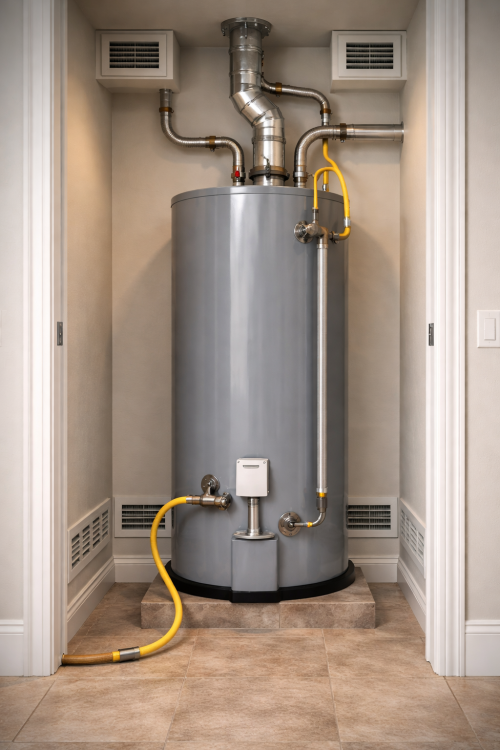
Bedroom and Bathroom Water Heater Closet Rules
Fuel-fired water heaters face additional restrictions when they are installed in a bedroom, bathroom, toilet room, storage closet or a space that opens only into one of those rooms.
Under commonly adopted ICC-based provisions, fuel-fired water heaters in bedrooms, bathrooms and related restricted locations are permitted only when the installation satisfies an applicable code exception or enclosure requirement.
A listed direct-vent appliance can qualify under one pathway. Another commonly recognized arrangement uses a separate sealed enclosure that receives combustion air directly from outdoors.
The precise appliance type, door construction, air-supply method and permitted installation arrangement depend on the adopted code edition, local amendments and manufacturer instructions.
Important distinction
A louvered door that draws combustion air from a bedroom is not equivalent to a sealed enclosure supplied with outdoor combustion air. Do not alter the door, louvers or air openings without confirming the approved design for the installed heater.
The International Residential Code water-heater provisions describe restrictions involving storage closets, bedrooms and bathrooms, along with direct-vent and sealed-enclosure pathways.
Closets that open only into a bedroom or bathroom
A heater closet accessed only through a bedroom or bathroom can still fall under restricted-location rules even when the appliance is physically separated by a door.
Verify:
- whether the installed appliance is permitted in that location
- whether the appliance is listed as direct vent
- whether the enclosure must be sealed from the living space
- whether combustion air must be supplied directly from outdoors
- whether the door must be solid, weather-stripped or self-closing
- whether local amendments impose additional requirements
An existing heater may have been accepted under an older code edition. Replacement work is normally reviewed under requirements currently enforced by the local jurisdiction, but the scope of required corrections and any exceptions vary.
Heat Pump Water Heaters in Closets
A heat pump water heater does not burn fuel and therefore does not require combustion air. It does, however, require sufficient airflow through the heat-pump section to absorb heat from the surrounding air and discharge cooler, dehumidified air.
A poorly designed closet can contribute to:
- reduced heat-pump efficiency
- longer recovery times
- greater use of backup electric resistance elements
- cool exhaust air returning directly to the inlet
- restricted filter access
- lower closet temperatures
- condensate drainage problems
- increased noise in nearby living spaces
Room-volume requirements depend on the model
There is no universal minimum closet volume for every heat pump water heater. Requirements depend on the appliance design and whether the inlet, exhaust or both are ducted.
Some manufacturer literature uses approximately 700 cubic feet as a planning threshold for particular unducted models. The same manufacturer may permit installation in a smaller closet when specified louvers, transfer openings, door gaps or duct configurations are provided.
This is a model-specific example, not a national code rule.
A small closet may require one or more of the following:
- a fully louvered door
- separate upper and lower transfer openings
- a specified net free area
- a defined gap below the door
- inlet-air ducting
- exhaust-air ducting
- both inlet and exhaust ducts
U.S. Department of Energy heat pump water-heater guidance identifies airflow, room temperature, service clearance, electrical service, plumbing and condensate disposal as major installation considerations.
Prevent inlet and exhaust air recirculation
The air inlet and cool-air exhaust must be positioned according to the manufacturer’s instructions. When discharged cool air is pulled directly back into the inlet, efficiency and recovery performance can decline.
Check:
- clearance around the air inlet
- clearance in front of the exhaust
- the position of the closet-door grille
- approved duct diameter
- maximum duct length
- allowable elbow count
- space to remove and clean the filter
Provide approved condensate drainage
Heat pump water heaters remove moisture from surrounding air and produce condensate. That water must drain through an approved arrangement without leaking into the closet or damaging finished areas.
The installation may require:
- a primary condensate connection
- a secondary or overflow connection
- a gravity drain with continuous slope
- a condensate pump where gravity drainage is unavailable
- protection against blockage, freezing or backflow
Condensate tubing should remain accessible for inspection and cleaning. A blocked, disconnected or kinked line can cause water damage even when the storage tank itself is not leaking.
Electric Tank Water Heaters in Closets
A conventional electric resistance water heater does not require combustion air or a fuel-gas vent. That makes enclosure design simpler, but it does not remove electrical, plumbing, access or leak-protection requirements.
An electric water-heater closet should still provide:
- manufacturer-required clearances
- access to upper and lower element panels
- access to thermostats and wiring compartments
- a correctly sized branch circuit and breaker
- an accessible disconnect where required
- access to the cold-water shutoff valve
- an unobstructed temperature-and-pressure relief system
- space to drain, service and replace the tank
- a drain pan or other leak protection where required
Do not install shelving or store household items in front of electrical access panels. A technician must be able to remove the covers and safely test or replace heating elements and thermostats.
Temperature-and-Pressure Relief Valve Requirements
A storage water heater must have an approved temperature-and-pressure relief valve, commonly called a T&P valve. It is designed to release water if unsafe temperature or pressure develops inside the tank.
The valve and its discharge piping must remain accessible and unobstructed inside the closet.
Common T&P discharge-pipe requirements
Exact termination rules vary by code edition and local amendment, but ICC-based provisions commonly require discharge piping to:
- connect directly to the relief-valve outlet
- use an approved temperature-rated material
- be no smaller than the valve outlet
- serve only the relief valve to which it is connected
- flow by gravity without an upward trap
- contain no shutoff valve or other obstruction
- terminate at an approved location where discharge will not cause injury or structural damage
- provide an air gap where discharge enters a drainage receptor
- have no threaded fitting at its open termination where prohibited
- remain protected against freezing where applicable
Some locally adopted provisions permit discharge to the floor, an approved receptor, outdoors or another approved visible location, subject to detailed termination requirements. The accepted arrangement must be confirmed locally.
Never cap or plug a relief pipe
Water discharging from the T&P system may indicate excessive temperature, high pressure, thermal expansion, valve contamination or another fault. Blocking the discharge can disable a critical safety pathway. Arrange professional diagnosis instead.
Keeping the system accessible also makes it easier to identify abnormal discharge and unsafe temperature conditions. Our safe water heater temperature guide explains normal temperature settings and scalding considerations.
Drain Pan and Leak-Protection Rules
A safety pan is commonly required when leakage from the water heater or its connections could damage the building. This often applies to heaters installed above occupied space, inside finished areas, in attics or in other damage-sensitive locations.
The locally adopted code determines whether a pan is mandatory, its required dimensions and where the pan drain may terminate.
Typical safety-pan inspection points
- whether a pan is required for the installation location
- whether the pan is approved and corrosion-resistant
- whether it is large enough to receive minor leakage or condensate
- whether the drain connection is properly sized
- whether the drain slopes continuously to an approved location
- whether the termination is unobstructed and observable where required
- whether the pan is cracked, rusted or disconnected
As one ICC-based example, certain residential-code provisions specify a pan at least 1½ inches deep with a drain not smaller than ¾ inch where the pan requirement applies. Local amendments and adopted code editions may differ.
A drain pan is intended to collect minor leakage and provide warning. It is not designed to contain a full tank rupture indefinitely.
The pan drain and T&P discharge are different systems
The pan drain carries incidental leakage or condensate. The T&P discharge pipe carries potentially hot water released by a safety valve.
Do not combine, cap or reroute either system without confirming the adopted code. Any permitted relief-pipe termination involving the pan must still satisfy applicable air-gap, sizing, visibility and discharge requirements.
Leak detectors and automatic shutoff valves
A jurisdiction, building owner, insurer or equipment manufacturer may require or recommend a leak detector, alarm or automatic water shutoff.
These protections are especially useful when the heater is:
- on an upper floor
- above a finished ceiling
- inside a condominium or apartment
- infrequently inspected
- installed without a nearby floor drain
Condensing Gas Water Heater Closet Requirements
A condensing gas water heater extracts additional heat from combustion products and produces condensate. Its installation must therefore address both the vent system and condensate disposal.
Verify:
- approved combustion-air intake and exhaust materials
- manufacturer-required vent slope
- minimum and maximum equivalent vent length
- approved terminal locations and clearances
- condensate-trap requirements
- an approved condensate drain
- neutralization where required or recommended
- freeze protection
- access to clean the trap and drain
Combustion condensate can be acidic. Do not route it through materials or to locations that are not approved by the heater manufacturer and local code.
Other Local Requirements That May Apply
Seismic restraint
Earthquake-prone jurisdictions may require approved straps or another anchorage system. Restraints should secure the tank without blocking control panels, valves, drain fittings or the relief system.
Thermal expansion control
A check valve, backflow preventer or pressure-reducing valve can create a closed plumbing system. Where required, an approved thermal-expansion control device must be installed, properly sized and adequately supported.
Garage-connected closets
A closet located in or opening into a garage may trigger requirements involving ignition-source elevation, vehicle-impact protection, fire separation and protection of wall or door penetrations.
These rules depend on the heater type, enclosure design and local code. Do not assume that every garage closet follows the same elevation or barrier requirement.
Accessible shutoff controls
The cold-water shutoff, gas valve, electrical disconnect and emergency controls should remain identifiable and accessible. Finished panels, stored items and shelving should not conceal them.
Common Water Heater Closet Inspection Problems
The following are common issues rather than a ranked national list. Whether a condition fails inspection depends on the appliance instructions and locally adopted code.
| Inspection issue | Why it matters | Typical next step |
|---|---|---|
| Blocked combustion-air opening | Can contribute to incomplete combustion, soot and vent spillage | Remove the obstruction and verify the required net free area |
| Incorrect solid or louvered door | The door may not match the approved air-supply or sealed-enclosure design | Evaluate the door and air pathway against the manual and local code |
| Insufficient service space | Controls, panels or components cannot be reached safely | Remove obstructions or modify the enclosure as approved |
| No practical removal path | Replacement may require altering framing, piping or nearby equipment | Redesign or enlarge access before replacement |
| Improper vent slope, support or material | Can impair draft or allow exhaust leakage | Have the vent corrected under the applicable manual and code |
| T&P pipe capped, reduced or trapped | Can compromise a critical temperature-and-pressure safety pathway | Install an approved, unobstructed discharge arrangement |
| Missing or ineffective drain pan | Leakage can damage floors, ceilings and adjacent rooms | Install a compliant pan and drain where required |
| Heat-pump air recirculation | Cool exhaust returns to the inlet and reduces performance | Correct clearances, grille position or ducting |
| Blocked condensate drain | Can cause leakage, corrosion or equipment shutdown | Clear and correctly route the condensate system |
| Household storage around the heater | May block air, controls, clearances and service access | Remove items from required working and safety areas |
Warning Signs That Need Immediate Attention
A closet can conceal developing combustion, venting, electrical and water problems. Do not wait for a formal inspection when serious warning signs appear.
Leave the area or arrange urgent help if you notice:
- a gas odor
- a carbon-monoxide alarm
- soot, scorch marks or melted materials
- exhaust odor or visible vent spillage
- a disconnected, rusted-through or collapsing vent
- yellow, unstable or rolling flames where visible
- burning electrical smells or repeated breaker trips
- steam, violent boiling sounds or uncontrolled overheating
- continuous T&P discharge
- active leakage from the tank body
For a suspected gas leak or carbon-monoxide event, leave the building and follow emergency guidance from the gas utility, alarm manufacturer or emergency services. Do not remain inside attempting to diagnose the heater.
Final Water Heater Closet Code Checklist
Use this checklist as a preliminary screening tool. It does not replace the appliance manual, permit review or local inspection.
| Category | Pass indicators | Needs correction or verification |
|---|---|---|
| Appliance type | Model, fuel and venting design are identified | Heater type or official manual is unknown |
| Location | Bedroom, bathroom and storage restrictions are satisfied | Fuel-fired unit opens into a restricted room without a confirmed pathway |
| Clearance | Listing and manufacturer clearances are maintained | Construction or storage enters prohibited areas |
| Service access | Controls, panels, valves and filters are reachable | Repairs require removing permanent obstructions |
| Combustion air | Approved air source and net free area are confirmed | Louvers or ducts are undersized, blocked or unverified |
| Venting | Materials, routing, support and termination match the manual | Loose joints, corrosion, poor slope or improper materials are present |
| T&P system | Valve and discharge pipe are accessible and unobstructed | Pipe is capped, reduced, trapped, valved or improperly terminated |
| Leak protection | Required pan, drain and leak controls are functional | Leakage could damage finished construction without drainage |
| Heat-pump airflow | Room volume, louvers or ducts match the exact model instructions | Airflow is restricted or cool exhaust returns to the inlet |
| Condensate | Drain is connected, sloped and accessible | Condensate line is disconnected, clogged or leaking |
Frequently Asked Questions
Does a water heater closet need a louvered door?
Not always. A louvered door may be required when it forms part of an approved combustion-air or heat pump airflow design. A solid door may be acceptable where air is provided through outdoor ducts, a sealed direct-vent system or manufacturer-approved heat pump ducting.
How much clearance does a water heater need in a closet?
There is no universal clearance for every model. Side, rear, front and top distances come from the appliance listing, manufacturer instructions and locally adopted code. Clearance to combustible materials, working space and appliance-removal access are separate requirements.
Can a gas water heater be installed in a bedroom closet?
Fuel-fired water heaters in or opening into bedrooms are restricted. A listed direct-vent appliance or an approved sealed enclosure supplied with outdoor combustion air may qualify under applicable code provisions. The exact design must comply with the locally adopted code and manufacturer instructions.
Can an electric water heater be installed in a bedroom closet?
An electric resistance water heater does not require combustion air, but it must still meet electrical, plumbing, service-access, drainage and local location requirements.
Can a heat pump water heater go in a small closet?
Possibly, when the exact model’s airflow requirements are met through approved louvers, transfer openings or ducting. The installation must also provide filter access, condensate drainage and required inlet and exhaust clearances.
Can a water heater closet be used for storage?
It should not be treated as unrestricted storage. Items must not block combustion air, vents, controls, electrical panels, valves, relief piping, service space or the appliance-removal path. Fuel-fired appliances may also be restricted in spaces legally classified as storage closets.
Does a closet water heater need a drain pan?
A pan is commonly required where leakage from the tank or its connections could damage the building. The exact requirement, pan dimensions and approved drain termination depend on the locally adopted code.
Can a T&P relief pipe terminate above a water-heater pan?
Some adopted provisions allow particular relief-pipe termination arrangements involving the pan, but only when all required air-gap, pipe-sizing, visibility and discharge conditions are satisfied. The pan drain and relief pipe remain separate systems. Confirm this arrangement with the local plumbing inspector rather than improvising it.
Why is the water heater closet getting very hot?
Possible causes include restricted heat pump airflow, improper venting, hot piping, inadequate enclosure design or normal heat released by the equipment. Soot, exhaust odor, unstable flames, scorch marks or a carbon-monoxide alarm require immediate attention.
Who determines whether the closet passes inspection?
The local authority having jurisdiction makes the final code determination. The inspector considers the adopted code, local amendments, appliance listing and manufacturer installation instructions.
Do replacement water heaters have to meet current closet code?
Replacement work is normally reviewed under requirements currently enforced by the local jurisdiction, but the scope of required upgrades and any exceptions vary. A replacement may trigger corrections involving venting, combustion air, relief piping, electrical connections, seismic restraint or service access. Confirm permit and inspection requirements before installation.
Final Answer
A compliant water heater closet is not defined by one door style, one air-opening formula or one clearance measurement. It must be evaluated as a complete mechanical and plumbing installation.
The correct design depends on the heater type, appliance listing, manufacturer instructions and locally adopted code. Gas heaters may need verified combustion air and approved venting. Electric tanks need electrical and service access. Heat pump units need model-specific airflow, filter clearance and condensate drainage. Storage tanks require an accessible relief system and leak protection where applicable.
Do not assume that a working heater is code-compliant. Identify the exact appliance, review its official manual, keep the enclosure free of obstructions and have uncertain combustion, venting, pressure, drainage or electrical conditions evaluated by a qualified professional or local inspector.