
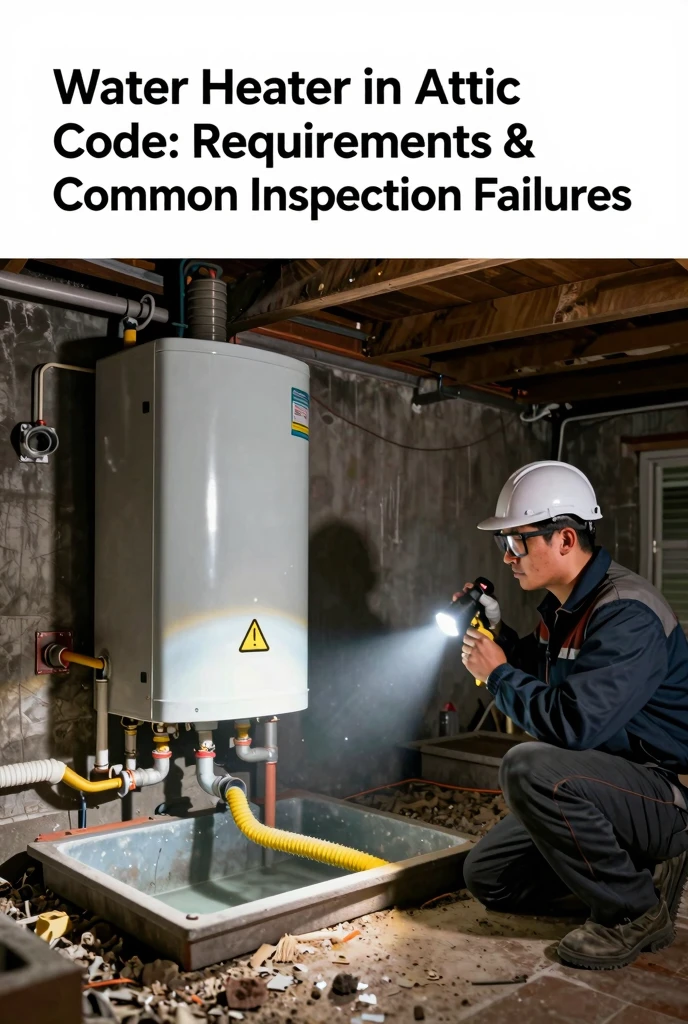
Is a water heater allowed in an attic?
Yes. A water heater can usually be installed in an attic when the installation complies with the locally adopted building, plumbing, mechanical, fuel-gas and electrical codes. It must also follow the water-heater manufacturer’s installation instructions.
For a storage-tank water heater, the most important attic requirements commonly involve a properly sized drain pan, a separate pan drain, correctly routed temperature-and-pressure relief discharge piping, safe service access, stable structural support and—when the unit burns fuel—approved venting and combustion air.
An attic location does not automatically make a water heater unsafe. However, a leak may remain unnoticed while water spreads through insulation, framing and finished ceilings. This makes drainage, leak detection and service access especially important.
Quick Answer
A code-compliant attic water-heater installation will commonly need:
- An approved drain pan beneath a storage-tank unit where leakage could damage the building
- A pan drain that runs by gravity to an approved and observable discharge location
- A separate, unrestricted T&P relief-valve discharge pipe
- A safe passageway and adequate service space around the appliance
- A stable, level structure capable of carrying the heater’s full operating weight
- Correct venting and combustion-air provisions for fuel-fired equipment
- Compliance with the adopted local code and the manufacturer’s instructions
Important: The International Residential Code is a model code. States, counties and cities may adopt different editions, add amendments or enforce additional rules. Always confirm the requirements with the local building department before installing or replacing an attic water heater.
Attic Water Heater Code Requirements at a Glance
| Installation Item | What Is Commonly Required | Why It Matters |
|---|---|---|
| Drain pan | An approved pan beneath a storage-tank heater where leakage could damage the building | Contains minor leakage and directs it toward the pan drain |
| Pan drain | A gravity drain of the required diameter terminating at an approved location | Allows water entering the pan to leave without overflowing into the ceiling |
| T&P discharge | A separate, full-size and unrestricted discharge pipe installed according to code and manufacturer instructions | Allows dangerous temperature or pressure to discharge safely |
| Attic access | A usable passageway, continuous flooring where required and service space at the appliance | Allows safe inspection, maintenance, repair and replacement |
| Structural support | A level platform and framing capable of supporting the filled appliance | Prevents movement, settlement and excessive structural loading |
| Gas venting and combustion air | An approved venting system and adequate combustion air for the specific appliance | Reduces fire, carbon-monoxide and combustion risks |
| Electrical service | Approved wiring, disconnecting means and service access as required for the unit | Allows safe operation and servicing |
1. Is a Drain Pan Required Under an Attic Water Heater?
Under the model IRC, an approved pan is required beneath a storage-tank water heater when leakage from the tank could damage the building. Because an attic tank is normally positioned above insulation, framing and finished ceilings, this condition usually applies.
The exact pan requirements depend on the code edition and local amendments, but the pan generally must:
- Be made from an approved, corrosion-resistant material
- Be large enough to receive dripping or leakage from the tank
- Have a minimum depth that complies with the adopted code
- Contain a drain opening of the required size
- Be positioned so water can enter the pan without being blocked by insulation or surrounding materials
- Remain accessible enough to inspect for corrosion, standing water or a blocked drain
Many IRC editions specify a pan depth of at least 1.5 inches. However, this should not be presented as the only requirement: pan material, thickness, drain size and suitability beneath a fuel-fired appliance may also be regulated.
A drain pan is intended to manage limited leakage and provide an early warning. It is not designed to contain a ruptured tank indefinitely, and it does not replace routine inspection, leak detection or an automatic shutoff system.
Does a Tankless Water Heater Need a Drain Pan?
A wall-mounted tankless water heater does not store the same volume of water as a conventional tank, so the storage-tank pan rule may not apply in the same way. However, local codes, manufacturer instructions or the installation location may still require drainage or other water-damage protection.
Condensing tankless units also produce condensate that must be routed through an approved condensate drain. A condensate line is not the same thing as a drain-pan line or a T&P relief discharge pipe.
2. Attic Water Heater Drain-Line Requirements
The drain-pan outlet must connect to an approved drain line. Under commonly adopted IRC provisions, the pan drain is generally at least 3/4 inch in diameter and must run to an approved termination without reducing the pipe size.
A compliant pan drain will commonly need to:
- Drain by gravity without relying on a pump unless the local authority approves another arrangement
- Maintain a continuous route that does not trap water unnecessarily
- Terminate over a suitable indirect waste receptor or at an approved exterior location
- End where discharge can be noticed rather than concealed inside a wall, ceiling or inaccessible cavity
- Be protected from freezing where it passes through an unconditioned attic or exterior area
- Remain separate from the water heater’s T&P relief-valve discharge pipe
Where exterior termination is permitted, some model-code provisions require the pipe to end between 6 and 24 inches above the adjacent ground. That measurement applies to a qualifying exterior termination; it should not be described as a universal rule for every drain arrangement.
Why Visible Drain Termination Matters
Water at the end of a pan drain may be the first warning that the tank, a connection or another component is leaking. If the pipe terminates in a hidden location, the pan may drain without alerting the homeowner—or the line may become blocked and allow the pan to overflow.
A pan that has no drain line provides only temporary containment. Once it fills, water can still enter the attic insulation and ceiling below.
3. T&P Relief-Valve Discharge Requirements
The traempeture-and-pressure relief valve is a critical safety device. It opens when temperature or pressure reaches a dangerous level. Its discharge pipe must never be treated as an ordinary leak drain.
The T&P discharge pipe will generally need to:
- Be at least as large as the relief-valve outlet
- Use a material approved for hot-water relief discharge
- Run by gravity and avoid creating a trapped section
- Remain open and unrestricted
- Contain no shutoff valve, cap, plug or threaded fitting at the termination
- Discharge to an approved location where hot water or steam will not injure people or damage the building
- Remain separate from the drain-pan line
- Follow the adopted local code and the relief-valve manufacturer’s instructions
The discharge pipe must not be directly connected to the building’s drainage system. Where it discharges through an indirect waste receptor, the approved arrangement may include an air gap. Other authorised termination methods may have different requirements.
Never cap a dripping T&P discharge pipe. Discharge may indicate excessive pressure, excessive temperature, thermal expansion, debris in the valve or a defective valve. A qualified plumber should identify the cause.
4. Attic Access, Passageway and Service-Space Rules
An attic water heater must be safely reachable for inspection, maintenance, repair and eventual replacement. A small attic opening alone does not automatically provide compliant access.
Under commonly adopted IRC mechanical provisions, attic appliances may require:
- A passageway no more than 20 feet long from the access opening to the appliance
- A passageway at least 30 inches high and 22 inches wide
- Continuous solid flooring at least 24 inches wide from the opening to the appliance
- A level service area measuring at least 30 inches by 30 inches in front of the service side
- An access opening large enough to remove the appliance
- A lighting outlet near the appliance
- A switch located at the attic access point
- A receptacle outlet near the appliance where required
Exceptions or alternative provisions may apply where the attic is large enough to allow equipment removal without the standard passageway arrangement. Local amendments can also change these dimensions or add requirements.
The route must be practical, not merely measurable. Framing members, ducts, low roof slopes, exposed wiring and unstable walking surfaces can make an otherwise adequate opening unsafe.
5. Structural Support and Filled Water-Heater Weight
A storage water heater becomes much heavier when filled. Water weighs approximately 8.34 pounds per US gallon before adding the weight of the tank itself.
| Tank Capacity | Approximate Water Weight | Likely Total Filled Weight |
|---|---|---|
| 40 gallons | About 334 lb | Often approximately 450–500 lb |
| 50 gallons | About 417 lb | Often approximately 525–600 lb |
| 75 gallons | About 626 lb | Often approximately 750–850 lb |
These total-weight ranges are estimates because empty-tank weight varies by model. The actual shipping or empty weight should be checked in the manufacturer’s specifications.
The platform and supporting framing should be level, stable and capable of carrying the appliance’s operating load. The heater should not simply be placed on loose boards spanning ceiling joists. Where the adequacy of the framing is uncertain—especially with a large tank, older home or modified attic—a qualified contractor or structural professional should evaluate it.
Why Attic Water Heaters Create Greater Damage Risk
The main concern is not necessarily that an attic heater will fail more frequently. The concern is that leakage may travel through insulation, framing and ceiling materials before anyone notices it.
Possible consequences include:
- Wet or compressed insulation
- Stained or collapsed ceiling drywall
- Damage to flooring, furniture or electrical fixtures below
- Moisture trapped inside framing cavities
- Mould growth if materials remain wet
- More difficult emergency shutoff access
The final repair cost depends on the amount of water released, how long it remains undetected and which building materials are affected. For that reason, a universal attic-leak damage range would be misleading.
Useful additional protections can include a water alarm, a monitored leak sensor and an automatic shutoff valve. These devices do not replace required drainage or code compliance, but they may reduce the time between a leak beginning and the water supply being shut off.
Common Attic Water Heater Inspection Failures
| Potential Failure | Why It May Be Flagged | Likely Correction |
|---|---|---|
| Missing or damaged drain pan | Tank leakage could damage ceilings and other building materials | Install an approved pan sized for the appliance |
| Pan with no drain connection | The pan can fill and overflow into the attic | Add an approved gravity drain route |
| Hidden or improper pan-drain termination | Discharge may not be observable or may damage the building | Reroute it to an approved termination |
| Pan drain and T&P pipe combined | The two systems serve different purposes and must remain properly routed | Provide separate compliant discharge piping |
| Capped, reduced or trapped T&P discharge pipe | Restriction can interfere with a critical safety device | Replace or reroute the pipe correctly |
| Unsafe or undersized access route | The appliance cannot be safely serviced or removed | Improve the opening, passageway, flooring or service area |
| Inadequate structural support | The platform or framing may not safely carry the filled heater | Reinforce or rebuild the support system |
| Improper venting or combustion air | A fuel-fired appliance may create fire or carbon-monoxide hazards | Correct the venting and combustion-air system |
| Missing service light or receptacle | Required service provisions may be absent | Add the locally required electrical service features |
| Unprotected piping in a freezing attic | Frozen piping can block drainage or cause leaks | Relocate, insulate or protect the piping as approved |
Inspectors do not necessarily review these items in one universal ranked order. The exact inspection depends on the appliance type, permit scope, adopted code, manufacturer instructions and local enforcement practices.
What Inspectors Check on an Attic Water Heater
There is no universal inspection order followed in every city. The inspector will consider the locally adopted code, the type of water heater, the work covered by the permit and the manufacturer’s installation instructions.
However, attic inspections commonly focus on the following areas:
- Leak containment: Is an approved drain pan installed where required?
- Pan drainage: Can water leave the pan through a properly sized and routed drain?
- T&P discharge: Is the relief-valve pipe separate, unrestricted and safely terminated?
- Access: Can a technician safely reach, service and remove the appliance?
- Structural support: Can the platform and framing carry the heater’s full operating weight?
- Venting and combustion air: Does a fuel-fired unit have an approved combustion and exhaust arrangement?
- Electrical safety: Are the wiring, disconnecting means and required service provisions properly installed?
- Manufacturer clearances: Is enough space provided for operation, inspection and component replacement?
A missing pan is easy to recognise. Other failures can be less obvious, such as an undersized access route, a trapped relief pipe, an unsafe vent connection or a drain that terminates where leakage cannot be noticed.
Common Attic Water Heater Inspection Failures
| Potential Failure | Why It Matters | Typical Correction |
|---|---|---|
| Missing, damaged or undersized drain pan | Leakage can reach insulation and the ceiling below | Install an approved pan suitable for the appliance |
| Pan installed without a drain | The pan can fill and overflow | Add an approved gravity drain where required and practical |
| Improper pan-drain termination | Discharge may remain hidden or damage the building | Reroute the line to an approved termination |
| Pan drain connected to the T&P pipe | The two pipes serve different purposes and discharge under different conditions | Provide separate compliant piping |
| Capped, reduced or restricted T&P pipe | A restriction can interfere with an essential safety device | Replace or reroute the discharge pipe correctly |
| Unsafe attic passageway | The appliance cannot be reached or removed safely | Improve the access opening, flooring or service route |
| Insufficient service space | Controls, elements, burners or other components cannot be safely serviced | Create the required working area around the service side |
| Weak or deteriorated platform | The support may not safely carry the filled appliance | Repair or reinforce the platform and framing |
| Improper gas venting | Combustion gases may enter the attic or occupied areas | Correct the vent connector, vent system or termination |
| Inadequate combustion air | A fuel-fired appliance may burn improperly or backdraft | Provide an approved combustion-air arrangement |
| Missing service lighting or electrical provisions | The appliance cannot be safely inspected or maintained | Add the locally required light, switch, receptacle or disconnect |
| Freeze-exposed water or drain piping | A frozen pipe can leak, burst or prevent drainage | Protect or reroute the piping as locally approved |
Not every item in this table applies to every appliance. For example, combustion-air and venting requirements apply to fuel-fired units but not to a conventional electric resistance water heater.
New Attic Installation vs Replacement
A new attic installation usually receives broader review than a straightforward replacement because the location, access route, structural support, drainage and utility connections are all part of the new work.
New Installation
A new attic installation will commonly be reviewed for:
- The suitability of the attic location
- Access opening and equipment-removal route
- Passageway flooring and service space
- Drain pan and pan-drain termination
- T&P relief discharge
- Structural support
- Water, gas and electrical connections
- Venting and combustion air for fuel-fired units
- Required permits and inspections
- Compliance with the manufacturer’s instructions
Replacement Installation
A like-for-like replacement may not trigger every requirement that would apply when creating a completely new attic installation. This does not mean that all existing defects can automatically remain.
Corrections may still be required when:
- The existing condition creates an immediate safety hazard
- The drain pan or relief discharge is damaged or improperly installed
- The replacement changes the tank size, fuel, venting method or electrical demand
- The existing platform cannot carry the new unit’s filled weight
- The new manufacturer requires different clearances or connections
- The permit includes alterations beyond a simple appliance replacement
- Local amendments specifically require an upgrade
Ask the contractor to identify which proposed changes are required by the local code, which are required by the manufacturer and which are optional damage-prevention improvements.
Attic vs Other Water Heater Locations
| Location | Potential Advantage | Main Concern | Service Access |
|---|---|---|---|
| Attic | Keeps the appliance outside normal living and storage areas | Leakage can damage insulation and ceilings before detection | Often difficult |
| Garage | Usually easier to access, drain and replace | Vehicle impact, freezing and fuel-fired installation rules may apply | Usually good |
| Basement | Generally accessible with lower overhead water-damage exposure | Flooding, floor drainage, moisture and venting can still be concerns | Usually good |
| Utility closet | Convenient access near the occupied area | Limited clearance, ventilation, drainage or combustion air | Moderate |
| Approved exterior enclosure | May reduce damage inside the home | Freezing, weather exposure, corrosion and appliance-listing limitations | Varies |
An attic is not automatically prohibited or unsafe. It is simply less forgiving when drainage, access or maintenance is poor. The best location is the one that provides safe installation, reliable drainage and practical long-term servicing.
How Attic Placement Affects Installation Cost
There is no reliable national surcharge that applies to every attic water-heater installation. The additional cost depends on the work required at the specific property.
An attic project may require extra labour or materials for:
- Removing the old tank through a restricted opening
- Using additional technicians or lifting equipment
- Creating or improving the attic passageway
- Installing continuous flooring or a service platform
- Reinforcing the supporting structure
- Installing a new drain pan
- Routing the pan drain to an approved location
- Correcting the T&P discharge pipe
- Changing water, gas or electrical connections
- Correcting venting or combustion-air problems
- Adding required service lighting or electrical equipment
- Protecting exposed piping from freezing
- Obtaining permits and completing inspection corrections
A useful quote should separate the normal replacement price from attic-specific labour, required code corrections and optional upgrades.
| Quote Category | What the Contractor Should Explain |
|---|---|
| Water heater and standard labour | Appliance price, removal, basic connections and startup |
| Attic-access labour | Removal difficulty, number of workers and lifting method |
| Drainage work | Pan type, drain route and termination location |
| Platform or framing work | Why reinforcement is needed and who will perform it |
| Vent or combustion corrections | The defect being corrected and the proposed compliant arrangement |
| Electrical or gas alterations | Whether separate licensed work or permits are required |
| Permit and inspection | Who obtains the permit and whether fees are included |
| Optional protection | Leak alarm, automatic shutoff valve or monitored sensor |
Attic Water Heater Homeowner Checklist
This checklist can reveal obvious warning signs, but it does not replace an inspection by a qualified professional or the local building department.
Drain Pan and Drainage
- Is a pan installed beneath the storage tank?
- Is the pan free from cracks, corrosion and standing water?
- Is a drain line connected to the pan?
- Does the drain run without visible low spots, crushing or blockage?
- Does the line terminate at an approved and observable location?
- Is the drain protected from freezing where necessary?
T&P Relief Discharge
- Is a discharge pipe connected to the relief valve?
- Does the pipe remain at least as large as the valve outlet?
- Is it free from valves, caps, plugs and visible restrictions?
- Is it separate from the drain-pan line?
- Does it terminate where hot discharge will not injure someone or damage the building?
- Are there signs of dripping, corrosion or previous discharge?
Do not cap a dripping relief pipe. The discharge may indicate excessive pressure, excessive temperature, thermal expansion, debris or a defective valve.
Access and Serviceability
- Can the water heater be reached without walking on exposed ceiling material?
- Is the passageway free from unsafe ducts, wiring and obstructions?
- Is adequate service space available at the appliance?
- Can the old tank be removed through the available opening?
- Is permanent service lighting available where required?
- Can the water, gas and electrical supplies be shut off safely?
Platform and Structure
- Is the water heater level and stable?
- Does the platform show bending, movement, decay or previous water damage?
- Is the tank supported by a properly constructed platform rather than loose boards?
- Was the structure reviewed before installing a larger-capacity tank?
Fuel-Fired Units
- Is the vent connector securely attached?
- Are required clearances from combustible materials maintained?
- Are there signs of soot, corrosion or melted materials?
- Is approved combustion air available?
- Are carbon-monoxide alarms installed where required?
If you smell gas, observe soot or suspect combustion gases are entering the home, leave the affected area and contact the gas utility or emergency service from a safe location.
What Homeowners Commonly Get Wrong
Assuming the Pan Can Contain a Major Failure
A drain pan can collect limited leakage. It may not contain a ruptured tank, disconnected supply line or flow rate greater than the drain can carry.
Installing a Pan Without a Working Drain
A pan without a usable drain provides only temporary containment. Once it fills, water can still overflow into the attic.
Combining the Pan Drain and Relief Discharge
The pan drain carries ordinary leakage collected beneath the tank. The T&P pipe can carry dangerously hot emergency discharge. They are separate safety systems.
Ignoring the Appliance-Removal Route
The opening and passageway should accommodate the largest appliance that must be removed. A replacement can become much more expensive if the old tank cannot pass safely through the existing route.
Assuming an Existing Installation Is Automatically Acceptable
An older installation may have been permitted under earlier rules, installed without inspection or altered after the original work. Existing does not necessarily mean compliant or safe.
Increasing Tank Size Without Checking the Platform
A larger tank adds water weight, appliance weight and often a larger footprint. The structure, pan, service space and removal route should be reviewed before increasing capacity.
Ignoring Freeze Exposure
Water lines, pan drains, condensate lines and relief piping can freeze in an unconditioned attic. A frozen drain may be unable to protect the home during a leak.
Special Considerations by Water Heater Type
Electric Storage Water Heater
An electric tank does not require combustion air or a flue. It still requires correct wiring, overcurrent protection, grounding, disconnecting means, drainage, access and structural support.
Atmospheric-Vent Gas Water Heater
An atmospheric unit relies on natural draft. Vent sizing, vent slope, clearances, combustion air and protection against backdrafting are critical.
Power-Vent or Direct-Vent Water Heater
These units normally require electrical power and appliance-specific vent components. Vent length, materials, terminal clearances and condensate handling must follow the manufacturer’s instructions.
Tankless Water Heater
A tankless unit reduces stored-water weight but still needs service access, sufficient gas or electrical capacity, freeze protection and approved venting where applicable. A condensing model also needs proper condensate disposal.
Heat-Pump Water Heater
A heat-pump unit requires adequate surrounding air, condensate drainage, service clearance and operation within the manufacturer’s temperature limits. Attic temperature extremes may affect performance or make a particular model unsuitable.
When an Attic Water Heater May Be a Poor Choice
Another location deserves serious consideration when:
- No dependable gravity-drain route is available
- The attic opening cannot accommodate installation and future removal
- The service passageway is unsafe or impractical
- The structure cannot support the filled appliance without major work
- Fuel-fired venting or combustion air cannot be provided safely
- Water and drain piping cannot be protected from freezing
- The attic temperature falls outside the appliance’s approved operating range
- A garage, basement, utility room or approved exterior location offers substantially easier servicing and lower damage exposure
Relocation is not automatically cheaper. It may require new plumbing, gas or electrical service, drainage, venting, permits and building repairs. Compare the complete project scope before deciding.
Questions to Ask the Installer
- Which locally adopted code applies to this installation?
- Does the project require a permit and inspection?
- Can the old and new heaters pass safely through the attic opening?
- Is the existing platform adequate for the new unit’s filled weight?
- Where will the drain-pan line terminate?
- Where will the T&P discharge pipe terminate?
- How will exposed piping be protected from freezing?
- Which corrections are required by code?
- Which changes are required by the manufacturer?
- Which proposed items are optional upgrades?
- What attic-specific labour is included in the quote?
- Would an automatic water shutoff valve be practical?
Frequently Asked Questions
Can a Water Heater Legally Be Installed in an Attic?
Usually, yes. It must comply with the locally adopted codes, permit requirements and manufacturer’s installation instructions. Drainage, access, structural support and appliance-specific safety requirements commonly apply.
Does Every Attic Water Heater Need a Drain Pan?
A storage-tank water heater generally requires an approved pan where leakage could damage the building, which normally includes an attic. Tankless units and some replacement situations may be treated differently under local rules.
Can the Drain Pan and T&P Valve Share One Pipe?
They should generally remain separate. The pan line handles collected leakage, while the T&P line carries emergency temperature or pressure discharge.
Does an Existing Attic Water Heater Have to Meet Every Current Rule?
Not necessarily. Existing installations and replacements may be treated differently from new work. However, hazardous conditions, altered systems, local amendments and manufacturer requirements can still require corrections.
Is an Attic Water Heater More Expensive to Replace?
It can be. Difficult removal, additional labour, drainage work, framing reinforcement, vent corrections and electrical changes can increase the total price. The contractor should itemise those costs rather than applying an unexplained attic surcharge.
Should an Attic Water Heater Have a Leak Detector?
A leak detector is a useful additional safeguard. A sensor connected to an automatic shutoff valve provides more protection than an audible alarm alone. Neither device replaces a required drain pan or drain line.
Can a Heat-Pump Water Heater Be Installed in an Attic?
Possibly, but only when the attic provides the required air volume, temperature range, condensate drainage, access and structural support specified by the manufacturer and local code.
Bottom Line
A water heater can be installed in an attic, but permission alone does not make the installation practical or safe. The complete system must provide reliable drainage, unrestricted relief discharge, safe access, adequate structural support and the electrical, venting or combustion provisions required for the specific appliance.
Where another location offers safer access and lower water-damage exposure, it should be considered. Where the attic remains the practical option, obtain an itemised quote, secure any required permit and confirm the installation against both local code and the manufacturer’s instructions.
The real decision is not simply whether an attic water heater is allowed. It is whether the appliance can be safely installed, drained, inspected, maintained and eventually replaced.