
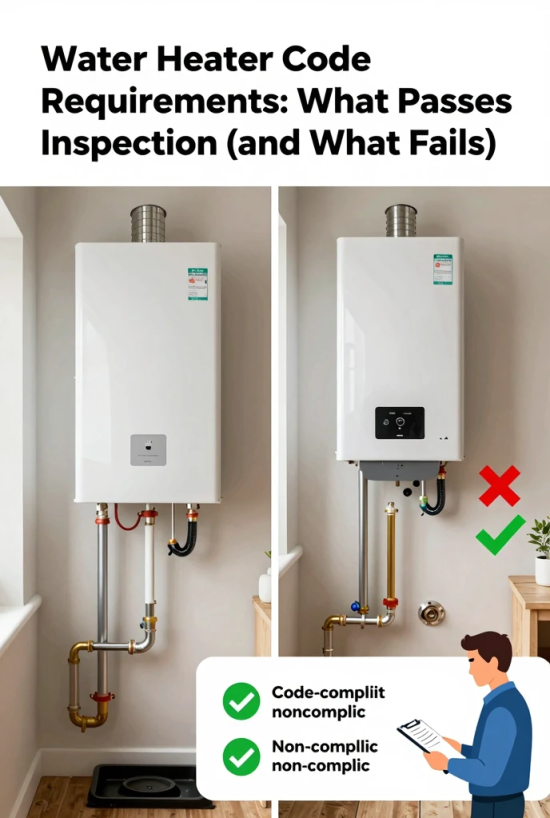
Water heater code requirements are not identical across the United States. The correct installation depends on the codes adopted by the state or local jurisdiction, applicable amendments, the heater’s fuel type and installation location, and the equipment’s listing and manufacturer instructions.
Common requirements address pressure relief, discharge piping, water-supply shutoffs, leakage protection, thermal expansion, equipment access, structural support, gas venting, combustion air and electrical safety. However, whether a particular rule applies—and exactly how it must be satisfied—can vary by jurisdiction and installation.
Quick answer
A compliant water heater installation must satisfy the building, plumbing, mechanical, fuel-gas and electrical requirements adopted locally. It must also follow the equipment’s listing and manufacturer instructions and receive any permit or inspection required by the authority having jurisdiction.
Why Water Heater Code Requirements Vary
There is no single national water heater checklist that applies unchanged in every city and state. Model codes provide widely used starting points, but jurisdictions decide which code family and edition to adopt and may modify those provisions through state or local amendments.
A residential water heater installation may be governed by some combination of:
- the International Residential Code
- the International Plumbing Code
- the Uniform Plumbing Code
- a state-written plumbing or mechanical code
- the International Fuel Gas Code or another adopted fuel-gas code
- the National Electrical Code as adopted locally
- state, county or municipal amendments
- the water heater’s listing and manufacturer installation instructions
The first step is identifying the code edition and amendments adopted where the property is located. The International Code Council provides a useful code-adoption resource, but final confirmation should come from the local building department or authority having jurisdiction.
The Correct Water Heater Compliance Framework
Water heater compliance is best understood as a coordinated system rather than a “strictest rule wins” contest. The adopted code, local amendments, approved equipment listing and manufacturer instructions must work together, with the authority having jurisdiction resolving questions about the installation.
| Compliance layer | What it controls | What to verify |
|---|---|---|
| Adopted model or state code | Baseline plumbing, fuel-gas, mechanical, building and electrical requirements | Which code family and edition currently apply |
| State and local amendments | Regional requirements involving permits, seismic risk, climate, flood exposure and inspection procedures | Whether the state, county or city has modified the model-code provisions |
| Equipment listing and instructions | Unit-specific clearances, vent materials, electrical supply, drainage, combustion air and installation methods | The requirements for the exact make and model |
| Authority having jurisdiction | Permitting, plan review, interpretation and final inspection approval | Which department issues permits and performs inspections |
If the manufacturer instructions appear to conflict with the adopted code, the installer should not choose one document and ignore the other. The appropriate step is to obtain clarification from the manufacturer and the local code official before proceeding.
Does a Water Heater Replacement Require a Permit?
Many jurisdictions require a plumbing, mechanical, fuel-gas or electrical permit for water heater installation or replacement, including some like-for-like replacements. Other jurisdictions provide limited exemptions or use different permit procedures.
Before work begins, verify:
- whether a permit is required
- which trade permit applies
- whether a licensed contractor must obtain the permit
- whether gas, electrical or utility approval is also required
- when the installation must be inspected
- whether existing conditions must be corrected during replacement
A permit requirement should never be assumed from the heater type alone. The local building department or authority having jurisdiction is the controlling source.
Common Water Heater Code Requirements
The following categories appear frequently in residential water heater codes, but their exact requirements and exceptions depend on the adopted provisions and the installation.
| Requirement | Commonly applies to | What commonly varies |
|---|---|---|
| T&P relief protection | Storage water heaters and other equipment requiring temperature or pressure relief | Valve arrangement, discharge routing, permitted materials and termination |
| Cold-water shutoff and drain valve | Storage water heaters and many replacement installations | Valve type, accessibility and replacement requirements |
| Drain pan and pan drain | Locations where leakage could damage building components | When a pan is required, pan material, drain size and termination |
| Thermal expansion control | Closed water-supply systems created by check valves, pressure-reducing valves or backflow devices | Approved control method, sizing and placement |
| Venting and combustion air | Fuel-fired water heaters | Appliance category, vent material, termination, clearances and air-supply method |
| Electrical supply and disconnecting means | Electric, heat-pump, powered gas and many tankless units | Circuit size, overcurrent protection, disconnect location and applicable GFCI requirements |
| Support, anchorage and access | All installations to some degree | Seismic restraint, platform design, service clearances and removal access |
| Location protection | Garages, attics, closets, crawl spaces, flood-prone areas and exterior locations | Impact protection, elevation, drainage, working space, weather protection and permitted appliance type |
Location rules can become detailed quickly. See our guides to water heater attic code requirements and water heater closet code requirements for installation-specific guidance.
T&P Relief Valve and Discharge Pipe Requirements
The temperature-and-pressure relief valve is a critical safety component on a storage water heater. It is designed to open when temperature or pressure reaches an unsafe condition, allowing hot water or steam to discharge through an attached pipe.
T&P discharge piping is also a frequent inspection concern because seemingly minor installation details can restrict flow or direct discharge to an unsafe location.
Common IRC-based discharge-pipe requirements
Under the 2024 International Residential Code model provisions, discharge piping serving a temperature, pressure or combination relief valve must generally:
- not connect directly to the building drainage system
- discharge through an air gap located in the same room as the water heater
- not be smaller than the relief-valve outlet
- serve no other equipment
- discharge to the floor, an approved waste receptor, the water-heater pan where permitted or another approved termination point
- terminate in a manner that does not cause personal injury or structural damage
- remain observable at its discharge point
- flow by gravity without traps or upward sections
- contain no valve or tee fitting
- have no threaded connection at its open termination
- use material permitted by the adopted code or otherwise tested, rated and approved for the application
The 2024 IRC model provision places the open termination not more than 6 inches above and not less than two discharge-pipe diameters above the floor or flood-level rim of the receiving waste receptor. This is a model-code example, not a universal national rule. The locally adopted edition and amendments must still be confirmed.
The ICC’s published 2024 IRC water heater provisions contain the complete model-code language for relief valves, discharge piping, drain pans and related requirements.
Why discharge-pipe details matter
A reduced, capped, valved, trapped or improperly routed pipe may interfere with safe discharge. A pipe ending where hot water could injure someone or damage the building can also create an inspection and safety concern.
Homeowners should never cap a dripping discharge pipe or plug the relief valve. Water coming from the valve or discharge line may indicate excessive temperature, high pressure, thermal expansion, a faulty valve or another installation problem that requires professional diagnosis.
For pricing related to valve diagnosis and replacement, see our water heater pressure relief valve cost guide.
Drain Pan and Leakage Protection
A drain pan is commonly required where leakage from a storage water heater could damage building components. It is not automatically required beneath every heater in every jurisdiction, and replacement exceptions may apply.
As one 2024 IRC-based example, a required pan must be at least 1½ inches deep and have sufficient size and shape to receive dripping or condensate from the tank or water heater. Pan material, drain routing, drain size, termination and replacement exceptions depend on the adopted code and local amendments.
A pan is intended to manage limited leakage or dripping. It is not designed to contain a ruptured tank indefinitely, and its drain must not be confused with the separate T&P discharge pipe.
Common Water Heater Inspection Issues
There is no reliable national dataset ranking water heater inspection failures by frequency. However, the following conditions are commonly identified during installation reviews and inspections:
- incorrect T&P discharge-pipe size, routing, material or termination
- missing, damaged or improperly drained safety pan where required
- missing thermal-expansion control on a closed water-supply system
- inadequate access for inspection, service or replacement
- insufficient support, anchorage or seismic restraint where required
- gas shutoff, connector or sediment-trap concerns on applicable fuel-fired units
- incorrect vent material, slope, clearance or termination
- inadequate combustion air for applicable fuel-fired installations
- missing garage impact protection or ignition-source elevation where required
- electrical circuit, disconnect, grounding, bonding or wiring concerns
- condensate drainage problems on condensing tankless or heat-pump units
- installation that does not match the equipment’s listing or manufacturer instructions
These issues should not be treated as a universal checklist. The inspector evaluates the actual heater, fuel type, installation location, approved equipment documentation and locally adopted requirements.
Location-Specific Water Heater Requirements
A water heater that is acceptable in one part of a home may require additional protection when installed in a garage, attic, closet, crawl space, exterior location or flood-hazard area.
This section provides a national overview. Installation-specific details must still be verified through the locally adopted code, the equipment’s listing and manufacturer instructions, and the authority having jurisdiction.
Garage installations
Garage installations commonly raise two separate code questions: whether an ignition source must be elevated and whether the appliance is exposed to damage from a vehicle.
Under the 2024 International Residential Code model provision, a water heater with an ignition source must generally have that ignition source located at least 18 inches above the garage floor. The model provision includes an exception for appliances listed as flammable vapor ignition-resistant, commonly abbreviated as FVIR.
This measurement applies to the ignition source, not automatically to the bottom of the tank or the height of a platform. The locally adopted code and the heater’s listing must still be checked.
A heater exposed to vehicle movement may also require approved impact protection. Whether a bollard, curb, platform or another protective method is appropriate depends on the appliance location and local approval—not simply on whether the heater is inside a garage.
The ICC’s published 2024 IRC water heater provisions contain the model-code language for garage ignition-source elevation and related installation requirements.
Attic installations
Attic installations may trigger requirements involving an access opening, passageway, working platform, lighting, a nearby receptacle, drain-pan protection and an approved drainage route.
The exact requirements depend on the adopted plumbing and mechanical codes, the heater type and the configuration of the attic.
See our complete guide to water heater attic code requirements for detailed access, working-space and drainage guidance.
Closet installations
A closet installation must preserve manufacturer-required clearances and sufficient access for inspection, service and eventual replacement. Fuel-fired units may also be subject to combustion-air, venting and room-location restrictions.
A conventional atmospheric gas water heater should not be assumed acceptable in every bedroom, bathroom or storage closet. Direct-vent, sealed-combustion and other listed appliances can have different installation allowances.
Our water heater closet code guide explains clearance, combustion-air, door and service-access requirements in greater detail.
Crawl spaces and underfloor locations
A water heater installed beneath a floor may require an adequate access opening, a continuous passageway, a level service area and protection from moisture, flooding, freezing and physical damage.
The equipment must also remain accessible for inspection, repair and removal. Exact opening, passageway and working-space dimensions depend on the adopted code and installation.
Exterior installations
An outdoor water heater must be listed for exterior use or installed in an approved weather-resistant enclosure. Equipment listed only for indoor use should not be placed outdoors merely because the local climate appears mild.
Exterior installations may require consideration of:
- rain, wind and direct weather exposure
- freeze protection
- vent and combustion-air termination clearances
- weather-rated electrical components
- condensate disposal
- corrosive coastal or chemical environments
- physical protection and service access
Flood-hazard areas
Water heaters and their gas, electrical and control components may require elevation or other approved flood-damage protection in regulated flood-hazard areas. The required protection depends on the local floodplain ordinance, design flood elevation, building classification and equipment location.
FEMA’s guidance on protecting building utility systems from flood damage discusses elevating or protecting vulnerable gas and electric water-heating equipment.
A simple platform should not be assumed sufficient without confirming structural support, anchorage, service access, utility connections, electrical protection and local floodplain requirements.
Seismic restraint
Water-heater anchorage or strapping requirements depend on the adopted code, seismic design conditions and state or local amendments. They are especially prominent in California and other higher-seismic-risk jurisdictions but are not identical nationwide.
Where restraint is required, the number and position of restraints, anchorage method and permitted materials must follow the applicable requirements. Improvised metal tape or an inadequate wall connection may not qualify as an approved restraint system.
Gas Water Heater Code Requirements
Fuel-fired water heaters involve additional requirements because the installation must safely deliver fuel, provide combustion air and remove combustion products.
The correct requirements depend on the appliance design and category. Atmospheric, direct-vent, power-vent and condensing water heaters do not all use the same venting system or combustion-air method.
Gas shutoff and fuel-supply components
A gas water heater commonly requires an accessible appliance shutoff valve and an approved fuel connection or piping arrangement. Gas piping must be sized for the appliance input and the other connected gas loads served by the system.
A sediment trap may be required where it is not incorporated into the appliance and where no adopted-code exception applies. Its need, location and configuration should be verified under the locally adopted fuel-gas provisions.
Gas piping, connectors and joints must be tested or checked using approved methods. A flame should never be used to search for a gas leak.
Gas water heater venting
Gas water-heater venting must be selected for the exact appliance category and installed according to the listed vent system and manufacturer instructions.
Depending on the model, an approved system may involve:
- a properly lined masonry chimney
- Type B gas vent
- a listed single-wall vent connector where permitted
- a dedicated direct-vent system
- a listed power-vent system
- manufacturer-approved plastic or special gas vent for applicable condensing equipment
Vent diameter, connector rise, slope, joint fastening, clearance from combustible materials and termination location cannot be determined safely from one generic online rule. These details depend on the appliance, listed vent system, total vent height, lateral length and adopted code.
The ICC’s published 2024 IRC fuel-gas provisions provide the model-code framework for residential gas piping, appliance venting and combustion air.
Combustion air
A fuel-fired water heater that draws air from the installation space must have an adequate supply of air for combustion, ventilation and dilution of flue gases. However, two permanent openings are only one recognized method.
Depending on the appliance and building configuration, an approved method may use:
- indoor air from a sufficiently large communicating space
- two openings or ducts communicating with the outdoors
- a qualifying single-opening outdoor-air method
- mechanically supplied combustion air
- an engineered combustion-air system
- a direct-vent or sealed-combustion appliance using its listed air-intake system
Opening size depends on appliance input, duct orientation, free area, grille or louver restrictions and the selected method. Random wall or door openings should not be added without proper sizing and approval.
Restricted rooms and contaminated air
Fuel-fired appliances can be restricted in bedrooms, bathrooms, toilet rooms, sleeping areas and storage closets unless an applicable exception, approved enclosure or suitable direct-vent arrangement is used.
Combustion air should not be drawn from spaces containing substances that can damage the appliance or contribute to corrosive combustion products. Potential contaminants include chlorine products, solvents, aerosol chemicals, pool chemicals and certain cleaning compounds.
Carbon-monoxide protection
Carbon-monoxide alarm requirements are generally controlled by the adopted residential or building code rather than the water-heater chapter alone. An alarm does not replace correct combustion air, venting or professional evaluation of a fuel-fired appliance.
A carbon-monoxide alarm, visible soot, vent spillage, persistent ignition problems, gas odor or unusual exhaust odor requires prompt professional attention.
Electric Water Heater Code Requirements
Electric water heaters do not require gas piping, combustion air or exhaust venting, but they remain subject to plumbing and electrical requirements.
Common electrical considerations include:
- a branch circuit sized for the heater’s nameplate rating
- proper overcurrent protection
- approved conductors, wiring methods and connections
- equipment grounding and bonding
- a disconnecting means where required
- access to electrical compartments for service
- GFCI protection where required by the locally adopted electrical code
Wire size, breaker rating and disconnect requirements should not be copied from another heater merely because the units have similar tank capacities. The installer must use the electrical ratings shown on the exact equipment nameplate and follow the locally adopted electrical requirements.
Tankless Water Heater Code Requirements
Tankless water heaters still require a complete code review even though they do not store a large tank of hot water. Requirements vary considerably between gas and electric models.
Gas tankless units
A gas tankless installation may require:
- gas piping sized for the appliance input
- an accessible gas shutoff valve
- vent materials listed for the exact model
- manufacturer-specified vent termination clearances
- an approved combustion-air method
- condensate drainage on condensing models
- electrical power for controls, ignition and freeze protection
- manufacturer-required service clearances
- freeze protection for exterior or exposed installations
A gas line that previously served a conventional storage-tank heater may not have sufficient capacity for a higher-input tankless unit.
Electric tankless units
Whole-house electric tankless heaters can require substantial electrical capacity, multiple branch circuits and large overcurrent-protection equipment. The existing electrical service and panel capacity should be evaluated before a unit is selected.
The installation must follow the unit’s nameplate ratings, approved wiring diagram, conductor specifications and locally adopted electrical requirements.
Condensate disposal
Condensing gas tankless units produce acidic condensate that must be routed through approved materials to a permitted disposal point. A condensate neutralizer may be required by the manufacturer, the drainage materials or the local jurisdiction.
Condensate should not be discharged casually across floors, walkways or locations where it can freeze, create damage or become a slipping hazard.
Heat Pump Water Heater Code Requirements
A heat pump water heater combines plumbing, refrigeration, condensate and electrical requirements. Its installation also depends heavily on the surrounding room, available airflow and ambient temperature.
Common considerations include:
- minimum room volume or approved ducting
- manufacturer-required airflow clearances
- air-filter access
- condensate collection and drainage
- a correctly sized electrical branch circuit
- service and replacement access
- drain-pan protection where leakage could cause damage
- structural support for the filled tank
- manufacturer-specified operating-temperature limits
Placing a heat pump model inside a small sealed closet can reduce performance or violate the equipment instructions unless an approved ducting, transfer-air or ventilation arrangement is provided.
Manufacturer Instructions and Equipment Listing
Manufacturer instructions do not simply override the building code. Instead, adopted codes commonly require listed appliances to be installed according to their listing and approved installation instructions.
The manual for the exact model may establish:
- clearances from walls and combustible materials
- vent pipe type, diameter and maximum equivalent length
- vent and combustion-air termination spacing
- gas pressure and fuel-conversion limitations
- electrical supply and circuit requirements
- condensate materials and neutralization
- minimum room volume or ducting
- freeze-protection procedures
- service clearances
- required installation accessories
If the manufacturer instructions and locally adopted code appear inconsistent, the installer should stop and request clarification from the manufacturer and authority having jurisdiction. The homeowner should not independently decide which requirement to ignore.
How Water Heater Codes Address System Risks
Water heater provisions address specific physical risks rather than merely creating paperwork.
| System risk | Related protection | Purpose |
|---|---|---|
| Excess temperature or pressure | T&P relief valve and unrestricted discharge piping | Provides an approved path for emergency relief |
| Thermal expansion in a closed system | Approved thermal-expansion control | Controls pressure increases as heated water expands |
| Leak damage | Drain pan, approved drainage and suitable location | Helps direct limited leakage away from vulnerable materials |
| Combustion products | Approved venting and adequate combustion air | Supports combustion and removal of flue gases |
| Vehicle, seismic or flood damage | Impact protection, anchorage and elevation where required | Reduces damage from location-specific hazards |
| Electrical shock or overheating | Correct circuit, overcurrent protection, grounding and disconnecting means | Protects equipment, wiring and occupants |
For more detail on closed-system pressure control, see our water heater expansion tank cost and code guide.
For thermostat settings and scald-risk guidance, see our safe water heater temperature guide.
For help identifying the source of visible water, see our water heater leaking guide.
What a Water Heater Inspector Commonly Reviews
An inspector primarily evaluates visible compliance with the locally adopted requirements, approved permit documents and equipment installation instructions.
The inspection may include:
- permit and equipment information
- heater location and accessibility
- structural support and anchorage
- cold-water shutoff and plumbing connections
- T&P relief valve and discharge piping
- drain pan and pan drain where required
- thermal-expansion control where applicable
- gas shutoff, connector and sediment trap where applicable
- vent material, routing, clearances and termination
- combustion-air method
- electrical circuit, disconnect, grounding and bonding
- condensate disposal
- garage, attic, closet, seismic or flood protections
- manufacturer-required clearances and accessories
The inspector may not be able to see concealed work or diagnose the heater’s internal condition. Passing an inspection confirms visible compliance at the time of inspection; it does not guarantee future performance or remove the need for maintenance.
Homeowner Code Verification Checklist
Homeowners should not attempt to perform a technical code inspection themselves, but they can gather the information needed for a qualified review.
- Identify the authority having jurisdiction. Confirm whether the city, county, state or another agency issues the permit.
- Verify the adopted code edition. Ask which plumbing, residential, fuel-gas and electrical codes currently apply.
- Record the equipment information. Note the manufacturer, model number, fuel type and input or electrical rating.
- Obtain the correct installation manual. Use the manual for the exact model rather than a similar water heater.
- Confirm the required permits. Determine whether replacement, relocation, fuel conversion, gas work or electrical work requires separate approval.
- Review the installation location. Note whether the heater is in a garage, attic, closet, crawl space, exterior area or flood-hazard zone.
- Ask what must remain visible. Confirm whether any connections or work must remain exposed until inspection.
- Keep the documentation. Save the permit, final approval, invoice, model information and manufacturer manual.
Safety note: Do not operate a questionable T&P valve, open electrical compartments, alter gas piping, modify combustion-air openings or change a vent system merely to check code compliance. These actions can release scalding water, expose energized components or create a fire or combustion hazard.
Frequently Asked Questions
Are water heater code requirements the same in every state?
No. States and local jurisdictions adopt different code families and editions and may add amendments. The heater’s listing and manufacturer instructions must also be considered.
Does replacing a water heater require a permit?
Many jurisdictions require a permit and inspection, including for some like-for-like replacements. Others have exemptions or simplified procedures. Confirm the requirement with the local building department before work begins.
Does every garage water heater need an 18-inch platform?
No. The IRC model provision addresses the height of the ignition source rather than automatically requiring every tank to sit on an 18-inch platform. The model provision also includes an exception for listed FVIR appliances, and local amendments may differ.
Does every gas water heater need two combustion-air openings?
No. Two openings are one recognized method, but other methods can include indoor-air calculations, a qualifying single opening, mechanical combustion air, an engineered method or a direct-vent appliance. The selected method must be properly sized and approved.
Are seismic straps required everywhere?
No. Seismic restraint depends on the adopted code, seismic design conditions and state or local law. Requirements are more prominent in higher-seismic-risk jurisdictions.
Can manufacturer instructions override the building code?
That is not the best way to describe the relationship. Adopted codes commonly require listed appliances to be installed according to their approved instructions. When an apparent conflict exists, the installer should obtain clarification from the manufacturer and authority having jurisdiction.
Can a water heater pass inspection and still have a problem?
Yes. An inspection generally evaluates visible code compliance, not every internal component or future operating condition. A heater may still require maintenance, diagnosis or repair after passing inspection.
Who has the final say on a water heater installation?
The authority having jurisdiction administers and interprets the locally adopted requirements and approves the installation through the permitting and inspection process.
Bottom Line
Water heater code compliance depends on four connected elements: the adopted code, state and local amendments, the equipment’s listing and manufacturer instructions, and approval by the authority having jurisdiction.
Start by confirming the permit requirements and adopted code edition. Then evaluate the heater by fuel type and installation location, with particular attention to pressure relief, thermal expansion, drainage, access, venting, combustion air, electrical supply and location-specific protection.
This guide provides a national framework, not a substitute for local plan review or inspection. When a requirement is unclear, verify it with the local code official and the manufacturer before installation proceeds.