
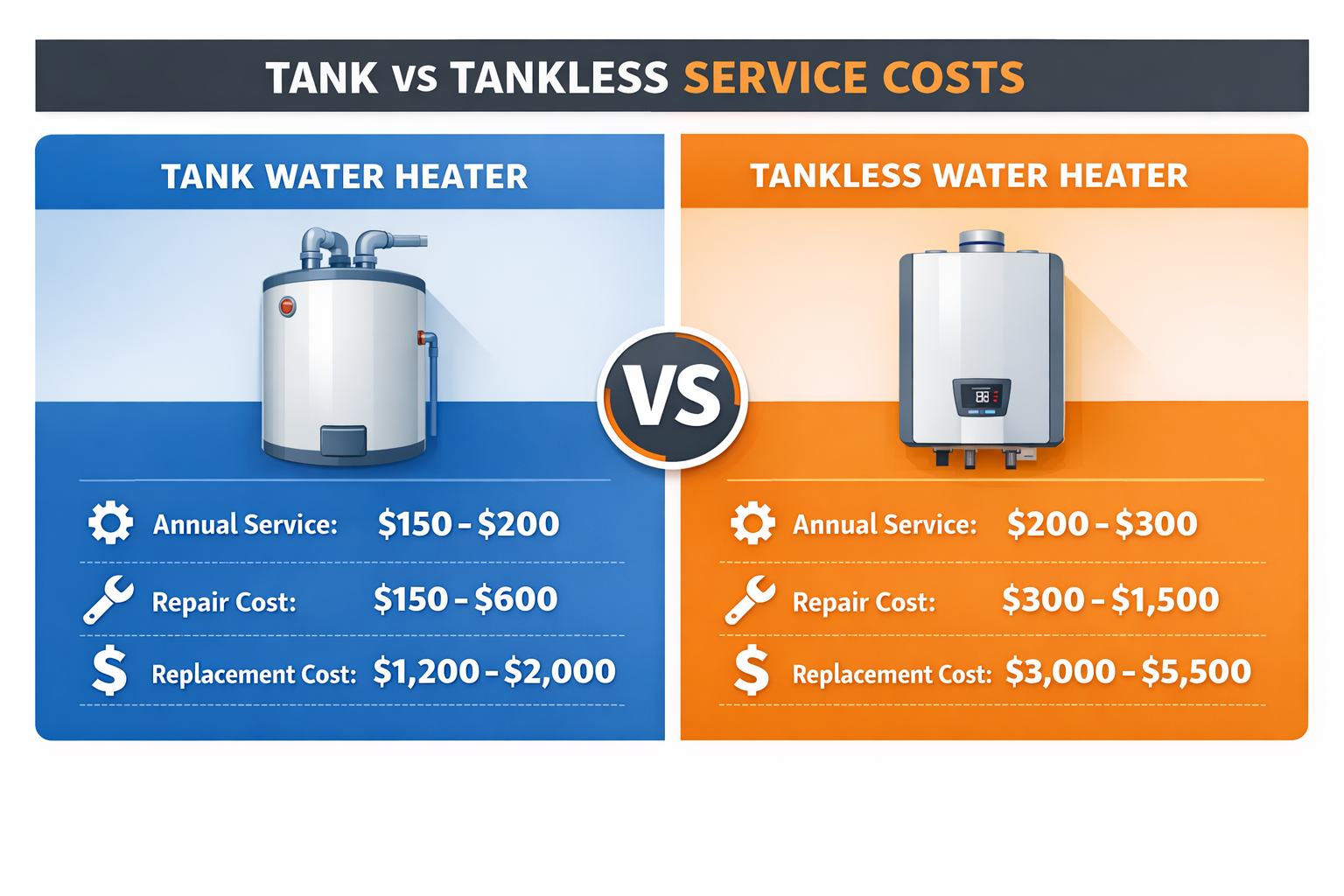
Most homeowners pay about $100 to $300 for routine service on a tank-style water heater and $150 to $350 for standard tankless maintenance. A basic inspection or service call may cost $75 to $150, while servicing neglected, difficult-to-access, or more complex equipment can cost $250 to $500 or more before replacement parts are added.
The final water heater service cost depends on the type of unit, the work included, local labor rates, water hardness, accessibility, and whether the technician discovers a problem that requires separate diagnostic or repair work.
Quick answer
Routine service is preventive maintenance, not an unlimited repair package. It may include an inspection, tank flushing or tankless descaling, filter cleaning, and basic performance checks. Replacement parts, leak repairs, vent corrections, and substantial diagnostic work usually cost extra.
Average Water Heater Service Cost
There is no nationally standardized “full service” package. One contractor may quote only a tank flush, while another may include a broader inspection of plumbing connections, controls, safety components, and overall performance.
The table below shows reasonable national planning ranges for common professional services. These are estimates rather than fixed prices.
| Service type | Typical cost | Common scope |
|---|---|---|
| Basic inspection or service call | $75–$150 | Visual inspection, symptom review, and basic operating checks |
| Tank flush with basic inspection | $100–$200 | Draining or flushing loose sediment, checking for visible leaks, and reviewing operation |
| Broader tank maintenance visit | $150–$300 | Flush plus selected safety, pressure, burner, element, or venting checks |
| Tankless flushing or descaling | $150–$350 | Heat-exchanger flushing, inlet-filter cleaning, and basic system checks |
| Complex or neglected-system service | $250–$500+ | Heavy scale, difficult access, extended cleaning, or additional diagnostic time |
| Replacement parts or repairs | Additional | Parts, repair labor, and corrective work are normally quoted separately |
A price near the bottom of the range may cover only a straightforward flush or inspection. A higher quote may reflect more technician time, difficult access, additional testing, or cleaning of several components.
Compare the written scope rather than assuming that the highest price is automatically the most complete service.
What Does “Water Heater Service” Mean?
The phrase water heater service is used loosely. It can describe preventive maintenance, a diagnostic appointment, a tank flush, tankless descaling, or actual repair work.
For this guide, water heater service means a professional preventive-maintenance visit intended to inspect the equipment, complete appropriate cleaning, and verify basic operation.
Preventive maintenance
Preventive maintenance is completed while the heater is still operating. Its purpose is to manage sediment or mineral scale, inspect accessible components, and identify conditions that may need further evaluation.
Diagnostic service call
A diagnostic visit focuses on a specific complaint, such as no hot water, repeated shutdowns, an error code, unusual noise, or inconsistent temperature.
The initial service-call fee may cover travel and a limited evaluation. More extensive troubleshooting, repair labor, and parts may be quoted separately, so homeowners should confirm the company’s fee policy before booking.
Repair visit
A repair visit corrects a confirmed fault, such as a failed thermostat, heating element, ignition component, valve, or control. These repairs are not normally included in a preventive-maintenance price.
What Is Commonly Included in Water Heater Service?
The exact checklist varies by heater type, contractor, service package, and manufacturer requirements. Ask the company to specify the included tasks in writing.
A professional maintenance visit may include some of the following:
- visual inspection for leakage, corrosion, and damaged connections
- review of the heater’s age, condition, and maintenance history
- temperature and basic performance checks
- inspection of accessible shutoff valves and plumbing connections
- tank flushing or tankless heat-exchanger descaling
- cleaning of accessible water or air filters
- visual inspection of the T&P valve and discharge piping
- review of the drain pan, condensate system, or expansion tank where present
- inspection of visible gas venting or combustion-air components
- identification of conditions requiring separate repair or diagnostic work
Not every company performs every task during a standard appointment. Removing an anode rod, performing combustion analysis, testing incoming water pressure, or opening electrical compartments may require a different package or additional labor.
Tank Water Heater Service
Service for a storage-tank heater commonly focuses on sediment management, visible plumbing conditions, and accessible safety components. The exact checklist changes depending on whether the heater uses gas, electricity, or heat-pump technology.
Tank flushing
A tank flush removes water and loose sediment through the drain valve. Professional tank flushing commonly costs about $100 to $200, although larger tanks, restricted drain valves, and difficult access can increase the price.
Our water heater flush cost guide explains the pricing and scope of this service in greater detail.
Flushing cannot reverse internal tank corrosion or repair a deteriorated tank lining. A heavily neglected or older tank may also be difficult to drain, and the technician may recommend a cautious approach based on its condition.
Gas tank service
A gas water-heater visit may include visual checks of accessible burner, ignition, draft-hood, and venting components in addition to the tank and plumbing.
Depending on the quoted scope, the technician may look for:
- abnormal visible flame conditions
- soot or combustion staining
- corrosion around the draft hood or vent connector
- loose or deteriorated visible vent joints
- blocked combustion-air openings
- ignition or pilot-related operating problems
A complete combustion, fuel-gas, or venting diagnosis is not automatically included in routine maintenance. A gas odor, soot, visible vent spillage, or carbon-monoxide alarm requires prompt professional or emergency attention rather than an ordinary maintenance appointment.
Electric tank service
An electric tank does not require combustion-air or exhaust-vent inspection. Maintenance may instead focus on sediment, water temperature, visible plumbing conditions, and accessible electrical enclosures.
Opening electrical compartments for testing or replacing heating elements, thermostats, and wiring is generally diagnostic or repair work rather than basic maintenance.
Anode-rod assessment
The anode rod helps protect a conventional steel storage tank against internal corrosion. Physically removing the rod can require additional time, overhead clearance, and specialized tools.
Some maintenance packages include an accessibility or condition assessment, while others charge separately for removal or replacement. Ask whether the quote includes only an accessibility assessment or actual rod removal and inspection.
Our anode rod replacement cost guide covers the additional price when a depleted, seized, or inaccessible rod needs replacement.
Tankless Water Heater Service Cost
Routine tankless maintenance commonly costs about $150 to $350. The appointment may take longer than a straightforward tank flush because the technician may need to isolate the unit, circulate a manufacturer-approved flushing agent through the heat exchanger, rinse the system, and clean accessible filters.
Depending on the model and service package, tankless maintenance may include:
- flushing or descaling the heat exchanger
- cleaning the cold-water inlet filter
- cleaning an air filter where fitted
- checking visible combustion-air intake and exhaust components
- reviewing available error codes
- visually inspecting burner or ignition components on gas models
- checking the condensate drain and neutralizer on condensing units
- reviewing accessible recirculation components where installed
Always follow the maintenance instructions for the exact make and model. For example, Rinnai’s official tankless water-heater flushing procedure specifies undiluted white vinegar for the units covered by its guidance and explains the isolation, circulation, and rinsing process.
Maintenance frequency depends on water hardness, household use, treatment equipment, and the manufacturer’s instructions. Hard water can increase mineral accumulation and may shorten the interval between descaling visits.
For a detailed breakdown, see our tankless water heater maintenance cost guide.
Heat Pump Water Heater Service
A heat pump water heater combines a storage tank with heat-pump equipment. In addition to ordinary plumbing and tank checks, maintenance may involve the air filter, airflow path, and condensate drainage system. ENERGY STAR’s heat pump water heater guidance identifies cleaning the air filter and condensate line as common routine maintenance tasks.
A service visit may include:
- cleaning or inspecting the air filter
- checking that the air inlet and exhaust remain unobstructed
- inspecting accessible condensate piping for blockage or leakage
- reviewing available error codes or operating modes
- checking visible electrical and plumbing connections
- flushing the storage tank where recommended for the model and water conditions
Filter and condensate-line cleaning may be routine, but refrigeration-system problems, fan failures, control-board faults, and condensate repairs require separate diagnosis or repair.
What Is Usually Not Included in Routine Service?
A preventive-maintenance quote commonly excludes replacement parts and substantial corrective work unless the written estimate specifically includes them.
Possible additional charges include:
- anode-rod removal or replacement
- heating-element or thermostat replacement
- gas control valve, burner, or ignition repair
- expansion-tank replacement
- T&P valve or discharge-pipe replacement
- drain-valve repair
- active leak repair
- venting or combustion-air corrections
- tankless sensors, pumps, or control boards
- condensate pump or neutralizer replacement
- water-softening or scale-treatment equipment
- replacement assessment and new-heater installation
Ask whether the service-call or diagnostic fee will be credited toward repair work you approve. Company policies vary.
What Affects Water Heater Service Cost?
The heater type matters, but it is only one part of the quote.
Scope of the appointment
A visual inspection costs less than a flush, descaling procedure, or extended diagnostic visit. Confirm whether the quote covers preventive maintenance only or also includes troubleshooting a specific symptom.
Water hardness and mineral buildup
Hard water can create more mineral scale in tankless heat exchangers and contribute to sediment accumulation in storage tanks. A neglected system may require additional circulation time, repeated rinsing, or more extensive cleaning.
Accessibility
Heaters in cramped closets, attics, crawl spaces, or obstructed utility areas can require more labor. The technician also needs practical access to valves, filters, drain connections, and service panels.
Heater condition and maintenance history
A regularly maintained heater is often more straightforward to service than one with a seized drain valve, blocked filter, heavy scale, or visible corrosion.
Local labor and service-call rates
Labor costs vary by region. After-hours visits, emergency appointments, long travel distances, and high-cost metropolitan areas may carry higher minimum charges.
Repairs discovered during the visit
Maintenance can reveal a worn valve, depleted anode rod, failed expansion tank, ignition issue, or another condition requiring repair. Parts and repair labor are normally added only after the homeowner receives and approves a separate estimate.
Compare the Scope, Not Just the Price
A low quote is not automatically incomplete, and a high quote is not automatically thorough. Regional labor rates, promotional offers, and company pricing structures vary.
Before booking, ask:
- Is the service-call fee included in the quoted price?
- Does the appointment include a flush or only an inspection?
- Which safety and performance checks are included?
- Is anode-rod removal and inspection included or separately priced?
- For a tankless unit, are the manufacturer-approved flushing agent and filter cleaning included?
- Are visible gas venting, heat-pump airflow, or condensate components inspected?
- Will the technician provide a written estimate before starting additional work?
- Is any diagnostic fee credited toward an approved repair?
The strongest quote is the one that clearly defines the included work, exclusions, and additional-charge policy before the appointment begins.
Signs Your Water Heater Needs Service
Routine maintenance is easiest to schedule while the water heater is still operating normally. Once the unit develops a specific performance problem, however, it may need diagnostic or repair work rather than a standard maintenance visit.
| What you notice | What it may indicate | Best next step |
|---|---|---|
| Rumbling or popping from a storage tank | Sediment accumulation, mineral deposits or expansion noises | Schedule an inspection before assuming that flushing alone will solve the problem |
| Reduced hot-water capacity or slower recovery | Sediment, mineral scale, a failed heating component or increased household demand | Request diagnosis if performance has noticeably changed |
| Fluctuating water temperature | Thermostat, control, flow, scale or mixing-valve problem | Book a diagnostic visit rather than maintenance alone |
| Tankless error codes or repeated shutdowns | Scale, blocked filters, venting concerns, ignition faults or component failure | Provide the model number and displayed error code when scheduling service |
| Discoloured or rusty-looking hot water | Plumbing corrosion, sediment, anode deterioration or internal tank corrosion | Arrange an inspection because flushing is not always the correct solution |
| Water around the tank or connections | Loose connection, valve leak, condensate issue or tank failure | Treat it as a leak diagnosis rather than routine maintenance |
Urgent warning: Gas odour, smoke, soot, sparking, a burning smell, a carbon-monoxide alarm or water reaching electrical components requires prompt professional or emergency attention. Do not wait for a routine maintenance appointment or attempt to open the equipment.
Water Heater Service vs Repair vs Replacement
Water heater service, repair and replacement solve different problems. Preventive maintenance can clean appropriate components and reveal developing concerns, but it cannot correct a failed part or restore a leaking storage tank.
| Situation | Likely service type | Why |
|---|---|---|
| Heater operates normally and is due for scheduled care | Preventive service | Cleaning, inspection and basic performance checks may be appropriate |
| No hot water, repeated error codes or unreliable operation | Diagnostic visit | The cause must be identified before the correct repair can be priced |
| Failed valve, thermostat, element or ignition component | Repair | A replaceable component may restore normal operation |
| Storage tank itself is leaking or severely corroded | Replacement assessment | A leaking tank body generally cannot be repaired reliably |
| Older heater with repeated or increasingly expensive failures | Repair-versus-replacement comparison | Condition, repair cost, reliability and replacement plans should be considered together |
For broader installation pricing, see our water heater replacement cost guide.
Is Water Heater Service Worth the Cost?
Professional service is often worthwhile when the heater is operating, will remain in use and has maintenance tasks recommended by its manufacturer. Its value comes from managing sediment or scale, checking accessible components and identifying conditions that may need attention.
Service is more likely to be worthwhile when:
- the heater will remain in use for the foreseeable future
- the manufacturer recommends periodic flushing, descaling or filter cleaning
- the home has hard water or a history of mineral accumulation
- maintenance records may be relevant to warranty coverage or property management
- the unit contains accessible filters or components that require regular cleaning
- performance has gradually declined but no major failure is evident
- the heater has not been inspected for an extended period
A full maintenance package may offer less value when:
- the storage tank is actively leaking
- the heater is already scheduled for replacement
- severe corrosion makes further service impractical
- a confirmed major failure makes replacement more economical
- the proposed work does not match the manufacturer’s requirements
- the contractor is recommending generic tasks without considering the model or condition
An older water heater is not automatically unworthy of service. Tank integrity, operating condition, repair history and replacement plans matter more than age alone.
What Happens If Water Heater Maintenance Is Skipped?
Skipping recommended maintenance does not guarantee early failure, just as regular service cannot guarantee a particular lifespan. However, sediment, mineral scale, blocked filters and unresolved operating concerns can affect performance and make later service more involved.
Depending on the heater type, water quality and operating conditions, skipped maintenance may contribute to:
- sediment accumulation in a storage tank
- mineral scale inside a tankless heat exchanger
- restricted water flow through filters or internal passages
- reduced heat transfer or slower hot-water recovery
- increased operating noise
- temperature inconsistency
- blocked air filters or condensate drainage on heat pump models
- overlooked leakage, corrosion, venting or combustion concerns
- more time-consuming cleaning during a later appointment
Maintenance can reduce certain preventable risks and provide an opportunity to identify deterioration. It cannot stop normal ageing, internal tank corrosion, manufacturing defects or every component failure.
How Often Should a Water Heater Be Serviced?
There is no single maintenance schedule that applies to every water heater. Follow the instructions for the exact make and model first, then consider water hardness, household demand, installation conditions and prior maintenance.
Many residential systems receive some form of inspection or maintenance approximately once a year, but the required task and interval vary.
- Storage-tank heaters: Flushing frequency depends on sediment conditions, water quality and manufacturer guidance.
- Tankless heaters: Descaling may be needed more often in hard-water conditions and less often where effective water treatment limits scale.
- Heat pump water heaters: Air filters commonly need attention more frequently than the tank or plumbing components, while condensate drainage should remain clear.
- Rental properties and high-use households: Heavier demand may justify more frequent inspection.
- Units with recirculation systems: Pumps, filters and related components may have separate maintenance requirements.
- Older or previously neglected heaters: Have the condition assessed before beginning aggressive flushing or descaling.
Our water heater maintenance schedule explains common tasks by heater type and interval.
DIY vs Professional Water Heater Service
Some manufacturers describe limited homeowner maintenance, such as cleaning an accessible air filter, checking the area around the unit or following a model-specific draining procedure. That does not mean every maintenance task is safe or appropriate for DIY work.
Limited homeowner checks may include:
- keeping the area around the heater accessible and free of stored items
- checking for visible water, corrosion or damaged piping
- cleaning an accessible air filter according to the owner’s manual
- recording displayed tankless or heat-pump error codes
- checking whether visible air openings are obstructed without altering the equipment
- reviewing the manufacturer’s maintenance schedule and warranty terms
Professional service is the safer choice when:
- the heater uses gas or has a combustion or venting concern
- electrical testing or internal component access is required
- the tank has not been flushed for many years
- valves are seized, leaking or difficult to operate
- the unit displays recurring error codes or shuts down repeatedly
- the tankless heat exchanger requires a flushing procedure
- the T&P valve or discharge piping appears damaged or incorrect
- there is leakage, overheating, soot, sparking or a burning smell
- the exact manufacturer procedure is unavailable or unclear
Do not remove gas components, alter venting, open energised electrical compartments, remove the T&P valve or attempt internal repairs without appropriate training. Follow the manufacturer’s shutdown instructions and contact a qualified professional when the condition is uncertain.
One-Time Service vs Annual Maintenance Plan
Some plumbing companies offer annual membership plans that include a water heater inspection, reduced diagnostic fees, priority scheduling or repair discounts. A plan may provide value when it also covers other plumbing, heating or cooling equipment in the home.
Before enrolling, compare:
- the total annual membership price
- the exact water heater tasks included
- whether tank flushing or tankless descaling costs extra
- limits on appointments, properties or covered equipment
- diagnostic-fee policies
- repair discounts and exclusions
- priority or emergency-service terms
- automatic-renewal and cancellation conditions
A maintenance plan is not automatically cheaper than booking individual service. Its value depends on the included work and how many benefits the household will realistically use.
Water Heater Service Decision Checklist
Use this framework before booking an appointment:
- Identify the purpose. Determine whether you need routine maintenance, diagnosis of a symptom or repair of a confirmed failure.
- Check the manufacturer’s guidance. Review flushing, filter-cleaning, descaling and inspection recommendations for the exact model.
- Consider the heater’s condition. Active leakage, serious corrosion or repeated failures may justify a replacement assessment.
- Gather useful information. Note the model number, fuel type, age, symptoms, error codes and known maintenance history.
- Request a written scope. Confirm which cleaning, inspection and testing tasks are included.
- Ask about exclusions. Clarify whether parts, diagnostic work, anode removal and repairs cost extra.
- Compare fee policies. Ask about minimum labour charges, service-call fees, repair credits, travel and after-hours pricing.
- Choose by qualification and scope. Do not select a contractor based only on the lowest or highest quote.
Frequently Asked Questions
How much does a plumber charge to service a water heater?
A basic inspection or service call may cost approximately $75 to $150. Routine tank-style maintenance commonly costs $100 to $300, while tankless flushing or descaling often costs $150 to $350. Difficult access, heavy scale, extended diagnosis and repairs can increase the total.
Does water heater service include repairs?
Usually not. Preventive service may identify a failed valve, thermostat, heating element, ignition component or other problem, but replacement parts and repair labour are normally quoted separately.
Does every water heater need annual flushing?
Not necessarily. Flushing frequency depends on the manufacturer’s instructions, water hardness, sediment conditions, heater type and maintenance history. Annual attention is common, but it is not a universal requirement for every model or household.
Why does tankless water heater service cost more?
Tankless maintenance may require isolation valves, circulation equipment, an approved flushing agent, filter cleaning and additional time to service the heat exchanger. Cost depends on the model, scale accumulation, location and accessibility.
Can servicing an old water heater cause it to leak?
Maintenance does not damage sound tank metal, but operating old valves or disturbing accumulated deposits may reveal deterioration that was already present. A technician may recommend limited service or replacement assessment when a tank is badly corroded or has been neglected for many years.
Will regular service extend water heater life?
Appropriate maintenance can manage sediment or scale and help identify developing problems, but it cannot guarantee a specific lifespan. Water quality, installation, household use, tank condition, component quality and normal ageing also affect longevity.
Should I service a leaking water heater?
A leak should be diagnosed before routine maintenance is attempted. A loose fitting, drain connection or valve may be repairable, but leakage from the storage tank body generally indicates that replacement is needed.
Is a water heater service-call fee applied toward repairs?
Some companies credit the service-call or diagnostic fee toward an approved repair, while others charge it separately. Ask about the policy before scheduling because practices vary by contractor.
Bottom Line
Most homeowners can expect to pay approximately $100 to $300 for routine tank-style water heater service and $150 to $350 for standard tankless maintenance. More involved service can cost $250 to $500 or more when access is difficult, mineral accumulation is severe or additional diagnostic work is required.
The most important step is confirming what the quote includes. A clearly defined maintenance visit can support dependable operation and reveal developing concerns, but it is not a substitute for diagnosis, repair or replacement when the heater has already developed a serious fault.