
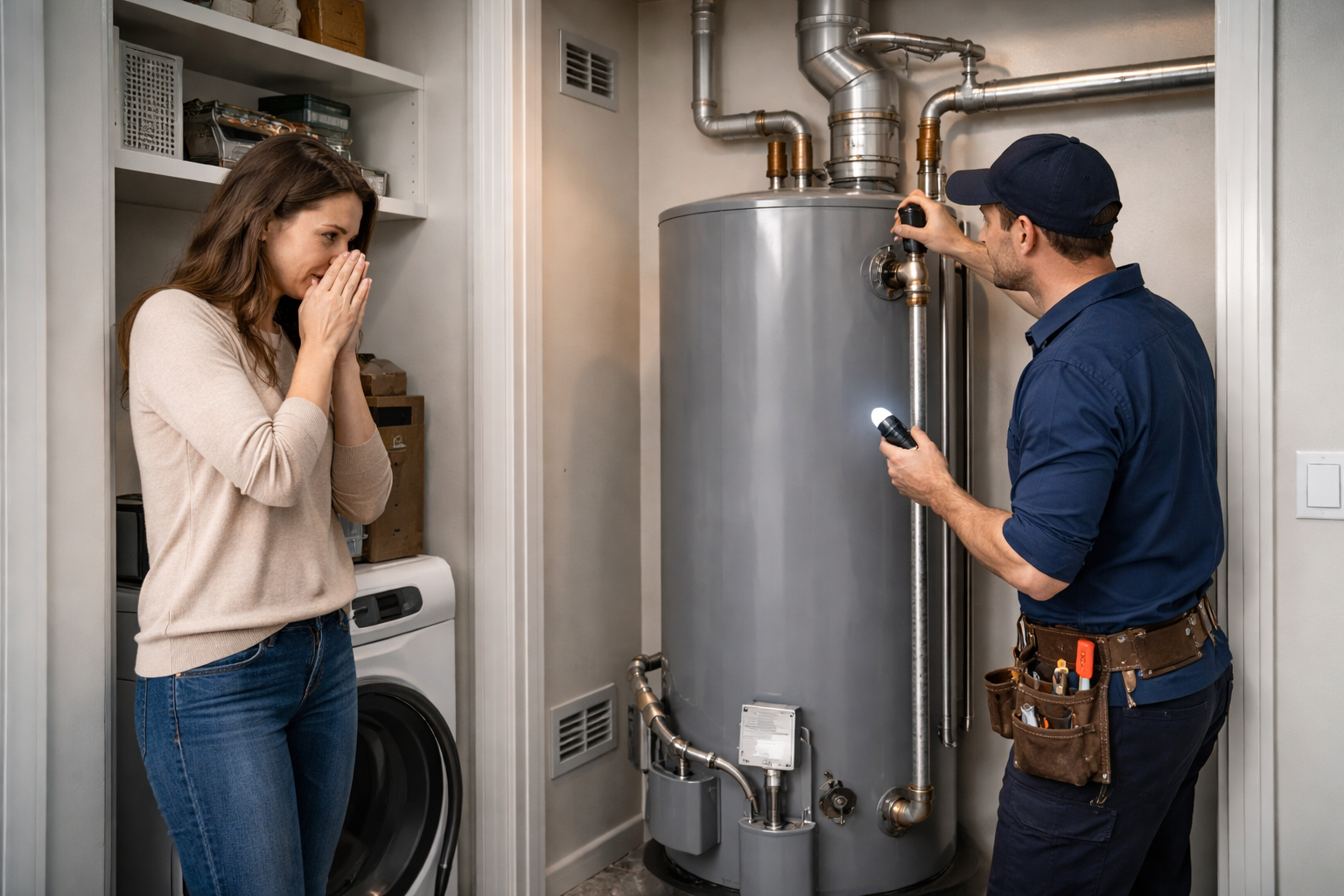
If your water heater smells like rotten eggs, the odor is commonly associated with hydrogen sulfide gas in the water. When the smell affects only hot water at several fixtures, bacteria inside a storage water heater or an interaction involving the anode rod and local water chemistry may be responsible. If both hot and cold water smell, the incoming water or household plumbing system is more likely to be involved.
Before flushing the tank or replacing a component, determine whether the odor is actually in the water. A sink drain, fixture, private well, plumbing system and gas leak can all produce smells that homeowners may describe as sulfur-like or similar to rotten eggs.
Quick answer: Smell a glass of hot and cold water away from the sink, then repeat the test at another fixture. Hot-water-only odor at multiple fixtures points toward the storage water heater. Odor in both hot and cold water points toward the incoming supply or plumbing. Odor at only one sink may come from the drain, overflow opening, aerator or local plumbing rather than the heater.
Possible gas leak: leave the building
This guide addresses a rotten-egg smell that appears in the water. If you smell a sulfur-like odor in the room when no water is running—especially near a gas water heater, gas valve or gas piping—treat it as a possible fuel-gas leak. Leave without operating switches, phones or appliance controls inside. Contact the gas supplier or emergency services from outside.
Why Does My Water Heater Smell Like Rotten Eggs?
A rotten-egg smell in hot water is commonly associated with hydrogen sulfide. This gas can occur naturally in groundwater, be produced by certain sulfur bacteria in a well or plumbing system, or develop through bacterial and chemical activity inside a storage water heater.
When only the hot water smells at several fixtures, the heater becomes a likely source. Possible contributors include bacteria inside the tank and an interaction involving sulfate in the water, microorganisms and the electrochemical activity of the sacrificial anode rod.
The anode rod is not necessarily defective. Its job is to protect the steel tank from corrosion. Under certain water conditions, however, the reactions associated with an anode can contribute to hydrogen sulfide production or make an existing odor more noticeable.
If hot and cold water both smell at multiple fixtures, the condition is less likely to be confined to the water heater. The incoming municipal water, private well or household plumbing system may need to be investigated.
First, Check Whether the Smell Is in the Water or the Drain
A sink drain can release a sewer-like or rotten-egg odor when running water pushes air out of the drain. This can make a drain problem seem like a water-heater problem.
Use this clean-glass test before servicing the heater:
- Fill a clean glass with cold water from the affected faucet.
- Carry the glass away from the sink and smell the water.
- Repeat the test with hot water.
- Perform the same hot-and-cold comparison at another fixture.
If the water in the glass does not smell after you move away from the sink, the likely source is the drain, overflow opening, garbage disposal, aerator or another local fixture condition. Flushing the water heater or replacing its anode would not correct that source.
If the water itself smells after it has been carried away from the sink, continue by comparing hot and cold water throughout the home.
Use Hot Water, Cold Water and Fixture Location to Find the Likely Source
| What You Notice | More Likely Source | What to Check Next | Appropriate Next Step |
|---|---|---|---|
| Only hot water smells at several fixtures | Storage water heater, tank bacteria or anode-related chemistry | Confirm that cold water and water away from the drains do not smell | Have the heater, anode system and relevant water conditions evaluated |
| Hot and cold water both smell at several fixtures | Incoming water, private well or household plumbing system | Test water near where the supply enters the home | Contact the utility, local health authority or water-treatment professional as appropriate |
| The smell occurs at only one sink or bathroom | Drain, aerator, faucet, overflow opening or local branch plumbing | Smell a glass of water away from that fixture | Inspect and clean the affected fixture or drain before servicing the heater |
| The odor is strongest after water has been unused | Stagnant water, plumbing biofilm, well conditions or tank activity | Compare the first draw with water after normal flow at multiple fixtures | Determine whether the condition begins in the source water, plumbing or heater |
| The room smells even when no water is running | Possible fuel gas, sewer gas or another environmental source | Do not continue investigating beside a gas appliance | Leave and contact the gas supplier from outside if a gas leak is possible |
Common Causes of Rotten-Egg Smell in Hot Water
Bacteria Inside a Storage Water Heater
Certain bacteria can contribute to odorous water inside a storage water heater. A heater-related condition becomes more likely when the smell:
- appears in hot water but not cold water;
- occurs at several hot-water fixtures;
- is more noticeable after the heater or plumbing has sat unused;
- temporarily improves after a large amount of hot water is used; or
- returns after a basic tank flush.
These clues do not prove that bacteria are the cause. Water chemistry, the anode system and the incoming supply may also contribute, so repeated odor should be diagnosed rather than treated through trial and error.
A normal tank flush and a manufacturer-approved tank disinfection are different procedures. Flushing drains water and loose material from the tank. Disinfection is intended to address bacterial activity and may require a model-specific procedure, chemical concentration and contact time.
Do not pour an arbitrary amount of bleach, hydrogen peroxide or another chemical into a potable-water system. Follow the heater manufacturer’s instructions or use a qualified professional. For the scope and pricing factors of ordinary flushing, see our guide to water heater flush cost.
Anode Rod and Water-Chemistry Interaction
Most traditional storage water heaters contain a sacrificial anode rod. The rod corrodes preferentially to help protect the steel tank, making it an important part of the heater’s corrosion-control system.
Depending on the water chemistry, bacterial conditions and anode material, electrochemical activity inside the tank may contribute to hydrogen sulfide odor. This is why replacing the heater or flushing the tank without identifying the underlying condition does not always produce a lasting result.
Do not remove the anode and leave the tank without suitable corrosion protection. Doing so may shorten tank life and may conflict with the manufacturer’s instructions or warranty terms.
A plumber or manufacturer may consider whether a compatible alternative is appropriate, such as a different sacrificial-anode material or a powered anode. The correct option depends on the heater model, water chemistry, available clearance and manufacturer requirements.
Our guide to water heater anode rod replacement cost explains the component, labor factors and professional replacement considerations in greater detail.
Hydrogen Sulfide in a Private Well or Incoming Water
If hot and cold water both smell at several fixtures, investigate the incoming water or plumbing system before blaming the heater. Hydrogen sulfide may occur naturally in groundwater or be produced by sulfur bacteria in a well, distribution piping or household plumbing.
Private-well owners should not select treatment equipment based on smell alone. Water testing can help determine whether the condition involves hydrogen sulfide, bacterial activity or another water-quality issue. The appropriate response may involve well service, disinfection, oxidation, aeration, filtration or another treatment chosen for the confirmed condition.
Homes connected to a public water system can compare several fixtures, determine whether nearby properties have noticed a similar change and contact the water utility when both hot and cold water are affected.
A Sink Drain, Overflow Opening or Fixture
If only one sink seems affected and water in a clean glass smells normal away from the sink, the water heater is unlikely to be the source. Organic material and bacteria in a drain, garbage disposal, overflow passage or aerator can produce odor that becomes noticeable when running water pushes air out of the drain.
Correcting the local drain or fixture condition is more appropriate than flushing the water heater or replacing its anode.
Why a New Water Heater May Smell Like Rotten Eggs
A new hot water heater can produce sulfur-smelling water even when the previous heater did not. This does not automatically mean the new unit is defective.
A new sacrificial anode may interact differently with the home’s existing water chemistry. Sulfate in the water, bacterial activity and electrochemical conditions inside the tank may combine to create or intensify hydrogen sulfide odor.
First confirm that the smell is in the water, is limited to hot water and occurs at more than one fixture. The installer or manufacturer can then review the heater model, anode type, water source and approved corrective options.
Does the Type of Water Heater Change the Diagnosis?
Gas Storage Water Heaters
A gas storage heater can develop rotten-egg-smelling hot water because of conditions involving stored water, bacteria, water chemistry and the anode rod. The gas burner itself does not normally create a sulfur odor in the water.
A sulfur-like smell in the surrounding room is different. If the odor is present when no water is running, treat it as a possible fuel-gas leak and follow the emergency instructions near the top of this guide.
Electric Storage Water Heaters
An electric storage water heater can experience the same tank-water and anode-related conditions as a gas storage heater. The electrical energy source does not prevent hydrogen sulfide odor from developing in stored water.
A burning-plastic, overheating or electrical smell is not the same as rotten-egg-smelling water. Turn off the heater at the breaker only when it is safe to do so and arrange professional inspection if there are signs of overheating, arcing, smoke or damaged wiring.
Tankless Water Heaters
A conventional tankless water heater does not normally contain the large storage tank and sacrificial anode found in a traditional tank-style heater. Automatically blaming an anode rod therefore does not fit a tankless system.
When hot water from a tankless system smells like rotten eggs, investigate the incoming water, household piping, stagnant branch lines, fixtures, drains and water-treatment equipment. Manufacturer-specific components and maintenance requirements may also need professional evaluation.
Do not diagnose the problem from smell alone
A rotten-egg odor is a symptom, not proof that one specific component has failed. The location of the odor, whether it affects hot or cold water, the number of fixtures involved, the water source, heater type and recent plumbing changes must all be considered.
Authoritative Guidance on Rotten-Egg Odor in Water
The Minnesota Department of Health’s hydrogen sulfide guidance explains that rotten-egg odor can originate naturally, from sulfur bacteria or through activity inside a water heater.
The U.S. Environmental Protection Agency describes the clean-glass test for separating water odor from sink-drain odor. A. O. Smith also publishes a model-specific example of a water-heater chlorination procedure for odor-causing bacteria. Manufacturer procedures must be applied only to compatible equipment and should not be treated as universal instructions.

Is Rotten-Egg-Smelling Hot Water Dangerous?
A rotten-egg odor in water does not, by itself, establish whether the water is safe to drink. Hydrogen sulfide can be noticeable at low concentrations because of its strong odor, but smell alone cannot confirm the source or rule out a separate bacterial or water-quality condition.
The appropriate response depends on where the odor is found:
- Hot water only: The storage water heater becomes a likely source, but the specific cause still needs to be identified.
- Hot and cold water: Investigate the incoming supply, private well or household plumbing system.
- One fixture only: Check the drain, aerator, overflow opening and local plumbing before servicing the heater.
- Odor in the room rather than the water: Treat a possible fuel-gas leak as an emergency and follow the evacuation guidance near the top of this article.
Private-well owners should consider appropriate water testing when the smell affects both hot and cold water, changes suddenly, appears with discoloration or follows flooding, well work or a long period of nonuse. A local health authority, certified laboratory or qualified well professional can advise which tests are appropriate.
Do not judge drinking-water safety by smell alone
A strong odor can make water unpleasant, but odor strength is not a substitute for water testing. When the source is uncertain—especially with a private well—use appropriate testing and local professional guidance rather than assuming the water is either safe or contaminated.
Why the Rotten-Egg Smell May Be Stronger in Hot Water
Heating can make dissolved gases easier to release and detect. Conditions inside a storage tank may also support bacterial or electrochemical activity that contributes to the odor. This is why cold water can seem normal while hot water from the same home smells much stronger.
However, stronger odor after heating does not prove that the heater created the original water-quality condition. The incoming water may already contain sulfate, hydrogen sulfide or bacteria that become more noticeable after storage and heating.
Other clues can include black staining on plumbing fixtures or tarnishing of silverware, but these observations are not substitutes for water testing or a proper heater diagnosis.
How to Remove Rotten-Egg Smell From a Water Heater
The correct fix depends on the source identified in the first half of this guide. Flushing, disinfecting, changing an anode and treating incoming water address different conditions. They should not be treated as interchangeable remedies.
| Confirmed or Likely Source | Possible Corrective Approach | Best Starting Contact |
|---|---|---|
| Odor-causing activity inside a storage tank | Manufacturer-approved tank disinfection followed by thorough flushing | Plumber, water-heater technician, installer or manufacturer |
| Anode and water-chemistry interaction | Evaluation of the existing anode and compatible alternatives | Plumber, installer or heater manufacturer |
| Hydrogen sulfide or sulfur bacteria in private-well water | Testing followed by well service or correctly selected treatment | Certified laboratory, well contractor, local health authority or water-treatment professional |
| Odor in public water at hot and cold fixtures | Utility investigation and plumbing evaluation if required | Water utility, followed by a plumber if the supply is not affected |
| One drain, faucet or branch line | Clean or repair the affected fixture, drain or local plumbing | Homeowner or plumber, depending on the condition |
1. Flush the Tank When Flushing Is Appropriate
A tank flush removes stored water and loose sediment through the drain valve. It may temporarily reduce an odor by replacing stagnant tank water, but flushing alone does not necessarily eliminate bacteria or correct an anode-related reaction.
This distinction matters because an odor that returns after an ordinary flush does not automatically mean the heater must be replaced. It may mean that the underlying bacterial, anode or incoming-water condition was never addressed.
Flushing involves hot water, a drain valve, a hose and the heater’s energy supply. Follow the instructions for the specific model, and do not begin the process when:
- the drain valve is damaged, heavily corroded or leaking;
- the heater has an active tank leak;
- the electrical or gas shutoff cannot be identified confidently;
- the installation cannot be drained safely;
- the tank has been neglected for many years and its condition is uncertain; or
- the manufacturer requires a different service procedure.
See our dedicated guide to water heater flush cost for the difference between basic flushing, sediment-related service and more involved professional work.
2. Use Only a Manufacturer-Approved Disinfection Procedure
Tank disinfection is intended to address bacteria contributing to odorous or discolored hot water. It is not the same as draining and refilling the heater.
A proper procedure may specify:
- which disinfecting chemical may be used;
- the concentration or measured quantity;
- how the solution is introduced into the heater;
- which hot-water lines and fixtures must be included;
- the required contact time;
- how the system must be flushed afterward; and
- how the heater is safely returned to service.
These details can differ by manufacturer, model, tank capacity and whether the well or wider plumbing system is also being treated. Do not improvise by pouring an arbitrary amount of bleach, hydrogen peroxide or another chemical into a potable-water system.
Unless the heater manufacturer provides a clear procedure that the homeowner can safely follow, chemical disinfection should be completed by a qualified plumber or water-heater technician.
A. O. Smith publishes a technical chlorination procedure for odor-causing bacteria. That bulletin is an example of model and manufacturer guidance, not a universal procedure for every residential water heater.
Do not increase the temperature casually
Some technical procedures use elevated temperatures as part of microbial control, but hotter stored water increases scald risk. Do not raise the thermostat as a casual odor remedy. Temperature changes, mixing valves and disinfection procedures should follow manufacturer instructions and a qualified evaluation. See our guide to safe water heater temperature for the scalding and system-design considerations.
3. Evaluate the Anode When Hot-Water-Only Odor Returns
If the odor is limited to hot water and returns after appropriate tank service, the anode system and water chemistry deserve further evaluation.
Possible professional responses may include:
- inspecting the condition and material of the existing sacrificial anode;
- reviewing the heater manufacturer’s approved replacement options;
- considering a compatible aluminum/zinc or other sacrificial-anode material;
- considering a compatible powered anode where appropriate;
- reviewing whether a water softener is affecting anode consumption or tank conditions; and
- testing the water when the relevant chemistry is unclear.
No single anode type is best for every heater or water supply. Available overhead clearance, heater construction, electrical access, water chemistry, water-softener use, manufacturer instructions and warranty requirements may all affect the decision.
Do not simply remove the anode and operate the tank without an approved corrosion-protection system. The anode helps protect the tank, and removing it without a suitable alternative may shorten tank life or conflict with manufacturer requirements.
For component-specific pricing and installation factors, read our guide to water heater anode rod replacement cost.
4. Test the Incoming Water When Hot and Cold Both Smell
If the smell affects hot and cold water throughout the home, replacing parts in the water heater is unlikely to correct the original source.
For a private well, the investigation may include:
- testing the source water;
- inspecting the well and household plumbing;
- determining whether bacteria or dissolved hydrogen sulfide is involved;
- checking for associated iron, manganese, staining or other water-quality conditions; and
- selecting treatment only after the condition is understood.
Depending on the results, professional options may include well disinfection, oxidation, aeration, filtration or a combined treatment system. Equipment selection and sizing can depend on hydrogen sulfide concentration, flow rate, pH, iron, manganese and other water characteristics. A generic sulfur filter is not automatically the correct solution.
The Minnesota Department of Health’s hydrogen sulfide guidance explains possible well-water sources and the importance of understanding the cause before choosing treatment.
If the home receives municipal water and both hot and cold water smell, compare multiple fixtures and contact the water utility. The utility can help determine whether the condition is entering the property or developing inside the home’s plumbing.
5. Correct a Drain or Fixture Problem Locally
When water in a clean glass smells normal away from the sink, servicing the water heater will not address the likely source. Inspect the affected drain, overflow channel, garbage disposal, aerator and faucet.
A persistent one-fixture problem may also involve a seldom-used branch line, flexible connector or another local plumbing condition. A plumber can isolate the source when ordinary fixture cleaning does not resolve it.
Can You Fix Rotten-Egg-Smelling Hot Water Yourself?
Homeowners can perform the initial diagnostic comparisons without opening the heater, altering gas or electrical components or adding chemicals.
Reasonable Homeowner Checks
- Perform the clean-glass test away from the drain.
- Compare hot and cold water.
- Test more than one fixture.
- Note whether the odor appears after stagnation.
- Confirm whether the home uses a private well or public water.
- Check whether the problem began after a new heater, anode, water softener or plumbing change.
- Record which fixtures are affected before arranging service.
Use a Professional When the Work Involves the Heater or Water Chemistry
Professional service is the safer choice when the job requires:
- opening an anode connection that is seized or difficult to access;
- chemical disinfection without clear model-specific instructions;
- gas or electrical shutdown procedures the homeowner cannot identify;
- private-well disinfection or treatment selection;
- whole-house filtration, oxidation or aeration equipment;
- diagnosis after repeated unsuccessful treatment;
- correction of leakage, corrosion, overheating or electrical damage; or
- changes that could affect the heater’s warranty, installation or listing.
Anode removal can require substantial force. Applying that force incorrectly may damage the tank or connected piping. Gas controls, combustion components and live electrical compartments are not part of a routine odor diagnosis and should not be opened casually.
Who Should You Call?
| Situation | Best Starting Contact |
|---|---|
| Hot-water-only odor from a storage heater | Licensed plumber, water-heater technician, installer or manufacturer |
| Hot and cold water smell from a private well | Certified laboratory, well contractor, local health authority or water-treatment professional |
| Hot and cold municipal water smell | Water utility, followed by a plumber if the utility supply is not affected |
| Odor at one sink only | Homeowner fixture check or plumber |
| Sulfur-like odor in the room near gas equipment | Leave immediately and contact the gas supplier or emergency services from outside |
When Does Water Heater Replacement Make Sense?
A rotten-egg smell alone does not prove that the water heater has failed. Odor problems commonly involve water chemistry, bacterial activity or an interaction with the anode and may occur in a tank that is otherwise serviceable.
Replacement becomes more reasonable when the odor problem exists alongside other evidence that the heater is no longer a good repair candidate, such as:
- water leaking through the tank body;
- significant tank or connection corrosion;
- multiple unrelated component failures;
- poor hot-water performance that remains after proper diagnosis;
- parts that are unavailable or impractical to replace;
- an expired warranty combined with high total repair cost;
- repeated professional treatments that have not produced a lasting result; or
- a diagnosis showing that replacement is more practical than restoring the existing heater.
Age can inform this decision, but it should not control it by itself. A newer leaking tank may require replacement, while an older heater with a correctable anode or water-quality condition may remain repairable.
Replacing the heater will not resolve hydrogen sulfide entering from a private well or incoming water supply. Installing a new tank without correcting the source can allow the odor to return.
For a broader breakdown of equipment, labor and project factors, see our guide to water heater replacement cost.
How to Reduce the Chance of the Odor Returning
There is no universal maintenance interval that prevents every sulfur odor. The most useful preventive steps depend on the heater, water source, manufacturer instructions and confirmed cause.
- Follow the maintenance instructions for the specific water-heater model.
- Correct private-well or incoming-water conditions rather than repeatedly treating only the heater.
- Have the anode inspected according to manufacturer guidance and local water conditions.
- Do not remove the anode without an approved corrosion-protection alternative.
- Use the home’s plumbing periodically after long vacancies where practical.
- Maintain water softeners and other water-treatment equipment according to their instructions.
- Investigate returning odor instead of repeatedly adding chemicals.
- Keep records of tank service, disinfection, anode changes and water-test results.
Our water heater maintenance schedule explains how maintenance varies by heater type, manufacturer requirements and water conditions.
How to Confirm That the Fix Worked
Repeat the same tests used to diagnose the problem. Testing consistently is more useful than relying on whether one shower or faucet happens to smell better.
- Test hot and cold water in clean glasses away from the sink.
- Repeat the test at more than one fixture.
- Check the first draw after the water has sat unused.
- Check again after normal household use.
- Record whether the odor is gone, reduced, unchanged or returning.
Use the results to guide the next decision:
- Odor is gone at every affected fixture: The corrective work appears successful.
- Odor is reduced but still present: The work may have addressed only part of the cause.
- Odor returns only in hot water: Reevaluate the tank, disinfection procedure, anode and water chemistry.
- Hot and cold water still smell: Investigate the incoming water or plumbing system.
- Only one fixture still smells: Focus on that fixture, drain or local branch.
- A new heater develops the same odor: The water chemistry or incoming supply may be the continuing source.
Frequently Asked Questions
Why does my hot water heater smell like rotten eggs?
Hot-water-only odor at multiple fixtures commonly points toward conditions inside a storage water heater. Possible contributors include bacterial activity, sulfate in the water and reactions associated with the sacrificial anode. Compare hot and cold water and test the water away from sink drains before diagnosing the heater.
How do I remove the rotten-egg smell from my water heater?
The remedy may involve manufacturer-approved disinfection, tank flushing, evaluation of the anode system or correction of the incoming water. The correct option depends on whether the odor comes from the storage tank, source water, plumbing or a local drain.
Will flushing a water heater remove the sulfur smell?
Flushing may temporarily reduce odor by replacing stagnant tank water, but a basic flush does not necessarily eliminate bacteria or correct an anode-related reaction. If the smell returns, the underlying condition still needs to be evaluated.
Why does my new hot water heater smell like rotten eggs?
A new heater’s anode may interact differently with the home’s existing water chemistry and bacterial conditions. Confirm that the odor is limited to hot water at multiple fixtures, then ask the installer or manufacturer about approved diagnostic and anode options. The smell does not automatically mean the new heater is defective.
Can an electric water heater smell like rotten eggs?
Yes. Electric and gas storage heaters can both develop sulfur-smelling hot water because the issue involves stored water, bacterial activity, water chemistry or the anode—not necessarily the heater’s energy source. A burning, overheating or electrical odor is a separate problem requiring immediate attention.
Why does water from my tankless heater smell like rotten eggs?
A conventional tankless heater does not normally use the same large storage tank and sacrificial anode as a tank-style heater. Investigate the incoming water, household plumbing, stagnant branch lines, drains, fixtures and treatment equipment before assuming the tankless unit created the odor.
Is rotten-egg-smelling hot water safe to drink?
Odor alone cannot confirm drinking-water safety. If hot and cold water both smell—especially in a home with a private well—appropriate testing is more reliable than judging safety by odor strength.
Should I replace my water heater because it smells?
Not automatically. Odor alone does not prove tank failure. Replacement is more defensible when the heater also leaks, has serious corrosion, has multiple failures or remains uneconomical to repair after the actual odor source has been diagnosed.
Bottom Line
When a water heater smells like rotten eggs, begin by locating the odor rather than replacing parts at random. Test water away from the drain, compare hot and cold samples and check more than one fixture.
Hot-water-only odor at multiple fixtures points toward the storage heater, tank bacteria or anode-related chemistry. Odor in hot and cold water points toward the incoming supply or household plumbing. One-fixture odor often belongs to the drain or local fixture.
Use flushing, disinfection, anode work or water treatment only when it matches the diagnosed source. A rotten-egg smell by itself is not a reason to replace an otherwise serviceable water heater, and a new heater will not solve an untreated well or incoming-water problem.