
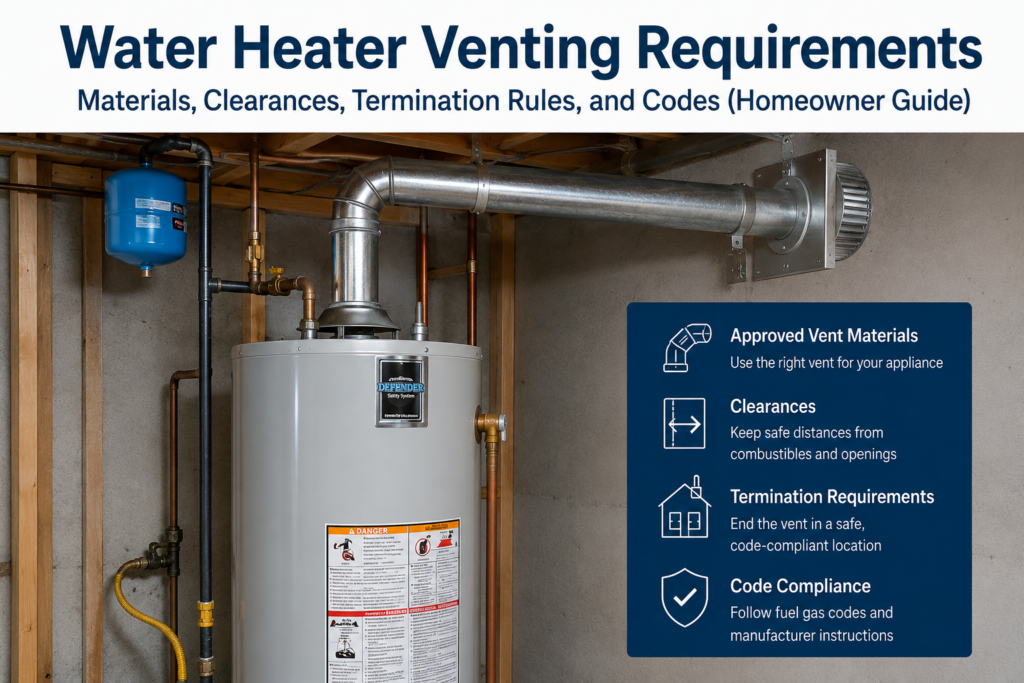
Quick answer: Gas-fired water heaters generally require a vent system that carries combustion products outdoors, but there is no single "water heater vent pipe" that works for every appliance. Atmospheric, power-vent, direct-vent, and condensing water heaters can require different vent materials, sizing methods, clearances, routing, and termination rules.
Safety: Water-heater venting is a combustion-safety system. If a carbon-monoxide alarm activates, the vent is visibly disconnected, there is obvious scorching or melting around the draft hood or vent connection, or combustion products appear to be spilling into the room, stop using the appliance and have the installation evaluated by a qualified professional.
The most important step in understanding water heater venting requirements is identifying the type of appliance before choosing a vent material, applying a clearance number, or deciding whether an existing chimney can be reused.
A conventional atmospheric gas water heater may use a natural-draft Category I vent system. A power-vent heater uses mechanical exhaust. A direct-vent heater uses a listed system that communicates with the outdoors for combustion air and exhaust. Condensing and other mechanically vented appliances can require vent systems and materials that would be inappropriate for a conventional atmospheric tank.
That leads to the central rule for this guide:
Identify the appliance venting type first → check the listing and manufacturer instructions → apply the fuel-gas code adopted locally → then evaluate the existing vent or chimney.
For the broader permit, installation, drainage, fuel-gas, and safety requirements that can affect a residential installation, see our water heater code requirements guide.
Water Heater Venting Requirements at a Glance
The table below shows the practical differences between the major residential gas-water-heater venting arrangements. It is a starting point, not a substitute for the installation manual for the exact appliance.
| Water Heater Type | How It Vents | Typical Vent Approach | What Controls the Final Requirement? |
|---|---|---|---|
| Atmospheric / natural draft | Hot flue gases rise naturally through a draft hood and vent system. | Approved Category I vent system such as Type B gas vent, an approved chimney system, or a permitted connector arrangement. | Appliance listing, manufacturer instructions, Category I vent-sizing rules, and locally adopted fuel-gas code. |
| Power vent | A fan or blower mechanically moves combustion products outdoors. | Manufacturer-designed mechanical vent system; approved material varies by appliance. | Exact appliance listing and manufacturer venting instructions. |
| Direct vent | Uses a listed arrangement that communicates with the outdoors for combustion-air supply and combustion-product discharge. | Listed direct-vent system specified for the appliance. | Manufacturer instructions, appliance listing, and applicable termination rules. |
| Condensing | Extracts additional heat from combustion gases and produces condensate. | Manufacturer-approved vent system using the specific material permitted for that appliance. | Appliance and vent manufacturer instructions, listing requirements, and condensate provisions. |
Do not choose vent material from the words "gas water heater" alone. A vent system that is correct for an atmospheric Category I tank can be completely inappropriate for a mechanically vented, direct-vent, or condensing appliance.
First Identify What Type of Water Heater You Have
You usually do not need to disassemble anything to identify the broad venting type. The appliance label, model number, installation manual, and visible vent arrangement provide the safest starting points.
Atmospheric or Natural-Draft Water Heater
A conventional atmospheric storage water heater typically has a draft hood at the top of the tank. Combustion gases rise through a vent connector into an approved gas vent or chimney system.
This is the type of installation most homeowners mean when asking about Type B gas vent, single-wall connector pipe, upward connector slope, chimney sizing, or sharing a vent with a furnace.
Power-Vent Water Heater
A power-vent water heater uses a fan or blower to move combustion products through its vent system. The presence of that blower changes the venting design, but it does not automatically tell you what pipe material is permitted.
Vent material, diameter, allowable length, fittings, termination, and routing must follow the requirements for the exact appliance.
Direct-Vent Water Heater
A direct-vent appliance uses a listed venting arrangement that communicates with the outdoors for both combustion-air supply and combustion-product discharge.
That distinction matters because an atmospheric water heater that draws combustion air from the surrounding room does not operate the same way as a listed direct-vent appliance.
Condensing Water Heater
A condensing gas water heater extracts additional heat from the combustion gases, producing condensate that must be addressed as part of the approved installation.
These appliances can use vent systems and materials that are fundamentally different from atmospheric Category I water heaters. The 2024 International Fuel Gas Code directs the design, sizing, and installation of Category II, III, and IV appliance vents to the listed appliance manufacturer's instructions.
You can review the model-code framework in 2024 IFGC Chapter 5 — Chimneys and Vents.
Why the Vent Category Determines the Rest of the Rules
The International Fuel Gas Code separates gas-appliance venting by appliance category and vent-system type instead of treating every gas appliance as though it uses the same flue.
For Category I appliances, depending on the appliance and installation, recognized pathways can include:
- Type B gas vent;
- approved chimney and chimney-lining systems;
- single-wall metal connector or vent arrangements where permitted;
- listed gas-vent systems; and
- approved engineered venting methods.
For Category II, III, and IV appliances, the 2024 IFGC sends vent design and sizing back to the appliance manufacturer's instructions. The code also requires vent systems generally to be installed and terminated in accordance with both the applicable code provisions and the appliance or vent manufacturer's instructions.
This distinction is why a useful venting guide should not begin with:
"What diameter vent pipe should I buy?"
It should begin with:
"What venting system is this exact appliance listed and approved to use?"
Can You Reuse the Existing Water Heater Vent?
Sometimes, but an existing vent or chimney should never be assumed suitable simply because the new water heater can physically connect to it.
Under 2024 IFGC Section 501.15, an existing chimney or vent must be reevaluated when an appliance is permanently disconnected from it or when an appliance is connected to it as part of a new installation.
The new water heater may differ from the old one in:
- fuel input;
- vent category;
- draft characteristics;
- vent-connector requirements;
- manufacturer venting instructions; and
- whether another appliance still shares the vent.
| Replacement Situation | Can You Assume the Existing Vent Is Reusable? | What Needs Verification? |
|---|---|---|
| Similar atmospheric Category I replacement | No automatic assumption. | Vent/chimney condition, appliance input, connector arrangement, vent sizing, and manufacturer requirements. |
| New heater has different Btu/h input | No. | Existing vent capacity and Category I sizing must be reevaluated. |
| Atmospheric heater replaced by power-vent, direct-vent, or condensing model | No. | The replacement can require an entirely different listed vent system and termination arrangement. |
| Shared furnace is removed from the chimney | No. | The remaining chimney or vent must still be suitable and correctly sized for the water heater operating by itself. |
| Chimney or vent is damaged, obstructed, corroded, or deteriorated | No. | The unsafe condition must be corrected before the vent or chimney is relied upon. |
Important replacement issue: Removing another appliance from a shared chimney can change how the remaining water heater vents. A chimney that was suitable for a furnace and water heater together is not automatically correctly sized for the water heater alone.
Atmospheric Water Heater Venting Requirements
Conventional draft-hood-equipped gas storage water heaters are commonly Category I appliances. These systems depend on natural buoyancy and vent or chimney draft instead of positive-pressure mechanical exhaust.
A typical atmospheric vent system can include:
- the water heater's factory draft hood;
- a vent connector;
- Type B gas vent, an approved chimney, or another permitted Category I vent system;
- adequate support and required clearance from combustible construction; and
- a compliant outdoor termination.
The important word is system. Appliance input, vent diameter, vertical height, connector rise, horizontal connector length, vent type, and whether another appliance shares the vent all affect Category I vent performance and sizing.
The 2024 IFGC provides dedicated Category I sizing methods because these variables interact.
Does a Water Heater Vent Need to Slope Upward?
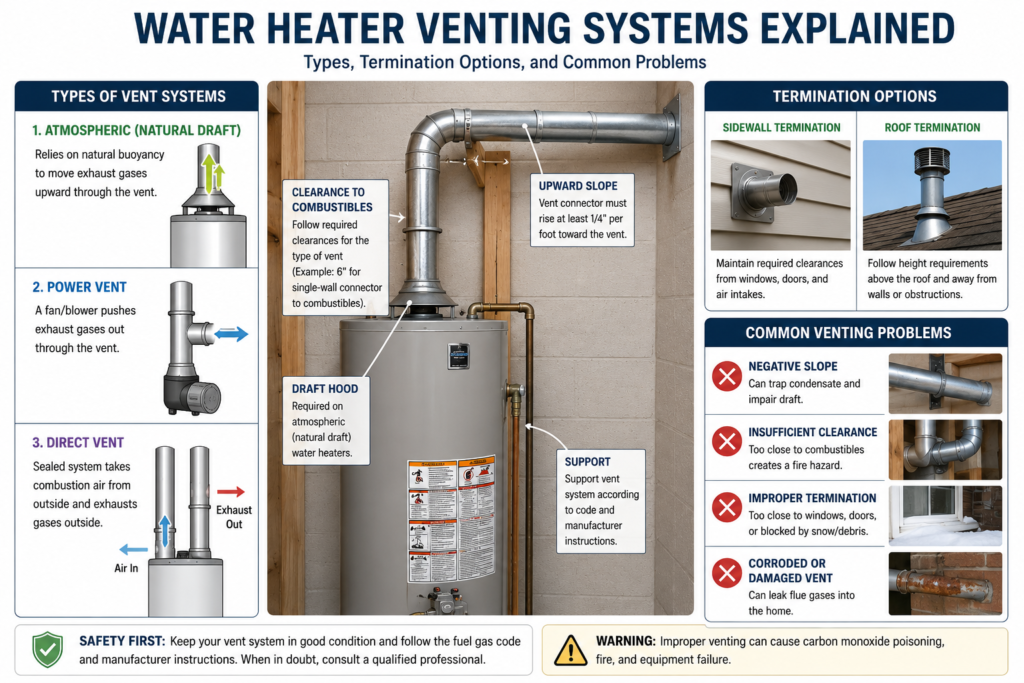
For a conventional Category I vent connector, yes. The model-code rule requires the connector to be installed without dips or sags and to slope upward toward the vent or chimney at least ¼ inch per foot of horizontal run.
The reason is practical: natural-draft appliances rely on buoyant hot flue gases moving toward the vertical vent or chimney. Downward pitch or sagging can work against that draft and impair vent performance.
Key distinction: The ¼-inch-per-foot rule is a Category I vent-connector rule. Power-vent, direct-vent, and other manufacturer-designed systems can have different routing and slope requirements.
Type B Gas Vent vs. Single-Wall Vent Connector
Type B gas vent and ordinary single-wall metal connector pipe are not interchangeable terms.
| Feature | Type B Gas Vent | Single-Wall Metal Connector |
|---|---|---|
| What it is | A listed gas-vent system tested for its intended application. | A single-wall metal connector used where the appliance, location, and code permit it. |
| Clearance to combustibles | Follow the listed vent system and manufacturer instructions. | For a listed appliance with a draft hood under the 2024 IFGC baseline, Table 503.10.5 specifies 6 inches, unless an applicable listing or manufacturer instruction specifies otherwise. |
| Where it can be used | According to the vent listing, appliance requirements, and applicable code. | More limited; do not assume a single-wall connector can substitute for a listed vent system through building assemblies. |
The 2024 fuel-gas connector table confirms the distinction: listed Type B vent material follows its listing, while single-wall metal pipe serving a listed draft-hood appliance has a 6-inch minimum clearance in that specified configuration.
You can review the provision directly in the 2024 fuel-gas connector-clearance table.
That is why the statement "every water-heater vent needs 6 inches of clearance" is incorrect. The clearance depends on the vent or connector type, listing, appliance, and installation.
What Size Vent Pipe Does a Water Heater Need?
There is no reliable gallon-size-to-vent-diameter rule.
For a Category I water heater, vent sizing can depend on:
- the appliance input in Btu/h;
- vertical vent or chimney height;
- connector rise;
- horizontal connector length;
- vent type;
- whether another appliance shares the vent; and
- the appliance and vent manufacturer requirements.
The 2024 IFGC provides multiple Category I sizing pathways, including dedicated vent-sizing tables and approved engineering methods. It even allows certain properly table-sized installations to use a vent size smaller than the draft-hood outlet when all applicable conditions are satisfied.
That is why shortcuts such as "40-gallon tank = 3-inch vent" or "the vent must always be exactly the same diameter as the draft hood" are not reliable design rules.
Homeowner decision: Start with the heater's Btu/h input, vent category, and manufacturer instructions. Have the existing vent evaluated against the applicable sizing rules rather than changing vent diameter by rule of thumb.
Can a Gas Water Heater Use PVC Vent Pipe?
Some gas water heaters can use approved plastic venting, but only where the exact appliance is listed for that venting material and the manufacturer identifies the specific material.
An atmospheric Category I water heater should not be converted to PVC simply because PVC is inexpensive or because another high-efficiency appliance in the home uses plastic venting.
The presence of a blower also does not automatically mean that ordinary PVC is acceptable for every power-vent water heater.
Under 2024 IFGC Section 503.4.1, where plastic piping is used to vent an appliance, the appliance must be listed for that venting material and the manufacturer's instructions must identify the specific plastic piping material. Vent material listed to UL 1738 is another recognized pathway where applicable.
Do not use this shortcut: "Power vent = PVC" or "high efficiency = PVC." Use only the vent material specifically approved for the appliance and vent system.
Why Manufacturer Instructions Matter More for Modern Vent Systems
The 2024 IFGC makes this hierarchy especially clear for Category II, III, and IV appliances: their vent design, sizing, and installation must follow the listed appliance manufacturer's instructions.
The code also requires equipment and appliances generally to be installed in accordance with their approval, listing conditions, and manufacturer instructions. Where a listed appliance's instructions are more restrictive than a general code provision, those listed conditions matter.
Direct-vent appliances follow the same manufacturer-first principle: the listed appliance must be installed according to its approved venting instructions.
Key takeaway: Identify the water heater's venting type before evaluating material, size, slope, clearance, termination, or reuse. Atmospheric Category I systems, power vents, direct vents, and condensing systems can follow fundamentally different requirements. An existing vent is usable only if it remains compatible, correctly sized, safe, and permitted for the appliance actually connected to it.
Power Vent vs. Direct Vent vs. Power Direct Vent
Power-vent, direct-vent, and power-direct-vent water heaters are often grouped together, but they are not the same venting system.
| Vent Type | How Exhaust Moves | Where Combustion Air Comes From | What Controls the Vent System? |
|---|---|---|---|
| Power vent | A fan or blower mechanically moves combustion products outdoors. | Often from the surrounding room, depending on the appliance design. | Exact appliance listing and manufacturer instructions. |
| Direct vent | Combustion products discharge outdoors through a listed direct-vent system. | Combustion air is supplied from outdoors through the listed system. | Appliance listing, manufacturer instructions, and applicable termination requirements. |
| Power direct vent | A fan or blower mechanically moves combustion products outdoors. | Outdoor combustion air is supplied through a separate or combined listed system. | Exact appliance and vent-system manufacturer instructions. |
The practical homeowner takeaway is simple: a blower does not automatically make a water heater direct vent, and direct vent does not automatically mean power vent.
Current manufacturers sell atmospheric, power-vent, direct-vent, and power-direct-vent water heaters as distinct configurations because their combustion-air and exhaust systems are designed differently.
Do not choose vent material from the vent-type name alone. Use the exact model number and installation manual to identify the approved material, diameter, allowable length, fittings, routing, and termination.
Water Heater Vent Termination Requirements
A water-heater vent must terminate where combustion products can discharge safely without creating a re-entry, blockage, fire, moisture, or combustion-air problem.
There is no single termination clearance that applies to every water heater. The required location can depend on:
- whether the appliance is natural draft, mechanical draft, or direct vent;
- the appliance input;
- whether the vent terminates through a wall or roof;
- nearby doors and operable windows;
- forced-air intakes;
- finished grade, decks, porches, and balconies;
- nearby walls and building obstructions; and
- the appliance manufacturer's listed termination requirements.
The 2024 International Fuel Gas Code separates vent-terminal rules by vent type rather than using one universal distance.
Windows and Doors
Sidewall vent terminals must maintain the clearance required for the specific appliance and venting arrangement from operable windows, doors, and other openings into the building.
Direct-vent and nondirect-vent appliances can have different clearances, and manufacturer instructions can impose additional requirements.
That is why advice such as "every water-heater vent must be 3 feet from a window" is too broad to use as a general design rule.
Grade, Decks, Porches, and Balconies
Sidewall terminals also need adequate clearance above finished grade and other surfaces so snow, vegetation, debris, or normal use does not obstruct the terminal.
For direct-vent appliances within the applicable 2024 IFGC table, the model-code baseline includes a 12-inch minimum clearance above finished grade, deck, porch, or balcony. The exact appliance instructions still need to be checked because the listed system can impose additional requirements.
Forced-Air Intakes
Vent terminals must be positioned so combustion products are not readily drawn back into the building through outdoor-air or mechanical-air intakes.
The required separation depends on the type of vent and applicable code provision, so the location should be checked against the specific termination rule and manufacturer diagram rather than a single generic distance.
Roof Terminations
Roof termination height depends on vent size, roof pitch, and proximity to nearby walls or other portions of the building.
Some gas-vent configurations use the familiar 2-foot / 10-foot relationship, while smaller listed gas vents located farther from vertical walls can follow roof-pitch-based termination heights instead.
You can review the current model-code framework in 2024 IFGC Chapter 5 — Chimneys and Vents.
Best rule: Treat termination clearance as a vent-system-specific requirement, not one memorized distance. Check the appliance type, vent type, code provision, and manufacturer termination diagram together.
Water Heater Vent Clearance to Combustible Materials
Vent clearance and appliance clearance are different questions.
This guide addresses the clearance required around the vent and vent connector. Broader spacing around the water heater itself, including service access and installation-space requirements, is a separate issue.
For a common listed draft-hood gas appliance under the 2024 IFGC baseline:
- single-wall metal vent connector: Table 503.10.5 specifies 6 inches from combustible material for the listed draft-hood-appliance configuration, unless an applicable listing or manufacturer instruction specifies otherwise;
- listed Type B gas vent: clearance is determined by the vent listing and manufacturer instructions.
This is why "every water-heater vent needs 6 inches of clearance" is incorrect. Six inches applies to a specific single-wall connector configuration, while listed vent products follow their listed clearances.
Do not improvise a heat shield. Approved clearance-reduction methods exist, but simply placing sheet metal, cement board, or another barrier beside an improperly located vent does not automatically make the installation compliant.
Can a Water Heater Share a Vent With a Furnace?
Yes. Compatible Category I water heaters and furnaces can share a properly designed and sized common vent.
The International Fuel Gas Code contains dedicated Category I common-vent sizing provisions and worked examples involving draft-hood-equipped water heaters and furnaces.
But common venting is a system-design question, not simply a matter of joining two pipes together.
The venting calculation can depend on:
- the input of each appliance;
- connector size;
- connector rise and horizontal length;
- common-vent height;
- common-vent diameter;
- vent material;
- draft-hood or fan-assisted appliance configuration; and
- the venting category of each connected appliance.
Under 2024 IFGC Section 503.10.4, vent connectors serving Category I appliances must not be connected to a portion of a mechanical-draft system operating under positive static pressure, such as a vent portion serving a Category III or Category IV appliance.
Compatibility matters: Two appliances are not automatically safe to common vent simply because they both burn natural gas. Their vent categories and the entire common-vent arrangement must be compatible.
What Happens When a High-Efficiency Furnace Replaces the Old Furnace?
This is one of the most easily overlooked water-heater venting problems in existing homes.
Imagine an older installation where an atmospheric furnace and an atmospheric water heater both vent into the same masonry chimney:
Before: Atmospheric furnace + atmospheric water heater → shared chimney
Now the furnace is replaced with a high-efficiency model using its own manufacturer-designed vent system.
After: High-efficiency furnace → separate vent system
Atmospheric water heater → old chimney by itself
The water heater is now commonly described in the trade as an orphaned water heater because it is the only appliance left on a chimney that previously served a larger combined input.
The change matters because the original chimney may no longer be correctly sized for the smaller remaining load. If the flue stays too cool or does not establish adequate draft, possible problems include:
- poor or delayed draft;
- excessive flue-gas condensation;
- moisture-related deterioration of an unsuitable chimney or liner; and
- combustion-product spillage if adequate draft is not maintained.
The code requirement is not that every orphaned water heater automatically receive a chimney liner.
Under the existing-chimney provisions, the vent or chimney must be resized as necessary to control flue-gas condensation and provide the connected appliance with the required draft.
Depending on the actual installation, professional solutions can include:
- a correctly sized listed chimney-lining system;
- another approved Category I vent arrangement;
- changing to a water heater with a different approved venting system; or
- another code-compliant engineered solution.
Replacement lesson: A furnace upgrade can create a water-heater venting issue even when nobody replaces the water heater. When one appliance is removed from a shared vent or chimney, the remaining system must still be correctly sized and suitable for what remains connected.
Can You Reuse an Existing Chimney for a Gas Water Heater?
Yes, if the chimney remains safe, compatible, and correctly sized for the specific water heater and venting arrangement.
The condition, lining, effective size, and compatibility of an existing chimney matter more than whether the new connector can physically reach the old opening.
| Check | Why It Matters |
|---|---|
| Vent-category compatibility | A chimney or Category I vent arrangement should not be assumed suitable for a different appliance vent category. |
| Flue condition | The flue-gas passageway must not have conditions that allow combustion products to escape or prevent proper venting. |
| Liner condition | The lining system must remain suitable for the appliance and venting conditions. |
| Effective vent size | The system must be sized to control excessive condensation and provide the required draft. |
| Other connected appliances | Adding or removing appliances can change the sizing requirements for a common vent. |
| Termination | The vent still has to terminate in a permitted location and meet the applicable termination rules. |
The existing-vent provisions of the fuel-gas code require a chimney or vent to remain properly sized and in suitable condition when appliances are connected or permanently disconnected.
Condensing Water Heater Venting and Condensate
Condensing gas water heaters require additional attention because the venting system must handle both combustion products and condensate.
Under 2024 IFGC Section 503.9, provisions must be made to collect and dispose of condensate from venting systems serving Category II and Category IV appliances and applicable noncategorized condensing appliances.
The condensate drain must follow the appliance and vent manufacturer instructions.
That does not mean every condensing water heater uses the same plastic pipe, slope, drainage arrangement, or termination.
The exact appliance documentation can control:
- approved vent material;
- vent diameter;
- maximum equivalent length;
- permitted fittings;
- condensate handling; and
- termination configuration.
For tankless-specific installation scope and cost implications, see our tankless water heater installation cost guide.
Combustion Air and Venting Are Related, but They Are Not the Same Thing
Venting carries combustion products out of the building. Combustion air supplies the air needed for safe combustion.
An atmospheric water heater can have draft problems even when the metal vent appears intact if the appliance does not receive adequate combustion air or if conditions in the building interfere with natural draft.
Combustion-air conditions can be especially important in:
- small utility closets;
- tightly constructed homes;
- mechanical rooms affected by exhaust equipment;
- homes with powerful kitchen or ventilation exhaust systems; and
- installations where required combustion-air openings have been blocked or altered.
For location-specific mechanical-room requirements, see our water heater closet code guide.
This guide does not provide combustion-air sizing calculations because combustion-air design is a separate decision from vent sizing.
Signs a Water Heater Vent Needs Professional Evaluation
Some potentially serious venting problems can be recognized without performing combustion testing or dismantling the appliance.
Have the installation evaluated if you notice:
- a carbon-monoxide alarm;
- a disconnected or visibly separated vent connector;
- scorching, discoloration, or melted material around the draft hood or vent connection;
- significant corrosion or repeated moisture around the vent system;
- a natural-draft connector that visibly sags or slopes downward;
- damaged, crushed, or badly deteriorated vent material;
- a chimney arrangement that changed when a furnace or another gas appliance was replaced;
- a Category I appliance connected into a positive-pressure portion of an incompatible vent system; or
- an installation that does not match the water-heater manufacturer's venting instructions.
Do not use a flame, match, smoke source, or improvised draft test to decide whether a questionable vent is safe. Draft and spillage testing are combustion-safety procedures that should be performed using appropriate methods and equipment by a qualified professional.
Common Water Heater Venting Problems Found During Inspection
| Problem | Why It Matters |
|---|---|
| Wrong vent material | Vent materials are not interchangeable across atmospheric, positive-pressure, and condensing systems. |
| Insufficient clearance to combustibles | Vent and connector clearances must match the applicable code provision, listing, and manufacturer requirements. |
| Negative slope or sagging connector | Category I natural-draft connectors require proper upward routing toward the vent or chimney. |
| Improper common venting | Shared vent capacity and appliance compatibility have to be evaluated as one system. |
| Category I connector tied into a positive-pressure vent | The IFGC prohibits Category I connectors from entering positive-pressure portions serving incompatible mechanical-draft systems such as Category III or IV appliances. |
| Old chimney not reevaluated after furnace replacement | Removing a shared appliance can leave the remaining vent improperly sized for draft and condensation control. |
| Improper termination | A poorly located terminal can be obstructed or allow combustion products to re-enter the building. |
| Damaged or deteriorated chimney or vent | The venting system must remain suitable for safely conveying combustion products outdoors. |
When Water Heater Venting Work Needs a Qualified Professional
A homeowner can identify the appliance model, read the installation manual, look for obvious visible damage, and compare the installed system with documented requirements.
Professional evaluation or installation is appropriate when the work involves:
- resizing or redesigning a vent;
- changing vent material;
- adding or modifying a common vent;
- installing or replacing a chimney liner;
- creating or modifying a roof or sidewall termination;
- changing from atmospheric to power-vent, direct-vent, or condensing equipment;
- evaluating a water heater left alone on a former shared chimney;
- performing combustion, draft, or spillage testing; or
- correcting any condition associated with combustion-product leakage or carbon monoxide.
If you are deciding whether the broader installation is appropriate as a DIY project, see our can you install a water heater yourself guide.
Water Heater Venting FAQs
Does Every Gas Water Heater Need a Vent?
Ordinary vented residential gas water heaters need a compliant means of discharging combustion products outdoors. The required vent system depends on the appliance design and listing. Electric resistance and heat-pump water heaters do not produce fuel-combustion exhaust and therefore do not use a gas flue in the same way.
What Vent Pipe Does an Atmospheric Gas Water Heater Use?
A conventional Category I atmospheric water heater can use an approved Category I venting arrangement such as Type B gas vent, an approved chimney system, and permitted connector components. The exact configuration and size must meet the appliance instructions and applicable Category I vent-sizing rules.
Does a Water Heater Vent Need to Slope Upward?
For a conventional Category I vent connector, yes. The model-code baseline requires the connector to rise toward the vent or chimney at least ¼ inch per foot and to be installed without dips or sags. Manufacturer-designed mechanical vent systems can have different routing requirements.
Can a Water Heater Vent Run Horizontally?
Yes. Many vent systems include horizontal sections, but allowable length depends on the appliance, vent category, vertical height, connector rise, vent material, fittings, and applicable manufacturer or code sizing rules. Horizontal vent length should not be approved from pipe diameter alone.
Can a Gas Water Heater Use PVC Vent Pipe?
Some listed gas water heaters can use approved plastic venting. The appliance manufacturer's instructions must identify the permitted vent material. PVC should not be assumed acceptable simply because the heater uses a blower or is described as high efficiency.
Can a Water Heater and Furnace Share the Same Vent?
Compatible Category I appliances can share a properly designed and sized common vent. Common venting must account for both appliances and should not be created simply by joining two vent connectors together.
Can I Reuse the Existing Chimney When Replacing a Water Heater?
Yes, if the chimney remains safe, compatible, correctly sized, properly lined where required, and suitable for the replacement appliance. The vent or chimney must be reevaluated when appliances are connected or permanently removed from the system.
Does an Electric Water Heater Need an Exhaust Vent?
A conventional electric resistance water heater does not produce combustion exhaust, so it does not require a gas flue. Heat-pump water heaters also do not use a fuel-combustion flue, although they can have separate installation-space, airflow, or ducting requirements.
Bottom Line
Water heater venting requirements begin with the appliance, not the pipe. An atmospheric Category I tank, power-vent heater, direct-vent heater, and condensing appliance can require very different vent materials, sizing methods, clearances, routing, and termination arrangements.
For conventional atmospheric water heaters, Category I vent sizing, upward connector slope, combustible clearances, chimney condition, and common venting all matter. For mechanically vented, direct-vent, and condensing appliances, the manufacturer's listed vent system becomes especially important.
And when a water heater or another appliance connected to the same chimney changes, do not assume the old vent remains suitable. Removing a furnace from a shared chimney can change the remaining water heater's draft and condensation conditions even when the water heater itself stays in place.
Best final check: Identify the exact water-heater model and vent category, read its installation manual, verify the existing vent or chimney against the fuel-gas code adopted by your local authority, and have the system professionally evaluated before changing vent size, vent material, common-vent connections, chimney lining, or termination.