
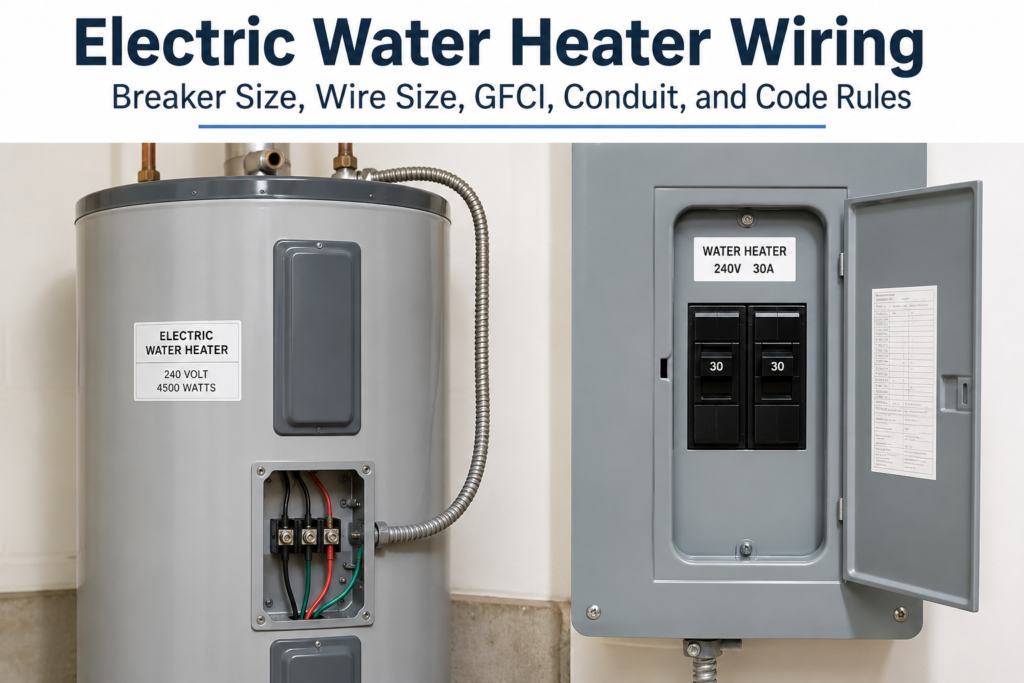
Quick answer: Many conventional residential electric storage water heaters with a 4,500-watt maximum load operate at 240 volts and are commonly installed on a 30-amp, two-pole branch circuit with 10 AWG copper conductors. But that is a common configuration—not a universal rule. The correct breaker, conductor size, voltage, grounding, and disconnect arrangement must be verified from the exact heater's data plate, manufacturer instructions, and the electrical code adopted where it is installed.
Safety: This guide explains electrical requirements and how to verify an existing installation. It does not provide instructions for live-voltage testing, replacing circuit breakers, modifying electrical panels, installing branch-circuit conductors, or working inside energized electrical compartments. Those tasks can expose you to dangerous voltage and should be handled by a qualified person where required.
Searching for electric water heater wiring requirements often produces one-line answers such as "240 volts, 30 amps, and 10-gauge wire." That answer is useful as a reference for many conventional 4,500-watt resistance tanks, but it becomes misleading when applied to every electric water heater.
The electrical requirement is determined primarily by the appliance's voltage, maximum electrical load, manufacturer instructions, branch-circuit requirements, and locally adopted electrical code—not simply by whether the tank holds 40, 50, or 80 gallons.
Best verification sequence: Water heater data plate → manufacturer installation manual → adopted electrical code → existing circuit check.
For the broader permit, plumbing, installation, and safety rules that can affect a residential water heater, see our water heater code requirements guide.
Electric Water Heater Wiring Requirements at a Glance
For a homeowner evaluating a conventional electric storage water heater, these are the electrical requirements that matter most.
| Requirement | Typical 4,500W / 240V Storage-Heater Reference | What Controls the Final Requirement? |
|---|---|---|
| Voltage | 240V is common. | Water heater data plate and manufacturer instructions. |
| Maximum load | 4,500W at 240V = 18.75A. | Nameplate maximum wattage or rated current. |
| 125% sizing value | 18.75A × 125% ≈ 23.4A. | Applicable storage-water-heater branch-circuit rule. |
| Common branch circuit | 30A, two-pole is commonly encountered on applicable 4,500W residential models. | Appliance markings, manufacturer instructions, overcurrent rules, and adopted code. |
| Common copper conductor | 10 AWG copper is the standard small-conductor size permitted with 30A overcurrent protection under the applicable small-conductor rule. | Breaker rating, conductor material, wiring method, terminations, adjustment factors, and local requirements. |
| Neutral | Many conventional 240V resistance tanks do not use one for the heating load. | Exact factory wiring diagram. |
| Equipment grounding | Required. | Manufacturer instructions and adopted electrical code. |
| Disconnecting means | Required; the permitted arrangement depends on installation and code. | Adopted electrical code and actual installation. |
Reference, not a prescription: The 30A / 10 AWG combination is a useful answer for many common 4,500W conventional storage heaters, but it should never override the exact heater's markings, manufacturer instructions, conductor conditions, or locally enforced electrical requirements.
Water Heater Wire and Breaker Reference by Wattage
The safest way to use a wattage table is to show the electrical load and the 125% minimum sizing value without pretending that wattage alone selects every component of the branch circuit.
| Heater Rating at 240V | Calculated Load | 125% Sizing Value | What the Table Tells You |
|---|---|---|---|
| 3,500W | 14.6A | About 18.2A | The appliance markings and manufacturer instructions still determine the permitted circuit configuration. |
| 4,500W | 18.75A | About 23.4A | Many applicable residential models are encountered on 30A two-pole circuits with 10 AWG copper, but verify the exact heater. |
| 5,500W | 22.9A | About 28.6A | The higher load reinforces why breaker and conductor requirements must be checked against the exact model. |
The calculations above are straightforward:
Current = watts ÷ volts
Applicable storage-heater sizing value = rated current × 125%
The 2024 International Residential Code electrical provisions reflect the storage-water-heater sizing rule corresponding to NEC 422.13 for fixed storage-type water heaters within its scope.
This math is useful for understanding the circuit. It is not a substitute for appliance markings or an electrical design calculation where other code provisions apply.
Start With the Water Heater Data Plate, Not the Tank Size
The heater's data plate is the best starting point because it identifies the appliance you are actually supplying.
Look for information such as:
- rated voltage;
- element wattage;
- maximum wattage or connected load;
- rated current where provided;
- phase;
- model number; and
- any marked electrical or overcurrent-protection requirements.
Then use the model number to locate the manufacturer's installation manual and factory wiring diagram. Those documents can contain electrical requirements that cannot be determined from gallon capacity alone.
Replacement rule: Match the existing circuit to the new appliance. Do not assume the circuit is correct simply because it powered the old water heater for years.
Why 4,500 Watts at 240 Volts Is So Common
Conventional residential electric storage heaters commonly use heating elements in the 4,500-watt range. Current A. O. Smith residential models, for example, use dual 4,500-watt elements across several tank capacities.
You can see this directly on A. O. Smith's ProLine electric water heater specifications, which list dual 4,500-watt elements on a current residential model.
At 240 volts, a 4,500-watt maximum load is:
4,500W ÷ 240V = 18.75A
18.75A × 125% ≈ 23.4A
That is the electrical logic behind the familiar 30-amp branch-circuit configuration used on many 4,500-watt residential heaters. It is much more useful to understand that relationship than to memorize "50-gallon heater = 30 amps."
Tank Size Does Not Determine Water Heater Wire Size
A 30-, 40-, or 50-gallon label describes how much hot water the tank stores. It does not directly describe the heater's electrical demand.
Manufacturers sell different tank capacities using the same element wattage. A. O. Smith, for example, offers multiple conventional residential sizes with dual 4,500-watt elements. Rheem likewise lists residential models across different capacities with 3,800- or 4,500-watt element configurations.
That means a larger tank does not automatically require a larger conductor or breaker, and two heaters of similar capacity do not automatically have identical electrical requirements.
Instead of asking:
"What wire size does a 50-gallon water heater need?"
Ask:
"What voltage, maximum electrical load, breaker, and conductor requirements does this exact water-heater model specify?"
Do Two 4,500-Watt Elements Mean a 9,000-Watt Load?
No—not on a conventional non-simultaneous design. This is one of the most important reasons not to size the circuit by simply adding the wattage printed on both elements.
Many conventional dual-element storage heaters use an upper and lower heating element that do not operate simultaneously during normal operation. The controls transfer heating demand between different portions of the tank.
Manufacturers therefore can list two 4,500-watt elements while the heater's maximum operating wattage remains 4,500 watts.
The correct circuit calculation should use the appliance's maximum connected load or other applicable nameplate rating, not an assumption that every installed heating element is energized at the same time.
This same operating sequence matters when troubleshooting poor recovery, partial hot water, or a heater that stops heating. Our electric water heater not heating guide owns that diagnostic decision.
What Does the NEC Actually Control?
The National Electrical Code does much more than associate a wire gauge with a water heater. Depending on the appliance and adopted edition, electrical requirements can govern:
- branch-circuit sizing;
- overcurrent protection;
- conductor ampacity and protection;
- equipment grounding;
- disconnecting means;
- wiring methods and physical protection; and
- other electrical safeguards required for the installation.
The appliance's listing and manufacturer instructions also matter, so the electrical supply must be evaluated as a complete system.
NEC 422.12 Is Not the Storage-Water-Heater Rule
Some online guides cite NEC 422.12 as though it were the rule requiring or sizing an electric water-heater branch circuit.
That is incorrect. In the NEC material reproduced by ICC, Section 422.12 addresses central heating equipment.
The storage-type water-heater provision is associated with NEC 422.13, and the corresponding 125% sizing principle is reflected in the IRC electrical provisions.
Container 1 takeaway: A 240V, 4,500W conventional tank commonly leads to the familiar 30A / 10 AWG copper arrangement, but the appliance data plate and installation manual remain the final starting point. Do not size a circuit from tank gallons, element count, or an internet chart alone.
Does an Electric Water Heater Need a Dedicated Circuit?
For a conventional hardwired 240-volt residential storage water heater, an individual branch circuit is the normal arrangement.
The important distinction is why. There is not a universal NEC rule saying that every 240-volt appliance automatically requires a dedicated home-run simply because it operates at 240 volts. The water heater's substantial fixed load, appliance requirements, branch-circuit rules, overcurrent protection, and manufacturer instructions combine to determine the permitted circuit arrangement.
For the common 4,500-watt storage heater discussed above, this normally means the water heater is supplied by its own properly sized branch circuit rather than sharing ordinary household loads.
Practical answer: If you are replacing a conventional hardwired 240V storage water heater, expect it to have an individual water-heater circuit. Verify that circuit against the new heater rather than assuming the old installation is automatically correct.
Can You Use 12-Gauge Wire on a 30-Amp Water Heater Circuit?
Generally, no—not for ordinary 12 AWG copper branch-circuit conductors protected by a 30-amp breaker.
This is one of the most important safety distinctions in electric water heater wiring.
The 2024 IRC Table E3705.5.3, corresponding to NEC 240.4(D), limits the overcurrent-protection rating for the listed small copper conductors as follows:
| Copper Conductor | Maximum Overcurrent Protection Under the Small-Conductor Rule |
|---|---|
| 14 AWG copper | 15A |
| 12 AWG copper | 20A |
| 10 AWG copper | 30A |
This explains an otherwise confusing situation. A 4,500-watt heater at 240 volts draws about 18.75 amps, but that does not mean ordinary 12 AWG copper can simply be placed on a 30-amp breaker because its calculated appliance load looks low enough.
The branch-circuit conductor and the overcurrent protective device must comply together.
Fire-safety rule: Never increase a water-heater breaker from 20A to 30A while leaving ordinary 12 AWG copper branch-circuit conductors in place unless a qualified evaluation establishes that a specific code provision permits the complete installation. A larger breaker is not a cure for repeated tripping.
What Breaker and Wire Size Does a 4,500-Watt Water Heater Commonly Use?
For many conventional residential storage heaters rated at 4,500 watts and 240 volts, the familiar reference configuration is:
| Item | Common 4,500W / 240V Reference |
|---|---|
| Voltage | 240V |
| Calculated load | 18.75A |
| 125% sizing value | About 23.4A |
| Common branch-circuit arrangement | 30A, two-pole where specified for the appliance |
| Common copper conductor for a 30A circuit | 10 AWG copper, subject to the complete wiring method and applicable requirements |
This table finally gives the direct answer many homeowners are looking for, while preserving the important limitation: the exact water heater controls the final circuit requirements.
10/2 or 10/3: Does a 240V Water Heater Need a Neutral?
Many conventional 240-volt resistance storage water heaters use two ungrounded supply conductors plus an equipment grounding conductor and do not use a neutral for the heating load.
That is why a conventional heater may appear to have fewer current-carrying conductors than a homeowner expects from other 240-volt appliances.
| Conductor | Purpose |
|---|---|
| Two ungrounded conductors | Supply the 240V load. |
| Neutral | Used only where the appliance design has loads requiring a neutral connection. |
| Equipment grounding conductor | Provides the equipment-grounding path required for electrical safety. |
Neutral and ground are not interchangeable. The exact wiring diagram supplied with the heater determines whether the appliance requires a neutral.
Why Can Factory Water Heater Wires Look Smaller?
A smaller-looking factory conductor inside the heater does not mean the home's branch-circuit conductors can be downsized.
Factory appliance wiring is part of a listed appliance assembly and can be designed around different insulation systems, operating temperatures, internal conditions, and product-listing requirements than field-installed building wiring.
The house branch circuit still has to meet the rules that apply to the field-installed conductors and overcurrent protection.
Do not use the size of a factory pigtail or internal conductor as a substitute for determining the required branch-circuit conductor size.
Does an Electric Water Heater Need a Disconnect?
Yes, a disconnecting means is required. What varies is how that requirement is satisfied.
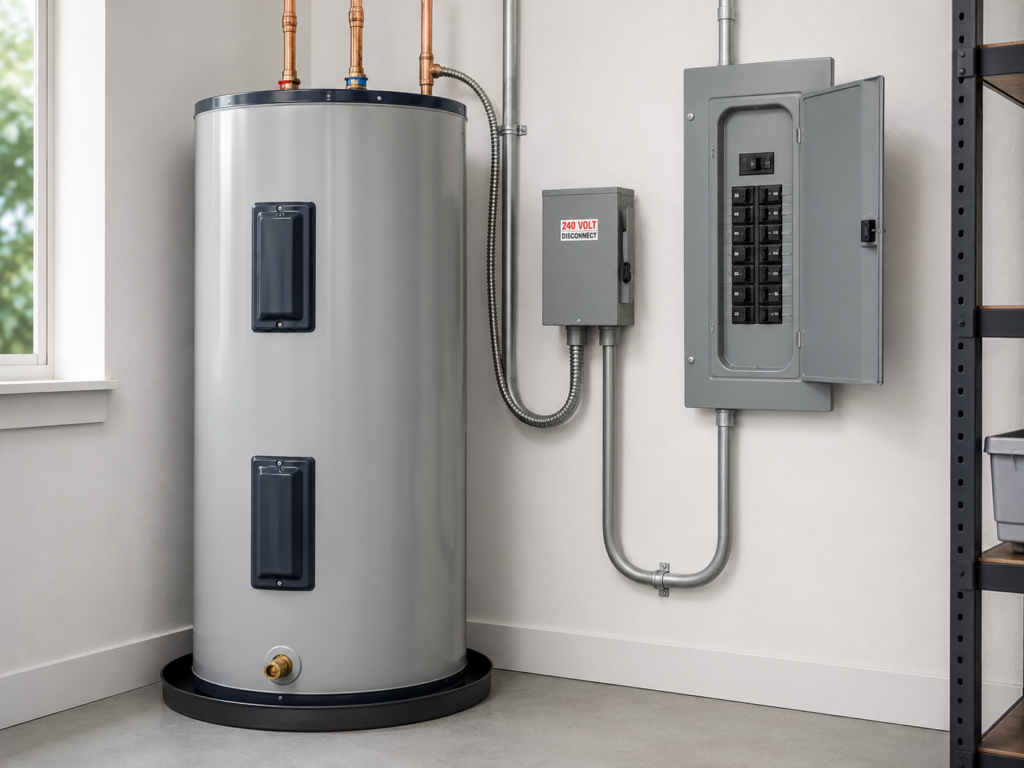
The 2024 IRC appliance-disconnection provisions require appliances to have a means of disconnecting the ungrounded supply conductors. For applicable permanently connected appliances, the permitted arrangement can include a branch-circuit switch or breaker within sight of the appliance, or an applicable device located elsewhere that can be locked in the open position.
Direct answer: A water heater does not universally require a separate wall switch mounted beside the tank, but the installation does require a compliant disconnecting means. Whether the panel breaker satisfies that requirement depends on its location, lockability, and the code applied to the installation.
Does an Electric Water Heater Need GFCI or AFCI Protection?
GFCI and AFCI requirements should be checked against the NEC edition adopted locally, connection method, circuit characteristics, installation location, manufacturer requirements, and local amendments.
This is particularly important because electrical protection requirements have changed between NEC editions, and modern electric water-heating products include conventional hardwired resistance tanks, heat-pump units, plug-in products, and other configurations that are not electrically identical.
For a conventional hardwired 240V tank, do not assume that a rule applying to a 240V receptacle automatically applies in the same way to a permanently connected appliance. Likewise, do not assume that no protection could ever be required simply because the heater is hardwired.
The correct approach is to identify the actual connection and the electrical code enforced by the AHJ.
Does Water Heater Wiring Have to Be in Conduit?
Not everywhere. Conduit is a wiring method and a form of physical protection—not a universal water-heater requirement that applies identically in every residential installation.
What is permitted depends on:
- where the wiring is installed;
- whether it is exposed to physical damage;
- the cable or conductor type;
- the connection method at the heater;
- manufacturer instructions; and
- the electrical code and amendments adopted locally.
Wiring exposed in a garage or unfinished utility area can require different protection from cable concealed inside protected residential construction.
Can You Reuse the Existing Water Heater Circuit?
Yes—if the existing circuit is suitable for the new heater. Reuse should be a verification decision, not an assumption.
| Verify | Why It Matters |
|---|---|
| Supply voltage | Must match the new heater's rating. |
| Maximum appliance load | The replacement may not have the same electrical demand as the old heater. |
| Breaker / overcurrent protection | Must be appropriate for both the appliance and the branch circuit. |
| Conductor size and material | Must coordinate with the required circuit and overcurrent protection. |
| Equipment grounding | Older or altered wiring should not be assumed to provide a correct grounding path. |
| Disconnect | The existing arrangement must satisfy the requirement applicable to the replacement. |
| Visible wiring condition | Heat damage, corrosion, damaged insulation, loose equipment, or previous modifications can require correction. |
Existing does not automatically mean compliant. An old heater can operate for years on a circuit that is unsuitable for its replacement—or on an installation that was altered incorrectly in the past.
Heat Pump and Electric Tankless Water Heaters Need Different Checks
The 4,500W conventional resistance-tank example is useful, but it should stop being your reference point when the appliance technology changes.
Heat Pump Water Heaters
Current heat-pump water heaters can use different electrical configurations even within the same product family. Rheem, for example, offers ProTerra heat-pump models with 15-amp and 30-amp 240V configurations, and the market also includes 120V heat-pump products.
So a heat-pump water heater should be checked from its own data plate and installation documents rather than automatically inheriting the branch circuit used by a conventional resistance tank.
For broader heat-pump ownership and installation considerations, see our heat pump water heater cost guide.
Electric Tankless Water Heaters
Electric tankless water heaters can require much higher instantaneous electrical capacity than storage tanks.
For perspective, current manufacturer specifications show even a small 120V, 3.5 kW A. O. Smith electric tankless model drawing about 29 amps and specifying a 30-amp breaker with 10 AWG wire. Larger whole-house electric tankless products can require dramatically more electrical capacity and, depending on the model, multiple circuits.
That is why tankless electrical design belongs to the exact manufacturer's specifications and a proper evaluation of available service capacity—not a conventional storage-tank wiring table.
See our tankless water heater installation cost guide for the broader installation implications.
When Should You Stop and Call a Qualified Electrician?
A homeowner can safely read the appliance data plate, locate the model number, review the installation manual, identify the labeled breaker from the normal panel face, and compare documented requirements.
Professional electrical work is appropriate when the job requires:
- installing a new branch circuit;
- changing breaker size or breaker type;
- replacing or resizing branch-circuit conductors;
- working inside the electrical panel;
- performing live-voltage testing;
- diagnosing burned, melted, or overheating wiring;
- correcting missing or questionable equipment grounding;
- modifying the disconnect arrangement; or
- investigating repeated breaker trips.
Those tasks involve shock, arc, overheating, and fire hazards and should not be handled by trial and error.
If you are deciding whether to perform the broader water-heater replacement yourself, see our can you install a water heater yourself guide.
Common Electric Water Heater Wiring Problems
| Problem | Why It Matters |
|---|---|
| 30A breaker protecting ordinary 12 AWG copper | The small-conductor overcurrent rule generally limits 12 AWG copper to 20A protection. |
| Circuit does not match replacement heater | Voltage, load, breaker, or conductor requirements can differ from the old unit. |
| Neutral confused with equipment ground | They perform different electrical functions and are not interchangeable. |
| Missing or questionable grounding | The equipment-grounding path is an important safety function. |
| Improper disconnect arrangement | The appliance requires a compliant means of disconnecting the supply. |
| Damaged or unprotected wiring | Heat damage, exposed wiring, poor strain relief, or physical damage can create shock and fire hazards. |
| Breaker repeatedly trips | Repeated tripping can indicate an appliance or circuit fault and should not be corrected by installing a larger breaker without diagnosis. |
Electric Water Heater Wiring FAQs
What Wire Size Does a 4,500-Watt Electric Water Heater Commonly Use?
Many conventional 4,500-watt, 240V residential storage heaters are installed on 30A two-pole circuits using 10 AWG copper branch-circuit conductors. Verify the exact model's markings and instructions because appliance and installation requirements can differ.
Can You Put 12-Gauge Copper Wire on a 30-Amp Water Heater Breaker?
Ordinary 12 AWG copper branch-circuit conductors are generally limited to 20A overcurrent protection under the small-conductor rule corresponding to NEC 240.4(D). A normal 30A water-heater circuit therefore should not simply be placed on 12 AWG copper because the heater's calculated load is less than 20 amps.
Does an Electric Water Heater Need a 30-Amp Breaker?
Many conventional 240V, 4,500W residential models use a 30A two-pole circuit, but not every electric water heater does. Check the exact appliance ratings and manufacturer instructions.
Does a 240V Water Heater Need 10/2 or 10/3?
Many conventional 240V resistance storage heaters use two ungrounded conductors plus an equipment grounding conductor and do not require a neutral for the heating load. Other appliance designs can differ, so follow the heater's wiring diagram.
Does a 240V Water Heater Need a Neutral?
Not necessarily. Many conventional resistance tanks operate their 240V heating load without a neutral. A neutral and equipment grounding conductor are different and should never be treated as interchangeable.
Does an Electric Water Heater Need Its Own Circuit?
Conventional hardwired 240V storage water heaters normally use an individual branch circuit. The final requirement depends on the appliance load, manufacturer instructions, branch-circuit rules, and locally adopted electrical code.
Does an Electric Water Heater Need a Disconnect?
Yes, a compliant disconnecting means is required. Depending on the installation and applicable code, that can be a qualifying branch-circuit breaker or switch located within sight of the appliance or an applicable lockable device located elsewhere.
Can I Reuse My Existing Water Heater Circuit?
Yes, if the existing voltage, breaker, conductors, grounding, disconnect arrangement, wiring condition, and other requirements are suitable for the replacement heater. The old appliance having worked on the circuit does not prove the circuit is correct for the new one.
Bottom Line
For many conventional residential electric storage water heaters, the practical reference point is 240 volts, a 4,500-watt maximum load, a 30-amp two-pole circuit, and 10 AWG copper conductors. That directly answers the common wiring question—but it remains a reference configuration, not a rule for every electric water heater.
The exact heater's data plate and manufacturer instructions come first. Tank capacity does not determine wire size, two 4,500-watt elements do not automatically create a 9,000-watt load, 12 AWG copper should not simply be placed on a 30A breaker, and an existing circuit must be verified before it is reused for a replacement heater.
Best final check: Read the exact heater's data plate and installation manual, identify the electrical code and amendments enforced by your AHJ, and have the branch circuit evaluated before changing breakers, conductors, grounding, disconnects, or other high-voltage wiring.