
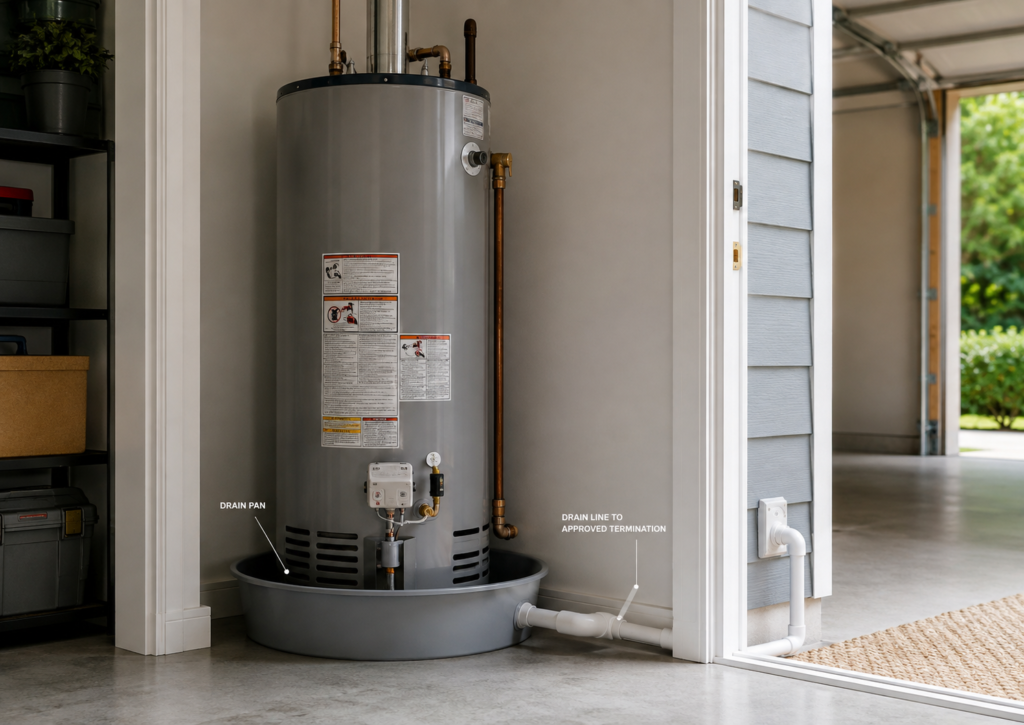
Quick answer: A drain pan is not automatically required under every water heater in the United States. Under the 2024 International Residential Code (IRC) and International Plumbing Code (IPC) model provisions, a pan is required for a storage tank-type water heater or hot-water storage tank when leakage from the tank would cause damage.
That is only the starting point. Your actual requirement depends on the code and edition adopted where you live, local amendments, the installation location, and the water heater manufacturer's instructions. An attic, upper floor, interior closet, basement, or garage should therefore not be treated as an automatic nationwide "yes" or "no."
Water heater drain pan code requirements are easy to oversimplify because the rules are not based on one nationwide room-by-room checklist. A plumber may tell one homeowner that a pan is required while another homeowner with a similar-looking installation is told it is optional, and those answers can differ because the installations are governed by different codes, editions, amendments, or damage conditions.
The safest way to evaluate the requirement is to start with the applicable model-code rule, determine whether leakage could damage the building, and then verify what your local authority having jurisdiction (AHJ) has actually adopted. For the broader requirements that can affect a residential installation, see our water heater code requirements guide.
Water Heater Drain Pan Code Requirements at a Glance
The table below summarizes the relevant 2024 IRC and IPC model-code baseline. It should not be read as proof of what your city, county, or state currently enforces.
| Question | 2024 IRC / IPC Model-Code Baseline |
|---|---|
| When is a pan required? | For a storage tank-type water heater or hot-water storage tank where leakage from the tank would cause damage. |
| Minimum pan depth | 1½ inches (38 mm). |
| Pan size | Sufficient size and shape to receive dripping or condensate from the tank or water heater. |
| Minimum pan drain | ¾-inch (19 mm) indirect waste pipe. |
| Exterior drain termination | Where exterior termination is used under these model provisions, the drain terminates 6 to 24 inches above adjacent ground. |
| Plastic pan under a gas heater | The 2024 IRC and IPC permit qualifying plastic meeting specified flame-spread and smoke-developed limits. Older adopted editions can differ. |
The current model-code provisions can be reviewed directly in 2024 IRC Section P2801.5 and 2024 IPC Section 504.7.
Important: Model codes are not automatically the enforceable code everywhere. A jurisdiction may use an earlier edition, follow a UPC-based plumbing code, or amend a model code locally. Identify the code actually adopted by your AHJ before treating a model-code provision as the legal requirement for a specific installation.
Why Do Plumbers and Inspectors Give Different Answers?
The disagreement is not always as simple as one person being wrong. Water heater pan requirements can change because of the code family, code edition, local amendments, and the way the installation's potential for water damage is evaluated.
1. Different Jurisdictions Can Use Different Code Frameworks
Many residential installations are evaluated under IRC- or IPC-derived requirements, while other jurisdictions use plumbing codes based on the Uniform Plumbing Code (UPC) or their own amended state and local rules.
That matters because the wording and scope are not necessarily identical. The 2024 IRC and IPC model provisions begin with a broad damage-based trigger: a storage tank needs a pan where leakage would cause damage. Other adopted codes can define locations, exceptions, materials, or drainage details differently.
2. The Code Edition Matters
Even two articles accurately describing the IRC can appear to disagree if they were written from different editions.
For example, the required-pan provision appeared at P2801.6 in earlier IRC editions such as the 2018 and 2021 IRC. In the 2024 IRC, the required-pan provision is numbered P2801.5.
So seeing P2801.6 cited on an older water-heater page does not automatically mean the section number is wrong. The first question should be: Which code edition is being cited?
3. Local Amendments Can Change the Model-Code Answer
A state, county, or city can adopt a model code and modify it. The locally enforceable requirement can therefore be more specific or more restrictive than the unamended model-code language.
For example, the 2022 Allegheny County Plumbing Code contains an amended provision requiring a floor drain or approved water heater drain pan regardless of the heater's location and specifically includes basement floors.
That is why statements such as "garage water heaters never need pans" or "basement water heaters never need pans" are not reliable nationwide code rules.
4. "Would Leakage Cause Damage?" Is Not Always a Simple Question
The 2024 IRC and IPC model language does not reduce the requirement to a list of room names. Instead, the trigger is whether leakage from the storage tank would cause damage.
That is usually easy to understand when a tank sits over a finished ceiling, hardwood floor, living area, or other water-sensitive construction. It can be less obvious where a heater sits on a concrete slab, in an unfinished utility area, or in a garage with little water-sensitive construction nearby.
The practical question is therefore not merely "What room is the water heater in?" It is:
If this tank begins leaking, what building materials or occupied areas could the water damage—and what does the locally adopted code say about that installation?
Does My Water Heater Need a Drain Pan?
Use location as a clue, not as a universal code verdict. The following table shows the questions that matter most when evaluating common residential locations.
| Water Heater Location | Why a Pan May Be Required | What to Verify |
|---|---|---|
| Attic | Leakage can damage insulation, framing, ceilings, and occupied rooms below. | Pan, drainage, termination, and the separate attic-access and installation rules adopted locally. |
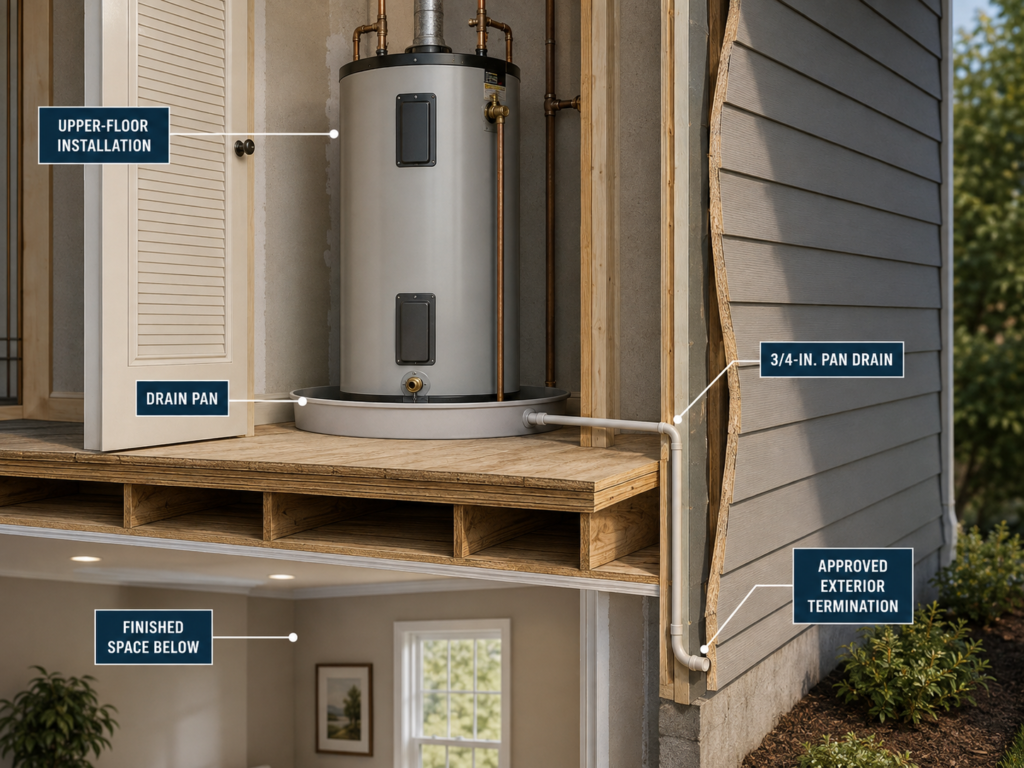
| Upper floor | Water can damage the floor assembly and finished space below. | Adopted pan rule and where a gravity drain can legally terminate. |
| Interior utility closet | Finished flooring, walls, cabinetry, or adjacent living areas may be exposed. | Local damage trigger plus any closet-specific installation requirements. |
| Basement | Finished basements and water-sensitive construction can still be damaged. | Do not assume "basement" creates an automatic exemption; check the adopted code and local amendments. |
| Garage | A bare slab may reduce some damage exposure, but local rules can create specific exceptions or additional requirements. | Local amendments, floor construction, surrounding materials, and installation-specific requirements. |
| Lowest floor on concrete slab | Damage potential may differ from an upper-floor installation, but that alone does not create a nationwide exemption. | Whether the jurisdiction has adopted an explicit slab exception or another local rule. |
If your heater is in an attic, do not use this table as a substitute for the other requirements that can apply to attic installations. Our water heater in attic code guide covers attic access, service space, structural considerations, drainage, and other location-specific issues in greater detail.
Likewise, an interior mechanical closet can involve requirements beyond the pan itself. See our separate water heater closet code guide rather than trying to apply drain-pan rules to the entire installation.
What Do the 2024 IRC and IPC Actually Require?
For a conventional storage-tank installation, the 2024 IRC and IPC are closely aligned on the core drain-pan trigger.
IRC Section P2801.5 and IPC Section 504.7 address a storage tank-type water heater or hot-water storage tank installed where tank leakage would cause damage. In that situation, the model codes require a pan made from specified or otherwise approved material.
This distinction matters because the trigger is based on potential damage, not simply on whether the heater is gas or electric, 40 gallons or 50 gallons, or installed in a room with a particular name.
Decision rule: First determine whether the installation falls within the adopted code's pan requirement. Only after that should you evaluate the required pan depth, material, drain size, drain-piping material, and termination.
Water Heater Drain Pan Size, Depth, and Materials
Once a pan is required, the 2024 IRC and IPC establish minimum physical requirements. This is another area where practical product advice and actual code language are often mixed together online.
Minimum Pan Depth: 1½ Inches
Under the 2024 IRC and IPC model provisions, the pan must be at least 1½ inches (38 mm) deep.
The codes also require the pan to be of sufficient size and shape to receive dripping or condensate from the tank or water heater. That wording matters.
You may see retailers or manufacturers recommend buying a pan a certain number of inches wider than the tank. That can be useful product-selection guidance, but it should not be presented as though the 2024 IRC simply says, for example, "the pan must be two inches wider." The model-code language focuses on minimum depth and sufficient size and shape.
Metal and Plastic Pan Requirements
The 2024 IRC and IPC list several acceptable material paths, including:
- galvanized steel or aluminum at least 0.0236 inch (0.6010 mm) thick;
- plastic at least 0.036 inch (0.9 mm) thick; and
- other approved materials.
Material selection becomes especially important when the pan is installed beneath a gas-fired water heater.
Can You Put a Plastic Drain Pan Under a Gas Water Heater?
Do not answer this question without knowing the adopted code edition. The IPC model-code rule changed between the 2021 and 2024 editions.
| Model Code | Plastic Pan Beneath Gas-Fired Water Heater |
|---|---|
| 2021 IPC | The model code prohibited a plastic pan beneath a gas-fired water heater. |
| 2024 IPC | Qualifying plastic is permitted when it meets the specified flame-spread and smoke-developed limits under ASTM E84 or UL 723. |
| 2024 IRC | Qualifying plastic is permitted when it meets the specified flame-spread and smoke-developed limits under ASTM E84 or UL 723. |
The 2021 IPC Section 504.7 therefore gives a different answer from the 2024 IPC Section 504.7. This is a practical example of why advice such as "plastic pans are always prohibited under gas water heaters" or "plastic is always allowed" is too broad.
If your jurisdiction still enforces an older code edition, the older restriction may remain relevant. The selected drain pan also needs to be suitable for the actual appliance and installation, so check the pan documentation, water heater installation instructions, and locally adopted requirements before choosing the material.
Key takeaway: The room name alone does not determine the answer. Identify the adopted code and edition first, determine whether leakage from the storage tank would trigger the pan requirement, and then verify the required pan material and dimensions for that installation.
Water Heater Pan Drain Requirements
A code-compliant water heater pan is more than a shallow tray beneath the tank. Where the adopted code requires both a pan and a pan drain, the drain must carry collected water to a permitted termination point using the required pipe size and an approved piping material.
Under 2024 IRC Section P2801.5.1 and 2024 IPC Section 504.7.1, the pan drain must be an indirect waste pipe at least ¾ inch (19 mm) in diameter.
Important distinction: A ¾-inch connection on the pan does not mean any convenient ¾-inch pipe is automatically acceptable. The adopted code also controls the permitted drain-piping materials and termination method.
The applicable 2024 model provisions can be reviewed directly in IRC Sections P2801.5.1 through P2801.5.3 and IPC Sections 504.7.1 and 504.7.2.
Where Can a Water Heater Pan Drain Terminate?
The 2024 IRC and IPC model provisions require the pan drain to extend full size to an approved termination rather than simply ending wherever routing is easiest.
Under the 2024 model-code baseline, the drain can generally:
- terminate over a suitably located indirect waste receptor;
- terminate over a floor drain under the IPC provision; or
- extend to the exterior of the building.
Where the drain extends outdoors under these provisions, it must terminate at least 6 inches and not more than 24 inches above the adjacent ground surface.
The drain must also extend full size to its termination point. A required ¾-inch pan drain should therefore not be reduced to a smaller pipe farther downstream simply because the smaller line is easier to route.
Do not choose a termination point by convenience alone. A nearby fixture connection, wall cavity, crawl space, or other improvised discharge location should not be assumed acceptable. Verify the drain route against the code and amendments actually adopted where the heater is installed.
Can You Use PVC for a Water Heater Pan Drain?
Do not assume ordinary PVC pipe is acceptable simply because a water heater pan was supplied with a plastic or PVC-style drain fitting.
The pan fitting and the downstream drain piping are not necessarily governed by the same material requirement.
The 2024 IRC directs safety-pan drain piping to the materials identified in Table P2906.5. The 2024 IPC directs safety-pan drain piping to Table 605.4. Those water-distribution tables include materials such as CPVC, copper, PEX, galvanized steel, polypropylene, and other listed piping systems.
Ordinary PVC water-service pipe appears elsewhere in the IPC material tables, but it is not listed as water-distribution pipe in Table 605.4. The IRC's corresponding Table P2906.5 likewise lists CPVC rather than ordinary PVC.
That means this shortcut is unreliable:
"The pan came with a PVC fitting, so PVC pipe must automatically be code-compliant for the entire drain."
The correct piping material depends on the adopted code, applicable material table, local amendments, and the fittings and products used in the installation. If the requirement is unclear, confirm the intended material before a long drain route is installed through finished construction.
Does a Replacement Water Heater Need a New Pan Drain?
This is one of the easiest parts of water heater drain pan code to misread because the pan and the pan drain are separate requirements.
The 2024 IRC and IPC contain a replacement exception stating that where a pan drain was not previously installed, a new pan drain is not required for the replacement water heater under that model-code provision.
That does not create a blanket exemption from the pan itself.
| Replacement Question | 2024 IRC / IPC Model-Code Principle |
|---|---|
| Can the replacement still need a pan? | Yes. If the installation falls within the required-pan provision, the pan itself can still be required. |
| What if the old installation had no pan drain? | The model-code replacement exception can remove the requirement to add a new pan drain where one was not previously installed. |
| Does that settle every replacement? | No. The locally adopted code, amendments, permit conditions, and AHJ requirements still control the actual installation. |
ICC's 2024 Plumbing Code Essentials explains the distinction directly: the replacement may still require a pan even when adding a new pan drain is excepted.
This distinction matters in older homes because routing a new gravity drain through existing finished construction can be substantially more involved than placing the replacement water heater in a pan. The exception addresses the drain requirement without turning every replacement installation into a blanket pan exemption.
What Changed in the 2024 IRC for Equipment Inside a Drain Pan?
The 2024 IRC adds another pan-related provision that many older water heater articles do not address.
Section P2801.5.3 addresses appliances, equipment, and insulation that could themselves be damaged when an auxiliary drain pan fills. Where those portions are subject to water damage, they must be installed above the pan's flood level rim. Supports located inside the pan must be water-resistant and approved.
This should not be interpreted as a universal instruction to raise every water heater by the same amount or place every tank on improvised blocks. The provision is conditional on whether relevant portions of the appliance, equipment, or insulation are subject to water damage if the pan fills.
Do not improvise supports inside a drain pan. Follow the water heater manufacturer's installation instructions and the locally enforced requirements where the 2024 flood-level-rim provision applies.
Do Tankless Water Heaters Need Drain Pans?
There is no reliable nationwide answer of simply "tankless water heaters never need drain pans."
The 2024 IRC P2801.5 and IPC 504.7 provisions discussed in this guide specifically refer to a storage tank-type water heater or hot-water storage tank. A conventional tankless water heater therefore does not fall under that storage-tank wording in the same way as a conventional tank heater.
However, that should not be turned into a universal exemption under every plumbing-code family, local amendment, installation condition, or manufacturer's instructions. Condensing tankless units can also have separate condensate-drainage requirements, which are a different issue from the storage-tank safety pan addressed here.
Treat a tankless installation as a separate code question rather than automatically applying either the storage-tank pan requirement or a blanket exemption.
Water Heater Pan Drain vs. T&P Relief Valve Discharge
A water heater drain pan and its temperature-and-pressure (T&P) relief system serve different purposes, even though some plumbing codes permit relief discharge to terminate at the pan under specified conditions.
| System | Primary Purpose |
|---|---|
| Drain pan and pan drain | Collect and route leakage, dripping, or condensate associated with the tank or water heater. |
| T&P relief valve and discharge piping | Provide a safety discharge path when excessive temperature or pressure causes the relief valve to open. |
The T&P discharge system has its own code requirements for pipe size, material, routing, gravity flow, fittings, and termination. Do not assume that the simpler pan-drain requirements can be applied to the relief-valve discharge piping.
If water is coming from the relief-valve area rather than from the tank itself, see our guide to a water heater pressure relief valve leaking. Repeated relief-valve discharge should be diagnosed rather than treated as an ordinary tank leak.
What a Water Heater Drain Pan Can—and Cannot—Protect Against
A drain pan is useful protection, but its role is easy to exaggerate.
A properly installed pan and drain can help collect and route:
- slow tank leakage;
- dripping around the water heater;
- small amounts of water reaching the base of the appliance; and
- condensate where applicable to the installation.
What a shallow drain pan is not is a storage vessel designed to hold the entire contents of a failed 40-, 50-, or 75-gallon tank.
If the tank develops a major rupture, or incoming water reaches the pan faster than the drain can carry it away, significant water damage can still occur. A pan reduces risk; it does not make a failed storage tank harmless.
If you already have water in or around the pan, finding the source matters more than simply drying it out. Use our water heater leaking guide to distinguish common leak sources before deciding what needs repair.
How to Check the Water Heater Drain Pan Code Where You Live
If you are replacing a heater, responding to an inspection report, or deciding whether a plumber's proposed pan and drain are required, use this sequence rather than relying on a generic internet checklist.
-
Identify your authority having jurisdiction.
This may be a city, county, state, or another building or plumbing authority. -
Find the adopted code family and edition.
Determine whether the installation is governed by an IRC-, IPC-, UPC-, state-specific, or locally amended framework and which edition is currently enforced. -
Check local amendments.
Do not stop after finding the model code. Local amendments can add requirements, alter exceptions, or change how the model provision applies. -
Check the water heater manufacturer's instructions.
Appliance-specific installation requirements still matter even when you understand the general model-code baseline. -
Verify an ambiguous installation with the AHJ.
This is especially useful for replacements, unusual drain routes, garages, basements, older homes, and situations where two apparently credible sources give different answers.
If you are evaluating more than the drain pan itself, our complete water heater code requirements guide covers the broader compliance areas that can affect a residential installation.
If you are considering doing installation work yourself, also review whether you can install a water heater yourself, including permit, inspection, gas, electrical, venting, and safety considerations.
Common Water Heater Drain Pan Inspection Problems
Inspection problems usually involve the pan system as a whole rather than whether a metal or plastic tray is simply present beneath the heater.
| Potential Problem | Why It Matters |
|---|---|
| No pan where one is required | The installation does not provide the required protection where tank leakage can cause damage. |
| Pan too shallow or unsuitable | The pan may not meet the applicable depth, material, or sizing requirements. |
| Missing or undersized drain | Where a drain is required, the 2024 IRC/IPC model-code baseline calls for at least a ¾-inch indirect waste pipe. |
| Drain reduced downstream | The 2024 model provisions require the pan drain to extend full size to its permitted termination. |
| Unapproved drain material | A pan fitting does not by itself establish that the downstream drain piping complies with the adopted material table. |
| Improper termination | The drain must terminate in a location permitted by the applicable code rather than simply discharge somewhere convenient. |
| Pan damaged or drain obstructed | A cracked, corroded, obstructed, or poorly draining pan system cannot route leakage as intended. |
| T&P piping treated like a pan drain | Relief-valve discharge has separate safety requirements even where a code permits its termination at the pan. |
Water Heater Drain Pan Code FAQs
Does Every Water Heater Need a Drain Pan?
No. Under the 2024 IRC and IPC model provisions discussed here, the requirement applies to a storage tank-type water heater or hot-water storage tank installed where leakage from the tank would cause damage. The locally adopted code and amendments determine the enforceable requirement.
Does a Water Heater in a Garage Need a Drain Pan?
Not automatically under one nationwide rule. A garage installation should be evaluated under the locally adopted code, including the damage trigger and any specific local amendments or exceptions.
Does a Basement Water Heater Need a Drain Pan?
It can. An unfinished slab basement and a finished basement with water-sensitive flooring and walls do not present the same damage conditions, and local amendments can impose additional requirements. Do not treat "basement" as an automatic exemption.
How Deep Does a Water Heater Drain Pan Need to Be?
The 2024 IRC and IPC model provisions specify a minimum pan depth of 1½ inches (38 mm). The pan must also be of sufficient size and shape to receive dripping or condensate from the tank or heater.
What Size Is a Water Heater Pan Drain?
The 2024 IRC and IPC model-code baseline requires an indirect waste pipe at least ¾ inch (19 mm) in diameter. Local amendments can differ, so verify the requirement where the heater is installed.
Can a Water Heater Pan Drain Outside?
Yes, where the applicable code permits exterior termination. Under the 2024 IRC and IPC model provisions, an exterior pan drain terminates between 6 and 24 inches above adjacent ground.
Does a Replacement Water Heater Need a Drain Pan?
A replacement heater can still require the pan itself where the required-pan trigger applies. Under the 2024 IRC/IPC model provisions, the specific replacement exception concerns adding a pan drain where one was not previously installed. Local amendments and AHJ requirements still need to be checked.
Bottom Line
The safest answer to "Does my water heater need a drain pan?" is not a universal yes or no. Under the 2024 IRC and IPC model-code baseline, a storage tank needs a pan where leakage would cause damage, but the final requirement depends on the code family and edition adopted locally, amendments, the installation itself, and the manufacturer's instructions.
If a pan is required, compliance involves more than placing a tray beneath the heater. The pan's depth, size, material, drain diameter, drain-piping material, and termination all matter. Replacement installations can also receive a specific exception for a previously nonexistent pan drain without necessarily eliminating the requirement for the pan itself.
Best final check: Identify the code and edition your AHJ actually enforces, check local amendments, and compare those requirements with the water heater manufacturer's instructions before treating any national code summary—including this one—as final approval for a specific installation.