
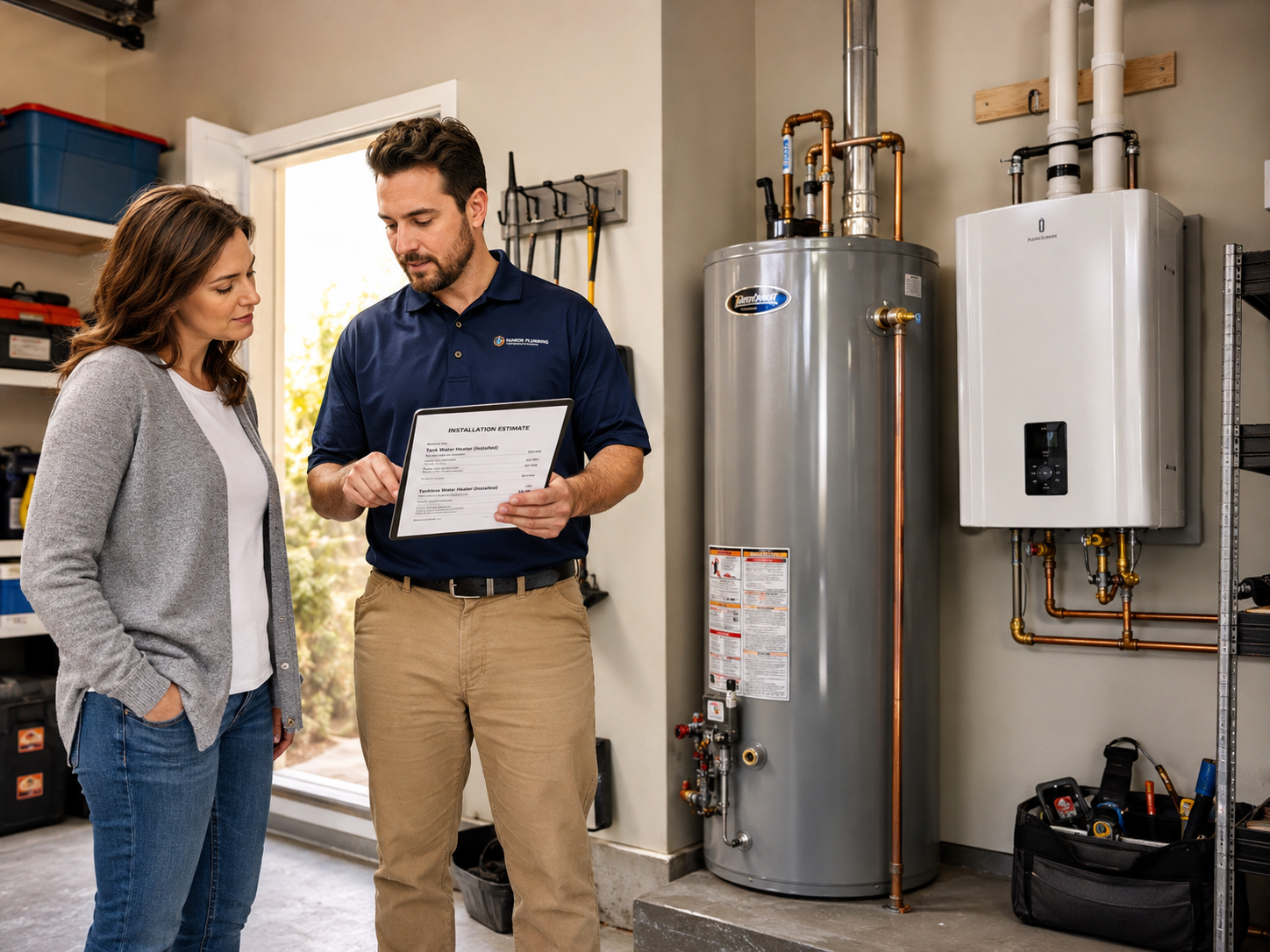
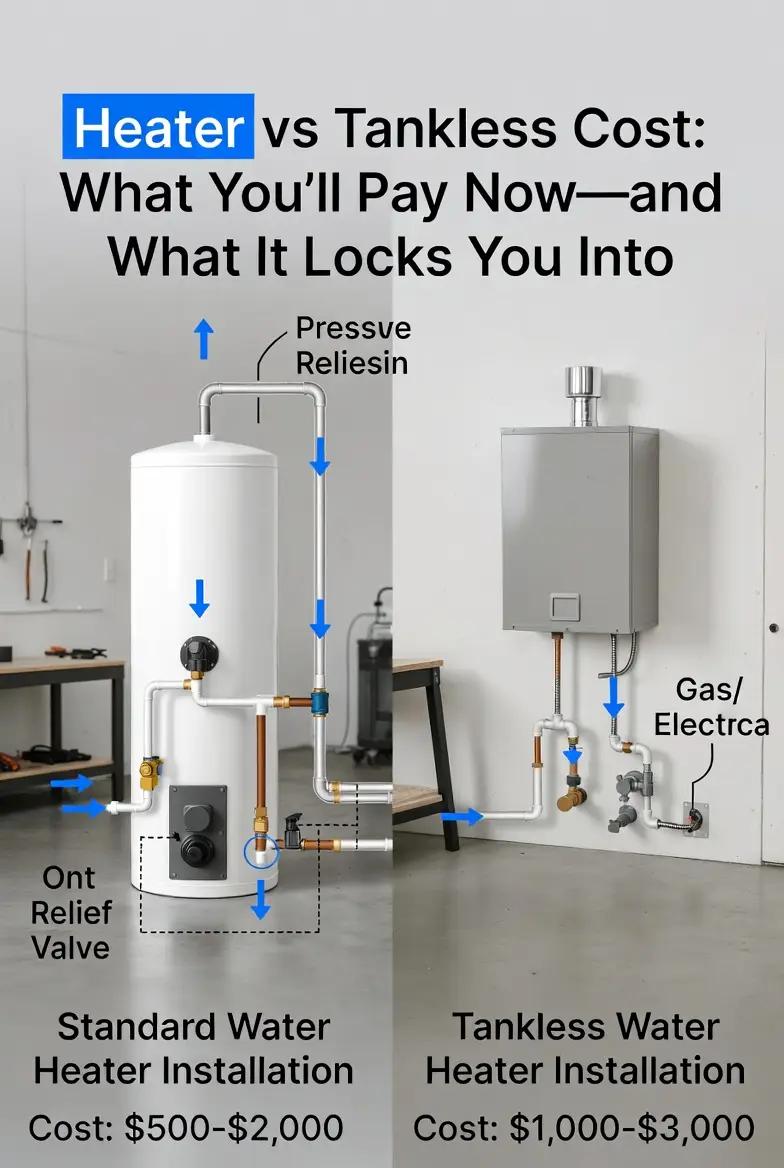
A tank water heater usually costs less to buy and install, while a tankless system generally costs more upfront but may reduce energy use, save space and remain serviceable longer. For many U.S. homes, a straightforward tank replacement costs approximately $1,200–$3,000, while a whole-home tankless installation commonly costs approximately $2,500–$6,500.
That comparison changes when the home needs gas piping, electrical-service work, new venting, condensate drainage or equipment relocation. An infrastructure-heavy tankless conversion can exceed $8,000–$10,000, and the resulting energy savings may not recover that installation premium during the homeowner’s expected time in the property.
The correct question is therefore not simply, “Which water heater costs less?” It is:
Which system delivers the best combination of installed cost, hot-water performance, operating expense, maintenance, expected service life and overall value for this particular home?
This guide compares those costs without assuming that either system is universally better.
Tank Water Heater vs Tankless Cost at a Glance
The table below provides practical planning ranges and key decision differences. These are not guaranteed quotes. Local labor rates, fuel type, equipment capacity, site access, permit requirements and infrastructure work can materially affect the final cost.
| Comparison factor | Tank water heater | Tankless water heater |
|---|---|---|
| Typical unit price | $400–$1,800 | $900–$3,500+ |
| Straightforward installed cost | $1,200–$3,000 | $2,500–$4,500 |
| Difficult or infrastructure-heavy project | $2,000–$4,500+ | $5,000–$10,000+ |
| Installation risk | Usually lower during a compatible, like-for-like replacement | Usually higher during a storage-tank-to-tankless conversion |
| Typical project time | Several hours to one working day for a straightforward replacement | One working day for a tankless-ready installation; several days when infrastructure changes are required |
| Energy use | Includes storage and standby losses, with performance varying by fuel and efficiency | Avoids most storage standby loss, but actual savings depend on usage, fuel, efficiency and recirculation |
| Maintenance exposure | Flushing, anode inspection, relief-valve checks and burner or element service | Descaling, inlet-filter cleaning, vent or combustion service and condensate maintenance where applicable |
| Potential service life | Often approximately 8–12 years, although actual life varies | Often approximately 15–20 years or longer with suitable installation and maintenance |
| Hot-water pattern | Stored reserve can handle a brief high-flow period, but the tank can eventually run out | Can provide long-duration hot water when demand remains within rated output |
| Simultaneous flow | Can use stored volume to support a temporary demand spike | Limited by the unit’s output at the actual temperature rise |
| Space requirement | Requires floor space for the storage tank | Compact and usually wall-mounted |
| Leak consequence | A failed tank can release a significant stored volume of water | No large storage tank, although piping and internal leaks remain possible |
| Best financial starting point | Urgent replacement, limited budget or a home already configured for a tank | Planned installation, suitable infrastructure, long ownership and valuable nonfinancial benefits |
The most important difference is not always the price of the appliance. It is the amount of additional work required to create a safe, compatible and properly sized installation.
Quick Winner by Homeowner Priority
| Homeowner priority | Likely better starting point | Why |
|---|---|---|
| Lowest upfront cost | Tank | A compatible replacement generally uses more of the existing plumbing, fuel, electrical and venting infrastructure |
| Fastest ordinary replacement | Tank | Like-for-like equipment can often be installed with fewer design and utility changes |
| Lowest conversion risk | Tank | The home may already be configured for the same fuel, footprint and connection arrangement |
| Smallest footprint | Tankless | The compact wall-mounted design eliminates the large storage vessel |
| Long-duration hot water | Tankless | Hot water can continue as long as demand remains within the heater’s rated output |
| Brief, high simultaneous demand | A properly sized tank may perform better | Stored hot water can support a temporary burst above the heater’s continuous recovery rate |
| Longer potential service life | Tankless | Many units can remain serviceable longer when correctly installed and maintained |
| Stored hot-water reserve during an outage | Tank | Water that is already heated may remain usable temporarily, even when the system cannot reheat it |
| Major remodel or new construction | Tankless becomes more competitive | Utilities, venting, drainage and equipment location can be planned before finishes are completed |
| Major infrastructure changes required | Tank usually wins financially | The tankless installation premium may become too large to recover through operating savings |
Compare the Same Fuel and Project Type
A fair cost comparison must match systems that serve the same function. Comparing a basic electric tank replacement with a difficult whole-home gas tankless conversion produces a dramatic price difference, but it does not reveal which technology is inherently more economical.
Gas Tank vs Gas Tankless
This is the most relevant comparison for many homeowners considering a tank-to-tankless conversion.
Both systems require a suitable gas supply, but a whole-home gas tankless model may have a much higher maximum input than the existing storage heater. The contractor may need to evaluate:
- Total connected gas load
- Available gas pressure
- Developed pipe length
- Gas meter and regulator capacity
- Approved combustion venting
- Condensate drainage for a condensing model
- Electrical power for controls, fans and ignition
A compatible gas storage replacement may reuse more of the existing arrangement, although venting, combustion air, relief protection, gas piping and other conditions must still be evaluated.
Gas tankless generally has a greater opportunity to reduce standby-related energy use, but the financial result depends on the installation premium and actual fuel savings.
Electric Tank vs Whole-Home Electric Tankless
An electric resistance tank and an electric tankless heater both convert electricity directly into heat. Tankless avoids storage standby losses, but a whole-home unit may require several dedicated high-amperage circuits and substantial available electrical-service capacity.
A fair comparison should include:
- The cost of the electric tank and its required circuit
- The number and size of the tankless circuits
- Breaker and conductor requirements
- Panel, feeder and dwelling-load capacity
- Possible electrical-service or utility work
- Local electricity rates and time-of-use pricing
- Expected winter inlet-water temperature
- Available tankless flow at the required temperature rise
A lower-priced electric tankless appliance can become the more expensive project when significant electrical work is required.
Point-of-Use Tankless vs Central Storage
A small point-of-use tankless heater is not necessarily a whole-home replacement. It may serve one remote sink, bathroom or limited fixture group.
Point-of-use equipment can reduce hot-water wait time or solve a localized plumbing problem, but its lower purchase price should not be used to represent the cost of a central whole-home tankless system.
Replacement vs Conversion
Replacing one tank with a similar tank is usually a lower-risk project than converting a storage system to tankless. Likewise, replacing an existing tankless heater may cost less than completing a first-time conversion because compatible utilities, mounting, venting and drainage may already exist.
For a broader comparison of replacement scenarios, see our water heater replacement cost guide. Homeowners who already have a tankless system should review the separate guide to tankless water heater replacement cost.
Do Not Ignore the Heat Pump Water Heater Alternative
When replacing an electric resistance tank, the financial choice is not limited to another resistance tank or a whole-home electric tankless system. A heat pump water heater stores hot water but moves heat rather than producing all of it through electric resistance.
Heat pump equipment has different space, drainage, airflow, recovery and installation requirements, but it may offer stronger operating-cost potential than whole-home electric tankless in a suitable home. It should be evaluated separately before treating tankless as the automatic efficiency upgrade.
Upfront Installed Cost: Tank vs Tankless
Tank Water Heater Installed Cost
A straightforward tank water heater replacement commonly costs approximately $1,200–$3,000. Difficult access, higher capacity, relocation, fuel changes or correction work can raise the total to approximately $2,000–$4,500+.
A typical tank quote may include:
- The new storage heater
- Draining and removing the old unit
- Standard hot and cold water connections
- Gas or electrical connection
- Temperature-and-pressure relief protection
- Basic startup and operational testing
- Disposal where stated
- Permit and inspection handling where required and included
Tank cost can rise when the project requires:
- A larger storage capacity
- Attic, crawl-space or confined-location labor
- A drain pan or drain connection
- An expansion tank where required
- Seismic restraint where applicable
- New venting or combustion-air corrections
- Gas-piping or electrical-circuit changes
- Platform, bollard or clearance corrections
- Water-pressure or relief-discharge corrections
- Wall, floor or roof restoration
Infrastructure work is not exclusive to tankless systems. Tank replacement simply tends to create less infrastructure risk when the new heater is compatible with the existing location and utilities.
See our detailed guide to tank water heater installation cost for a complete breakdown of tank equipment, labor and common corrections.
Tankless Water Heater Installed Cost
A tankless-ready installation may cost approximately $1,500–$3,500, while a straightforward whole-home project commonly costs approximately $2,500–$4,500. A standard storage-tank-to-tankless conversion may cost approximately $3,500–$6,500.
Infrastructure-heavy conversions involving major gas work, multiple electrical circuits, service upgrades, difficult venting, relocation or multiple units can reach $5,000–$10,000+.
A complete tankless project may include:
- The tankless heater and required accessories
- Wall mounting and water-piping changes
- Isolation and service valves
- Gas-load evaluation and piping work
- Dedicated electrical work
- Approved intake and exhaust venting for indoor gas models
- Condensate drainage for condensing gas models
- Recirculation equipment where included
- Old-tank removal and vent abandonment
- Permits, inspections and utility coordination
- Manufacturer-required startup and commissioning
- Wall, siding or roof restoration
See our complete guide to tankless water heater installation cost for project-specific ranges and the six-gate home-readiness test.
Why Tankless Usually Costs More to Install
The tankless premium is not simply a charge for newer technology. It often reflects the difference between replacing an appliance within an existing system and redesigning part of the home’s water-heating infrastructure.
| Cost factor | Tank replacement | Tankless conversion |
|---|---|---|
| Equipment location | Often remains within the existing footprint | May require a new wall location, mounting surface or exterior position |
| Water piping | Connections may remain close to the existing layout | Connections may need substantial relocation |
| Gas system | A compatible replacement may use the existing branch after verification | Higher maximum input may require additional piping, meter or regulator evaluation |
| Electrical system | A compatible electric tank may use one existing circuit after verification | Whole-home electric tankless may require several dedicated circuits and a major capacity review |
| Venting | A compatible gas tank may use an existing approved system after evaluation | An indoor gas tankless unit may need a different approved intake and exhaust arrangement |
| Condensate | Ordinary non-condensing tanks generally do not produce combustion condensate | Condensing gas tankless equipment requires an approved disposal path |
| Building restoration | Often limited during a same-location replacement | New and abandoned penetrations may require drywall, siding or roofing work |
| Trade coordination | One contractor may complete much of a straightforward replacement | Plumbing, gas, mechanical, electrical and utility coordination may be required |
A high tankless quote is not automatically inflated, and a low quote is not automatically efficient. The proposals must be compared using the same equipment, demand calculation, infrastructure scope, permits and commissioning requirements.
Calculate the Tankless Installation Premium
The first financial calculation is the additional upfront amount required to choose tankless instead of a comparable tank installation.
Tankless installation premium = complete tankless installed quote − comparable tank installed quote
Use complete project quotes rather than equipment prices. Each quote should include the work required to deliver a functioning, inspected and commissioned system.
| Illustrative scenario | Tank quote | Tankless quote | Tankless premium |
|---|---|---|---|
| Tankless-ready home | $2,300 | $4,000 | $1,700 |
| Standard conversion | $2,300 | $5,600 | $3,300 |
| Infrastructure-heavy conversion | $2,500 | $8,000 | $5,500 |
These are teaching examples rather than national averages. Their purpose is to show that the financial decision begins with the premium—not the total tankless price alone.
A $1,700 premium may be easier to justify through energy savings, longer potential service life and homeowner preferences. A $5,500 premium creates a much higher financial barrier and may never be recovered through utility savings alone.
Operating Cost and Energy Savings
Storage heaters maintain a volume of hot water and lose some heat while that water waits for use. Tankless heaters operate on demand and avoid most storage standby loss.
However, lower energy use does not automatically mean a low utility bill or fast financial payback. Actual savings depend on:
- Fuel type
- Local gas and electricity rates
- Hot-water volume
- The number and pattern of daily draws
- The efficiency of the old and new equipment
- Incoming-water temperature
- Temperature setting
- Recirculation design and schedule
- Distribution-pipe losses
- Maintenance condition
U.S. Department of Energy guidance states that demand water heaters can be approximately 24%–34% more energy-efficient than conventional storage water heaters in homes using 41 gallons or less of hot water per day. The potential percentage advantage generally becomes smaller as daily hot-water consumption increases.
That figure describes water-heating energy efficiency under specified usage conditions. It does not mean:
- The entire household utility bill will fall by 24%–34%
- Every tankless installation will save the same annual amount
- Tankless will automatically repay a large conversion premium
- Electric tankless is the lowest-cost electric water-heating option
- Maintenance and recirculation have no financial effect
Gas Tank vs Gas Tankless Operating Cost
A properly sized gas tankless system may reduce fuel use by avoiding storage standby loss and, where applicable, using higher-efficiency combustion technology. The dollar savings depend on the old tank’s efficiency, the new unit’s UEF, household consumption and local gas prices.
Gas tankless economics become weaker when:
- The installation premium is large
- Hot-water use is modest but maintenance remains expensive
- Continuous recirculation creates additional heat loss
- Local gas rates are low
- The existing storage heater is already relatively efficient
- The homeowner plans to move before the premium can be recovered
Electric Tank vs Electric Tankless Operating Cost
Electric tankless can reduce storage standby loss, but both ordinary electric tank and electric tankless systems typically rely on electric resistance heating. The tankless unit does not create the same efficiency improvement associated with heat pump technology.
In some rate structures, a storage tank can also heat water during lower-cost periods and retain it for later use. Whole-home electric tankless creates a large instantaneous demand whenever hot water flows, which may be relevant where utilities use demand charges or time-dependent pricing.
Before choosing whole-home electric tankless solely for energy savings, compare:
- Expected annual consumption
- Electrical-upgrade cost
- Local rate structure
- Winter output
- Maintenance requirements
- A high-efficiency storage or heat pump water heater alternative
Does Tankless Pay for Itself?
Tankless may repay part or all of its upfront premium in some homes, but there is no universal payback period. The result depends on the additional installation cost and the homeowner’s net annual savings.
Net annual savings = annual energy savings − additional annual maintenance and operating costs
Simple payback = tankless installation premium ÷ net annual savings
| Illustrative scenario | Tankless premium | Net annual savings | Simple payback |
|---|---|---|---|
| Ready home with favorable economics | $1,700 | $120 per year | Approximately 14 years |
| Standard conversion | $3,300 | $100 per year | Approximately 33 years |
| Infrastructure-heavy conversion | $5,500 | $120 per year | Approximately 46 years |
| Higher maintenance difference | $3,300 | $40 per year | Approximately 83 years |
These examples are not predictions. They demonstrate why broad claims such as “tankless pays for itself” are incomplete.
Simple payback also omits several factors:
- Future utility-rate changes
- Repair costs
- Replacement timing
- Financing costs
- Available incentives
- Potential home resale value
- Discounted future cash flow
- The value of space savings
- The value of long-duration hot water
Tankless can still be the preferred system even when utility savings alone do not repay the full premium. A homeowner may reasonably value the compact footprint, reduced storage-tank leak exposure, long-duration hot water or longer potential service life.
The important point is to separate those benefits from a claim of guaranteed financial payback.
Hot-Water Performance: Stored Reserve vs Continuous Output
Cost should not be evaluated independently of performance. A cheaper system is not good value if it cannot support the household’s actual use.
How a Tank Water Heater Handles Demand
A storage heater delivers water from a heated reserve while simultaneously reheating incoming cold water. Its real-world performance depends on:
- Tank capacity
- First-hour rating
- Recovery rate
- Fuel type and input
- Thermostat setting
- Incoming-water temperature
- Fixture flow
- Time between high-demand periods
A properly sized tank can handle a brief period of high simultaneous demand by drawing from stored volume, even when that momentary demand exceeds the heater’s continuous recovery rate. The limitation is that the stored reserve can eventually be depleted.
How a Tankless Water Heater Handles Demand
A tankless heater produces hot water while water flows. Its capacity depends primarily on:
- Flow rate
- Incoming-water temperature
- Required outlet temperature
- Temperature rise
- Maximum heating output
- Minimum activation flow
- Fuel or electrical supply
- Whether one or multiple units are installed
A tankless system can continue supplying hot water for a long shower or repeated sequential use, provided total demand remains within its rated capacity.
Important: “Endless hot water” means continuous duration within the heater’s available output. It does not mean unlimited gallons per minute or an unlimited number of simultaneous fixtures.
Short High-Flow Demand vs Long-Duration Demand
| Usage pattern | Tank water heater | Tankless water heater |
|---|---|---|
| One ordinary shower | Usually suitable when the tank is correctly sized and recovered | Usually suitable when the required flow and temperature rise are within the unit’s output |
| Two simultaneous showers | Stored reserve may handle the temporary combined load | The unit must be rated for the combined flow at the actual temperature rise |
| Several fixtures for a short period | Can temporarily draw from stored hot water | May reduce outlet temperature or flow if demand exceeds maximum output |
| One very long shower | May eventually deplete the stored volume | Can continue as long as demand remains within capacity and utilities remain available |
| Sequential household use | Requires sufficient recovery between uses | Often well suited when each draw remains within rated capacity |
| Large tub fill | Performance depends on usable stored volume and recovery | Performance depends on flow rate, fill temperature and available output |
| Very low-flow hand washing | Stored hot water is available after the normal distribution-pipe delay | The heater must meet its minimum activation and modulation conditions |
| Cold-climate winter use | Colder inlet water reduces usable mixed volume and recovery performance | Colder inlet water increases the required temperature rise and reduces available GPM |
A tank can outperform tankless during a brief high-flow burst, while tankless can outperform a tank during a long draw that remains within its rated capacity. Neither technology should be selected from household size or bathroom count alone.
Which System Fits Your Household’s Usage Pattern?
| Household situation | Likely better starting point | What must be verified |
|---|---|---|
| Urgent failure with predictable demand | Compatible tank replacement | Size, fuel, venting, electrical supply, equipment location and required corrections |
| Long showers but limited simultaneous use | Tankless may be attractive | Required GPM at winter temperature rise and local service support |
| Several fixtures used together for short periods | A properly sized tank may provide strong burst performance | First-hour rating, recovery rate and peak-use duration |
| Very limited mechanical-room space | Tankless may be attractive | Suitable mounting location, utility capacity, venting, drainage and service access |
| Home needs major gas or electrical upgrades | Tank often wins financially | Complete upgrade cost and expected ownership period |
| New construction or major renovation | Tankless becomes more competitive | Demand, infrastructure design, recirculation and equipment location |
| Hard-water area | Either system can work | Scale-control strategy, flushing, anode care, water treatment and maintenance pricing |
| Long-term owner who values compact equipment | Tankless may justify the premium | Installation premium, net annual savings, maintenance and repair support |
| Electric home focused primarily on efficiency | Compare a heat pump water heater | Space, drainage, airflow, recovery, electrical supply and operating-cost estimates |
The correct decision comes from combining cost and performance. A household should not pay a large tankless premium for capacity it cannot use, and it should not select a cheaper tank that cannot support the required peak and duration of hot-water demand.
Container 1 takeaway: A tank water heater usually wins on immediate price and replacement simplicity. Tankless becomes more competitive when the home is already prepared, long-duration hot water and space savings matter, the installation premium is controlled and the homeowner expects to remain long enough to benefit. Compare complete installed projects—not equipment prices or marketing claims.
Tank vs Tankless Maintenance Costs
Neither system is maintenance-free. The cost difference depends on water quality, fuel type, equipment design, local service rates and whether the homeowner performs basic upkeep or hires a professional.
| Maintenance area | Tank water heater | Tankless water heater |
|---|---|---|
| Flushing | Periodic draining or flushing may help remove sediment from the bottom of the tank | Descaling may be required to remove mineral buildup from the heat exchanger |
| Water-quality exposure | Hard water can increase sediment, scale and anode consumption | Hard water can restrict heat-exchanger passages and reduce performance |
| Anode maintenance | Sacrificial anode inspection and replacement may extend tank life | No storage-tank anode rod |
| Filter maintenance | Usually limited unless the system includes additional filtration | Many units have an inlet-water filter that should be inspected and cleaned |
| Combustion and venting | Gas models may require burner, draft and vent inspection | Gas models may require burner, fan, venting and combustion-system inspection |
| Condensate system | Ordinary non-condensing tanks generally do not produce combustion condensate | Condensing gas units may require drain, pump and neutralizer maintenance |
| Relief protection | Temperature-and-pressure relief components should be inspected | Pressure-relief protection and discharge arrangements should be inspected |
| Recirculation | Possible with added pumps and controls | May be built in or added, increasing maintenance and control complexity |
Tank Water Heater Maintenance
Common tank water heater maintenance may include:
- Flushing sediment from the tank
- Inspecting or replacing the sacrificial anode rod
- Checking for rust, corrosion or water around the base
- Inspecting the temperature-and-pressure relief arrangement
- Checking the drain valve, shutoff valve and supply connections
- Inspecting burners, elements, thermostats or venting where applicable
The value of maintenance depends partly on the tank’s design and condition. An accessible anode rod may be worth replacing on an otherwise sound tank, while extensive work may not make sense on an older unit that is already leaking or severely corroded.
Review our guides to water heater flushing cost and anode rod replacement cost for more detailed ownership estimates.
Tankless Water Heater Maintenance
Tankless maintenance may include:
- Descaling the heat exchanger
- Cleaning the inlet-water filter
- Inspecting gas combustion and venting
- Checking condensate drainage and neutralizer media where applicable
- Inspecting recirculation components
- Testing controls, sensors and stored error codes
- Checking for freeze damage or blocked exterior terminations
Descaling frequency should not be treated as one universal annual rule. The appropriate interval depends on water hardness, usage, manufacturer guidance, scale-control equipment and system performance.
Our guide to tankless water heater maintenance cost explains descaling, service visits and common maintenance expenses in greater detail.
Maintenance takeaway: Tank maintenance is often simpler, while tankless maintenance can be more specialized. The financial difference depends heavily on water hardness, local labor rates and whether the equipment remains easy to service.
Repair Costs and Local Service Availability
A longer potential service life does not guarantee lower repair costs. Tankless systems use heat exchangers, sensors, control boards, flow sensors, fans, valves and electronic controls that may require brand-specific diagnosis and replacement parts.
Tank systems are generally simpler and are familiar to a larger pool of contractors. Common repairs may involve:
- Heating elements
- Thermostats
- Burners or ignition components
- Gas-control valves
- Relief valves
- Drain valves
- Anode rods
- Supply connections
Tankless repair can still be reasonable when the unit is otherwise sound and the failed component is available. However, ownership value weakens when:
- Qualified technicians are scarce
- The manufacturer has limited local parts support
- Diagnosis requires repeated paid visits
- A major heat-exchanger or control failure occurs outside warranty
- The original installation makes service difficult
- The unit has recurring scale, freeze or combustion problems
Before selecting tankless, ask which local contractor will service the exact brand after installation. A long written warranty has limited practical value when no qualified technician is available nearby.
Tank vs Tankless Lifespan
A conventional tank water heater often lasts approximately 8–12 years, while a properly installed and maintained tankless system may remain serviceable for approximately 15–20 years or longer. These are planning ranges, not guarantees.
| Lifespan factor | Tank water heater | Tankless water heater |
|---|---|---|
| Water quality | Hard water can increase sediment, scale and anode consumption | Hard water can restrict the heat exchanger and increase descaling needs |
| Pressure and thermal stress | High pressure and frequent cycling can accelerate tank and connection wear | Flow, temperature and cycling conditions can affect valves, sensors and heat-exchanger stress |
| Maintenance | Flushing and anode care may extend useful life | Descaling, filter cleaning and combustion maintenance may preserve performance |
| Installation quality | Venting, expansion control, relief discharge and location affect reliability | Sizing, gas or electrical capacity, venting, condensate handling and commissioning strongly affect reliability |
| Repairability | Simple components may be widely available, but a leaking tank usually requires replacement | Many components may be replaceable, but major parts can be expensive or brand-specific |
| Parts support | Common models are generally familiar to many contractors | Long-term value depends more heavily on manufacturer and local service support |
A tankless unit may last through most or all of a 15- to 20-year ownership period, while a storage tank may require replacement during that time. However, the longer potential lifespan should not be treated as a guaranteed financial credit that automatically justifies any installation premium.
10-, 15- and 20-Year Ownership Framework
There is no honest universal lifetime-cost total for tank and tankless systems. Ownership cost depends on local fuel prices, hot-water use, maintenance, repairs, installation premium and replacement timing.
Use this framework instead:
Total ownership cost = initial installation + energy + maintenance + repairs + replacement costs − incentives
| Ownership window | Tank cost exposure | Tankless cost exposure |
|---|---|---|
| 10 years | The original tank may remain in service or approach replacement age | The original unit may remain in service, but the installation premium may not yet be recovered |
| 15 years | A replacement may occur during the period, depending on age, condition and water quality | One maintained unit may last through much or all of the period, but repairs remain possible |
| 20 years | One or possibly two tank purchases may occur, depending on lifespan and starting age | The original unit may remain serviceable or may require major repair or replacement near the end of the period |
What to Include in Your Ownership Estimate
- Complete installed price for each system
- Available incentives
- Expected annual fuel or electricity use
- Routine maintenance costs
- Likely repair exposure
- Replacement probability during the ownership period
- Financing charges
- Recirculation operating cost
- Water-treatment or scale-control cost
- Expected years in the property
Do not automatically assume that a tank will require two replacements over 20 years or that tankless will require none. Use realistic ranges and test more than one scenario.
Tank vs Tankless During a Power Outage
Outage performance depends on the exact fuel type and control system.
Electric Tank Water Heater
An electric tank cannot reheat water without power, but the already-heated water stored in the tank may remain usable for a limited time.
Gas Tank Water Heater
Some atmospheric gas tank heaters with standing pilots and mechanical controls may continue operating without household electricity. Other models use electronic ignition, powered dampers, fans or controls and may stop heating during an outage.
Gas Tankless Water Heater
Most modern gas tankless systems require electricity for ignition, fans, sensors, controls and freeze protection. They generally do not produce hot water during a power outage unless suitable backup power is available.
Electric Tankless Water Heater
An electric tankless heater cannot produce hot water without electrical power.
For a deeper explanation, see our guide to whether a gas water heater works without electricity.
When a Tank Water Heater Is the Better Value
A tank water heater is often the stronger financial choice when:
- The homeowner needs the lowest upfront cost
- Hot water must be restored quickly
- The existing tank location and utilities are suitable
- A tankless conversion would require major gas, electrical or venting work
- The expected ownership period is short
- Household demand is predictable
- Brief high simultaneous demand is common
- Local tankless service support is weak
- The property is a rental where simple replacement and broad contractor availability matter
- The homeowner does not place high value on space savings or long-duration hot water
A tank is not automatically outdated or inefficient. A properly sized and correctly installed storage heater may provide the best balance of price, performance, repairability and replacement speed.
When Tankless Is Worth the Premium
Tankless becomes more attractive when:
- The home already has suitable gas or electrical capacity
- The venting and condensate routes are straightforward
- The required winter flow can be delivered by a practical model
- The installation premium is controlled
- The homeowner expects to remain in the property for many years
- Long-duration hot water has meaningful household value
- Space savings are important
- The equipment location reduces concern about a large storage-tank leak
- Local technicians support the selected brand
- Maintenance costs are understood and accepted
- New construction or remodeling makes infrastructure planning easier
Tankless may still be the preferred system even when energy savings alone do not repay the full premium. Space, comfort, service life and leak-risk preferences are legitimate benefits, but they should be separated from claims of guaranteed financial return.
When Neither Tank Nor Tankless Is the Best Choice
Homeowners replacing an electric resistance tank should also consider a heat pump water heater. It remains a storage system, but it moves heat from the surrounding air instead of relying entirely on electric resistance.
A heat pump water heater may be worth comparing when:
- Reducing electric operating cost is the main objective
- The home has suitable room volume and airflow
- A condensate drain is available
- The location can tolerate cooler surrounding air and operating sound
- Recovery and storage capacity match the household’s demand
- Available rebates materially improve the installed cost
It may be unsuitable where space, temperature, drainage, sound or recovery limitations cannot be addressed.
Review our guide to heat pump water heater cost before treating whole-home electric tankless as the automatic efficiency upgrade.
Planned Upgrade vs Emergency Replacement
The best system during a planned remodel may not be the best system after a sudden leak or no-hot-water failure.
| Decision condition | Tank replacement | Tankless conversion |
|---|---|---|
| Hot water must be restored immediately | Usually easier to complete quickly when a compatible model is available | May require design, trade coordination, permits and infrastructure work |
| Home has not been evaluated | Often the safer immediate starting point | Should not proceed until demand and utility capacity are verified |
| Conversion was planned in advance | Still available as the lower-cost option | Becomes more practical when sizing, venting and utility work are already resolved |
| Temporary hot water is available | May not be necessary if the homeowner prefers a planned upgrade | Allows more time for correct design and permitting |
| Budget is tightly limited | Usually provides better cost control | Open-ended infrastructure work creates greater financial risk |
An emergency failure is usually the worst time to discover that the home needs a new gas line, electrical-service work, difficult venting or utility coordination.
How to Compare Tank and Tankless Quotes
Do not compare only the final totals. Normalize both proposals so they include the same scope.
| Quote item | What both proposals should identify |
|---|---|
| Exact equipment | Manufacturer, complete model number, fuel type, capacity and included accessories |
| Sizing basis | Tank capacity and first-hour rating or tankless GPM at the required temperature rise |
| Equipment price | Heater, valves, controls, vent materials, recirculation components and accessories |
| Labor | Plumbing, gas, mechanical and electrical work included in the contract |
| Utility work | Gas piping, meter, regulator, circuits, panel, feeder or service changes |
| Venting and drainage | Approved vent scope, condensate disposal and treatment of the old vent |
| Removal and disposal | Old-equipment removal, hauling and disposal fees |
| Permits | Required permits, included fees, inspection scheduling and correction responsibility |
| Restoration | Drywall, paint, siding, roofing and penetration repairs |
| Commissioning | Startup, configuration, leak checks and performance testing |
| Maintenance assumptions | Expected flushing, descaling, filter, anode or combustion-service costs |
| Warranty | Manufacturer coverage, labor coverage, exclusions and local service process |
| Allowances | Every item that could increase after work begins |
Quote rule: Compare complete installed systems, not appliance prices. A $2,000 tank quote and a $4,500 tankless quote are not meaningful until equipment, permits, utility work, venting, restoration and commissioning are equally defined.
Tank vs Tankless Quote Red Flags
- No complete equipment model number
- Sizing based only on household size or bathroom count
- A tankless model selected from maximum advertised GPM alone
- A tank selected without considering first-hour rating and recovery
- Gas capacity approved from pipe diameter alone
- Whole-home electric tankless approved without an electrical-load calculation
- “Code upgrades” listed without identifying the actual condition
- No permit responsibility stated
- No venting or condensate scope for a gas tankless unit
- Open-ended gas, electrical or building-restoration allowances
- Guaranteed energy savings without stated usage or rate assumptions
- Claims that tankless always pays for itself
- Claims that tankless provides unlimited simultaneous flow
- No local warranty-service plan
- Pressure to sign before the home is inspected
Common Tank vs Tankless Comparison Mistakes
Comparing Different Fuels
A gas tankless conversion should not be compared directly with a basic electric tank replacement without accounting for fuel, utility and infrastructure differences.
Comparing Replacement With Conversion
A like-for-like tank replacement and a first-time tankless conversion are fundamentally different projects. Conversion work can include utility redesign, venting, drainage and building restoration.
Using Efficiency Percentages as Dollar Savings
A percentage improvement in water-heating efficiency is not the same as an equal percentage reduction in the entire household utility bill.
Ignoring Maintenance
Energy savings should be reduced by any additional maintenance and operating costs before payback is calculated.
Assuming “Endless” Means Unlimited Flow
Tankless can provide continuous hot water only within its rated output at the actual temperature rise.
Ignoring Winter Inlet-Water Temperature
Cold inlet water increases the required temperature rise and reduces the flow available from a tankless heater.
Assuming a Longer Lifespan Guarantees Better Value
A longer potential service life does not automatically recover a very large installation premium.
Ignoring Local Repair Support
A system that cannot be serviced quickly or affordably may deliver poor long-term value even when its published specifications are strong.
Forgetting the Heat Pump Alternative
Electric homeowners should compare tankless with both ordinary storage and heat pump water heaters rather than assuming tankless is the only efficiency upgrade.
Frequently Asked Questions
Is Tankless Cheaper Than a Tank Water Heater Over Time?
Sometimes, but not always. Tankless may use less energy and last longer, but a large installation premium, higher maintenance costs or a short ownership period can prevent it from becoming the lower-cost option.
How Much More Does Tankless Cost Upfront?
A straightforward tank replacement commonly costs approximately $1,200–$3,000, while a whole-home tankless installation may cost approximately $2,500–$6,500. Infrastructure-heavy conversions can exceed $8,000–$10,000.
How Much Can Tankless Save Each Year?
There is no universal dollar amount. Savings depend on fuel, water use, equipment efficiency, utility rates, recirculation and maintenance. Calculate savings using the specific old and proposed systems rather than a generic percentage.
What Is the Typical Tankless Payback Period?
There is no single payback period. Divide the complete tankless installation premium by maintenance-adjusted annual savings. A low premium may be recovered within the ownership period, while a major conversion premium may take decades or may never be recovered through energy savings alone.
Which System Lasts Longer?
Tank water heaters often last approximately 8–12 years, while tankless systems may last approximately 15–20 years or longer with suitable installation and maintenance. Actual service life varies significantly.
Which Costs More to Maintain?
Tankless maintenance is often more specialized because of descaling, filters, combustion components and condensate systems. Tank systems may require flushing, anode care and conventional burner or element service. Local water quality and labor rates determine the actual difference.
Which Is Better for Multiple Showers?
The answer depends on simultaneous flow and duration. A properly sized tank may handle a short high-flow burst using stored water. A tankless system can support long-duration use only when the combined flow remains within its output at the required temperature rise.
Can Tankless Provide Endless Hot Water?
Tankless can provide continuous hot water within its rated capacity. It does not provide unlimited gallons per minute or support an unlimited number of simultaneous fixtures.
Which Works Better During a Power Outage?
A storage tank may retain usable hot water temporarily. Some gas tank heaters with standing pilots may continue operating, while most modern gas tankless units require electricity for controls and ignition. Electric tank and electric tankless systems cannot reheat water without power.
Is Converting From Tank to Tankless Worth It?
It may be worthwhile when infrastructure is suitable, the installation premium is controlled, long-duration hot water and space savings matter, and the homeowner expects to remain long enough to benefit. It is less attractive when major utility upgrades are required.
Is Electric Tankless Cheaper Than an Electric Tank?
The appliance may be competitively priced, but whole-home electric tankless can require several high-amperage circuits and electrical-service work. The complete installed cost and operating estimate must be compared.
Should I Consider a Heat Pump Water Heater?
Yes, especially when replacing an electric resistance tank and reducing operating cost is the main priority. Heat pump equipment has different space, airflow, drainage, recovery and installation requirements, so it should be evaluated separately.
Final Tank vs Tankless Decision Matrix
| Decision priority | Likely better starting point |
|---|---|
| Lowest upfront cost | Tank water heater |
| Fastest emergency replacement | Compatible tank water heater |
| Lowest infrastructure risk | Tank water heater |
| Smallest equipment footprint | Tankless water heater |
| Long-duration hot water | Tankless, provided demand remains within rated capacity |
| Brief high simultaneous demand | A properly sized storage tank may perform better |
| Longer potential service life | Tankless water heater |
| Stored reserve during an outage | Tank water heater |
| New construction or planned remodel | Tankless becomes more competitive |
| Major gas or electrical upgrades required | Tank usually wins financially |
| Electric home focused on lowest operating cost | Compare a heat pump water heater |
| Unverified demand or infrastructure | Delay the decision until the home is evaluated |
Bottom Line
A tank water heater usually wins on upfront cost, installation speed, repair familiarity and predictable replacement. Tankless can win on compact size, long-duration hot water and potential service life, but those benefits do not guarantee financial payback.
The strongest decision comes from comparing matched fuels and complete installed projects. Calculate the tankless premium, estimate maintenance-adjusted annual savings, test performance against real household demand and consider how long you expect to remain in the property.
Choose a tank when affordability, speed and lower conversion risk matter most. Choose tankless when the home is ready, the premium is controlled and its comfort, space and longevity benefits have genuine value. Where electric operating cost is the primary concern, compare both with a heat pump water heater before making the final decision.