
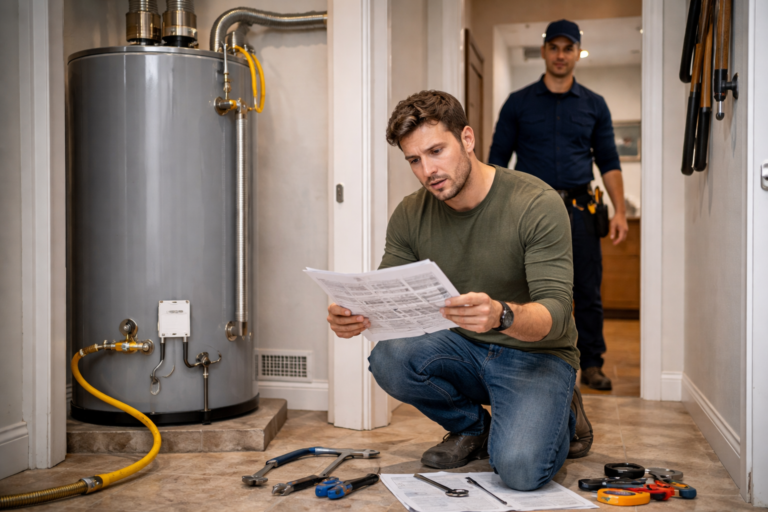
A homeowner may be legally allowed to install or replace a water heater in some jurisdictions, but permission does not automatically make the project safe or suitable for DIY work. Even a like-for-like electric replacement can involve a 240-volt electrical circuit, pressurized plumbing, temperature-and-pressure relief protection, thermal expansion, equipment handling, permits and inspection.
Gas, tankless, heat-pump, relocated and fuel-conversion installations usually involve additional trades, safety systems or infrastructure changes. For most homeowners, professional installation is the lower-risk choice.
Quick answer
You may be permitted to replace your own water heater in some locations, particularly in an owner-occupied home. Before proceeding, confirm local owner-performed-work rules, permit requirements, inspection procedures and the instructions for the exact heater. Gas units, whole-house tankless systems, heat-pump models, relocations and fuel conversions should generally be handled by qualified professionals.
Can a Homeowner Legally Install a Water Heater?
There is no single national rule determining whether every homeowner may install a water heater. States, counties and cities regulate owner-performed plumbing, gas and electrical work differently.
A jurisdiction may:
- allow an owner-occupant to obtain a permit and perform certain work
- allow plumbing work but require a licensed electrician for electrical modifications
- require licensed professionals for gas piping or fuel-fired appliances
- limit owner permits to a primary, owner-occupied residence
- require separate plumbing, mechanical, fuel-gas or electrical permits
- require one or more inspections before the heater is approved for use
- prohibit owner-performed work on rental, multifamily or commercial property
Contact the local building department or authority having jurisdiction before purchasing equipment or disconnecting the existing heater. Ask whether a homeowner may obtain the permit, which inspections apply and whether any part of the project must be completed by a licensed contractor.
Our water heater code requirements guide explains how locally adopted codes, amendments, equipment listings and manufacturer instructions work together.
Possible, Legal and Safe Are Different Questions
The question “Can I install a water heater myself?” actually contains three separate decisions.
| Question | What it means | What controls the answer |
|---|---|---|
| Is it legally permitted? | Whether a homeowner may perform the work and obtain the required permits | State and local licensing rules and the authority having jurisdiction |
| Is the project technically suitable? | Whether the plumbing, wiring, gas supply, venting and location are compatible with the new heater | The adopted code, equipment nameplate, listing and manufacturer instructions |
| Are you qualified to perform it safely? | Whether you can identify hazards, complete the work correctly and pass inspection | Your training, tools, experience and ability to recognise when the project has changed |
Permission to perform owner-occupied work is not proof of technical competence. Likewise, a heater that produces hot water is not necessarily code-compliant or safely installed.
DIY Suitability by Water Heater Type
| Project | Practical DIY suitability | Main complications |
|---|---|---|
| Like-for-like electric tank replacement | Sometimes legally permitted, but still technically demanding | High-voltage wiring, plumbing, pressure relief, equipment weight and inspection |
| Gas storage water heater | Professional installation strongly recommended | Gas supply, leak testing, combustion air, venting and carbon-monoxide risk |
| Gas tankless water heater | Generally a professional project | High gas input, listed vent system, condensate, electrical power and freeze protection |
| Whole-house electric tankless heater | Usually requires electrical and plumbing professionals | Multiple high-amperage circuits, panel capacity and a possible service upgrade |
| Heat pump water heater | Professional installation usually recommended | Electrical supply, airflow, room volume, condensate drainage and physical size |
| Relocation, new installation or fuel conversion | Professional planning and installation typically required | New utilities, structural work, permits, venting, electrical or gas-system changes |
This table describes practical risk, not a universal licensing rule. The local permit office determines who may legally perform each part of the project.
Can You Replace an Electric Water Heater Yourself?
An electric storage water heater is often presented as the easiest type to replace because it has no gas line or combustion vent. That does not make it a simple appliance installation.
A typical electric tank may involve a dedicated 240-volt branch circuit, high current, pressurised water connections, heavy lifting and several safety components that must operate together.
Electrical compatibility
The replacement heater must match the available electrical supply and comply with its exact nameplate requirements. Tank capacity alone does not determine whether the existing circuit is suitable.
The electrical review may involve:
- voltage and electrical rating
- total element wattage
- branch-circuit capacity
- double-pole breaker rating
- conductor size and insulation rating
- overcurrent protection
- equipment grounding and bonding
- junction-box connections and cable strain relief
- a disconnecting means where required
- GFCI protection where required by the locally adopted electrical code
Do not assume the existing breaker and conductors are suitable because the old and new tanks hold the same number of gallons. Compare the exact voltage, wattage and circuit requirements shown on both equipment nameplates.
Dry-firing the heating elements
An electric water heater must not be energised before the tank is completely filled and air has been purged from the plumbing. Applying power to an empty or partially filled tank can damage the heating elements.
A. O. Smith’s residential electric water heater instructions state that the tank must be filled and water must flow from a hot-water faucet before the heater is turned on.
This is one example of how a heater can appear correctly connected but still be damaged during startup.
Plumbing and pressure protection
The hot- and cold-water connections are only part of the plumbing work. A replacement may also require evaluation of:
- the cold-water shutoff valve
- hot- and cold-water connectors
- pipe-material compatibility
- the temperature-and-pressure relief valve
- the T&P discharge pipe
- the drain pan and pan drain where required
- thermal-expansion control in a closed water system
- static water pressure
- support for an expansion tank where installed
- leak checks during filling and startup
A check valve, backflow preventer or pressure-reducing valve can create a closed plumbing system in which heated water has limited room to expand. An approved means of thermal-expansion control may therefore be required under the locally adopted provisions.
Reusing the previous connections without evaluating these conditions can preserve an existing installation defect rather than create a compliant replacement.
Moving and positioning the tank
A storage water heater is bulky when empty and extremely heavy when filled. Safe removal and positioning may require two people, suitable moving equipment, a clear removal path and protection for stairs, walls and flooring.
The replacement must also fit the available space while preserving access to shutoff valves, electrical compartments, the relief system, service components and the eventual removal path.
What Counts as a Like-for-Like Replacement?
A like-for-like replacement means more than buying a heater with the same tank capacity. The new unit must be compatible with the existing location and infrastructure without substantial modification.
| Compatibility check | What must be evaluated |
|---|---|
| Fuel and appliance type | Electric tank for electric tank, or a compatible fuel-fired appliance category |
| Electrical demand | Voltage, wattage, branch circuit, breaker and conductor requirements |
| Gas demand | Appliance input rating and available gas-pipe capacity |
| Venting | Appliance category, vent material, diameter and termination arrangement |
| Physical dimensions | Height, width, connection locations, service clearances and removal path |
| Plumbing arrangement | Water connections, shutoff, relief discharge, drain pan and expansion control |
| Installation location | Approved use, access, structural support and environmental conditions |
| Permit scope | Whether replacement triggers inspections or corrections to existing conditions |
If the replacement requires relocation, new wiring, a larger electrical circuit, gas-pipe modification, a different vent system, structural alteration or fuel conversion, it is no longer a straightforward like-for-like project.
Why Gas Water Heater Installation Is Higher Risk
A gas water heater must safely coordinate the fuel supply, burner, ignition system, combustion air and exhaust vent. A unit can ignite and produce hot water while still having an unsafe gas, combustion or venting condition.
Gas installation may involve:
- confirming the correct fuel and appliance input rating
- checking gas-pipe capacity for all connected appliances
- providing an accessible appliance shutoff valve
- using approved gas piping or connectors
- providing a sediment trap where applicable
- testing joints using an approved leak-testing method
- providing an approved combustion-air method
- matching the vent system to the appliance category
- maintaining required vent clearances and termination distances
- checking for draft, spillage and combustion concerns
- meeting garage, closet and room-location restrictions
A. O. Smith’s residential gas water heater instructions state that installation requires skills involving plumbing, air supply, venting, gas supply and electrical supply. That is a substantially broader scope than reconnecting two water lines and a vent.
Safety warning: Do not attempt gas piping, leak testing, vent modification or combustion-air changes without the required training and local authorization. If you smell gas, leave the area and follow the gas utility or emergency-service instructions.
Gas and Electric Tankless Installations Are Different Projects
“Tankless water heater” is not one installation category. Gas and electric tankless units create very different infrastructure demands.
Gas tankless installation
A gas tankless heater often has a substantially higher input rating than a conventional storage heater. The project may require increased gas-pipe capacity, a dedicated listed vent system, combustion-air provisions, condensate drainage, electrical power and freeze protection.
The existing gas line and storage-heater vent should not be assumed suitable for a tankless replacement.
Whole-house electric tankless installation
A whole-house electric tankless heater can require several high-amperage branch circuits and substantial electrical service capacity. The project may involve a load calculation, multiple double-pole breakers, large conductors and potentially an electrical panel or service upgrade.
The electrical system should be evaluated before the heater is purchased. Discovering inadequate capacity afterward can turn a planned plumbing replacement into a major electrical project.
Heat Pump Water Heater Installation Considerations
A heat pump water heater may use water connections similar to an electric storage tank, but its surrounding installation requirements are different.
The project may require evaluation of:
- room volume and available airflow
- manufacturer-required clearances
- air-intake and exhaust paths
- condensate collection and drainage
- ambient operating temperature
- air-filter and service access
- unit height and overall dimensions
- electrical circuit compatibility
- drain-pan protection where required
- noise and vibration near occupied rooms
The U.S. Department of Energy’s heat pump water heater installation material highlights permitting, installation space and clearance as important project considerations.
Replacing a gas tank with a heat-pump model can also involve capping the gas supply, addressing the abandoned vent, installing or modifying an electrical circuit and creating a condensate route. That is a fuel-conversion project rather than a simple appliance swap.
A Water Heater Can Work and Still Be Installed Incorrectly
Producing hot water only proves that the heater can operate. It does not confirm that the complete installation is safe, code-compliant or ready to pass inspection.
A functioning heater may still have:
- incorrect breaker or conductor sizing
- loose or unprotected electrical connections
- an improperly routed T&P discharge pipe
- missing thermal-expansion control
- an absent drain pan where one is required
- insufficient combustion air
- incorrect gas venting
- an undersized gas supply
- inadequate access for service or replacement
- no required permit or final inspection
This is why checking whether the water becomes hot is not an adequate installation inspection.
DIY Installation Cost vs Professional Installation
The main potential DIY saving is installation labor. However, the homeowner still pays for the heater, permits, disposal, fittings, tools and any specialist work that cannot legally or safely be completed without a professional.
| Possible DIY saving | Costs or risks that remain |
|---|---|
| General installation labor | Permit and inspection fees |
| Contractor scheduling or minimum charge | Tools, fittings, connectors and safety equipment |
| Removal labor | Old-heater transport and disposal |
| Some basic plumbing labor | Electrician, gas fitter or venting specialist where required |
| Contractor markup on minor materials | Corrections required after an incomplete installation or failed inspection |
For complete equipment and professional installation pricing, see our water heater replacement cost guide.
When Might DIY Water Heater Installation Be Reasonable?
A homeowner-installed water heater should be considered only within a narrow set of circumstances. The clearest potential candidate is a genuinely like-for-like electric storage water heater replacement in a jurisdiction that allows owner-performed work.
Even that project may be reasonable only when all of the following are true:
- the local authority confirms that the homeowner may legally perform the work
- the homeowner can obtain every required permit and inspection
- the property qualifies for owner-performed work under local rules
- the replacement is an electric storage tank rather than a gas appliance
- the heater will remain in the same approved location
- the voltage, wattage and nameplate electrical requirements remain compatible
- the existing breaker, branch-circuit conductors and disconnect require no modification
- the water connections are compatible and in serviceable condition
- the cold-water shutoff valve operates correctly and does not leak
- the T&P relief valve and discharge arrangement can meet current local requirements
- the drain pan, pan drain and thermal-expansion arrangement are acceptable where required
- the replacement tank fits the space, clearances and removal path
- the homeowner has relevant electrical and plumbing experience
- the exact manufacturer instructions are available and fully understood
- no fuel conversion, relocation, structural work or utility alteration is involved
- the completed work can receive any required final approval
Meeting these conditions does not make the installation easy or risk-free. It only means the scope may be sufficiently controlled for an experienced homeowner to evaluate further.
Important: Experience replacing faucets, toilets or light fixtures does not automatically establish competence with a high-voltage, pressurized water-heating appliance. The relevant experience must cover the electrical and plumbing systems involved in this specific project.
When Should You Stop and Hire a Professional?
Stop treating the job as a straightforward DIY replacement as soon as the actual equipment, infrastructure or permitted scope differs from what you evaluated before beginning.
Gas piping, combustion or venting is involved
Professional installation is strongly recommended whenever the project involves:
- a natural-gas or propane water heater
- gas-pipe alteration or capacity evaluation
- a new gas connector or appliance shutoff arrangement
- combustion-air openings or mechanical combustion air
- a draft hood or atmospheric vent connector
- direct-vent, power-vent or condensing vent components
- possible flue-gas spillage or backdrafting
- a damaged, disconnected or corroded vent
- installation in a garage, closet or other restricted location
A gas water heater can ignite and produce hot water while still having an unsafe fuel, combustion-air or exhaust condition. Normal appliance operation is not proof that the gas and venting systems are safe.
The U.S. Consumer Product Safety Commission warns that fuel-burning appliances can create carbon-monoxide hazards when they are improperly installed, poorly maintained or connected to compromised venting systems. Read the CPSC fuel-burning appliance warning.
The electrical system must be changed
Obtain a qualified electrical assessment when the replacement requires:
- a different breaker rating
- new or larger branch-circuit conductors
- a new electrical disconnect
- repair of burned, brittle or damaged wiring
- changes to grounding or bonding
- additional circuits for an electric tankless heater
- a panel-capacity or electrical-load evaluation
- a panel or service upgrade
- conversion from gas to an electric or heat-pump water heater
Never assume that installing a larger breaker will make an undersized circuit suitable. The appliance rating, conductor capacity, overcurrent protection, disconnect and complete electrical system must be evaluated together.
The project is no longer like-for-like
The work should be reassessed when the new heater:
- uses a different fuel or energy source
- has materially different voltage or electrical demand
- has a higher gas-input rating
- requires a different venting system
- must be moved to another location
- requires new gas, water or electrical connections
- does not fit the existing room or removal path
- requires structural reinforcement or a new platform
- requires a new condensate drain
- changes from a storage tank to a tankless system
- changes from a gas tank to a heat-pump water heater
A fuel conversion may also require properly addressing the previous gas connection, abandoned vent, electrical supply and condensate route. It should not be treated as a simple appliance exchange.
The existing installation has defects
Stop and obtain qualified help when removing or examining the existing heater reveals:
- corroded or actively leaking piping
- a shutoff valve that will not close
- burned, brittle or undersized electrical wiring
- water damage beneath or around the heater
- a missing or unsupported expansion tank
- an improperly routed T&P discharge pipe
- a cracked, corroded or misaligned vent connector
- soot, scorching or signs of exhaust spillage
- an unstable floor, platform or mounting surface
- insufficient access for service or future replacement
- a drain pan or pan drain that cannot function as intended
If the existing unit is leaking, identify whether the water is coming from a connection, valve or the tank itself before assuming that a simple replacement will resolve every issue. See our guide to a leaking water heater for the main leak locations and replacement implications.
The permit or code requirements are unclear
Do not begin with the assumption that a replacement appliance is automatically exempt from permits. Requirements can vary by jurisdiction, property type, heater type, fuel source, installation location and the extent of associated plumbing or electrical work.
The International Code Council publishes model codes, but state and local governments determine which editions and amendments they adopt and how permits are administered. The ICC’s code-adoption resources explain why requirements differ among jurisdictions.
For a detailed overview of relief valves, drain pans, access, venting and location rules, see our water heater code requirements guide.
Stop-work rule
When the actual conditions differ from the permit scope, equipment instructions or infrastructure you evaluated before starting, pause the work. A partially completed installation is not a reason to continue beyond your training, authorization or available equipment.
What Many DIY Installation Guides Leave Out
Some leaks appear immediately, while others become visible later
A poorly sealed connection may leak during filling, while slow seepage can become noticeable only after pressure and temperature changes. Water may also travel along piping, insulation, framing or flooring before the source becomes obvious.
An installation that appears dry during an initial visual check may therefore still require professional correction if moisture, corrosion or staining appears afterward.
A working heater can still fail inspection
A water heater may produce hot water while still having:
- incorrect breaker or conductor sizing
- unsafe or unprotected electrical connections
- an incorrectly routed T&P discharge pipe
- missing thermal-expansion control
- an unsuitable drain pan or pan drain
- insufficient combustion air
- an improper vent connector or termination
- an undersized gas supply
- inadequate access for servicing or replacement
- missing protection in a garage location
- no required permit or final approval
Performance testing and code inspection answer different questions. Hot water confirms that the appliance can operate; it does not confirm that the complete installation is safe or compliant.
The old installation may already contain defects
A direct replacement does not necessarily allow every existing condition to remain unchanged. Removing the old unit may reveal an installation that predates current local provisions, has deteriorated or was never completed correctly.
Potential corrections can include:
- replacing a defective or inaccessible shutoff valve
- correcting T&P discharge piping
- adding an approved means of thermal-expansion control
- installing or correcting a drain pan where required
- repairing unsafe electrical connections
- correcting vent material, slope, support or clearances
- providing adequate service and replacement access
- adding vehicle-impact protection where locally required
The ICC’s 2024 IRC model water-heater provisions address installation, access, safety devices, pressure relief and related conditions. The edition and amendments enforced at a particular home must still be confirmed locally.
Two heaters with the same capacity may not have the same dimensions
Water heaters with the same nominal gallon capacity can differ in height, diameter, connection position, control location and required clearances.
Those differences can create problems such as:
- water connections that no longer align
- a vent connector that cannot be reused correctly
- a tank that will not pass through a doorway or attic opening
- insufficient airflow around a heat-pump model
- inaccessible controls or service panels
- a drain pan that is too small for the replacement
- loss of required access around the appliance
Water heaters installed in restricted areas can also be subject to location-specific requirements. Review our guides to water heater closet requirements and attic water heater requirements when either location applies.
Removing the old heater may be harder than installing the new one
An old tank may drain slowly because of sediment or a restricted drain valve. Plumbing connections may be seized by corrosion, and even an empty tank can be difficult to move through a closet, stairway or attic opening.
Restricted access, deteriorated components or a tank that cannot be safely removed are valid reasons to stop and obtain professional help. Do not force, cut or dismantle connected equipment when the water, electrical or fuel supply has not been positively made safe.
Electric elements can be damaged during startup
An electric storage water heater must be completely filled before it is energized. Applying power while the tank is empty or partially filled can damage the heating elements.
A. O. Smith’s residential electric water heater instructions warn users to fill the tank before operating the appliance. This is one reason installation competence includes following the complete startup requirements, not merely connecting the plumbing and wiring.
What Should You Confirm About Permits and Inspections?
Before purchasing or disconnecting a heater, ask the local building department or authority having jurisdiction:
- May an owner-occupant legally perform this work?
- Does water heater replacement require a permit?
- Are separate plumbing, electrical, gas or mechanical permits required?
- Must a locally licensed or authorized professional perform any part of the project?
- Which adopted code editions and local amendments apply?
- Which manufacturer documents or equipment specifications must be submitted?
- Are rough, pressure, gas, electrical or final inspections required?
- May the heater be operated before final approval?
- Must existing installation defects be corrected as part of the replacement?
- What records should be retained after approval?
The answers should come from the jurisdiction responsible for the property rather than a national retailer, online tutorial or permit rule from another city.
Keep the permit number, approved plans where applicable, inspection results, equipment receipt, model information and final approval with the home’s maintenance records.
Can DIY Installation Affect the Warranty?
A DIY installation does not automatically void every water heater warranty. The outcome depends on the written warranty, the cause of the failure and whether the appliance was installed and operated according to the manufacturer’s requirements.
Before proceeding, review:
- the complete warranty terms
- the installation and startup instructions
- required safety components and accessories
- equipment registration requirements
- excluded damage caused by improper installation or electrical supply
- requirements for professional diagnosis or warranty service
- documents needed to support a future claim
Damage caused by conditions such as dry firing, an improper electrical supply, excessive pressure or installation contrary to the manual may be treated differently from a manufacturing defect. Review the exact documents supplied with the heater rather than relying on a general claim about DIY warranties.
Can Unpermitted Work Affect Insurance or Liability?
Unpermitted or defective work can complicate an insurance investigation or liability dispute, especially when the installation contributed to water, fire, electrical or carbon-monoxide damage.
However, it is not accurate to say that every unpermitted installation automatically voids an entire insurance policy or claim. The outcome can depend on:
- the wording of the individual policy
- the actual cause of the damage
- whether the installation contributed to the loss
- required disclosures
- local permit and licensing rules
- the insurer’s investigation and applicable law
Ask the insurer or a qualified insurance professional how owner-performed work is treated under the specific policy before beginning the project.
Can DIY Installation Create Problems During a Home Sale?
Missing permits or visible installation defects may be raised during a home inspection, disclosure review, appraisal or later renovation.
Depending on local procedures, a property owner may be asked to:
- provide permit and inspection records
- obtain retrospective approval
- have the work evaluated by a qualified contractor
- open concealed work for inspection
- complete corrections before approval or sale
These outcomes are not automatic in every transaction, but keeping clear documentation reduces uncertainty for future owners, inspectors and contractors.
How Long Does Water Heater Installation Take?
There is no reliable universal installation time. A straightforward replacement in an accessible location can be substantially faster than a relocation, conversion or project that exposes existing defects.
Installation time can change because of:
- slow draining or heavy sediment
- restricted access, stairs or attic openings
- seized valves and corroded connections
- different tank dimensions or connection heights
- electrical, gas or venting corrections
- drain-pan or expansion-control work
- permit and inspection scheduling
- missing fittings or unavailable replacement parts
- old-heater transport and disposal
Treat a retailer’s or contractor’s installation time as a scenario-specific estimate rather than a guarantee. A job that exposes unsafe infrastructure should be paused and reassessed instead of rushed.
DIY Savings vs Costs That Still Remain
The primary potential DIY saving is installation labor. It does not eliminate the cost or responsibility of completing a permitted and compliant project.
| Potential DIY benefit | Cost or responsibility that remains |
|---|---|
| Reduced general installation labor | Heater, fittings, valves, connectors and required safety components |
| Greater control over scheduling | Permit, inspection and administrative requirements |
| Avoided removal labor | Safe transport and lawful disposal of the old heater |
| Direct purchase of minor materials | Specialized tools and equipment that may be used only once |
| Completion of legally permitted owner work | Professional electrical, plumbing, gas or venting work outside the owner’s scope |
| Potential labor savings after a successful installation | Corrections or professional takeover after an incomplete or failed installation |
Compare the complete project scope rather than contractor labor alone. Our water heater replacement cost guide explains the main equipment, labor and code-correction cost categories.
What Can a Homeowner Safely Do Before Installation?
A homeowner can reduce project delays and obtain more accurate estimates without personally performing hazardous plumbing, gas or electrical work.
Useful preparation can include:
- photographing the complete installation from several angles
- recording the manufacturer, model, serial number and nameplate ratings
- measuring the heater, doorway, stairway and removal path
- identifying whether the unit is electric, natural gas, propane, tankless or heat pump
- noting the apparent vent type without modifying it
- locating the main water shutoff and electrical panel
- checking permit requirements with the local building department
- clearing movable belongings from the work area
- obtaining written scopes from qualified contractors
- asking whether the quote includes permits, disposal and inspection
- keeping the installation manual and warranty accessible
Do not block combustion-air openings, disturb gas or electrical connections, operate damaged equipment or move materials that may contain asbestos merely to prepare the work area.
DIY or Professional Installation: Final Decision Checklist
| Decision question | Lower-risk condition | Professional-help trigger |
|---|---|---|
| May the homeowner legally perform the work? | The local authority has confirmed eligibility and issued the required permit | Rules are unclear, or locally authorized trade work is required |
| What type of heater is involved? | A genuinely like-for-like electric storage tank | Gas, tankless, heat pump, indirect, solar-assisted or combination equipment |
| Does the infrastructure remain compatible? | No electrical, gas, venting, structural or location changes are needed | Any circuit, gas-pipe, venting, condensate or relocation work is required |
| Is the existing installation serviceable? | Valves, piping, wiring, relief components and support appear sound | Corrosion, leaks, damaged wiring, vent defects or required corrections appear |
| Do you have directly relevant experience? | Demonstrable experience with the specific electrical and plumbing systems involved | Knowledge comes mainly from one tutorial or unrelated household repairs |
| Can the installation receive approval? | Required inspections and final approval are available | The plan depends on avoiding permits, documentation or inspection |
If any professional-help trigger applies, hiring the appropriate qualified plumber, electrician, gas professional or other locally authorized trade is the safer decision.
Frequently Asked Questions
Can I install an electric water heater myself?
A homeowner may be legally permitted to replace an electric water heater in some jurisdictions, particularly in an owner-occupied home. However, the project still involves a high-voltage branch circuit, plumbing connections, T&P protection, thermal expansion, equipment handling and possible permit inspections. Confirm the local rules and exact appliance requirements before deciding.
Do I need a plumber or electrician for an electric water heater?
A plumbing professional commonly handles the water connections, shutoff valve, relief system, drain pan and expansion control. An electrical professional may be needed when the circuit, breaker, conductors, disconnect, grounding or panel capacity requires evaluation or modification. Local licensing requirements control who may perform each part.
Can I install a gas water heater myself?
Gas water heater installation is not an appropriate DIY project for most homeowners because it involves fuel piping, leak testing, combustion air and exhaust venting. Local rules may also require qualified or licensed trade professionals.
Can I install a tankless water heater myself?
Tankless installation usually requires professional evaluation. Gas tankless units may require increased gas capacity, listed vent components, condensate drainage and electrical power. Whole-house electric models can require multiple high-amperage circuits and an electrical-service assessment.
Do I need a permit to replace a water heater?
Many jurisdictions require a permit for water heater replacement, but the rules vary. The project may require plumbing approval alone or separate electrical, mechanical and fuel-gas permits. Confirm the requirements with the building department responsible for the property.
Can a new water heater work but still fail inspection?
Yes. A heater can produce hot water while having incorrect wiring, inadequate venting, improper T&P discharge piping, missing expansion control, insufficient access or other installation defects.
Does installing a water heater yourself void the warranty?
Not automatically in every case. Warranty coverage depends on the written terms, installation quality and cause of failure. Damage caused by improper wiring, dry firing, excessive pressure or failure to follow the installation manual may not be treated as a manufacturing defect.
What temperature should a new water heater use?
The appropriate temperature depends on scald prevention, household needs, plumbing design and manufacturer guidance. Our safe water heater temperature guide explains the trade-offs and protective measures.
Bottom Line: Should You Install a Water Heater Yourself?
A homeowner may be legally permitted to install a water heater, but legal permission alone is not enough. The project must also be compatible with the existing plumbing, electrical supply, gas system, venting, installation location and locally adopted requirements.
A genuinely like-for-like electric storage-tank replacement may be considered only by an experienced homeowner who has confirmed:
- owner-performed work is allowed
- the required permits and inspections are available
- the appliance matches the existing electrical and plumbing infrastructure
- no wiring, gas, venting, structural or location changes are required
- the existing installation does not contain unresolved defects
- the complete manufacturer instructions can be followed
Professional installation is the safer choice when the project involves:
- natural gas or propane
- combustion air or venting
- electrical-circuit modifications
- tankless or heat-pump equipment
- relocation or fuel conversion
- damaged, outdated or incompatible infrastructure
- unclear permit requirements
- work outside the homeowner’s direct experience
The smartest decision is not proving that you can finish the installation. It is recognizing whether the job can be completed safely, legally and according to the exact equipment requirements—and stopping when it cannot.