
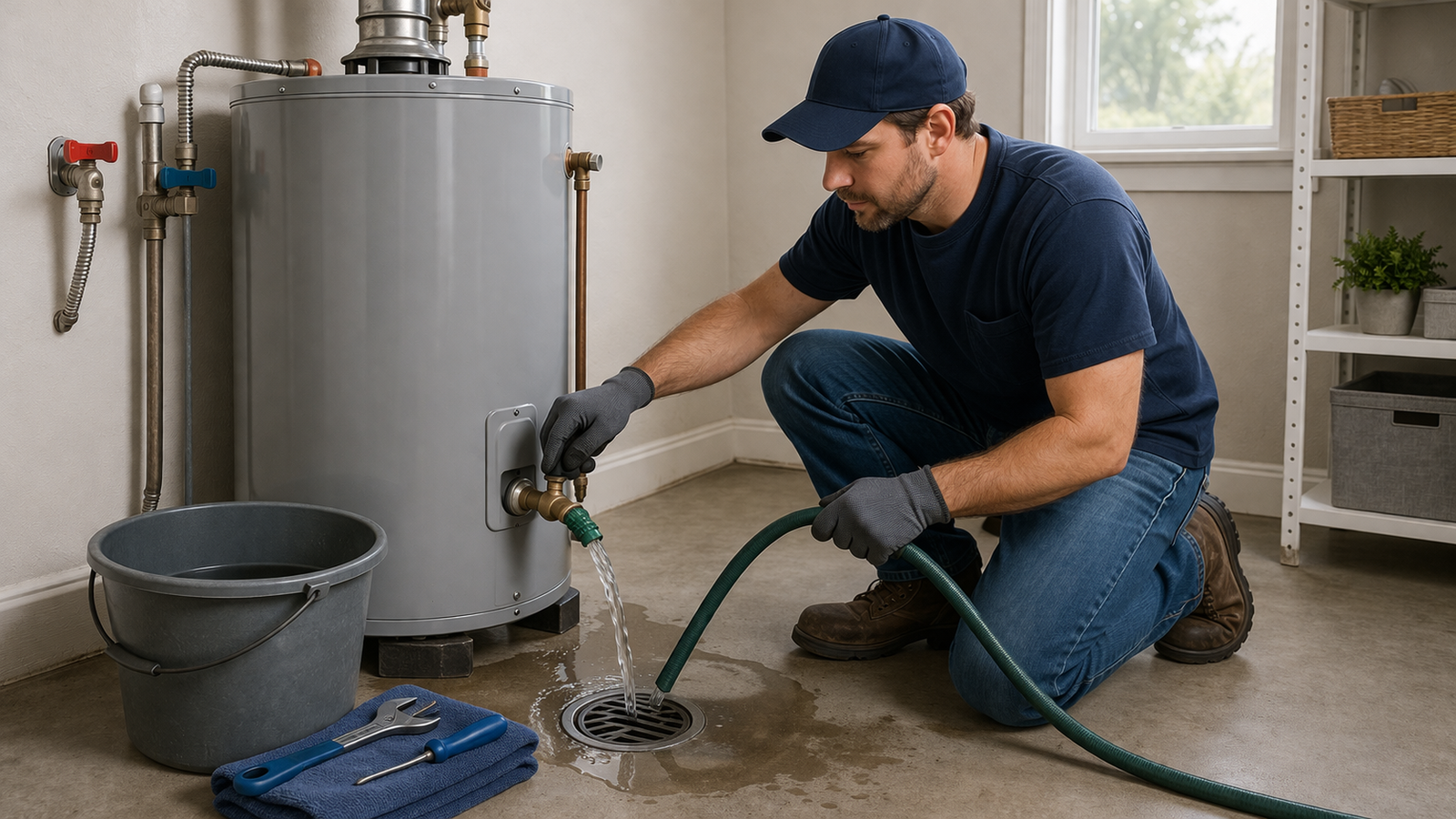
Draining a water heater is a manageable maintenance job, but two steps determine whether it goes safely: allowing the stored water to cool before opening the drain valve and confirming that the tank is completely full before restoring heat.
Skipping the cooling step can expose you to scalding water. Restoring electricity before an electric tank is full can dry-fire and destroy one or both heating elements. Gas and heat-pump water heaters also require model-specific shutdown and restart procedures.
This guide applies primarily to residential storage-tank water heaters. A tankless water heater is serviced through a different flushing or descaling process using its service valves.
Quick answer: Turn off the heater’s energy source, allow the water to cool, close the cold-water inlet, open a hot faucet, attach a secure hose to the drain valve and empty the tank. If sediment removal is the goal, use controlled cold-water flushing cycles before closing the valve.
Refill the tank with a hot faucet left open. Do not restore electricity or restart the gas control until a steady, air-free stream confirms that the tank is full.
Quick Water Heater Draining Sequence
- Identify whether the heater is electric, gas, heat pump or tankless.
- Read the shutdown and restart instructions on the heater and in its manual.
- Turn off electricity or shut down the gas control as directed.
- Allow the stored water to cool.
- Close the cold-water inlet valve.
- Open a nearby hot-water faucet and leave it open.
- Attach a secure hose to the drain valve.
- Route the hose downhill to a safe discharge location.
- Open the drain valve slowly and allow the tank to empty.
- If flushing, briefly cycle the cold supply to move additional loose sediment.
- Close the drain valve and refill the tank completely.
- Wait for a steady, air-free stream from the open hot faucet.
- Inspect the drain valve and nearby connections for leaks.
- Restore electricity or restart the gas control according to the manufacturer’s instructions.
The exact valve positions and restart procedure can differ by model. Treat this sequence as a general framework and follow the instructions printed on your heater when they differ.
Draining Versus Flushing a Water Heater
Draining and flushing are related procedures, but they do not have the same purpose.
| Procedure | What it does | When it is used |
|---|---|---|
| Drain | Removes water and some loose debris from a storage tank | Replacement, certain repairs, shutdown or preparation for flushing |
| Flush | Uses incoming cold water to suspend and carry out additional loose sediment | Routine maintenance on a storage-tank heater |
| Descale | Circulates an approved cleaning solution through a heat exchanger | Tankless water-heater maintenance |
Draining alone may remove a meaningful amount of loose sediment, but compacted material can remain at the bottom of the tank. Controlled flushing can remove additional debris, although it may not eliminate hardened mineral scale from a severely neglected heater.
For more detail on buildup inside the tank, see our guide to sediment in a water heater.
When Should You Drain a Water Heater?
Draining may be appropriate for maintenance, replacement or certain repairs, but it is not the correct response to every water-heater problem.
| Situation | Should you drain it? | Reason |
|---|---|---|
| Routine tank maintenance | Usually | Draining and flushing can remove loose sediment when performed according to the manual. |
| Popping or rumbling noise | Possibly | Sediment may be involved, but persistent noise can require further diagnosis. |
| No hot water | Not automatically | The problem may involve a thermostat, element, gas control, ignition system or power supply. |
| Leaking storage tank | Sometimes, after shutdown | Draining will not repair the tank, but controlled draining may limit leakage or prepare the unit for replacement. |
| Replacing the water heater | Yes | The tank normally must be emptied before it can be safely removed. |
| Replacing an element or lower component | Yes, fully or partially | The water level must be lowered below the component before removal. |
| Tankless maintenance | No, not by this procedure | Tankless units use an isolation and descaling process rather than draining a storage tank. |
A leaking storage tank is normally a replacement issue, not a sediment-maintenance problem. See water heater leaking causes and next steps before deciding whether it is safe to continue.
For recurring popping or rumbling, see our guide to a water heater making noise.
Stop Before Starting in These Situations
Do not continue with DIY draining when you find:
- A gas odor near the heater
- Burned, melted or exposed electrical wiring
- Arcing, smoke or a repeatedly tripping breaker
- An uncontrolled tank leak
- A cracked, brittle or badly corroded drain valve
- A drain valve that appears ready to break
- Water near live electrical equipment
- No safe place to discharge the water
- Uncertainty about shutting down or relighting a gas appliance
- A requirement for valve removal or major plumbing disassembly
Leave the area and contact the gas utility or emergency services if you smell gas. For electrical damage, keep power off and have the heater inspected by a qualified professional.
Allow the Water to Cool Before Draining
A storage tank can contain dozens of gallons of water hot enough to cause a severe burn. The U.S. Consumer Product Safety Commission reports that most adults can suffer third-degree burns after approximately two seconds of exposure to 150°F water, six seconds at 140°F or thirty seconds at 130°F.
Do not assume that the water temperature exactly matches the thermostat setting. Operating conditions, thermostat accuracy and thermal stacking can cause water near the top of the tank to be hotter than expected.
Safer Cooling Method
- Turn off the heater’s energy source.
- Leave the cold-water supply open temporarily.
- Run hot water at a faucet until the discharge temperature drops substantially.
- Close the faucet.
- Close the cold-water inlet before beginning the draining procedure.
Alternatively, turn the heater off several hours in advance and allow the stored water to cool naturally.
Even after cooling, wear gloves and eye protection and route the hose as though the discharge could still be hot.
For additional scald-prevention guidance, see the CPSC’s tap-water scald guidance.
What Is Dry Firing?
Dry firing occurs when an electric heating element is energized while it is not completely submerged in water. Without surrounding water to absorb the heat, an exposed element can overheat and fail rapidly.
Bradford White’s technical guidance warns that an element energized in an air pocket can generate enough heat in approximately 30 to 40 seconds to cause serious internal damage or complete failure. That is why refilling and energizing the heater at the same time is unsafe—the tank must already be full before electricity is restored.
Electric-heater rule: Do not turn the breaker back on until a hot faucet produces a continuous stream of water without bursts of air. That flow confirms that the tank has filled and the plumbing air has been purged.
Some newer electric and heat-pump models include dry-fire protection, but you should not assume that your heater has it or rely on it in place of a complete refill.
If an element has already been damaged, see our guide to water heater element replacement cost.
A gas water heater should also never be fired with an empty or partially filled tank. Without water to absorb heat, the tank can overheat and sustain serious damage.
Tools and Materials
Gather everything before shutting down the water heater.
- Garden hose suitable for the expected discharge temperature
- Bucket for testing flow and catching drips
- Work gloves
- Safety glasses
- Towels or absorbent pads
- Flathead screwdriver if the factory drain valve requires one
- Flashlight
- The water heater’s manual or model-specific instructions
Most residential drain valves accept a threaded garden-hose connection, but inspect the valve before assuming the hose will fit.
Do Not Insert Tools Into the Drain Valve
- Drill bits
- Coat hangers
- Screwdrivers
- Metal rods or improvised probes
Probing or forcing a clogged valve can damage its sealing surface, crack a plastic body or damage the threaded tank connection. A blocked valve that requires disassembly is beyond the safe scope of this general homeowner procedure.
Choose a Safe Discharge Location
The hose should be firmly attached, secured against movement and routed to a location that can accept the water without causing injury or property damage.
Possible locations may include:
- A suitable floor drain
- A utility sink capable of handling the flow and temperature
- A safe exterior drainage point permitted by local rules
- A monitored container for a small, controlled partial drain
When relying on gravity, the end of the hose normally needs to remain lower than the drain valve.
Do not discharge water:
- Near people, children or animals
- Across a walkway or driveway where it can create a hazard
- Beside the building foundation
- Near electrical equipment
- Onto flooring that hot water can damage
- Onto delicate plants or landscaping
- Where freezing, erosion or flooding can occur
- Into a drain prohibited by local regulations
A. O. Smith’s official guidance also emphasizes securing the hose and routing it to a safe area that will not be damaged by the discharge.
Turn Off the Water Heater Correctly
The shutdown method depends on the heater type. Do not use “set it to pilot” as a universal gas-heater instruction.
Electric Storage Water Heater
- Locate the dedicated double-pole breaker serving the water heater.
- Switch the breaker to OFF.
- Verify that the heater is de-energized with appropriate testing equipment when you are qualified to do so.
- Leave the breaker off until the tank has been fully refilled and purged.
Gas Heater With a Standing Pilot
Follow the printed gas-control instructions and the owner’s manual. Depending on the model and purpose of the drain, the correct setting may be PILOT, VACATION or OFF.
Do not turn valves or attempt to relight the pilot if you smell gas.
Gas Heater With Electronic Ignition
An electronic-ignition heater may not have a pilot position. Use the control’s shutdown procedure or gas shutoff method specified by the manufacturer.
Restart and ignition procedures differ by model. Follow the label attached to the heater rather than applying instructions from another gas appliance.
Heat-Pump Water Heater
A heat-pump water heater still contains a storage tank, so the basic draining process is similar to an electric tank. Switch off its dedicated breaker before draining.
Do not confuse the tank drain valve with the condensate drain. Follow the model manual for any additional instructions involving electronics, filters, airflow or condensate components.
A. O. Smith provides separate shutdown guidance for standard and electronic gas controls and advises following the printed model instructions. See its official water-heater shutdown guide.
How to Drain a Storage-Tank Water Heater
Step 1: Shut Off the Heat Source
Turn off electricity at the breaker or shut down the gas control according to the heater’s instructions. Confirm that the burner or heating elements cannot operate while the tank is being emptied.
Step 2: Cool the Stored Water
Allow the tank to cool for several hours, or draw down the hot water while the heat source is off and the cold supply remains open. Do not begin draining while the water is still dangerously hot.
Step 3: Close the Cold-Water Inlet
Locate the cold-water shutoff valve on the supply pipe entering the heater and close it.
If you are unsure which valve controls the heater, see our guide to the water heater shutoff-valve location.
Step 4: Open a Hot-Water Faucet
Open a nearby hot faucet and leave it open. This relieves residual pressure, provides an air path into the tank and helps prevent a vacuum from slowing the drain.
The faucet may stop flowing after the cold supply is closed. Leave it open during draining and refilling.
Step 5: Attach and Route the Hose
Thread the hose securely onto the drain valve at the bottom of the tank. Route it downhill to the selected discharge point and secure the outlet end so it cannot move.
Place a bucket beneath the valve connection to catch drips.
Step 6: Open the Drain Valve Slowly
Open the drain valve using its handle or the tool specified for that valve. Do not use excessive force.
Initial discharge may appear cloudy or contain small flakes of sediment. A strong, continuous flow generally indicates that the hose, air path and valve opening are clear.
If the water only trickles or does not flow, do not immediately operate the T&P relief valve or insert tools into the drain opening. The safe troubleshooting procedure appears in Section 2.
Step 7: Allow the Tank to Drain
Let the water discharge until the tank reaches the required level.
- For replacement, drain the tank completely.
- For a component repair, drain below the component being removed.
- For routine sediment maintenance, continue into the flushing procedure below.
How to Flush Sediment From the Tank
Draining removes water and some loose debris. Flushing uses incoming cold water to disturb and carry out additional sediment near the bottom of the tank.
- Keep the heat source off.
- Leave the hose connected and the drain valve open.
- Allow the tank to drain until the flow slows substantially.
- Briefly open the cold-water inlet.
- Let the incoming water disturb loose sediment and discharge through the hose.
- Close the cold supply and allow the disturbed material to drain.
- Repeat short flushing cycles until sediment decreases and the water runs reasonably clear.
There is no universal requirement to perform exactly two, four or any other fixed number of cycles. The endpoint depends on the condition of the tank and the appearance of the discharge.
What the Discharge Water Can Tell You
- Cloudy or gray water: May contain ordinary mineral sediment or entrained air.
- Small mineral flakes: Common during flushing of a tank with accumulated deposits.
- Rust-brown water that gradually clears: May be temporary disturbed material.
- Persistent dark rust color: Can indicate corrosion, deteriorating piping or source-water problems requiring further evaluation.
- Little or no sediment: May indicate a relatively clean tank or a valve opening blocked before debris can escape.
Do not assume that a flush has removed all buildup simply because the discharge becomes clear. Hardened scale may remain inside a neglected tank.
For professional-service pricing, see our guide to water heater flush cost.
A. O. Smith’s official draining and flushing guide also describes using the cold-water supply during tank flushing and advises following the manual for the exact model.
How Long Does It Take to Drain a Water Heater?
A typical residential tank may take approximately 20 to 60 minutes to drain, but the actual time can be shorter or significantly longer.
Drain time depends on:
- Tank capacity
- Whether the water was cooled in advance
- Hose length and internal diameter
- Whether the hose runs continuously downhill
- Drain-valve size and condition
- Whether a hot faucet is open
- The amount of sediment blocking the valve
- Available water pressure during flushing
Cooling can add several hours when the water is allowed to cool naturally. Flushing adds additional time depending on sediment load, and refilling commonly requires another period of tens of minutes based on tank size and household water flow.
Do not rush the procedure by opening an unsafe discharge route, handling scalding water or restoring heat before the tank is full.

What to Do If the Water Heater Will Not Drain
A water heater that produces little or no flow may have a blocked hose, an inadequate air path, a partially opened valve or sediment packed behind the drain-valve opening.
Do not immediately force the valve, remove it from the tank or insert improvised tools into the opening. A brittle valve or damaged tank connection can turn a maintenance job into an uncontrolled leak.
Step 1: Confirm That a Hot Faucet Is Open
Leave a nearby hot-water faucet open while draining. This allows air to enter the plumbing system and helps prevent a vacuum from slowing or stopping the flow.
The faucet may stop releasing water after the cold supply is closed. It should still remain open during the draining process.
Step 2: Check the Hose
Inspect the entire hose for:
- Kinks or flattened sections
- A frozen outlet
- Sediment blocking the hose
- An outlet positioned higher than the drain valve
- A closed nozzle or fitting at the discharge end
Disconnect the hose only after confirming that the heat source is off, the water has cooled and the drain valve is closed.
Step 3: Confirm That the Drain Valve Is Open
Some drain valves have a handle, while others require a screwdriver to turn the valve stem. Use only the method intended for the installed valve.
Do not apply excessive force. A plastic valve that has become brittle with age can crack or separate from the tank.
Step 4: Use a Controlled Cold-Water Pulse
If the valve is passing at least some water, a short pulse of incoming cold water may disturb loose sediment near the opening.
- Keep the hose connected and the drain valve open.
- Briefly open the cold-water inlet.
- Allow the increased flow to move sediment toward the drain.
- Close the cold supply and observe whether drainage improves.
Do not continue cycling the supply if the valve, hose or surrounding plumbing begins leaking.
Step 5: Know When to Stop
Stop the DIY procedure when:
- The drain valve will not open without significant force
- The valve body bends, cracks or begins leaking
- The valve opens but remains completely blocked
- The valve will not close after draining
- Removing or replacing the valve appears necessary
- The tank is severely corroded
- Water is leaking near electrical equipment
Drain-valve removal from a full or pressurized tank is not part of a safe general homeowner procedure. A plumber may need to isolate the system, control the remaining water and replace the valve.
Should You Open the T&P Relief Valve While Draining?
Some manufacturer procedures instruct the user or technician to operate the temperature and pressure relief valve to admit air into the tank. However, this should not be treated as a universal troubleshooting shortcut.
A T&P valve that is manually opened may fail to reseat and continue discharging. Bradford White instructs homeowners to contact a plumber when the valve does not flow correctly or fails to reseat after operation.
For a general homeowner procedure, opening a hot-water faucet is the lower-risk first method for admitting air.
See the Bradford White draining guidance for an example of a manufacturer-specific procedure that uses the relief valve.
Operate the T&P valve only when:
- The heater or valve manufacturer specifically instructs you to do so
- The discharge pipe is installed correctly
- The water has cooled
- The discharge can be observed safely
- You are prepared to address a valve that does not reseal
If the T&P valve continues dripping after it is operated, do not plug or cap the discharge pipe. See our guide to a water heater pressure relief valve leaking.
For replacement pricing, see water heater pressure relief valve replacement cost.
What to Do If the Drain Valve Leaks After Flushing
A drain valve may drip after it is closed because sediment is trapped on the sealing surface, the internal washer has deteriorated or the valve body has been damaged.
First Checks
- Confirm that the valve is fully closed without overtightening it.
- Wipe the valve dry.
- Observe whether water is leaking from the hose threads, valve stem or tank connection.
- Check again after the tank has refilled and pressure has stabilized.
Do not force a plastic valve tighter. Excessive pressure can crack the valve or damage the threaded connection at the tank.
How to Refill a Water Heater Safely
The refill procedure is the most important protection against dry-firing an electric heating element.
- Confirm that the heat source remains off.
- Close the drain valve completely without overtightening it.
- Remove the hose after the valve has been closed.
- Leave a nearby hot-water faucet open.
- Open the cold-water inlet slowly.
- Allow the tank to fill while air escapes through the open faucet.
- Wait until the faucet produces a continuous stream without sputtering or bursts of air.
- Close the faucet.
- Inspect the drain valve, supply connections and nearby plumbing for leaks.
- Restore electricity or restart the gas control only after confirming that the tank is full.
Do not energize while filling: Filling the tank and switching on the breaker at the same time is unsafe. An upper heating element may be exposed to air long enough to overheat before the rising water reaches it.
How Do You Know the Tank Is Full?
The tank is normally considered full when a hot-water faucet produces a steady stream without repeated bursts of air.
Bradford White’s dry-fire guidance specifically instructs users to confirm that the tank is completely filled by opening a hot-water faucet before energizing the elements.
Initial sputtering is normal while trapped air leaves the system. Do not restore electricity merely because water has started to appear at the faucet. Wait for the flow to become continuous.
How to Restart the Water Heater
Electric Water Heater
- Confirm that the tank is full and air has been purged.
- Check the drain valve and plumbing connections for leaks.
- Switch the dedicated breaker to ON.
- Allow the heater time to recover.
- Recheck the area for leakage and confirm normal hot-water production.
If the breaker trips, the heater fails to heat or the wiring smells burned, turn the breaker off and arrange professional diagnosis.
Standing-Pilot Gas Water Heater
Return the gas control to its normal operating setting according to the printed lighting instructions and owner’s manual.
If the pilot was extinguished, follow the exact relighting sequence attached to the heater. Do not attempt to relight the appliance if you smell gas.
Electronic-Ignition Gas Water Heater
Restore operation using the model-specific control sequence. Electronic-ignition units may not have a pilot light or manual pilot position.
Do not apply standing-pilot instructions to an electronic-ignition heater.
Heat-Pump Water Heater
After confirming that the tank is full, restore power at the breaker. Follow the model’s startup instructions and verify that no error codes appear.
Make sure the air filter, condensate drain and surrounding airflow were not disturbed during the work.
Normal and Warning Signs After Draining
| Observation | May be normal | Warning sign |
|---|---|---|
| Faucet flow | Temporary sputtering while air is purged | Flow remains weak, stops repeatedly or contains air long after refill |
| Water clarity | Brief cloudiness caused by air or disturbed sediment | Persistent dark-brown, black or heavily rust-colored water |
| Drain valve | A few residual drops immediately after hose removal | Continuing drip, cracked body or leakage at the tank connection |
| T&P discharge pipe | Dry during normal operation | Ongoing dripping or periodic discharge after reheating |
| Tank noise | Minor expansion sounds during reheating | Persistent loud popping, banging or boiling sounds |
| Electric operation | Normal recovery period before hot water returns | Breaker trips, heater does not recover or wiring smells burned |
| Gas operation | Normal burner startup according to the control sequence | Gas odor, repeated ignition failure, soot or abnormal flame |
Persistent popping or rumbling can indicate remaining sediment or another operating problem. See our guide to a water heater making noise.
Should You Flush an Old or Neglected Water Heater?
An older heater that has never been maintained deserves more caution than a regularly serviced tank.
Potential concerns include:
- A brittle plastic drain valve that cracks when operated
- A valve that will not reseal after flushing
- Heavy sediment blocking the drain opening
- Advanced corrosion around the valve or tank base
- A tank already close to leaking
- Hardened deposits that ordinary flushing cannot remove
Flushing does not normally create corrosion inside a healthy tank. However, operating fragile valves or disturbing a severely deteriorated heater can reveal an existing weakness.
Stop and arrange an inspection when the heater has major corrosion, active leakage, a damaged valve or an unknown maintenance history combined with advanced age.
Well Water, Hard Water and Flushing Frequency
Well water does not automatically contain more sediment than municipal water. Water quality varies by location, source and treatment system.
However, water with high hardness, iron, sand or suspended material can increase deposits inside the tank.
Base the maintenance interval on:
- The manufacturer’s instructions
- Measured water hardness
- The amount of sediment found during previous flushing
- Changes in water clarity or odor
- Recurring popping or rumbling
- Water-treatment equipment installed in the home
Annual flushing is a common manufacturer recommendation for storage-tank heaters. Rheem currently recommends flushing most residential tanks once per year, while A. O. Smith advises owners to follow the maintenance interval in the manual for their exact model. More frequent inspection may be appropriate in hard-water conditions, but no single interval applies to every tank.
See the Rheem flushing guidance and A. O. Smith draining and flushing guidance for manufacturer examples.
See our water heater maintenance schedule for a broader maintenance framework.
Do Tankless Water Heaters Need Draining?
A tankless water heater does not have a large storage tank to empty, so it is not drained and flushed using the procedure in this guide.
Tankless maintenance generally involves:
- Turning off power and fuel
- Closing the normal water-supply valves
- Connecting hoses to the hot and cold service ports
- Circulating a manufacturer-approved descaling solution
- Flushing the heat exchanger with clean water
- Restoring the service valves and checking for leaks
This is a different maintenance procedure, not a lower maintenance requirement.
See our guide to tankless water heater maintenance cost for professional-service and descaling considerations.
Fast Draining for Water Heater Replacement
When a heater is being removed, the goal is to empty the tank rather than clean it.
- Turn off electricity or shut down the gas control.
- Allow the water to cool.
- Close the cold-water supply.
- Open a hot-water faucet.
- Attach and secure the drain hose.
- Open the drain valve and empty the tank.
Cold-water flushing cycles are unnecessary when the heater is being discarded unless sediment is preventing the tank from draining.
Do not disconnect gas, electrical or plumbing connections until the tank has been shut down and the necessary work can be completed safely.
When Draining Will Not Fix the Problem
Draining and flushing may help with loose sediment, but they do not repair:
- A leaking storage tank
- A burned electric heating element
- A failed thermostat
- A defective gas-control valve
- An ignition-system problem
- Internal tank corrosion
- A damaged T&P valve
- A cracked drain valve
- An undersized water heater
- Improper wiring, gas pressure or venting
For a failed or deteriorated unit, see our guide to water heater replacement cost.
How to Protect the Water Heater After Flushing
- Confirm that the tank is completely full before restoring heat.
- Check the drain valve after refill and again after the first heating cycle.
- Inspect the T&P discharge pipe for dripping.
- Record the flushing date and observations.
- Note the amount and color of sediment removed.
- Follow the model-specific maintenance schedule.
- Investigate recurring noise, discoloration or leakage rather than repeatedly flushing without diagnosis.
- Keep the area around the heater dry and accessible.
Routine flushing cannot guarantee a specific service life, but documenting maintenance and responding to warning signs can help prevent avoidable operating problems.
How to Drain a Water Heater FAQs
How long does it take to drain a water heater?
A typical residential tank may take approximately 20 to 60 minutes to drain. A clogged valve, long hose, poor downhill routing or heavy sediment can make the process take considerably longer.
Do I need to turn off the water heater before draining it?
Yes. Turn off electricity at the breaker or shut down the gas control according to the manufacturer’s instructions. The burner or heating elements must not operate while the tank is being emptied.
How long should I let the tank cool?
Several hours may be needed when the water is allowed to cool naturally. You can reduce the temperature more quickly by turning off the heat source and drawing hot water while the cold supply remains open.
Why will my water heater not drain?
Common causes include a blocked hose, a closed or partially opened valve, inadequate airflow into the tank or sediment obstructing the drain-valve opening.
Can I drain a water heater without a floor drain?
Yes, when the hose can be routed safely to another approved discharge point. The destination must handle the water volume and temperature without causing injury, flooding or property damage.
What happens if I turn the power on before the tank is full?
An exposed electric heating element can dry-fire, overheat and fail within seconds. Do not restore electricity until steady, air-free water flows from an open hot faucet.
How do I know the tank is completely refilled?
Leave a hot faucet open while filling. The tank is normally full when the faucet produces a continuous stream without repeated sputtering or bursts of air.
How often should I drain and flush the tank?
Annual flushing is a common recommendation, but the correct interval depends on the model, water hardness, sediment load and manufacturer’s maintenance instructions.
Why is the drain valve dripping after I closed it?
Sediment may be trapped on the valve seat, or the internal seal may be worn or damaged. Do not overtighten a plastic valve. Continuing leakage may require valve replacement.
Should I replace a plastic drain valve with a brass valve?
A full-port brass valve may resist clogging better, but replacing a factory valve requires draining and plumbing work. Check the manufacturer’s instructions and warranty before modifying the heater.
Can changing the drain valve affect the warranty?
A modification may affect coverage when an incompatible part, incorrect installation or resulting damage contributes to a failure. The exact outcome depends on the written warranty and cause of the claim.
See our guide to water heater warranty coverage and exclusions.
Why is the water still brown after flushing?
Temporary brown water may be disturbed sediment or rust from plumbing. Persistent dark discoloration can indicate corrosion, source-water problems or deteriorating piping and should be investigated.
Should I drain a tank that is already leaking?
Draining will not repair a leaking tank, but controlled draining may reduce continuing water damage or prepare the unit for replacement after the energy and water supplies have been shut off.
Do tankless water heaters use the same draining procedure?
No. Tankless units are generally isolated and descaled through service ports. They do not use the storage-tank draining procedure described in this guide.
Can I flush a water heater that has never been maintained?
Possibly, but inspect the heater and drain valve first. An old, corroded or leaking tank with a brittle valve may require professional evaluation rather than aggressive DIY flushing.
Final Water Heater Draining Decision Framework
Step 1: Identify the Goal
- Routine maintenance: Drain and use controlled flushing cycles.
- Replacement: Drain completely; sediment cleaning is unnecessary.
- Component repair: Lower the water below the component as required.
- Active tank leak: Shut down the heater, control the water and arrange replacement.
- Tankless maintenance: Use the model-specific descaling procedure.
Step 2: Evaluate the Condition
Proceed only when the heater, drain valve, hose route and energy controls are safe to operate.
Stop when you find gas odor, electrical damage, severe corrosion, a cracked valve, uncontrolled leakage or a blockage that requires valve removal.
Step 3: Drain or Flush
Drain to remove water. Use controlled cold-water cycles when the goal is to carry additional loose sediment out of a storage tank.
Step 4: Refill and Purge
Close the drain valve, open the cold supply and leave a hot faucet open until water flows continuously without bursts of air.
Step 5: Restart Safely
Restore electricity or restart the gas control only after confirming that the tank is full and checking for leaks.
Step 6: Verify Operation
After the first heating cycle, inspect the drain valve, T&P discharge pipe and nearby connections. Investigate persistent noise, leakage, discoloration, ignition problems or breaker trips.
Bottom Line
Draining a water heater safely requires more than attaching a hose and opening a valve. The heater must be shut down correctly, the stored water must be cooled, the discharge must be controlled and the tank must be completely refilled before heat is restored.
Use draining to empty the tank and controlled cold-water flushing to remove additional loose sediment. Do not force a clogged or brittle valve, operate the T&P valve casually or insert improvised tools into the drain opening.
The safest sequence is simple: shut down, cool, drain, flush when appropriate, refill completely, purge the air, inspect for leaks and restart according to the manufacturer’s instructions.