
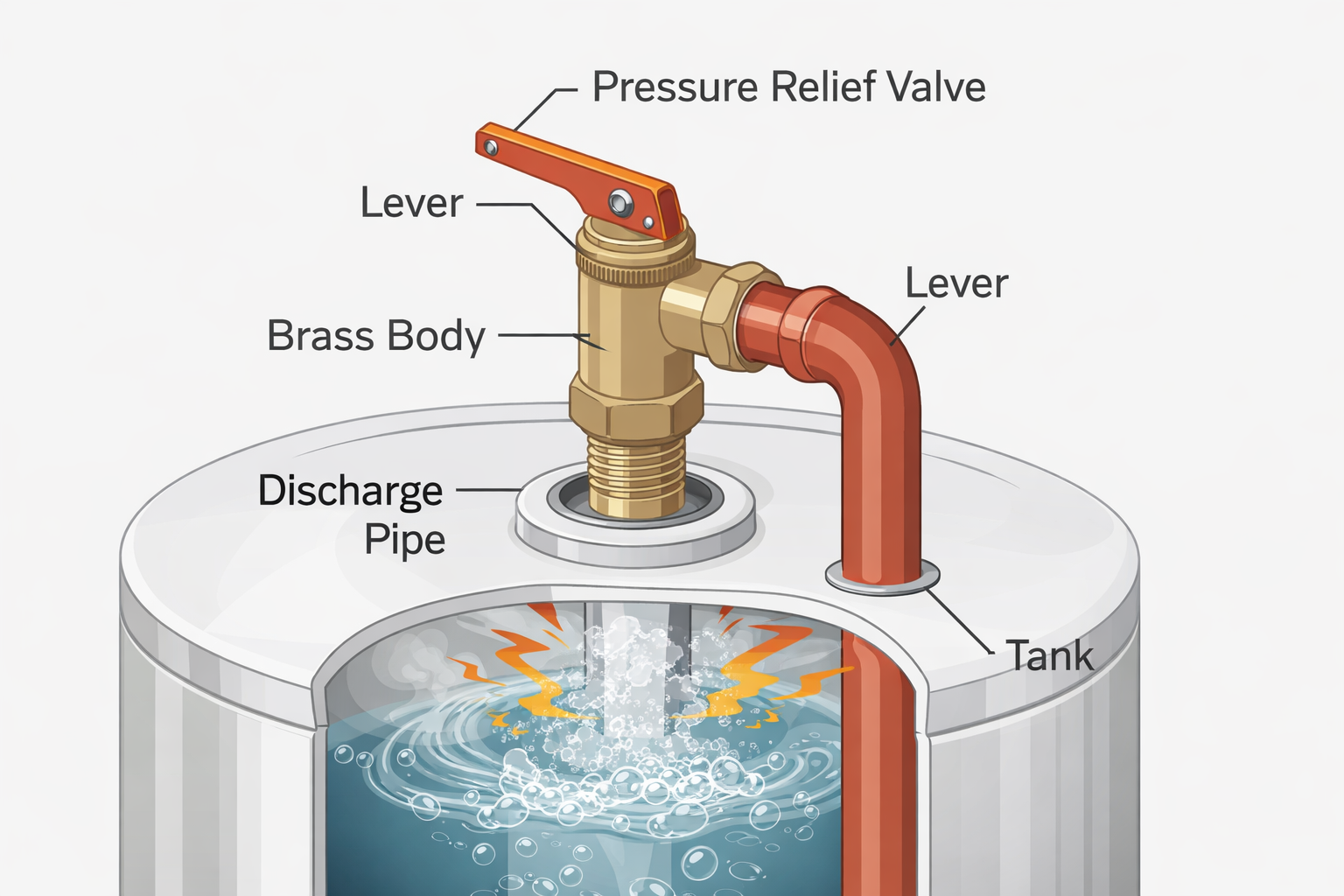
A leaking water heater pressure relief valve usually points to thermal expansion, excessive water pressure, overheating, debris on the valve seat or a worn valve. A typical residential T&P valve is rated to relieve pressure at 150 psi or temperature at 210°F. It opened for a reason, so recurring dripping should not be ignored or stopped by plugging the discharge pipe.
What to Do Right Now if the T&P Valve Is Leaking
The temperature and pressure relief valve—commonly called the T&P valve or TPR valve—is an essential safety device. Treat any active discharge cautiously because the water may be hot enough to cause severe burns.
Never cap, plug, clamp or install a shutoff valve on the T&P discharge pipe. The valve and discharge pipe must remain capable of releasing water safely if tank temperature or pressure becomes excessive.
Keep people away from the discharge outlet. Do not place your hand beneath it or attempt to judge the water temperature by touch.
If the valve is dripping slowly and the heater otherwise appears stable:
- Observe whether the discharge is continuous or mainly occurs during a heating cycle.
- Note whether opening a hot-water faucet causes the dripping to stop.
- Check whether faucets drip or hot-water pipes creak while the heater is recovering.
- Determine whether an expansion tank is installed on the cold-water supply.
- Arrange diagnosis if the valve continues dripping or opens during repeated heating cycles.
Seek prompt professional help when:
- Water flows continuously or forcefully from the discharge pipe.
- A large volume of unusually hot water is released suddenly.
- The discharged water produces steam.
- The water heater makes violent boiling, rumbling or pressure-related noises.
- The valve will not stop discharging.
- Water is reaching electrical equipment or creating an immediate flooding hazard.
If the discharge is forceful, steaming or dangerously hot, keep clear of the outlet. Shut off the water heater’s energy source only if the breaker, disconnect or gas control can be reached safely without approaching the discharge.
What the Pressure Relief Valve Is Designed to Do
A residential water-heater relief valve responds to excessive temperature, pressure or both. Combination T&P valves commonly installed on residential storage water heaters are typically rated to relieve at:
- 150 psi of tank pressure
- 210°F water temperature
The replacement valve must match the water heater’s required pressure rating, temperature rating and discharge capacity. These specifications are normally stamped or printed on the valve label and listed in the water-heater manual.
Watts describes residential T&P valves as safety devices designed to protect water heaters from excessive temperature and pressure.
A leaking valve can mean one of two broad things:
- The valve is responding correctly to excessive temperature or pressure elsewhere in the system.
- The valve itself cannot reseal correctly because of wear, corrosion, mineral deposits, debris or physical damage.
Replacing the valve without identifying which condition exists can leave the actual problem unresolved.
Slow Weeping Usually Points to Pressure; a Large Hot Discharge Points to Temperature
A. O. Smith Technical Bulletin #52 distinguishes between two common discharge patterns:
- Intermittent weeping or dribbling generally indicates that the valve is opening slowly in response to excessive pressure, often from thermal expansion in a closed plumbing system.
- A large, sudden discharge of hot water points more strongly toward temperature actuation and a possible thermostat or temperature-control malfunction.
This distinction is useful, but the discharge pattern should still be confirmed by measuring system pressure and checking actual water temperature. A damaged valve, debris on the seat or an incorrect installation can complicate the pattern.
Is It Normal for a Water Heater Relief Valve to Drip?
Recurring discharge should not be treated as normal operation. A drip that appears during or shortly after a heating cycle may strongly suggest thermal expansion in a closed plumbing system, but timing alone does not confirm the cause. The system pressure, expansion control and valve condition still need to be checked.
The discharge pattern can help narrow the possibilities:
| What you observe | Possible causes | Best next check | Urgency |
|---|---|---|---|
| Slow weeping during or after a heating cycle | Thermal expansion, closed plumbing system, missing expansion tank or failed expansion tank | Measure pressure before and during recovery and evaluate the expansion tank | Needs diagnosis; do not ignore recurring discharge |
| Drips constantly, even when the heater is not recovering | High static pressure, debris on the valve seat, corrosion, a weakened spring or a damaged valve | Check household pressure and inspect the valve condition | Schedule repair promptly |
| Started leaking after the test lever was operated | Debris caught on the valve seat, mineral buildup or a valve that no longer reseals | Follow the manufacturer’s instructions; replacement may be necessary if dripping continues | Prompt repair if the valve does not reseal |
| Large or forceful discharge of very hot water | Overheating, thermostat or control failure, severe overpressure or a valve stuck open | Keep clear, shut down safely and call a qualified plumber | Urgent |
| Water leaks around the valve threads | Loose connection, damaged threads, corrosion or failed thread seal | Dry the area and confirm whether water exits through the valve or around the threaded connection | Repair before water damages the heater or surrounding area |
| Water comes from a top fitting, tank seam or tank base | Plumbing connection leak, tank corrosion or internal tank failure | Identify the highest wet point and inspect the tank separately from the T&P valve | Tank-body leakage may require water-heater replacement |
The discharge pattern helps identify whether pressure or temperature is more likely, but it does not replace measurement. Even a slow recurring drip can reflect excessive pressure or a relief valve that can no longer seal correctly.
For help distinguishing a relief-valve discharge from a plumbing-connection or tank leak, see our complete guide to a leaking water heater.
How to Diagnose Why the T&P Valve Keeps Opening
The most useful evidence comes from three observations:
- When and how the discharge begins
- How plumbing pressure changes during a heating cycle
- Whether the expansion-control system is present and functioning
Test 1: Measure Household Water Pressure
A threaded water-pressure gauge can be attached to a suitable hose bib, laundry connection or another compatible test point. Follow the gauge manufacturer’s instructions and make sure all fixtures and water-using appliances are off before taking the static reading.
A gauge with a peak-pressure or maximum-reading pointer is especially useful because it can record the highest pressure reached while the water heater completes a recovery cycle.
Useful readings include:
- Cold static pressure: Pressure when no fixtures are running and the heater is not actively recovering
- Peak pressure during heating: The highest reading while the tank reheats a fresh supply of water
- Pressure after opening a fixture: Whether briefly using hot water lowers the pressure and stops the discharge
Residential supply pressure is commonly maintained around 50 to 60 psi and generally should not exceed 80 psi, although locally adopted plumbing requirements and equipment instructions control.
A. O. Smith Technical Bulletin #45 describes a peak-pressure test in which the gauge’s maximum-reading pointer is aligned with the current pressure, the water heater is allowed to complete a heating cycle and the highest pressure is then reviewed.
A high static reading may point to excessive municipal supply pressure or a defective pressure-reducing valve. A substantial rise that occurs primarily while the water heater is recovering strongly supports thermal expansion in a closed plumbing system.
Why the pressure rise matters: In an example published in A. O. Smith Bulletin #45, water trapped in a closed system at an initial pressure of 50 psi reached approximately 250 psi after a temperature increase of only 10°F.
That example illustrates how rapidly pressure can rise in a closed system. The exact pressure reached in a particular home depends on the plumbing volume, system design, trapped air, pipe flexibility and expansion-control equipment.
Test 2: Compare the Leak With the Heating Cycle
Record when the valve begins dripping:
- Does it begin after a large amount of hot water is used?
- Does it occur while the burner or heating elements are reheating the tank?
- Does it stop after someone opens a hot-water faucet?
- Does it continue after the heater has completed its recovery cycle?
Also look for other signs of a closed-system pressure rise:
- Hot-water pipes creak while the heater recovers and no fixtures are open
- Faucets drip during the recovery cycle
- Water initially surges when a fixture is opened and then settles to a lower pressure
- The T&P valve drips during recovery even though no water is being used
A. O. Smith Bulletin #45 identifies these as common symptoms of thermal expansion in a closed plumbing system. They do not prove the diagnosis individually, but several occurring together—along with a rising gauge reading—provide strong evidence.
Do not rely on the T&P valve as the permanent control for thermal expansion. The relief valve is intended as an emergency safety device rather than the routine means of accommodating expanded water.
Test 3: Evaluate the Expansion Tank
If an expansion tank is installed, its presence alone does not prove that it is working. The tank may be:
- Waterlogged because the internal bladder has ruptured
- Incorrectly precharged
- Undersized for the water heater and plumbing system
- Installed in an ineffective location
- Isolated from the heater by a closed valve
- Corroded or physically damaged
Many potable-water expansion tanks have a Schrader-style air valve. Water coming from that air valve strongly suggests that the internal bladder has failed. Air coming out does not prove that the tank is properly charged, correctly sized or connected effectively to the plumbing system.
Checking the precharge normally requires closing or isolating the water supply, opening a nearby fixture to relieve plumbing pressure and confirming that water pressure on the tank side has fallen before taking the air-pressure reading. The exact procedure should follow the expansion-tank manufacturer’s instructions.
The air charge should then be compared with the home’s measured cold static supply pressure. If adjustment is permitted, follow the tank manufacturer’s method and pressure limits rather than using an assumed generic setting.
Important: Do not add air to an expansion tank while the plumbing side remains pressurized or by guessing at a generic pressure. The correct precharge normally needs to match the home’s measured cold static pressure, subject to the expansion-tank manufacturer’s specifications.
If the tank releases water from the air valve, will not hold its air charge or is heavily corroded, replacement is generally necessary.
Why Thermal Expansion Makes the Relief Valve Drip
Water increases in volume as it heats. In an open plumbing system, some of that expanded water may move back toward the municipal supply or well system.
In a closed plumbing system, reverse flow is restricted by a device such as:
- A backflow preventer
- A check valve
- A pressure-reducing valve
- A water-meter assembly with an internal check valve
- Another device that prevents water from moving back toward the supply
When the water heater recovers, the expanded water has limited space to move. Plumbing pressure can then rise until:
- A properly sized and charged expansion tank absorbs the additional volume
- A faucet or water-using appliance opens and relieves pressure
- A weak plumbing component begins leaking
- The T&P valve opens to relieve the system
The relief valve may be responding correctly, but repeated discharge means the expansion-control system may be missing, improperly sized, incorrectly charged, isolated or no longer functional.
A Missing Expansion Tank May Affect Warranty Coverage
A. O. Smith Technical Bulletin #41 states that when one of its water heaters is installed in a closed plumbing system, a properly sized thermal expansion tank must be installed and that failure to provide appropriate expansion control may void the manufacturer’s warranty.
This is a manufacturer-specific requirement, not a universal statement for every brand. Check the installation manual and warranty terms for the exact water heater.
The same bulletin explains that a visibly bulged tank bottom indicates exposure to extremely high internal pressure—reported by A. O. Smith as pressure exceeding approximately 300 psi. A bulged or deformed tank should be taken out of service and evaluated for replacement.
High Incoming Water Pressure Can Also Open the Valve
Thermal expansion is not the only pressure-related cause. If the home’s incoming static pressure is already too high, the additional pressure created during a heating cycle may move the system closer to the valve’s opening point.
Possible causes include:
- High municipal supply pressure
- A missing pressure-reducing valve
- A pressure-reducing valve that is incorrectly adjusted
- A failed pressure-reducing valve
- Pressure changes caused by municipal supply conditions
If static pressure exceeds the locally permitted limit or rises above 80 psi, a qualified plumber should evaluate the pressure-reducing equipment and expansion-control system. Replacing the T&P valve alone will not correct excessive supply pressure.
Where incoming pressure is high, the appropriate system correction may require both a properly adjusted pressure-reducing valve and a correctly sized expansion tank. A pressure-reducing valve can itself create a closed system by preventing expanded water from moving back toward the supply.
Overheating Can Cause Hot or Forceful Discharge
A T&P valve may also open because the water temperature is becoming abnormally high. A large, sudden discharge of very hot water is more consistent with temperature actuation than the slow weeping commonly associated with pressure expansion.
Possible causes depend on the type of water heater.
On an electric tank water heater, overheating may be associated with:
- A thermostat set too high
- A thermostat that is not seated firmly against the tank
- Stuck thermostat contacts
- A grounded heating element
- Loose, damaged or incorrectly connected wiring
- An electronic control or temperature-sensor failure
On a gas water heater, overheating may involve:
- A defective gas control or thermostat
- A temperature-sensor fault
- An electronic control error
- A burner-control problem
Around 120°F is a common residential starting point for balancing hot-water comfort, energy use and scald protection, although household requirements and manufacturer instructions can differ.
Do not touch water coming from the discharge pipe to judge its temperature. If household hot water is unexpectedly much hotter than the thermostat setting, see our guides to a water heater that is getting too hot, choosing a safe water heater temperature, and water heater thermostat replacement cost.
The next step is determining whether the valve itself is damaged, contaminated or unable to reseal—or whether a different part of the water heater is actually leaking.

When the T&P Valve Itself Is the Problem
Water pressure and temperature should be checked before assuming that the relief valve has failed. However, the valve itself can become damaged, contaminated or unable to seal correctly.
Valve-related causes include:
- Mineral deposits or debris lodged on the valve seat
- Corrosion inside the valve body
- A weakened spring or damaged internal seal
- A test lever that is seized, loose or physically damaged
- An incorrectly sized or rated replacement valve
- Damage caused by repeated discharge or improper installation
- A valve that no longer reseals after its test lever is operated
A worn or contaminated valve may drip even when household pressure and water temperature remain within the expected range. That conclusion should be reached only after excessive pressure, thermal expansion and overheating have been ruled out.
Why Sediment or Debris Can Prevent the Valve From Resealing
When the T&P valve opens, moving water can carry mineral particles, rust or other debris across the valve seat. If material becomes trapped between the sealing surfaces, the valve may continue dripping after the original pressure or temperature condition has passed.
Debris on the valve seat becomes more plausible when:
- The valve began leaking immediately after its test lever was operated
- The plumbing system contains visible mineral scale or corrosion
- The valve has discharged repeatedly
- The valve is corroded or difficult to operate
- Measured system pressure and water temperature remain within the expected range
Heavy sediment inside the water heater can also reduce heat transfer and contribute to noisy or abnormal operation, but sediment in the tank does not prove that debris is holding the relief valve open. See our water heater flush cost guide for maintenance costs and the limits of flushing an older or heavily scaled tank.
Is the Water Coming From the Valve, Its Connection or the Tank?
Water can travel down the side of a tank before reaching the floor. A leak that appears to come from the T&P valve may actually begin at the valve outlet, around its threaded connection, at the welded tank fitting or at another plumbing connection.
Dry the accessible area carefully and identify the highest point where water first appears. Do not touch the discharge outlet while the valve is actively releasing water.
| Where water first appears | Likely possibilities | What it usually means |
|---|---|---|
| End of the discharge pipe | Thermal expansion, high pressure, overheating or a valve that cannot reseal | The pressure, temperature and expansion-control system should be diagnosed |
| Around the valve threads | Loose valve, damaged threads, corrosion or failed thread seal | The valve may need to be removed, inspected and correctly resealed or replaced |
| At the welded valve spud | Cracked weld, corrosion or failure where the factory fitting joins the tank | The welded spud is generally not field-repairable and the water heater usually requires replacement |
| Hot- or cold-water connection | Loose fitting, failed connector, corrosion or pipe-joint leak | A plumbing connection may be leaking rather than the relief valve |
| Tank seam, jacket or lower body | Internal tank corrosion or storage-tank failure | An internally leaking storage tank is generally not repairable and usually requires replacement |
| Drain valve near the bottom | Loose drain valve, debris on its seat, damaged threads or valve failure | The drain valve should be evaluated separately from the T&P valve |
A. O. Smith Technical Bulletin #52 distinguishes between leakage at the threaded valve connection, which may be corrected by removing and resealing the valve, and seepage at the welded tank spud, which is not considered repairable.
See our complete guide to diagnosing a leaking water heater for a broader breakdown of top connections, drain valves, internal tanks and surrounding plumbing.
How to Test a Water Heater Pressure Relief Valve Safely
Many manufacturers instruct owners to operate the T&P test lever periodically to confirm that water can pass through the valve and discharge pipe. Always follow the directions printed on the valve label and in the manual for the exact water-heater model.
Do not test the valve while the heater is actively overheating, while the valve is discharging forcefully or when the discharge pipe is missing, obstructed or routed unsafely.
Scalding warning: Water released through the T&P valve can be extremely hot. Keep your face, hands and body away from the discharge outlet. Confirm that the pipe terminates at a safe and visible location before operating the lever.
Do not test the valve if people, electrical equipment or finished surfaces could be exposed to the discharge.
A typical manufacturer-directed test involves:
- Turn off the water heater’s energy source according to the manufacturer’s instructions.
- Confirm that the discharge pipe is securely connected, unobstructed and directed to a safe termination point.
- Keep people away from the discharge outlet.
- Stand to the side of the valve rather than directly in front of it.
- Lift the test lever briefly so water flows through the valve and discharge pipe.
- Release the lever and allow it to return fully to the closed position.
- Observe whether the water flow stops and whether dripping continues afterward.
A. O. Smith’s water-heater maintenance guidance similarly recommends keeping clear of the discharge and confirming that the valve opens and reseals correctly.
Interpret the result carefully:
- Water flows and the valve reseals: The basic opening and closing action occurred, but this does not verify the valve’s exact pressure or temperature opening point.
- No water flows: The valve, internal passage or discharge pipe may be blocked, incorrectly installed or defective.
- The valve continues dripping: Debris may be trapped on the seat, or the valve may be worn and unable to reseal.
- The lever is seized or damaged: Do not force it. Arrange professional inspection or replacement.
An older, corroded or previously untested valve may not reseal after the lever is operated. Be prepared to shut off the heater’s energy source and cold-water supply and arrange replacement if the valve continues discharging.
T&P Discharge Pipe Requirements
The discharge pipe is part of the water heater’s safety system. It carries hot water or steam away from the valve toward a location where discharge can occur without exposing people or electrical equipment.
Manufacturer instructions and model plumbing codes commonly require the discharge pipe to:
- Be no smaller than the T&P valve outlet
- Use approved material rated for hot-water distribution
- Run continuously downward by gravity toward the termination point
- Remain unobstructed and free of internal restrictions
- Have no shutoff valve, cap, plug or threaded closure at the outlet
- Avoid traps or low points where water can remain
- Terminate where discharge can be observed
- Terminate without directing hot water toward people
- Avoid contact with live electrical components
- Follow the valve and water-heater manufacturer’s limits for pipe length, routing and fittings
Watts’ T&P valve guidance states that the discharge line should match the valve outlet size, pitch downward without traps and use no more than four fittings. That four-fitting limit applies to Watts’ published guidance; the instructions for the installed valve and the locally adopted plumbing code still control.
Model-code provisions commonly require the outlet to terminate close to the floor, above an approved receptor or at another safe and visible location. The precise termination height, permitted materials and routing requirements vary by jurisdiction.
The International Residential Code model provisions for water heaters describe common discharge-pipe requirements, but the locally adopted code and manufacturer instructions control the actual installation.
See our water heater code requirements guide for the difference between national model-code language, manufacturer instructions and local enforcement.
Never attempt to stop a dripping T&P valve by modifying the discharge pipe. Capping, plugging, reducing or adding a shutoff valve can prevent the safety device from relieving excessive temperature or pressure.
Why a New T&P Valve May Still Leak
If a newly installed pressure relief valve continues dripping, the original valve may not have been the underlying problem.
Possible causes include:
- Household static pressure is too high
- Thermal expansion raises pressure during each heating cycle
- The plumbing system is closed and has no expansion tank
- The existing expansion tank is waterlogged, incorrectly charged or undersized
- The water heater is overheating
- The new valve has the wrong pressure, temperature or discharge-capacity rating
- Debris entered the valve during installation
- The connection around the valve threads is leaking rather than the valve outlet
If a new valve still leaks, check cold static pressure, peak pressure during recovery, actual hot-water temperature, expansion-tank condition, valve rating and the exact point where water first appears.
Fix the Confirmed Cause
| Confirmed cause | Typical correction | Important caution |
|---|---|---|
| Thermal expansion in a closed system | Install or correctly size and charge a potable-water expansion tank | Do not use the T&P valve as the routine expansion-control device |
| Failed expansion tank | Replace a ruptured, waterlogged or badly corroded tank; correct the precharge when appropriate | Precharge should follow measured cold static pressure and manufacturer instructions |
| High incoming water pressure | Adjust, install or replace the pressure-reducing valve as required | A pressure-reducing valve may create a closed system, so expansion control may also be required |
| Overheating | Diagnose the thermostat, heating element, gas control, sensor, wiring or electronic control system | Forceful hot discharge or steam requires urgent attention |
| Debris or damaged valve seat | Follow the manufacturer’s procedure and replace the valve if it will not reseal | Confirm that system pressure and temperature are acceptable first |
| Leak around the valve threads | Remove, inspect and correctly reseal or replace the threaded connection | Damaged tank threads or corrosion may complicate the repair |
| Leak at the welded spud | Replace the water heater | The factory-welded tank fitting is generally not field-repairable |
| Tank-body leak | Replace the water heater | An internally leaking storage tank is generally not repairable |
How Much Does It Cost to Fix a Leaking T&P Valve?
The cost depends on whether the problem is the valve itself or the plumbing condition that caused it to discharge.
A straightforward professional valve replacement commonly costs a few hundred dollars. Correcting excessive pressure, replacing an expansion tank or repairing an overheating control can cost more.
Our dedicated water heater pressure relief valve cost guide covers planning ranges for:
- The replacement valve
- Professional labor
- Diagnostic and service-call charges
- Expansion-tank work
- Pressure-related repairs
- Related thermostat or control problems
Can You Replace a T&P Valve Yourself?
A competent homeowner with plumbing experience may be able to replace a T&P valve, but the job is more involved than simply unscrewing one part and installing another.
Safe replacement generally requires:
- Turning off the water heater’s electricity or gas supply
- Allowing the tank water to cool
- Closing the cold-water supply
- Relieving plumbing pressure
- Draining the tank to the level required by the valve position and manufacturer procedure
- Selecting a listed replacement with the correct size and ratings
- Removing and reinstalling the discharge pipe correctly
- Refilling the tank completely
- Checking the valve and threaded connection for leaks
- Restoring power to an electric heater only after the tank is completely full
The replacement valve must match the heater’s required:
- Inlet size and thread type
- Pressure rating
- Temperature rating
- Discharge capacity
- Probe length and installation arrangement, where applicable
- Listing and certification requirements
A. O. Smith Bulletin #52 also explains that the valve’s pressure rating must not exceed the water heater’s certified working pressure or the rating of the lowest-rated component in the system.
Call a qualified plumber when:
- Water is discharging forcefully or appears dangerously hot
- The underlying cause has not been confirmed
- Household pressure exceeds the permitted range
- The expansion tank or pressure-reducing valve needs diagnosis
- The valve, welded spud or tank threads are corroded or damaged
- The discharge pipe is missing or incorrectly installed
- The heater is difficult to isolate or drain safely
- The tank itself appears to be leaking
Repair the System or Replace the Water Heater?
A leaking T&P valve does not automatically mean the entire water heater needs replacement. Many pressure, expansion and control problems can be corrected without replacing the storage tank.
Repair is generally reasonable when:
- The tank and welded valve spud are not leaking
- The valve is the only damaged component
- High pressure or thermal expansion can be corrected
- The expansion tank or pressure-reducing valve can be repaired or replaced
- A thermostat, element or gas-control fault can be repaired economically
- The water heater otherwise meets the household’s needs
Consider water-heater replacement more seriously when:
- The storage tank is leaking
- The welded valve spud is seeping
- There is extensive corrosion around the valve opening or tank body
- Multiple major controls and plumbing components require repair
- The heater has required repeated recent service
- The unit no longer provides adequate capacity
- Replacement parts are unavailable or unusually expensive
- The total repair cost represents a substantial share of replacement cost
Repeated pressure problems alone do not prove that the water heater should be replaced. The pressure-reducing equipment, expansion tank and closed-system design should be evaluated first.
How to Reduce Future T&P Valve Problems
No maintenance plan can prevent every valve or control failure, but regular inspection can uncover pressure, temperature and corrosion problems before they cause recurring discharge.
- Keep the water temperature within the manufacturer’s recommended range.
- Investigate water that becomes unexpectedly hotter than the thermostat setting.
- Measure household pressure if fixtures, valves or appliances begin leaking.
- Check the expansion tank according to its manufacturer’s instructions.
- Replace a waterlogged, leaking or heavily corroded expansion tank.
- Inspect the T&P valve and discharge pipe for corrosion, damage and obstruction.
- Operate the test lever only according to the valve label and water-heater manual.
- Address recurring dripping rather than treating it as routine operation.
- Manage sediment according to the water-heater manufacturer’s maintenance instructions.
- Keep the discharge termination visible and unobstructed.
See our water heater maintenance schedule for a broader inspection and service plan.
Frequently Asked Questions
Is it normal for a water heater pressure relief valve to leak?
No recurring discharge should be treated as normal operation. Dripping during a heating cycle may indicate thermal expansion in a closed plumbing system, but the system pressure, expansion tank and valve condition still need to be checked.
Why does my T&P valve leak only after the water heats up?
Heating-cycle discharge commonly points toward thermal expansion. As water heats, it increases in volume. In a closed system, pressure can rise if no properly sized and charged expansion tank is available to absorb that additional volume.
Why is the new T&P valve still leaking?
The original valve may not have been the cause. Check static pressure, peak pressure during recovery, the expansion tank, actual water temperature, valve rating and whether the leak comes through the discharge pipe, around the threads or from the welded spud.
Can I plug the T&P discharge pipe to stop the leak?
No. Never cap, plug, clamp, reduce or install a shutoff valve on the discharge pipe. Doing so can prevent the safety valve from relieving excessive temperature or pressure.
What pressure should household plumbing have?
Residential pressure is commonly maintained around 50 to 60 psi and generally should not exceed 80 psi. Local plumbing requirements, appliance instructions and site conditions still control.
How do I know whether my expansion tank is bad?
Water coming from the expansion tank’s air valve strongly suggests a ruptured internal bladder. The tank may also be defective if it will not hold its air charge, is badly corroded or cannot prevent a substantial pressure rise during water-heater recovery.
How do I test a water heater pressure relief valve?
Follow the valve label and water-heater manual. Confirm that the discharge pipe terminates safely, turn off the heater’s energy source as directed, keep clear of the outlet, briefly lift the test lever and confirm that water flows and then stops after the lever is released.
What if the valve does not reseal after testing?
Turn off the heater’s energy source, close the cold-water supply if required and arrange replacement. Debris, corrosion or a damaged valve seat may prevent the valve from closing properly.
Is a leaking T&P valve dangerous?
It can be. Forceful hot-water discharge, steam, abnormal overheating or extreme pressure requires prompt attention. Even a slow recurring drip can indicate a system condition that should not be ignored.
How much does it cost to replace a T&P valve?
Professional replacement commonly costs a few hundred dollars, depending on local labor rates, access, diagnosis and whether the discharge pipe requires correction. Pressure, expansion-tank or overheating repairs may increase the total.
Can I replace the pressure relief valve myself?
A competent homeowner with plumbing experience may be able to replace it, but the heater must be shut down, cooled, isolated and drained as required. The replacement must match the correct size, pressure, temperature and discharge-capacity ratings.
How often should a T&P valve be replaced?
There is no universal replacement interval for every valve and water heater. Inspect and test it according to the valve label and manufacturer’s manual. Replace it if it will not open, will not reseal, leaks because of valve damage, is badly corroded or no longer meets the heater’s required ratings.
Bottom Line
A leaking water heater pressure relief valve is a symptom, not a complete diagnosis. It may be releasing water because of thermal expansion, excessive supply pressure, overheating or a failed expansion tank—or it may be worn and unable to reseal.
Never plug the discharge pipe. Observe when the leak occurs, measure system pressure, evaluate the expansion tank and confirm the actual water temperature before replacing the valve. Correcting the underlying cause is the only reliable way to prevent the leak from returning.