
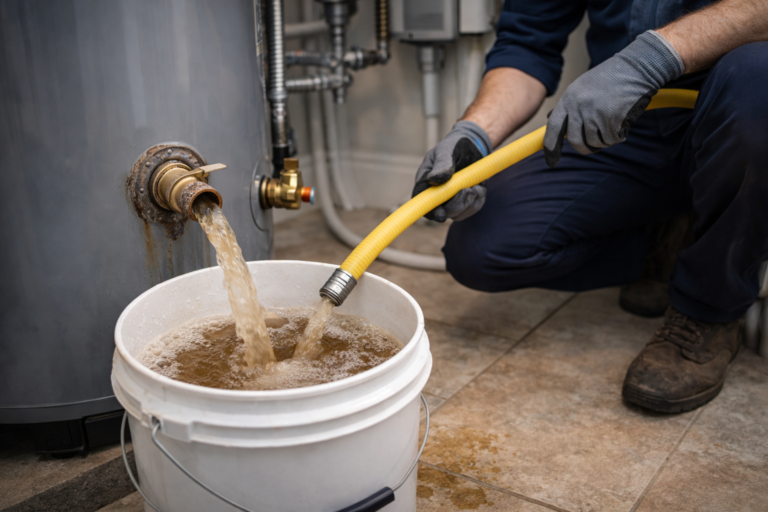
Sediment in a water heater is a layer of minerals, scale, sand, rust or other debris that collects inside a storage tank. A small amount may cause no noticeable problem, but heavier buildup can reduce available hot water, create popping or rumbling noises, slow recovery and interfere with normal heat transfer.
Loose sediment can often be removed by flushing the tank. However, hardened mineral scale, a clogged drain valve, internal corrosion or a damaged heating component may require professional diagnosis instead of repeated flushing.
This guide explains what water-heater sediment looks like, the symptoms it may cause, how to distinguish it from other plumbing problems and when the condition is serious enough to consider repair or replacement.
Safety warning
Water heaters contain hot, pressurized water and may also involve high-voltage electricity, gas or combustion equipment. Follow the manufacturer’s instructions for your exact model before draining, opening an access panel or restarting the heater. Stop and contact a qualified professional if you smell gas, find active leakage, see scorched wiring or cannot shut the unit down safely.
What Is Sediment in a Water Heater?
Water-heater sediment is solid material that enters with the water supply or separates from the water as it is repeatedly heated. Gravity causes much of this material to settle near the bottom of a storage tank.
The exact contents vary according to the home’s water source, plumbing system and water hardness. Common forms include:
- Mineral deposits: Calcium carbonate and other dissolved minerals can separate from hard water as it is heated.
- Sand and silt: Fine particles may enter from a private well, municipal water work or the incoming water supply.
- Rust particles: Reddish-brown debris may come from aging pipes, internal corrosion or deteriorating metal components.
- Plumbing debris: Material loosened during pipe repairs or utility work can move through the system and collect in fixtures or the tank.
Sediment vs. limescale
The terms sediment, mineral buildup and limescale are often used interchangeably, but they are not identical.
Sediment is the broad term for material that settles or collects inside the tank. Limescale is a harder mineral deposit, usually associated with calcium-rich hard water, that may adhere to tank surfaces and heating components.
Loose sediment is generally easier to flush out. Hardened scale may remain attached even after the tank has been drained and may require a different maintenance approach.
What Does Water-Heater Sediment Look Like?
Sediment is not always visible at a faucet. It is most clearly observed in water released through the tank’s drain valve during maintenance.
Depending on its source, water-heater sediment may appear as:
- white, cream or gray mineral flakes
- chalky pieces of hardened scale
- fine sand or gritty particles
- reddish-brown rust debris
- dark particles mixed with drained water
- cloudy water that leaves solid material after settling
Appearance alone does not prove that the water heater is responsible. Cloudy water may contain harmless air bubbles, while brown water can come from corroded plumbing, utility work or disturbed deposits elsewhere in the water supply.
Is the Water Heater Really the Source?
Before blaming the tank, compare several hot- and cold-water fixtures around the home. This simple test can help separate water-heater sediment from supply-water, pipe or fixture problems.
| What you observe | What it may suggest |
|---|---|
| Particles appear only in hot water at several fixtures | The water heater or hot-water piping becomes a stronger suspect |
| The same particles appear in hot and cold water | The incoming supply, well system or main plumbing may be responsible |
| The issue occurs at only one faucet or shower | Check the aerator, showerhead, cartridge or local supply line first |
| Discoloration started after plumbing or utility work | Deposits may have been temporarily disturbed elsewhere in the system |
| Rust-colored debris continues only on the hot side | The heater or hot-water piping should be inspected for corrosion |
Common Symptoms of Sediment Buildup
Sediment can affect sound, hot-water capacity, recovery time and energy use. However, no single symptom confirms the diagnosis. Failed heating elements, thermostat faults, plumbing restrictions and other water-heater problems can produce similar results.
Popping, crackling or rumbling noises
Popping or rumbling is one of the most commonly reported symptoms of sediment in a gas storage water heater. Water trapped beneath or within mineral deposits can become hot, form steam bubbles and force its way through the buildup.
Electric water heaters may also produce crackling or sizzling noises when mineral deposits collect around the lower heating element. Mild expansion sounds can be normal, but loud, persistent or worsening noises deserve investigation.
Hot water runs out faster
A substantial layer of sediment occupies space that would otherwise hold heated water. The heater may therefore provide less usable hot water than its rated tank capacity suggests.
You may notice:
- showers turning cold sooner than before
- hot water running out during normal household use
- poor performance when several fixtures are used
- a gradual reduction in capacity despite unchanged demand
Reduced hot-water capacity can also result from a failed electric element, damaged dip tube, thermostat problem or an undersized heater. Sediment should be treated as one possible cause rather than the automatic answer.
Slower recovery after hot-water use
Recovery time is the time required to heat incoming cold water after a shower, bath or other large draw. Mineral deposits may interfere with heat transfer, particularly near the bottom of a gas-fired tank or around the lower element of an electric heater.
Other possible causes of slow recovery include:
- a weakened or failed heating element
- a burner or ignition problem
- an incorrect thermostat setting
- low electrical voltage
- a gas-supply problem
- unusually cold incoming water
- household demand exceeding the heater’s capacity
Higher energy use
A heater that transfers heat less effectively may need to operate longer to reach its thermostat setting. That can increase energy use, but utility rates, seasonal inlet-water temperature, household demand and equipment condition also affect monthly bills.
A rising gas or electricity bill alone does not confirm sediment. It becomes more meaningful when accompanied by slower recovery, reduced capacity or new tank noises.
A clogged or slow drain valve
Because sediment collects near the bottom of the tank, loose material can gather around the drain opening. During maintenance, the valve may release only a weak stream, clog repeatedly or fail to drain.
Do not force an old valve or insert tools into the opening without understanding the risk. Plastic or corroded valves can crack, begin leaking or fail to close after they are disturbed.
Our guide to water heater flushing costs explains what a professional tank flush normally includes and how drain-valve problems can affect the final service price.
Cloudy, gritty or discolored hot water
Mineral particles or debris may occasionally appear after the tank has been disturbed. However, cloudy or gritty water can also come from:
- a clogged faucet aerator
- corroded pipes
- recent utility work
- sediment entering from a private well
- a deteriorating internal component
- air trapped in the water
Check multiple hot- and cold-water fixtures before concluding that sediment inside the heater is the source.
How Sediment Affects Different Water-Heater Types
Sediment does not affect every type of water heater in exactly the same way. The design of the system determines where material collects, which components may be affected and what maintenance method is appropriate.
Gas storage water heaters
In a conventional gas water heater, the burner heats the tank from below. Sediment accumulating across the tank bottom can interfere with heat transfer and contribute to popping or rumbling as heated water moves through the deposits.
Heavy buildup may increase burner run time, reduce recovery performance and concentrate heat near the bottom of the tank. Persistent noise does not prove that the tank is unsafe, but it should not be ignored when performance is also declining.
Electric storage water heaters
Most residential electric water heaters use upper and lower immersion heating elements. Sediment tends to collect near the lower element, where it can restrict water circulation, surround the element and contribute to overheating or premature failure.
If an electric heater produces only a limited amount of hot water, a failed or sediment-covered lower element may be involved. Testing an element requires working near high-voltage wiring and should be left to a qualified person unless the homeowner has suitable electrical experience.
See our guide to water heater element replacement costs for typical repair prices, labor factors and signs that an electric element may need replacement.
Heat-pump water heaters
A heat-pump water heater still stores water in a tank, so mineral sediment can collect inside it. These systems also include air filters, condensate drainage, electronic controls and backup electric elements.
Slow recovery may therefore come from sediment, an electric-element problem, restricted airflow or another heat-pump fault. Follow the manufacturer’s maintenance instructions rather than applying a generic gas-heater procedure.
Tankless water heaters
Tankless water heaters do not store a large volume of water in which debris settles into a bottom layer. Their main mineral-related problem is scale accumulating inside the heat exchanger and narrow waterways.
Tankless scale is normally addressed through manufacturer-approved descaling rather than draining a storage tank. The equipment, procedure and approved cleaning solution vary by model.
Is Sediment in a Hot-Water Tank Dangerous?
Ordinary sediment is not usually an immediate emergency by itself. The greater concern is whether buildup is reducing performance or whether symptoms being blamed on sediment actually indicate leakage, overheating, corrosion, combustion trouble or an electrical fault.
Substantial sediment buildup may:
- reduce usable tank capacity
- slow heat transfer and recovery
- contribute to popping or rumbling noises
- increase stress around a lower electric element
- restrict or block the drain valve
- make routine maintenance more difficult
- contribute to premature component wear
Sediment does not normally make properly treated household water suddenly toxic. However, persistent changes in color, odor or particle content should not automatically be dismissed as harmless minerals. The source may need evaluation by a plumber, water supplier or qualified water-testing professional.
Warning Signs That Need Prompt Attention
Stop operating or attempting to flush the heater when the symptoms suggest something more serious than routine sediment buildup.
Arrange professional help promptly if you notice:
- a gas or fuel odor
- soot, scorching or signs of improper combustion
- burning smells, melted wiring or repeated breaker trips
- water leaking from the tank body
- a bulging, heavily corroded or visibly damaged tank
- uncontrolled or dangerously hot water
- continuous discharge from the temperature-and-pressure relief system
- steam, violent boiling sounds or severe overheating
- a drain valve that cracks, leaks or will not close
A leaking tank body cannot be repaired by flushing. Gas, electrical, combustion and pressure-related faults also require proper diagnosis rather than repeated attempts to remove sediment.
How Serious Is the Sediment Buildup?
There is no universal timeline that makes sediment light after one year and severe after five years. Accumulation varies according to water hardness, well conditions, household usage, temperature settings, tank design, pipe condition and previous maintenance.
| Observed condition | What it may indicate | Reasonable next step |
|---|---|---|
| No performance problems and only a small amount of loose material during routine draining | Limited or routine accumulation | Follow the manufacturer’s maintenance guidance and monitor future buildup |
| New rumbling, slower recovery or reduced hot-water capacity | Moderate buildup or another developing heater fault | Inspect the heater and determine whether model-approved flushing is appropriate |
| Drain valve repeatedly clogs or discharged water contains substantial gritty material | Heavier loose sediment near the bottom of the tank | Consider professional service, especially if the valve is old, plastic or corroded |
| Symptoms remain after a correctly performed flush | Hardened scale, component failure, corrosion or a different diagnosis | Have the heater tested before paying for repeated flushing |
| Tank leakage, severe corrosion or repeated component failures | The problem extends beyond ordinary sediment maintenance | Compare repair and replacement costs instead of treating sediment alone |
Routine maintenance can make loose sediment easier to manage, but the correct schedule depends on the model, water quality and amount of buildup. Our water heater maintenance schedule explains the annual checks homeowners can use as a planning framework.
The next section explains how sediment is removed, when flushing is appropriate, when DIY work should stop, what professional service may cost and how to choose between flushing, repair and replacement.
How Do You Remove Sediment From a Water Heater?
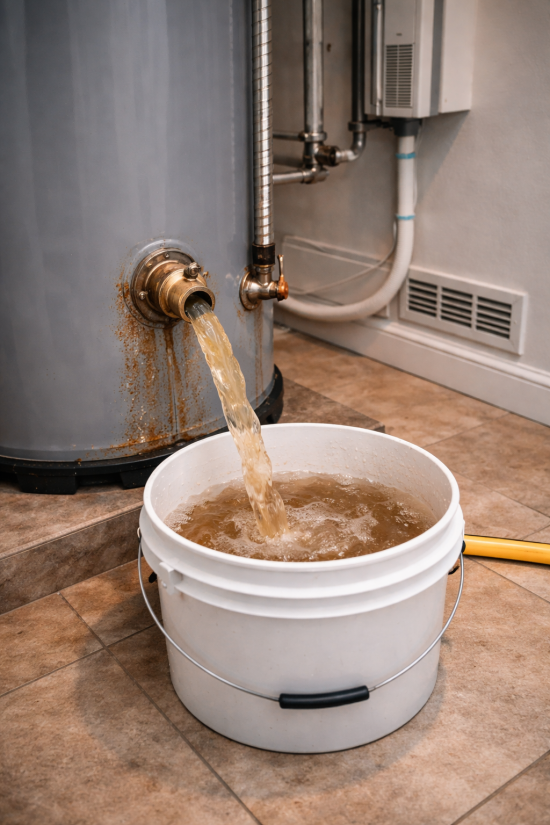
Loose sediment is normally removed by draining and flushing a storage water heater. Water flowing through the tank suspends mineral flakes, sand, rust and other loose material so it can leave through the drain valve.
Flushing is most likely to help when:
- the buildup is loose rather than hardened onto internal surfaces
- the drain valve opens and allows normal flow
- the tank is not leaking or severely corroded
- sediment is the actual cause of the symptoms
- the procedure follows the instructions for the exact heater model
A tank flush cannot repair internal corrosion, seal a leaking tank or remove every layer of hardened mineral scale. It may improve noise, capacity and recovery when loose sediment is responsible, but it should not be treated as a universal fix for every water-heater problem.
Water-Heater Sediment Flush: Safe Process Overview
Shutdown, draining and restart procedures vary among gas, electric, heat-pump and electronically controlled water heaters. Always use the manufacturer’s manual for your exact model.
Important safety warning
Water inside the tank may be hot enough to cause severe burns. The heater may also involve high-voltage electricity, gas or combustion equipment. Do not drain, open or restart the unit unless you understand the correct model-specific procedure. Never restore electricity to an electric water heater until the tank is completely full and air has been purged from the hot-water lines.
1. Find the model-specific instructions
Locate the heater’s model number and use its official installation or use-and-care manual. Confirm the approved shutdown, cooling, draining, refilling and restart sequence before opening a valve.
Do not assume that instructions written for a conventional gas heater also apply to an electric, heat-pump or electronically controlled model.
2. Shut down the heat source
An electric water heater is generally switched off at the circuit breaker. A gas heater must be placed in the control or shutdown position specified by its manufacturer. Some heat-pump and smart water heaters require additional control-panel steps.
If you cannot identify the correct breaker, gas control or shutdown procedure, stop and contact a qualified technician.
3. Allow the water to cool
Follow the manufacturer’s cooling guidance before draining the tank. Keep children and pets away, and route the drain hose to a location that can accept the discharge without causing burns, flooding or property damage.
Do not handle or test the discharged water with your hands.
4. Isolate the incoming water
The cold-water inlet is commonly closed before draining. A hot-water faucet may then be opened, when directed by the manufacturer, to reduce pressure and allow air to enter the system.
Do not force a seized or leaking shutoff valve. A defective valve may need repair before the heater can be drained safely.
5. Connect and inspect the drain hose
Attach a suitable hose securely to the drain valve near the bottom of the tank. Make sure the hose will not disconnect, kink or create a tripping hazard.
Inspect the drain valve before opening it. Old plastic valves and heavily corroded metal valves can crack or begin leaking after being disturbed.
6. Drain and flush the tank
Open the drain valve only after completing the required shutdown and isolation steps. Depending on the manufacturer’s procedure, the tank may be drained fully or flushed using controlled periods of incoming cold water to stir loose material.
The discharged water may contain:
- white or gray mineral flakes
- chalky scale fragments
- sand-like grit
- reddish-brown corrosion debris
- cloudiness or suspended particles
The process may be repeated as directed until the discharge contains substantially less loose material. Clearer water does not prove that all hardened scale has been removed.
7. Refill the tank completely
After the drain valve is closed, reopen the cold-water supply and refill the tank according to the manual. A hot-water faucet is often left open until water flows steadily and trapped air has cleared.
Inspect the drain valve, hose connection area and nearby fittings for leaks before restoring the heat source.
8. Restart and check the result
Restore operation only after confirming that the tank is completely full. Follow the manufacturer’s relighting, electrical or control-panel procedure.
After the water has reheated, check whether:
- popping or rumbling has decreased
- hot-water capacity has improved
- recovery time is closer to normal
- the drain valve remains dry
- the heater operates without error codes, ignition failures or breaker trips
For a detailed breakdown of professional service prices and what should be included, see our guide to water heater flushing costs.
Can You Flush a Water Heater Yourself?
A homeowner may be able to perform routine flushing when the heater is accessible, its valves are in good condition and the manufacturer provides clear owner-maintenance instructions.
DIY flushing becomes much less appropriate when the heater has been neglected for years, the tank is installed in a damage-sensitive location or the valves appear brittle, clogged or corroded.
| DIY may be reasonable when | Professional service is safer when |
|---|---|
| The official manual provides a clear owner-maintenance procedure | The manual is unavailable or the shutdown procedure is unclear |
| The shutoff and drain valves operate normally | A valve is seized, brittle, corroded, clogged or already leaking |
| There is a safe and suitable drainage location | The heater is in an attic, finished room or area with poor drainage |
| The tank has no leakage or serious corrosion | The tank is wet, bulging, heavily rusted or structurally questionable |
| Only routine draining and flushing are required | Gas controls, electrical parts, burners or safety devices need diagnosis |
Contact a qualified plumber or water-heater technician when sediment blocks the drain valve, the tank will not drain or you are concerned that disturbing an old fitting could create an uncontrolled leak.
Common Water-Heater Flushing Mistakes
Restoring electricity before the tank is full
An electric heating element must remain submerged while energized. Restoring power to an empty or partially filled tank can dry-fire the element and cause it to fail.
Assuming one flush removes hardened scale
Flushing can remove loose material. It may not remove mineral scale that has hardened onto the tank bottom or around a heating element.
Once the loose debris is gone, repeatedly draining the tank may provide little additional benefit.
Forcing a blocked drain valve
Do not push wire, tools or other objects through an old drain valve without understanding the heater’s design and condition. The valve may crack, leak or fail to close afterward.
Ignoring recurring sediment
Repeated buildup may result from hard water, sand from a private well, corrosion in older plumbing or disturbed municipal supply material. Flushing the tank without investigating the source may allow the problem to return quickly.
Failing to check for leaks
A drain valve that has remained closed for years may begin dripping after it is opened. Inspect the valve during refilling, after reheating and again later in the day.
Treating every noise as sediment
Popping and rumbling may be related to mineral deposits, but hissing, screeching, electrical buzzing, repeated clicking or combustion noises can have different causes.
If the sound continues after flushing, diagnose the heater instead of assuming it needs another flush.
What If the Water Heater Is Clogged With Sediment?
A heavily clogged tank may release little or no water through the drain valve even when the tank is full. Dense debris can settle directly over the drain opening and repeatedly block the flow.
Possible signs include:
- only a trickle exits the drain hose
- the flow stops shortly after the valve opens
- the drain valve clogs repeatedly during service
- large amounts of gritty material appear intermittently
- the tank cannot be emptied through its normal drain
A clogged drain does not automatically mean the water heater must be replaced. A professional may be able to clear or replace the valve and remove loose buildup. The decision depends on the tank’s condition, installation location and whether corrosion or leakage is present.
Never remove a clogged drain valve from a full or pressurized tank. Uncontrolled hot-water discharge can cause severe burns, flooding and major property damage.
When Flushing Does Not Fix the Problem
A proper flush should remove at least some loose material. It will not correct the symptoms when hardened scale, corrosion or another mechanical fault is responsible.
Arrange further diagnosis when:
- rumbling or popping returns soon after flushing
- the heater still provides much less hot water than expected
- recovery remains unusually slow
- an electric heating element repeatedly fails
- the drain valve remains blocked
- discolored hot water continues
- the tank shows active leakage or substantial corrosion
- the burner, ignition system or electrical controls malfunction
Persistent symptoms may involve:
- hardened mineral scale
- a failed electric heating element
- a thermostat fault
- a damaged dip tube
- a burner or ignition problem
- restricted hot-water piping
- internal tank deterioration
If sediment has contributed to a failed electric component, our guide to water heater element replacement costs explains typical repair prices and when replacing the element remains worthwhile.
How Much Does Water-Heater Sediment Removal Cost?
A professional tank flush commonly costs approximately $100 to $300 in the United States. The lower end generally applies to an accessible heater with functioning valves and manageable loose sediment.
Costs may increase when:
- the heater is difficult to access
- the drain valve is clogged or damaged
- the technician must diagnose another fault
- the tank has never been maintained
- additional parts need replacement
- local labor and service-call rates are high
| Service or condition | Typical cost treatment | What to confirm |
|---|---|---|
| Standard storage-tank flush | About $100–$300 | Whether draining, flushing, refilling and basic inspection are included |
| Blocked or damaged drain valve | Additional labor and parts may apply | Whether the valve will be cleared or replaced |
| Electrical, burner or control diagnosis | Usually quoted separately | Diagnostic fee, required parts and labor scope |
| Full tank replacement | Often about $600–$2,500 installed | Tank size, fuel type, access, code work, removal and disposal |
Ask what a quote includes before approving vague charges for “deep cleaning.” The contractor should explain whether the work covers flushing, valve replacement, diagnostics, anode inspection or another repair.
Should You Flush, Repair or Replace the Heater?
Do not replace a heater solely because it contains sediment or has reached an arbitrary age. Base the decision on the condition of the tank, the confirmed fault, repair cost, reliability and risk of future failure.
| Current condition | Best starting point | Why |
|---|---|---|
| Loose sediment, no leakage and otherwise normal operation | Flush and monitor | Routine maintenance may reduce noise and restore usable capacity |
| Symptoms continue after a correct flush | Diagnose before repeating the service | Another component or hardened scale may be responsible |
| Failed element, thermostat or valve in a sound tank | Compare targeted repair with replacement | An isolated repair may restore reliable service at a reasonable cost |
| Older heater with recurring failures and rising repair costs | Obtain a replacement quote | Repeated repairs may provide poor long-term value |
| Tank body is leaking or severely corroded | Replace the heater | Flushing cannot repair a failed storage tank |
When replacement becomes the realistic option, our water heater replacement cost guide explains typical installation ranges and the factors that can change the final quote.
How to Reduce Future Sediment Buildup
Follow the heater manufacturer’s maintenance guidance
Many manufacturers recommend periodic draining or flushing, but the correct interval depends on the model and local water conditions. Some homes may need more frequent attention, while others accumulate relatively little material.
Base the maintenance interval on:
- the heater’s official manual
- local water hardness
- whether the home uses a private well
- the amount of material removed during previous service
- the heater manufacturer’s warranty requirements
Rheem’s water-heater flushing guidance describes periodic flushing as routine maintenance while emphasizing proper shutdown and refilling procedures.
Inspect and maintain the anode rod
The sacrificial anode rod helps protect a steel storage tank from corrosion. It does not remove mineral scale, but a depleted rod can allow corrosion to progress and may increase the amount of rust-colored debris inside the system.
Inspection frequency depends on water chemistry, heater design and manufacturer recommendations. Our guide to water heater anode rod replacement costs explains professional pricing and when replacing the rod may still protect the tank.
Investigate hard water
Where mineral scale forms quickly, water testing can confirm the hardness level. A properly selected water softener may reduce calcium and magnesium hardness, but it should be sized and maintained according to local water conditions.
A sediment filter is not the same as a water softener. A filter may capture sand, silt or other solid particles but generally does not remove dissolved hardness minerals unless it is designed for that purpose.
Check private-well and supply conditions
Homes using private wells may need inspection of sediment filters, well equipment and pressure systems. Sudden debris after municipal work should be reported to the water supplier when it affects both hot and cold water.
Monitor early changes
Pay attention to:
- new popping or rumbling noises
- declining hot-water capacity
- slower recovery
- particles appearing only in hot water
- drain-valve leakage
- rust or moisture around the tank
Investigating a new symptom is usually more effective than waiting until the heater can no longer provide reliable hot water.
Storage-Tank Flushing vs. Tankless Descaling
This guide mainly applies to storage-tank water heaters. A tankless heater does not develop the same deep layer of sediment at the bottom of a tank. Instead, hard-water minerals may form scale inside the heat exchanger, inlet filter and internal waterways.
Tankless units are generally serviced by circulating a manufacturer-approved descaling solution through the system. Do not apply storage-tank draining instructions to a tankless heater.
Our guide to tankless water heater maintenance costs explains typical professional descaling prices and the factors that influence service frequency.
Frequently Asked Questions
How do I know whether my water heater has sediment?
Possible signs include popping or rumbling, reduced hot-water capacity, slower recovery, gritty material during draining and a repeatedly clogged drain valve. Because other faults can cause the same symptoms, sediment should be confirmed rather than assumed.
What does sediment from a water heater look like?
It may look like white or gray mineral flakes, chalky scale, sand-like grit, reddish-brown rust particles or cloudy drained water that leaves solid material after settling.
Is sediment in a hot-water tank dangerous?
Ordinary mineral sediment is not usually an immediate emergency. Heavy buildup may reduce performance and contribute to component wear. Active leakage, gas odors, electrical burning, severe overheating or continuous relief-system discharge require prompt professional attention.
How do you clear sediment from a water heater?
Loose sediment is usually removed by draining and flushing the storage tank according to its model-specific manual. Hardened scale, a blocked valve or continuing symptoms may require professional service.
Will flushing remove all the sediment?
Not necessarily. Flushing can carry out loose particles but may not remove deposits hardened onto the tank bottom or heating components. It also cannot repair corrosion, leakage or failed parts.
Why is no water coming from the drain valve?
The drain valve may be clogged with sediment, damaged or not opening correctly. Do not remove or force it while the tank is full or pressurized. A qualified professional can determine how to drain the heater safely.
Can sediment cause a water heater to stop working?
Heavy buildup may reduce capacity, slow heat transfer or contribute to lower-element problems. A complete failure can also involve the electrical supply, gas supply, ignition system, thermostats, heating elements or safety controls.
How often should a water heater be flushed?
Many manufacturers recommend periodic flushing, commonly around once a year in typical conditions. The correct schedule depends on the model, water hardness, supply conditions and how much material is found during prior service.
Should an old water heater be flushed for the first time?
Approach an older, neglected heater cautiously. Its valves may be brittle, deposits may be substantial and hidden corrosion may already exist. Professional inspection may be safer than disturbing a tank that has never been maintained.
Can sediment cause brown hot water?
Rust-colored debris from the heater can discolor hot water, but the source may also be the hot-water piping, incoming supply or recent utility work. Persistent brown water limited to the hot side should be investigated.
Final Answer
Sediment in a water heater is often manageable when it is identified early and remains loose enough to flush from a structurally sound tank. Common clues include rumbling noises, reduced hot-water capacity, slow recovery, gritty drain water and a clogged drain valve.
Do not assume that every symptom is caused by sediment or that repeated flushing will correct hardened scale, corrosion or a failed component. Follow the heater manufacturer’s instructions and stop DIY work when the valves are damaged, the tank leaks or the shutdown procedure is uncertain.
A proper flush may restore performance when loose sediment is the real problem. Persistent symptoms require diagnosis, while active tank leakage, severe corrosion or repeated costly failures usually shift the decision toward replacement.