
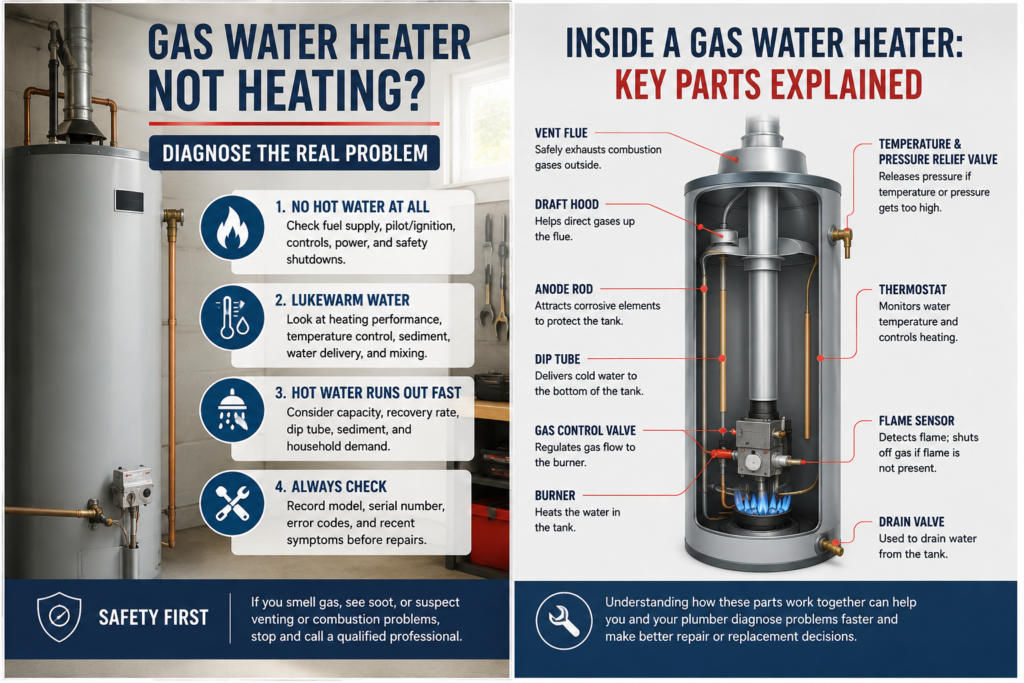
Quick answer: If your gas water heater is not heating, first determine which problem you actually have: no hot water at all, water that only gets lukewarm, or hot water that starts normally but runs out much faster than expected. Those symptoms point toward different diagnostic paths. A complete loss of hot water more often points toward gas supply, pilot or ignition, gas-control, burner-operation, electrical-power, or safety-shutdown problems. Lukewarm water and short hot-water duration point more strongly toward heating performance, sediment, water delivery inside the tank, recovery rate, household demand, or plumbing-side mixing.
Gas safety warning: Stop troubleshooting if you smell gas, hear gas escaping, a carbon monoxide alarm activates, or you see obvious soot, smoke, combustion damage, or damaged/disconnected venting. If you suspect a gas leak, leave the home immediately and contact your gas utility or emergency authorities from a safe location. Do not operate lights, phones, switches, flames, or other possible ignition sources before leaving.
Carbon monoxide is a colorless, odorless, poisonous gas that can be produced when fuel does not burn properly. The U.S. Consumer Product Safety Commission includes malfunctioning fuel-burning water heaters among potential household CO sources. See the CPSC carbon monoxide guidance for additional safety information.
Gas Water Heater Not Heating? First Identify Which Problem You Have
“Not heating” sounds like one problem, but it can describe several mechanically different failures. Before assuming that the thermocouple, thermopile, gas valve, pilot assembly, thermostat, burner, or another specific component has failed, classify what is happening at the faucet.
| What You Notice | What It Usually Means | Diagnostic Direction |
|---|---|---|
| No hot water at all | The main burner may not be operating | Gas supply, pilot or ignition system, gas control, electrical power on certain models, or a safety shutdown |
| Water gets warm but never properly hot | The heater may be firing but producing or delivering inadequate heat | Temperature control, sediment, burner performance, dip tube, mixing/crossover, or unusually high demand |
| Water starts hot but becomes cold too quickly | The problem may involve usable capacity or recovery rather than complete ignition failure | Sediment, dip tube, recovery rate, simultaneous demand, or an undersized heater |
This distinction prevents one of the most common troubleshooting mistakes: treating every gas water heater problem as a pilot-light problem.
If you have not yet confirmed that the problem is specifically gas-related, start with our broader hot water heater not working guide, which covers the wider range of gas and electric water-heater failures.
How a Gas Water Heater Actually Heats the Water
Understanding the basic heating sequence makes the symptoms easier to interpret.
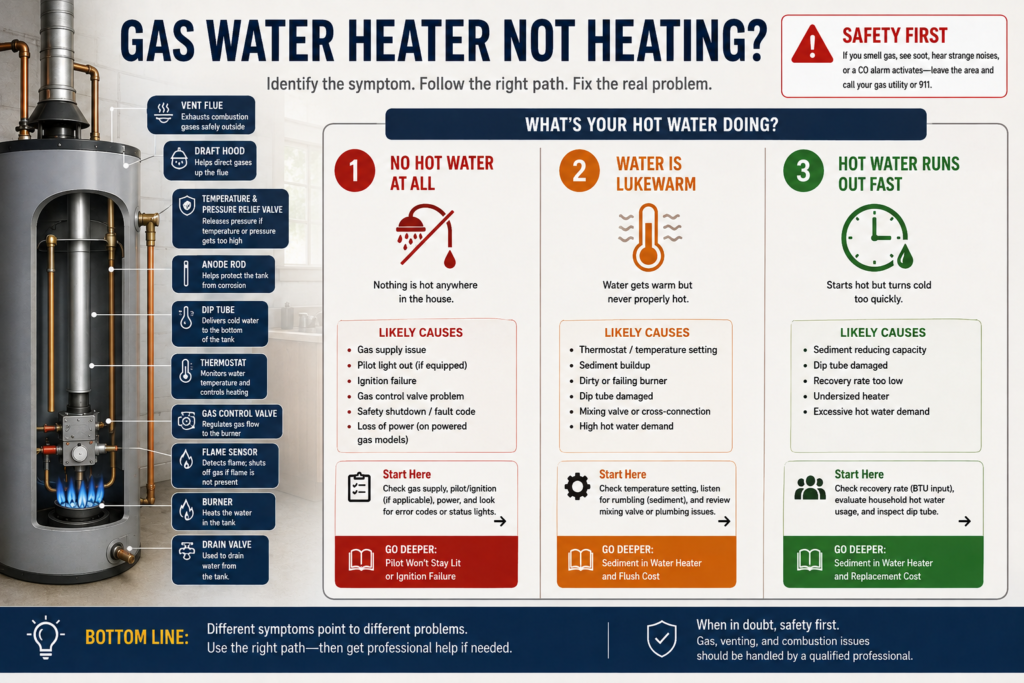
In a conventional gas storage water heater, cold water enters the tank and is normally directed toward the lower portion of the tank. When the water temperature falls below the control setting, the gas-control system calls for heat and the main burner operates beneath the tank. Heat from combustion passes through the heater’s combustion and flue path, transferring energy into the stored water before the exhaust gases are vented away from the home.
The ignition system is not identical on every gas water heater. Some older or simpler designs use a standing pilot that remains lit continuously. Other models use intermittent pilot ignition, electronic spark ignition, hot-surface ignition, powered controls, fans, pressure switches, flame sensors, or other safety components. A.O. Smith specifically distinguishes traditional standing-pilot systems from electronic/direct-spark designs and advises homeowners to follow the instructions for their exact model rather than treating every gas heater the same. See A.O. Smith’s pilot-light guidance.
This is why advice such as “check the pilot light” is sometimes useful but cannot diagnose every modern gas water heater.
No Hot Water at All From a Gas Water Heater
If hot-water faucets throughout the home are producing cold water, determine whether the heater appears to be completing a normal heating cycle.
Several different failures can prevent the main burner from producing heat:
- Gas supply interruption: the burner cannot operate if gas is not reaching the appliance.
- Pilot failure: on a standing-pilot model, an extinguished pilot can prevent the main burner from lighting.
- Ignition failure: an electronic or intermittent ignition system may attempt to start but fail before stable burner operation begins.
- Gas-control failure: the control may fail to call for heat or fail to operate the burner correctly.
- Flame-sensing or safety-system shutdown: modern controls can stop burner operation when the system does not confirm safe ignition or detects an abnormal condition.
- Loss of electrical power: power-vented and electronically controlled gas water heaters may require household electricity for ignition, controls, fans, sensors, or safety circuits.
- Model-specific lockout or fault: a status light or display may indicate that the heater has shut itself down rather than simply failing to ignite.
The important point is that “no hot water” does not identify the failed part. A pilot problem, thermopile problem, gas-control issue, loss of power, interrupted fuel supply, or safety lockout can produce a similar result from the homeowner’s perspective.
If the Pilot Light Is Out
If your heater uses a standing pilot and the pilot is visibly out, follow the lighting instructions printed on the heater or in the manufacturer’s manual for that exact model. Manufacturer instructions should take priority over generic relighting advice because control designs and ignition sequences vary.
Do not continue trying to relight the heater if you smell gas. A.O. Smith likewise instructs consumers to stop if gas is smelled and to rely on the unit’s label and owner’s manual for model-specific lighting procedures.
If the pilot lights but repeatedly goes out, that is a narrower problem with its own diagnostic path. See our water heater pilot won’t stay lit guide rather than assuming the thermocouple is automatically bad.
If the Heater Tries to Ignite but the Main Burner Never Lights
A heater that attempts to start but never establishes a stable burner flame has moved beyond a simple “pilot out” condition. Depending on the model, the problem can involve ignition, flame sensing, the gas-control system, gas delivery, safety circuitry, or another part of the startup sequence.
Electronic ignition systems can also enter a protective lockout after unsuccessful ignition attempts. A.O. Smith notes that electronic systems use flame-sensing safeguards and can lock out when proper ignition is not confirmed.
Our water heater ignition failure guide owns the deeper startup-sequence diagnosis, so this article does not duplicate those component-level checks.
If the Problem Started During a Power Outage
Do not assume that “gas-powered” means “works without electricity.”
A basic standing-pilot storage water heater may be able to operate without household electrical power, while power-vented, electronically controlled, and other gas models can depend on electricity for ignition, controls, blowers, sensors, or safety systems.
If the heater stopped producing hot water during or immediately after an outage, first identify the heater type before assuming a gas component has failed. Our guide to whether a gas water heater works without electricity explains that distinction in detail.
Pilot Is Lit but the Gas Water Heater Still Is Not Heating
A visible pilot flame does not prove that the entire water heater is operating correctly.
On a standing-pilot system, the pilot provides the ignition source for the main burner. The water heater still needs its gas control, burner, safety system, and temperature-sensing components to complete the heating cycle.
That creates an important troubleshooting distinction:
Pilot lit + no hot water does not automatically mean the pilot system is healthy enough to rule out every gas-side problem, and it certainly does not prove that the main burner is firing normally.
Possible categories include:
- the control is not calling for burner operation correctly;
- the main burner is not receiving or burning gas normally;
- the heater has entered a model-specific fault or safety lockout;
- a flame-sensing or control problem is interrupting the heating cycle;
- the burner is operating, but another problem is preventing adequate hot-water delivery.
This is also where random parts-swapping becomes expensive. A weak thermopile, gas-control problem, wiring issue, ignition fault, or safety interruption can produce overlapping symptoms. The homeowner’s job is to identify the symptom and collect model-specific information—not to guess which gas-control component should be replaced.
Gas-control valve testing, gas-pressure measurement, burner disassembly, combustion adjustment, vent modifications, and bypassing safety devices should be left to qualified professionals.
Gas Water Heater Produces Only Lukewarm Water
If the main burner operates but the water never reaches the expected temperature, the diagnostic path changes. This is no longer simply an ignition problem.
| Possible Cause | How It Can Affect Hot Water |
|---|---|
| Temperature-control problem | The heater may not maintain the intended stored-water temperature or may not call for heat normally |
| Sediment buildup | Mineral deposits can accumulate in a storage tank and interfere with normal heating performance |
| Burner or combustion-performance problem | The burner may operate but fail to provide normal heat input |
| Dip-tube problem | Incoming cold water may mix higher in the tank instead of being directed toward the lower portion |
| Mixing-valve or plumbing crossover | Cold water may mix into the hot-water distribution system and make the heater appear to be underheating |
| High household demand | The heater may be operating normally but unable to keep up with simultaneous showers, laundry, dishwashing, or other hot-water loads |
Sediment deserves special attention because the heater can still ignite and run while performance deteriorates. If the tank also produces popping or rumbling noises or you suspect mineral accumulation, see our sediment in water heater guide.
If you are considering professional maintenance rather than diagnosing an ignition failure, our water heater flush cost guide covers flushing prices and the financial side of that service.
Hot Water Starts Hot but Runs Out Too Fast
If the first shower or faucet use begins with normally hot water but the temperature falls much sooner than it used to, the burner may not be the main problem.
This symptom points more strongly toward usable storage capacity, recovery rate, and hot-water delivery.
- Heavy simultaneous demand: multiple showers, laundry, dishwashing, and other fixtures can draw stored hot water faster than the heater can recover.
- Sediment accumulation: deposits in an older tank can reduce usable performance and contribute to slow recovery.
- Dip-tube deterioration or damage: incoming cold water may mix with hot water higher in the tank, reducing usable hot-water duration.
- Reduced recovery performance: the burner may operate but restore tank temperature more slowly than expected.
- Undersized heater: the unit may not provide enough first-hour hot-water capacity for the household’s current demand.
The history of the symptom is valuable.
If the heater has always run out of hot water quickly, capacity and household demand deserve attention. If it previously supplied adequate hot water but has gradually begun running out much sooner, a change in heater performance or internal tank condition becomes more likely.
That is the central diagnostic rule for this page: complete loss of heat, weak heating, and insufficient hot-water duration may all feel like “the gas water heater is not heating,” but they do not point toward the same repair.
Does a Gas Water Heater Need Electricity to Heat Water?
Sometimes. The answer depends on the heater’s ignition, control, and venting design.
Some conventional atmospheric gas storage water heaters use a standing pilot and controls that do not depend on normal household electrical power for the basic heating cycle. Other gas water heaters use electronic ignition, powered controls, blowers, pressure switches, sensors, displays, or control boards that require electricity.
That means a power outage can create a confusing situation: the home may still have natural gas or propane available, but a powered gas water heater may be unable to complete the ignition, control, or venting sequence required to fire the burner.
| Gas Water Heater Type | Typical Electrical Dependency | What a Power Loss Can Affect |
|---|---|---|
| Standing-pilot atmospheric storage tank | Some designs can operate without household electricity | The heater may continue heating if its control system does not depend on external electrical power |
| Electronic-ignition gas storage tank | May require household electricity | Ignition or electronic control functions may stop |
| Power-vented gas water heater | Depends on electricity for powered venting and related controls | The burner may be prevented from operating when the blower or safety sequence cannot run |
| Gas tankless water heater | Commonly uses electronic ignition, sensors, controls, and powered components | The unit may stop producing hot water until electrical power returns |
Do not identify a heater’s electrical requirements from the word “gas” alone. Check the model number, rating plate, power connection, owner’s manual, and manufacturer documentation.
For the full explanation, see our guide to whether a gas water heater works without electricity.
Why Generic Water Heater Flash-Code Charts Can Mislead You
If your gas water heater has a blinking status light or digital error code, record the exact pattern before resetting, unplugging, or otherwise disturbing the heater.
But do not assume that a generic online flash-code chart identifies the failure.
The meaning of a blink pattern can depend on the heater manufacturer, exact model, gas-control valve, electronic controller, and control generation. The same number of flashes is not guaranteed to mean the same thing across different heaters.
A safer diagnostic process is:
- Record the exact code or blink pattern. Include the number of flashes and the pause pattern.
- Record the manufacturer and full model number.
- Photograph the heater rating plate and control label.
- Locate the manual or service information for that exact model.
- Use the manufacturer’s definition of the code rather than a generic chart.
The status code should be treated as a diagnostic clue, not automatic proof that a particular component needs replacement.
This matters especially with terms such as thermopile voltage, flame-sensing fault, ECO or high-limit shutdown, ignition lockout, flammable-vapor sensor, and gas-control fault. These are real diagnostic categories, but their exact code representation and service procedure can vary by model.
Is It a Gas Supply Problem or a Water Heater Problem?
A water heater cannot fire without fuel, but failure to ignite does not automatically mean the home’s gas service has failed.
The scope and timing of the problem can provide useful information without opening or testing gas piping.
| Observation | What It May Suggest |
|---|---|
| Only the water heater appears affected | An appliance-specific ignition, gas-control, burner, power, safety, or venting problem becomes more plausible |
| Other gas appliances also appear unavailable | A broader fuel-supply or utility problem may need to be ruled out |
| The problem began immediately after gas utility or gas-line work | The timing is relevant information to provide to the utility or service professional |
| The heater repeatedly attempts ignition but does not establish burner operation | A heater-specific ignition, control, fuel-delivery, or safety problem may require diagnosis |
| You smell gas | Treat the situation as a potential gas leak rather than continuing normal troubleshooting |
Do not loosen gas fittings, disconnect gas piping, adjust regulators, or intentionally release gas to confirm that fuel is present. Gas pressure, gas piping, and fuel-supply testing should be handled by qualified personnel.
When Venting or Combustion May Be Part of the Problem
A gas water heater must do more than ignite. It also needs appropriate combustion air and a safe path for combustion products to leave the building.
Natural-draft or atmospheric gas water heaters rely on warm combustion gases rising through the draft hood and flue. DOE’s Building America Solution Center explains that backdrafting occurs when those combustion gases fail to travel properly up the flue and instead spill into the surrounding indoor space.
Visible conditions that deserve professional attention include:
- soot or dark discoloration around the top of the heater or draft hood;
- melted or heat-damaged plastic near piping passing through the top of the heater;
- a disconnected, damaged, or obviously abnormal vent connector;
- visible smoke or evidence of combustion spillage;
- a carbon monoxide alarm activating.
DOE/PNNL specifically documents soot and melted plastic around the top of an atmospheric water heater as evidence that backdrafting has occurred or may still be occurring. See the Building America backdrafting guidance.
Our recommendation is deliberately conservative: do not turn suspected venting or combustion trouble into a DIY diagnostic experiment. If you see soot, heat damage, damaged venting, exhaust spillage, or another combustion abnormality, stop using the heater and have the system evaluated by a qualified professional.
This is not theoretical. CPSC has documented gas water heater recalls involving exhaust and combustion defects capable of allowing carbon monoxide to enter the home. See CPSC gas water heater recall information.
What You Can Safely Check Before Calling a Plumber
You can give a technician useful diagnostic information without dismantling the heater or opening gas and electrical systems.
Safely record:
- the exact symptom: no hot water, lukewarm water, or hot water that runs out too quickly;
- whether every hot-water fixture is affected or only one faucet or shower;
- the heater manufacturer and full model number;
- the serial number;
- the approximate installation age, if known;
- whether the heater is a storage tank or tankless model;
- whether it appears to use a standing pilot or electronic controls, if clearly identified on the heater;
- whether a visible pilot is lit, where the manufacturer provides a normal observation window;
- the exact status-light pattern or error code;
- whether a powered heater has normal electrical power;
- whether the failure followed a power outage, gas-service interruption, renovation, flooding, or other recent event;
- unusual popping, rumbling, repeated ignition attempts, or other new sounds;
- visible water around the heater and where it appears to originate;
- available warranty information.
Photographs of the entire heater, rating plate, gas-control label, visible venting, piping arrangement, and error display can also help the contractor identify the installed equipment before arriving.
What Gas Water Heater Work Should Be Left to a Professional?
The DIY boundary should be based on risk, not simply on whether a repair appears mechanically simple.
| Observation or Task | Appropriate Boundary |
|---|---|
| Record model and serial number | Normal homeowner observation |
| Record a blink pattern or error code | Normal homeowner observation |
| Confirm normal household power is available to a powered model | Homeowner observation without opening energized compartments |
| Follow the normal lighting or operating instructions printed by the manufacturer | Reasonable only when those instructions apply to the exact model and no gas-leak or safety warning is present |
| Gas pressure testing or adjustment | Qualified professional |
| Gas-control valve replacement | Qualified professional |
| Gas piping modification or leak repair | Qualified professional |
| Burner disassembly or combustion adjustment | Qualified professional |
| Venting modification or repair | Qualified professional |
| Bypassing a flame sensor, thermal cutoff, flammable-vapor sensor, pressure switch, or other safety device | Do not bypass safety controls |
Randomly replacing parts is also a poor diagnostic strategy. Pilot, thermopile, ignition, gas-control, wiring, power, safety, and fuel-delivery faults can produce overlapping symptoms. Proper diagnosis matters more than finding the first component whose failure description sounds similar.
How Much Does It Cost to Fix a Gas Water Heater That Is Not Heating?
The cost depends on what actually failed.
“Gas water heater not heating” is a symptom, not a repair. The final invoice may involve diagnosis, a small ignition-related component, a gas-control assembly, maintenance, venting work, electrical work on a powered heater, or—in some cases—a replacement decision.
| Repair Category | General Cost Direction | Why the Price Can Change |
|---|---|---|
| Pilot or ignition-related repair | Lower to moderate | Ignition architecture and the actual failed component vary by heater |
| Thermocouple, thermopile, or flame-sensing issue | Lower to moderate | Similar symptoms can also originate in the control or safety system |
| Gas-control or thermostat assembly | Moderate to high | The heater model and replacement control can significantly affect parts and labor |
| Sediment-related maintenance or flushing | Lower to moderate | Cost and usefulness depend on tank condition, accessibility, and the actual cause of poor performance |
| Venting or combustion correction | Highly variable | The required work may extend beyond a normal replaceable water-heater component |
| Multiple failures on an aging heater | Repair-versus-replacement territory | The combined repair bill may no longer make financial sense relative to replacement |
For actual U.S. repair-price ranges, diagnostic charges, labor, emergency service, and component costs, see our water heater repair cost guide.
That page owns the detailed cost question. Keeping the pricing detail there prevents this troubleshooting article from competing with our repair-cost hub.
Should You Repair or Replace a Gas Water Heater That Is Not Heating?
A loss of hot water does not automatically mean the heater needs replacement.
If the tank itself is sound and the problem is isolated to a replaceable ignition, sensing, control, electrical, or other serviceable component, repair may still make financial sense.
Replacement becomes more attractive when several conditions occur together:
- the tank body itself is leaking;
- substantial corrosion or deterioration is present;
- the heater has experienced repeated failures;
- hot-water performance has continued to deteriorate;
- an expensive repair is proposed on an already aging unit;
- several aging components may require additional work soon;
- the heater no longer provides enough hot water for the household.
The right comparison is not simply repair cost versus buying nothing. Compare the repair bill and remaining useful condition of the existing heater with the installed cost, reliability, and expected service from a replacement.
If the diagnosis puts replacement on the table, see our water heater replacement cost guide.
Gas Water Heater Not Heating FAQs
Why is my gas water heater running but not making hot water?
If the heater appears to operate but the water remains cold or lukewarm, the problem may involve main-burner performance, temperature control, gas-control operation, sediment, internal water delivery, plumbing-side mixing, or another condition that prevents normal hot-water production. A visible pilot alone does not prove that the main burner is completing the heating cycle.
Why is the pilot light on but I have no hot water?
The pilot is only one part of a standing-pilot heating system. The main burner still needs the correct call for heat, fuel flow, control operation, and safety confirmation. A lit pilot therefore does not prove that the heater is actually heating the stored water.
Why does my gas water heater only make lukewarm water?
Lukewarm water can point toward temperature-control problems, sediment, reduced burner performance, a dip-tube issue, plumbing crossover or mixing, high household demand, or another condition that reduces usable water temperature.
Why does my hot water run out much faster than it used to?
A gradual loss of hot-water duration can involve sediment accumulation, a damaged dip tube, reduced recovery performance, increased household demand, or deterioration inside an aging heater. If the heater has always run out quickly, sizing and first-hour capacity deserve more attention.
Can a power outage stop a gas water heater from working?
Yes, depending on the design. Some standing-pilot storage water heaters may not require normal household electrical power for heating, while electronic-ignition, power-vented, and many gas tankless systems use electricity for controls, ignition, blowers, sensors, or safety systems.
Should I reset a gas water heater that has a flashing status light?
Do not choose a reset procedure based only on a generic blink-count chart. Record the exact pattern, heater model, and control information and use the manufacturer’s instructions for that specific appliance. A repeated fault or safety shutdown may require diagnosis rather than repeated resetting.
Can sediment cause a gas water heater to stop heating properly?
Yes, sediment can contribute to poor heating performance, noise, slower recovery, and reduced usable hot-water capacity even when the burner still operates. It should not, however, be assumed to explain every case of complete burner or ignition failure.
When should I call a plumber for a gas water heater that is not heating?
Call a qualified professional when normal model-specific operating checks do not restore service, when the pilot or ignition repeatedly fails, when the main burner does not operate, or when diagnosis would require gas controls, fuel pressure, burner work, electrical compartments, venting, or safety devices. Gas odor, carbon-monoxide alarms, soot, damaged venting, or suspected combustion problems should be treated as safety issues rather than routine troubleshooting.
Bottom Line
If your gas water heater is not heating, start with the symptom rather than a guessed replacement part.
- No hot water at all: investigate the burner-operation path—fuel supply, pilot or ignition, controls, electrical power where required, and safety shutdowns.
- Lukewarm water: shift attention toward heating performance, temperature control, sediment, water delivery, mixing, and demand.
- Hot water runs out too quickly: think about usable capacity, recovery, sediment, dip-tube condition, household demand, and heater sizing.
Then record the heater model, serial number, control information, exact fault code or blink pattern, and the behavior you are seeing before approving repairs.
Keep the safety boundary clear. Homeowner observations can help narrow the problem. Gas piping, gas pressure, gas controls, burner work, combustion adjustment, venting repair, and safety-system bypasses are not routine homeowner troubleshooting.
The goal is not to replace the first part that sounds plausible. It is to determine which diagnostic path actually matches the symptom, identify whether a safety condition exists, and repair the correct problem.