
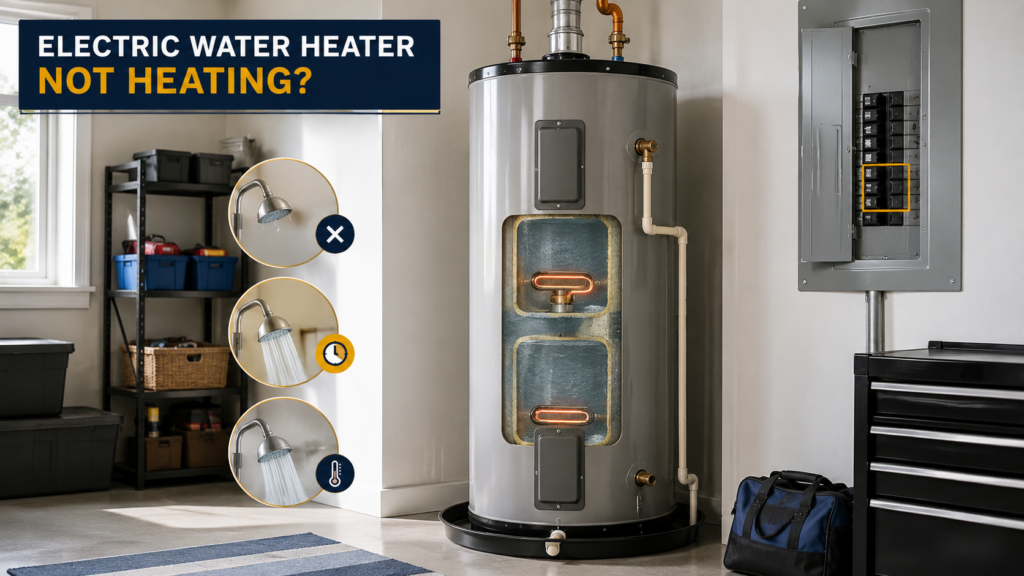
Quick answer: If your electric water heater is not heating, first identify what the heater is actually doing. No hot water at all, a small amount of hot water followed by cold water, lukewarm water, and unusually slow recovery are different symptoms and should not automatically be blamed on the same part. On many conventional dual-element electric storage water heaters, complete loss of heat can point toward the electrical supply, breaker, high-limit/ECO control, upper thermostat, upper heating element, or wiring, while short hot-water duration and slow recovery more often shift attention toward the lower heating system, sediment, usable tank capacity, or household demand.
Electrical safety warning: Conventional full-size electric storage water heaters commonly use a high-voltage dedicated electrical circuit. Do not remove access covers or touch heating-element terminals, thermostats, internal wiring, or junction-box connections while the heater is energized.
If diagnosis would require exposed electrical components, live-voltage testing, wiring repair, breaker or circuit work, or investigation of a repeated electrical trip, use a qualified professional experienced with electric water-heater systems.
A breaker or high-limit safety control that repeatedly trips is not something to keep resetting until the heater works. Repeated shutdown can indicate an electrical, control, overheating, or component fault that needs to be diagnosed.
Scope note: This guide primarily covers conventional residential electric resistance storage-tank water heaters. Heat-pump or hybrid water heaters, electric tankless systems, commercial multi-element heaters, single-element models, and some electronically controlled heaters can use different components and diagnostic sequences.
Electric Water Heater Not Heating? Identify the Symptom First
The most useful first step is not guessing whether the heating element or thermostat is bad. It is identifying the exact failure pattern.
| What You Notice | Likely Diagnostic Direction | What It Does Not Prove |
|---|---|---|
| No hot water anywhere | Incoming power, breaker or disconnect, high-limit/ECO, upper heating system, wiring, or electronic control | It does not automatically prove that the upper element has failed |
| A small amount of hot water, then cold | Lower heating system, usable tank capacity, sediment, dip tube, or recovery problem | It does not automatically prove that the lower element is the only possible cause |
| Water stays lukewarm | Heating output, thermostat or control, sediment, water mixing, dip tube, or unusually high demand | It does not automatically mean the temperature setting is too low |
| Water heats but recovery is much slower than before | Lower heating system, element output, sediment, electrical supply, or increased demand | It does not necessarily mean the tank is undersized |
| Breaker repeatedly trips | Electrical fault requiring diagnosis | The breaker itself is not automatically the failed component |
| Red reset/ECO repeatedly trips | Overheating, thermostat or control, wiring, or electrical fault | Pressing the reset again is not a permanent repair |
| Only one shower or faucet has poor hot water | Fixture, mixing cartridge, or local plumbing problem may be more likely | It does not automatically mean the water heater has failed |
If you are not yet certain whether the problem is specific to an electric heater, start with our broader hot water heater not working guide.
How a Dual-Element Electric Water Heater Heats the Tank
Understanding the normal heating sequence explains why different failures can create very different symptoms.
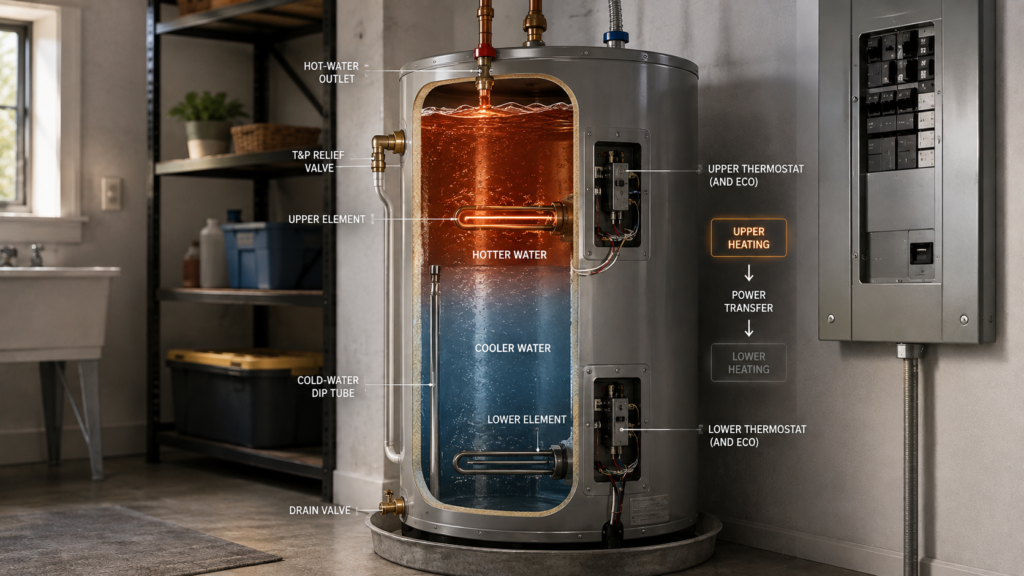
Many conventional residential electric storage water heaters use two resistance heating elements: an upper element and a lower element. Each heating area is controlled by a thermostat, but on a common non-simultaneous design, both elements do not normally heat at the same time.
Rheem describes non-simultaneous operation as a system in which only one heating element may heat at a time. When the upper portion of a substantially cooled tank needs heat, the upper heating system receives priority. Once the upper thermostat is satisfied, the control can transfer power to the lower thermostat and heating element.
A simplified sequence looks like this:
- The tank needs substantial reheating.
- The upper thermostat calls for the upper element.
- The upper element heats the upper portion of the tank.
- Once the upper thermostat is satisfied, the control transfers power to the lower heating circuit.
- The lower thermostat and lower element heat the lower portion of the tank until the required temperature is reached.
This creates one of the most useful diagnostic rules in the entire guide:
The lower heating element not being active at a particular moment does not automatically mean the lower element is defective. On a non-simultaneous system, the upper heating circuit may simply still have priority.
Not every electric water heater uses exactly this architecture, so the heater’s model, rating plate, wiring diagram, and manufacturer documentation still matter. Rheem maintains technical guidance covering electric thermostat operation, heating elements, element failures, recovery rates, wiring diagrams, and non-simultaneous operation. See Rheem’s water-heater technical bulletins.
No Hot Water at All From an Electric Water Heater
If hot-water fixtures throughout the home are producing cold water, think first about whether the heater is receiving electrical power and whether its normal heating sequence can begin.
Important diagnostic categories include:
- Loss of electrical supply: the heater cannot produce heat if its dedicated circuit or disconnect is off or power is otherwise unavailable.
- Tripped breaker: a breaker trip can interrupt power to the entire water heater.
- Opened high-limit/ECO control: the safety control can interrupt the heating circuit when an abnormal condition occurs.
- Upper thermostat or control problem: on many dual-element systems, the upper control manages the initial heating sequence and transfer to the lower circuit.
- Upper heating-system problem: failure involving the upper element or its control circuit can interfere with normal reheating of a substantially cooled tank.
- Damaged wiring or electrical connection: a loose, burned, open, or otherwise faulty connection can interrupt normal heater operation.
- Electronic-control fault: newer electric tanks may use thermistors, displays, control boards, or other electronic components rather than relying entirely on traditional mechanical controls.
A.O. Smith separates No Hot Water, Not Enough Hot Water, Tripped ECO, Upper Heating Element, Lower Heating Element, Upper Thermostat, and Lower Thermostat into distinct troubleshooting categories for standard residential electric water heaters. That is a useful reminder that “no hot water” is a symptom, not a component diagnosis. See A.O. Smith’s standard electric troubleshooting resources.
Breaker Tripped Once vs. Breaker Keeps Tripping
A tripped breaker is worth noticing because it can explain a sudden total loss of hot water.
But the important distinction is what happens afterward.
A breaker that immediately or repeatedly trips is giving you diagnostic information. Do not keep resetting it in an attempt to force the heater to operate.
Repeated trips can be associated with conditions such as:
- a grounded or shorted heating element;
- damaged internal wiring;
- a loose or overheated electrical connection;
- a thermostat or control fault;
- a problem involving the circuit, disconnect, or breaker;
- another electrical fault requiring proper diagnosis.
The breaker tripping does not prove the breaker itself needs replacement. The underlying heater circuit and electrical load must be considered.
If the breaker will not remain set or you see burned wiring, melted insulation, discoloration, arcing damage, or another obvious electrical abnormality, leave the heater off and have the problem professionally diagnosed.
The Red Reset Button Is a Symptom, Not a Repair
Many conventional electric storage water heaters have a high-limit safety control, commonly called the ECO, Energy Cut Off, high-limit switch, or reset control, associated with the upper thermostat area.
If the ECO opens, the heating system can stop operating. But resetting the control does not explain why it opened.
If the ECO trips repeatedly, possible diagnostic categories include abnormal overheating, thermostat or control failure, wiring faults, or another electrical condition. A.O. Smith maintains a dedicated Tripped ECO troubleshooting category rather than treating the reset button as the repair itself.
If the heater is also producing excessively hot water, do not keep resetting controls or changing settings blindly. Our water heater too hot guide covers overheating symptoms and their likely causes.
Some Hot Water, Then It Turns Cold Quickly
If you initially get normally hot water but the supply becomes cold much sooner than expected, the diagnostic picture changes.
On many dual-element storage heaters, a problem involving the lower heating system can still allow the upper portion of the tank to become hot. That can leave the household with some usable hot water, but substantially less than the tank normally provides.
Possible causes include:
- lower heating-element failure;
- lower thermostat or control problem;
- sediment reducing heating performance or usable tank capacity;
- a damaged dip tube allowing incoming cold water to mix higher in the tank;
- reduced recovery performance;
- increased household hot-water demand;
- a heater that is undersized for current usage.
The history of the problem is especially useful.
If the heater has always run out of hot water quickly, tank capacity and household demand deserve attention. If it previously supplied adequate hot water but recently began running cold much sooner, a change in heating performance or internal tank condition becomes more plausible.
For detailed element diagnosis, replacement considerations, and pricing, see our water heater element replacement cost guide. This page intentionally stays at the symptom-routing level so the dedicated element guide continues to own the deeper component intent.
Electric Water Heater Is Only Producing Lukewarm Water
Lukewarm water is not the same failure state as a completely cold tank.
If the heater produces some heat but the water never reaches the expected temperature, possible categories include:
| Possible Cause | How It Can Affect Water Temperature |
|---|---|
| Thermostat or control problem | The heater may fail to maintain or correctly call for the intended stored-water temperature |
| One heating circuit underperforming | The tank may still receive some heat without completing its normal heating cycle |
| Electrical supply or connection problem | Abnormal or interrupted power can prevent expected heater performance |
| Sediment or mineral scale | Deposits can interfere with heating performance and reduce usable hot-water capacity |
| Dip-tube problem | Incoming cold water can mix higher in the tank and cool the outgoing hot water sooner |
| Mixing valve or plumbing crossover | Cold water can mix into the hot-water system outside the tank and make the heater appear to be underheating |
| High household demand | The heater may be operating but unable to keep up with simultaneous hot-water use |
If thermostat or control failure is suspected, our water heater thermostat replacement cost guide covers the upper and lower controls in much greater detail.
If the heater is noisy, has gradually lost performance, or mineral accumulation is suspected, see our sediment in water heater guide.
Do not compensate for a heater that suddenly performs poorly simply by raising the temperature setting. A higher setting does not diagnose a failed heating circuit, sediment buildup, plumbing crossover, or capacity problem, and it can increase scald risk.
The U.S. Consumer Product Safety Commission recommends lowering residential water-heater temperature to about 120°F to help reduce tap-water scald injuries. See CPSC guidance on tap-water scald prevention.
The key takeaway from this first half is simple: a completely cold tank, a small amount of hot water, lukewarm water, and slow recovery are not interchangeable symptoms. The heater’s electrical sequence, water-side condition, and history of the problem determine which diagnostic path makes the most sense.
New Electric Water Heater Not Heating After Installation
If a new electric water heater produces no hot water shortly after installation, do not automatically assume the entire unit is defective.
The timing of the failure matters. A heater that has never worked correctly has a different diagnostic path from one that operated normally for years and then stopped heating.
Important possibilities include:
- Power was never restored: the breaker, disconnect, or another part of the electrical supply may still be off.
- An installation or wiring problem: the heater must be connected according to its rating plate, wiring diagram, installation instructions, and applicable electrical requirements.
- The tank was energized before it was completely full: electric resistance elements are designed to operate while submerged in water. Energizing an element before the tank is properly filled can damage it.
- A recently replaced element was dry-fired: the same risk exists after element service if power is restored before the element is fully submerged.
- A control or safety device has opened: startup may reveal a separate thermostat, ECO/high-limit, wiring, or electrical problem.
If the problem began immediately after heating-element work, see our water heater element replacement cost guide for the deeper element-specific discussion.
Do not repeatedly energize a newly installed heater that is not heating correctly while assuming it simply needs more time. The power supply, tank-fill history, installation connections, and manufacturer startup requirements should be verified first.
Why the Lower Heating Element May Not Be Active Yet
This is one of the most misunderstood parts of a conventional dual-element electric water heater.
On many residential non-simultaneous designs, the upper and lower heating elements do not normally operate at the same time. The upper heating circuit can receive priority while the upper portion of the tank is below its thermostat setting. Once that upper thermostat is satisfied, the control can transfer power to the lower thermostat and element.
| What Is Happening | What It Can Mean |
|---|---|
| Upper heating stage is active while the lower stage is inactive | This can be normal while the upper circuit still has priority |
| Upper portion becomes hot but usable hot water remains limited | A lower heating-system problem becomes more plausible |
| The heater does not progress normally through the heating sequence | The thermostat transfer function, lower circuit, element, or another control condition may require diagnosis |
The important rule is simple: an inactive lower element at one particular moment does not automatically prove that the lower element has failed.
Rheem’s electric water-heater technical material specifically covers non-simultaneous operation, thermostat operation, element failures, wiring diagrams, and recovery performance. See Rheem’s water-heater technical bulletins.
Confirming exactly where power is being transferred through the heating sequence requires electrical diagnosis. This guide intentionally does not provide live 240-volt testing instructions.
Electric Water Heater Takes Too Long to Recover
A heater that eventually produces hot water but takes much longer than it used to has a different failure pattern from a heater that produces no heat at all.
Slow recovery can involve:
- a lower heating-element or lower-control problem;
- reduced heating output;
- sediment or mineral accumulation;
- an electrical-supply or connection problem;
- very cold incoming water;
- increased household hot-water demand;
- tank capacity or first-hour performance that no longer matches household use.
The history of the heater helps separate a component problem from a normal capacity limitation.
If recovery has always been slow: tank size, heating output, incoming-water temperature, and household demand deserve more attention.
If recovery used to be normal and recently became much slower: a change in the lower heating system, controls, electrical condition, or sediment accumulation becomes more plausible.
If sediment is suspected and professional maintenance is being considered, our water heater flush cost guide covers the service and pricing side of flushing.
Check Whether the Whole House Is Affected or Just One Fixture
Before blaming the water heater, check hot-water performance at more than one fixture.
If every hot-water faucet and shower is affected, the heater or its electrical supply becomes a more plausible source of the problem.
If only one faucet or shower has poor hot water while other fixtures operate normally, the problem may be outside the heater.
Possible fixture-side causes include:
- a failed shower mixing cartridge;
- a faucet valve problem;
- a thermostatic mixing valve issue;
- a local plumbing crossover;
- another fixture-specific temperature or flow-control problem.
This simple check can prevent unnecessary replacement of heating elements, thermostats, or the entire water heater when the tank is actually producing hot water normally.
Do Not Raise the Temperature to Compensate for Poor Heating
If an electric water heater suddenly begins producing less usable hot water, increasing the temperature setting is not a substitute for diagnosing the problem.
A higher setpoint will not repair:
- a failed heating element;
- a thermostat or control fault;
- sediment accumulation;
- a damaged dip tube;
- a plumbing crossover or mixing problem;
- slow recovery;
- insufficient tank capacity.
It can, however, increase scald risk.
The U.S. Consumer Product Safety Commission recommends reducing residential water-heater temperature to about 120°F as part of tap-water scald prevention. See CPSC guidance on tap-water scalds.
What You Can Safely Check Before Calling a Plumber or Electrician
You can collect useful diagnostic information without opening energized electrical compartments or testing exposed wiring.
Before scheduling service, safely record:
- the exact symptom: no hot water, lukewarm water, short hot-water duration, or slow recovery;
- whether every hot-water fixture is affected;
- the manufacturer and full model number;
- the serial number;
- the approximate installation age;
- whether the heater is a conventional electric tank, heat-pump model, or another type;
- whether the breaker appears to be tripped;
- whether the problem began after a power outage;
- whether the heater or an element was recently installed or serviced;
- whether the ECO/high-limit control has tripped before;
- any digital error code or status indication;
- unusual popping, hissing, or rumbling noises;
- visible water around the tank;
- any visible overheating, discoloration, melted insulation, or electrical damage that can be seen without removing covers.
Photographs of the entire heater, rating plate, piping, visible electrical connection, and digital display can also help a technician identify the installed equipment before arriving.
What Electric Water Heater Work Should Be Left to a Professional?
The safety boundary becomes much more important when troubleshooting moves from observation into electrical testing or repair.
| Observation or Task | Appropriate Boundary |
|---|---|
| Record model, serial number, and symptoms | Normal homeowner observation |
| Check whether the breaker appears tripped | Normal observation without removing electrical-panel covers |
| Check whether multiple fixtures have the same problem | Normal homeowner observation |
| Record a digital error code or status indication | Normal homeowner observation |
| Expose internal water-heater wiring or terminals | Requires proper de-energization and appropriate electrical competence |
| Perform live-voltage measurements | Qualified professional or appropriately trained person |
| Diagnose a repeatedly tripping breaker | Qualified electrician or other appropriately qualified professional |
| Repair burned, loose, melted, or damaged wiring | Qualified professional |
| Test for a grounded or shorted heating element | Requires correct de-energization, meter use, and electrical knowledge |
| Modify the branch circuit, breaker, disconnect, or wiring configuration | Qualified electrical professional and applicable code compliance |
Element-resistance testing, thermostat testing, wiring diagnosis, and grounded-element testing are real diagnostic procedures, but they depend on the heater configuration and require correct electrical isolation and meter use. That level of component testing belongs beyond the scope of this general homeowner troubleshooting guide.
How Much Does It Cost to Fix an Electric Water Heater That Is Not Heating?
The repair cost depends on what actually failed.
“Electric water heater not heating” is a symptom, not a single repair. The final bill can involve diagnosis, a heating element, thermostat, ECO/high-limit control, electrical connection, wiring problem, sediment-related service, electronic control, or—in some cases—replacement of the heater.
| Repair Category | General Cost Direction | Why the Price Can Change |
|---|---|---|
| Heating-element repair | Lower to moderate | Upper vs. lower element, access, heater design, parts, and labor all affect the invoice |
| Thermostat or high-limit control | Lower to moderate | The actual control fault must be identified before replacement |
| Internal wiring or electrical connection | Variable | The scope can range from a localized connection problem to broader electrical work |
| Sediment-related service | Lower to moderate | Tank condition and whether maintenance can realistically restore performance matter |
| Repeated breaker or circuit fault | Variable | The underlying issue may involve the heater, wiring, circuit, breaker, or multiple components |
| Aging tank with several problems | Repair-versus-replacement territory | Additional repair spending may no longer make financial sense |
For current U.S. diagnostic fees, labor, component pricing, emergency service charges, and broader professional repair costs, see our water heater repair cost guide.
For component-specific pricing, see our water heater element replacement cost guide and water heater thermostat replacement cost guide.
Should You Repair or Replace an Electric Water Heater That Is Not Heating?
A loss of heat does not automatically mean the entire water heater needs replacement.
If the tank itself is structurally sound and the problem is isolated to a replaceable heating element, thermostat, control, or repairable electrical connection, fixing the existing heater may still make financial sense.
Replacement becomes more attractive when several conditions appear together:
- the tank body itself is leaking;
- significant corrosion or deterioration is present;
- the heater has required repeated repairs;
- multiple aging components are beginning to fail;
- the repair quote is high relative to replacement;
- the heater no longer provides enough hot-water capacity for the household;
- performance continues to deteriorate despite previous repairs.
The useful comparison is not simply repair cost versus spending nothing. Compare the repair bill and remaining condition of the existing heater with the installed cost, expected reliability, and useful service of a replacement.
If replacement is becoming a realistic option, see our water heater replacement cost guide.
Electric Water Heater Not Heating FAQs
Why is my electric water heater not heating at all?
Possible causes include loss of electrical power, a tripped breaker, an opened ECO/high-limit control, an upper heating-system problem, damaged wiring, or an electronic-control fault. A completely cold tank does not automatically prove that one specific element has failed.
Why do I get some hot water and then it turns cold?
On many dual-element storage heaters, the upper portion of the tank can still become hot even when the lower heating system is not operating normally. A lower element or thermostat problem is one possibility, but sediment, dip-tube problems, slow recovery, high demand, and tank sizing can produce similar symptoms.
Can a bad lower element make hot water run out faster?
Yes, it can. On common non-simultaneous dual-element heaters, the lower heating system helps heat the lower portion of the stored water after the upper heating stage is satisfied. If that lower system fails, the household may receive some hot water but substantially less than normal. Other causes should still be ruled out.
Why does the water heater reset button keep tripping?
The reset button is associated with the ECO/high-limit safety control. If it trips repeatedly, repeated resetting should not be treated as the repair. The underlying cause may involve overheating, thermostat or control failure, wiring, or another electrical problem.
Why does the breaker keep tripping when the water heater runs?
Repeated breaker trips can point toward an electrical fault such as a grounded or shorted heating element, damaged wiring, an overheated connection, control trouble, or a circuit problem. The breaker itself is not automatically the failed component.
Why is my new electric water heater not heating?
If the heater has never worked correctly after installation, review the installation and startup history. Possible categories include power not being restored, an installation or wiring problem, a control issue, or an element that was energized before the tank was completely filled.
Why is my electric water heater only producing lukewarm water?
Possible causes include a thermostat or control problem, one heating circuit underperforming, sediment, a dip-tube problem, plumbing crossover, mixing-valve trouble, abnormal electrical supply, or household demand exceeding the heater’s recovery capability.
Why is my electric water heater taking longer to reheat?
Recovery time depends on tank size, heating output, incoming-water temperature, electrical supply, and hot-water demand. A heater that suddenly takes much longer than before may have developed a lower-heating-system, control, electrical, or sediment-related problem.
Bottom Line
If your electric water heater is not heating, diagnose the symptom before guessing which part failed.
- No hot water at all: focus first on electrical supply, breaker, ECO/high-limit, upper heating system, wiring, and controls.
- Some hot water, then cold: the lower heating system, sediment, dip tube, usable capacity, and recovery become more relevant.
- Lukewarm water: consider heating performance, thermostat or control operation, sediment, water mixing, water delivery, and household demand.
- Slow recovery: consider the lower heating system, heating output, sediment, incoming-water conditions, and demand.
Remember that many common dual-element electric tanks operate non-simultaneously. An inactive lower heating stage at one particular moment therefore does not automatically prove failure.
Repeated shutdowns also matter. A breaker that keeps tripping or an ECO/high-limit control that repeatedly opens is pointing toward an unresolved condition—not asking to be reset indefinitely.
The goal is to identify the diagnostic path that actually matches the symptom, stay within a safe electrical boundary, and repair the real fault instead of replacing components by guesswork.